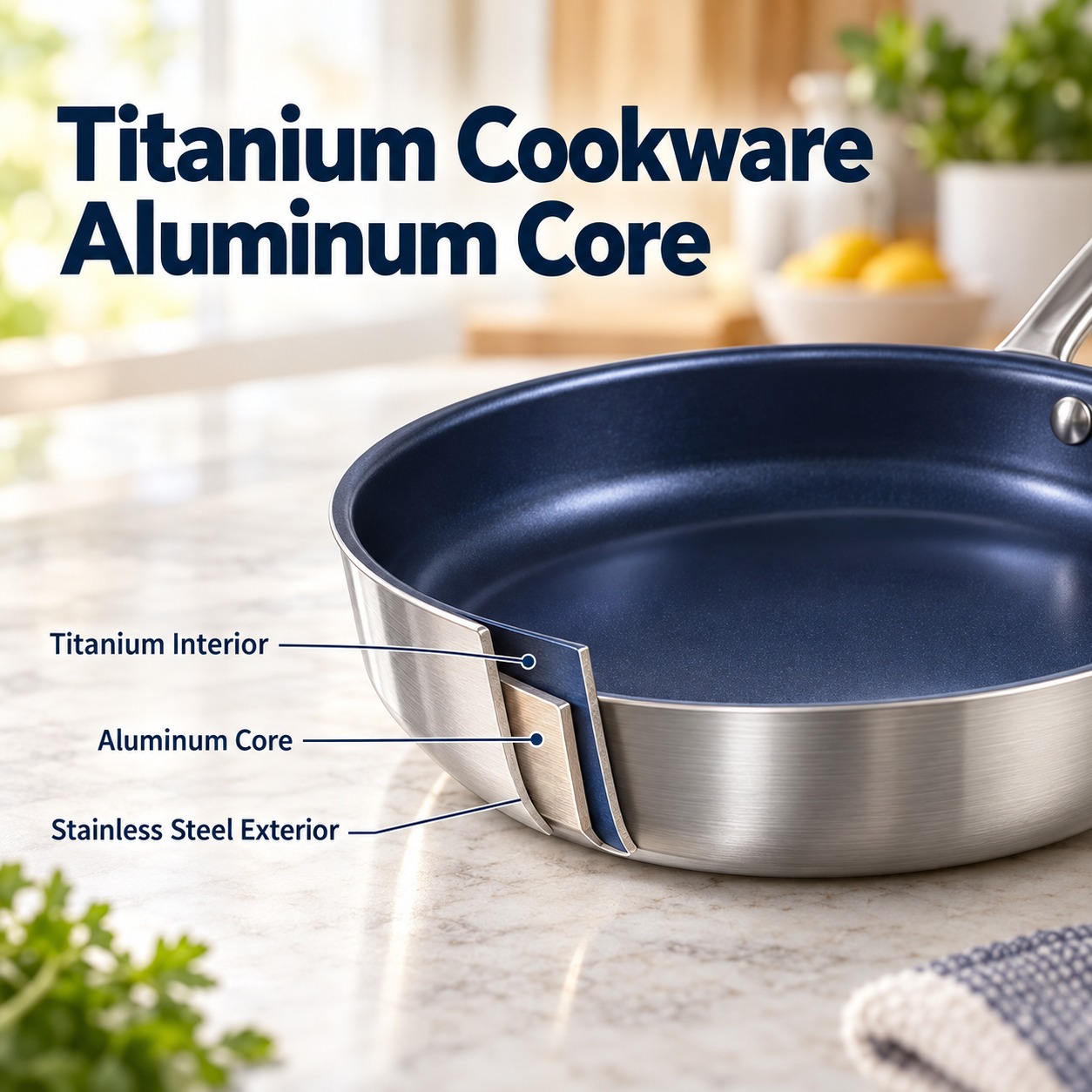
Evaluating induction heat transfer speed in pure titanium pans requires cutting through marketing jargon and confronting basic thermodynamics. Home cooks and commercial buyers often ask if pure titanium pans heat with induction's signature rapid response. The technical reality is direct: a solid sheet of pure titanium cannot heat on an induction stove. Pure titanium is paramagnetic and lacks the magnetic permeability needed to produce resistive eddy currents from an induction cooktop's magnetic field. To function on induction cooktops, cookware manufacturers build multi-ply composite cookware. These vessels bond a food-grade pure titanium cooking surface (Grade 1 or 2 TA1) to an aluminum core and a ferromagnetic 430 stainless steel base. Therefore, evaluating induction heat transfer speed in pure titanium pans assesses a layered system: magnetic activation in the outer steel, lateral heat spread through the aluminum core, and vertical heat delivery through the titanium cooking surface. Understanding these stages allows cooks and buyers to manage preheating, avoid hot spots, and choose durable cookware.
1. The Physics Paradox: Why Solid Pure Titanium Fails on Induction Stoves
Induction cooktops generate heat through high-frequency alternating magnetic fields (20 kHz to 50 kHz). When a compatible pan rests on the cooktop, this magnetic field penetrates the base, inducing electrical eddy currents. The pan's electrical resistance converts these currents into thermal energy via Joule heating, while magnetic hysteresis in ferromagnetic alloys creates supplemental heat.
This operating mechanism reveals why pure titanium fails on induction cooktops. Commercially pure Grade 1 and Grade 2 titanium are paramagnetic, with magnetic permeability barely exceeding 1.00005. Because titanium lacks permanent magnetic dipoles to align with external fields, the cooktop's magnetic flux passes through without resistance. Cooktop sensors detect an open circuit condition or insufficient electrical impedance, immediately displaying an error code and shutting off power delivery.
Furthermore, electromagnetic skin depth plays a critical role in induction efficiency. At standard induction frequencies, magnetic eddy currents concentrate within a thin surface skin depth in ferromagnetic 430 stainless steel (roughly 0.1 mm to 0.2 mm), converting electrical energy into concentrated thermal power. In contrast, pure titanium's low magnetic permeability causes the theoretical skin depth to expand drastically, dispersing electromagnetic energy rather than capturing it.
Some attempt using an external stainless steel converter plate under a single-wall pure titanium skillet. However, evaluating induction heat transfer speed in pure titanium pans using converter plates exposes severe inefficiencies. The loose interface creates microscopic air gaps that act as thermal barriers. Heat builds in the steel disc while slowly crossing into the titanium pan. Because pure titanium lacks horizontal conductivity, heat punches straight through contact points, scorching food while pan edges stay cold. Reliable induction cooking requires metallurgically bonded layers.
2. Thermal Conductivity Reality: Pure Titanium vs. Aluminum and Stainless Steel
Thermal conductivity is the secondary bottleneck when evaluating induction heat transfer speed in pure titanium pans. Measured in watts per meter-kelvin (W/m·K), it indicates how quickly a material moves thermal energy across its structure. High-conductivity metals rapidly equalize temperatures across a skillet floor.
Pure titanium provides thermal conductivity of roughly 17 to 22 W/m·K at room temperature. In contrast, copper conducts at roughly 398 W/m·K, cookware aluminum (1050 alloy) conducts at 220 to 237 W/m·K, cast iron conducts at 50 W/m·K, and 304 stainless steel conducts at 15 to 16 W/m·K. Pure titanium has roughly one-eleventh the thermal conductivity of aluminum.
Equally important is thermal diffusivity, which measures the rate at which temperature changes propagate through a metal under transient heating. Pure titanium exhibits low thermal diffusivity because its moderate specific heat capacity cannot compensate for its low thermal conductivity. When localized thermal energy is delivered to a titanium sheet, the metal cannot dissipate heat laterally. Heat concentrates above the heat source, creating severe hot spots while the sidewalls stay cool. This explains why unclad titanium pans scorch proteins and starches quickly. The table below compares thermal conductivity and induction coupling properties across standard cookware metals.
| Cookware Material Layer | Thermal Conductivity (W/m·K) | Magnetic State & Induction Response | Thermal Function in Cookware Architecture |
|---|---|---|---|
| Pure Titanium (TA1 / Grade 1–2) | 17 – 22 W/m·K | Paramagnetic (Zero direct induction heating) | Biocompatible, acid-proof, non-toxic food contact barrier |
| Cookware-Grade Aluminum (1050/3003) | 205 – 237 W/m·K | Paramagnetic (Incompatible without steel cladding) | Rapid horizontal heat distribution and hot spot elimination |
| Ferritic Stainless Steel (AISI 430) | 24 – 26 W/m·K | Ferromagnetic (Strong magnetic eddy current coupling) | Electromagnetic heat generator and structural base plate |
| Austenitic Stainless Steel (AISI 304) | 15 – 16 W/m·K | Non-magnetic (Poor induction response) | Standard corrosion resistance in traditional cookware |
| Tri-Ply Titanium Composite Pan | Effective System: ~140 – 175 W/m·K | Instant induction coupling via magnetic outer shell | Optimized hybrid: instant magnetic induction, fast spread, pure titanium contact |
3. Multi-Ply Cladded Architecture: How Modern Titanium Pans Solve the Speed Bottleneck
Because pure titanium cannot heat on induction alone and conducts heat slowly, manufacturers solve both issues with multi-ply cladding. In a high-quality induction-compatible titanium pan, the pan body combines three bonded metals pressed under extreme pressure and heat.
This tri-ply design assigns specific roles to each layer. The outer base is magnetic AISI 430 ferritic stainless steel (0.5 mm to 0.8 mm thick). It couples with the induction hob's magnetic field, generating heat in fractions of a second. Sandwiched inside sits a hidden aluminum core in titanium pans, typically 1.5 mm to 2.2 mm of 1050 pure aluminum. This core pulls heat outward across the base to eliminate cold edges.
Manufacturing technique is decisive here. High-end factories utilize continuous hot roll-bonding within a precise thermal window (380°C to 420°C), exerting thousands of tons of hydraulic pressure to forge an atomic-level bond between titanium, aluminum, and steel. Controlled atmospheric processing prevents oxygen pickup that could embrittle titanium sheet. This advanced fabrication eliminates microscopic delamination voids that impede heat transfer.
The interior surface is 0.4 mm to 0.6 mm of pure TA1 titanium. This layer is non-reactive, acid-proof, and scratch-resistant against metal utensils. Because the titanium layer is thin, heat transfers vertically through it quickly while the aluminum core maintains lateral balance. Choosing full roll-clad cookware over stamped bottom plates ensures the aluminum core extends up the sidewalls, preventing temperature drops along the perimeter.
4. Empirical Laboratory Protocols to Measure Induction Heat Transfer Speed
Evaluating induction heat transfer speed in pure titanium pans requires objective laboratory protocols. In cookware testing facilities, four standardized tests measure heating speed, heat distribution, and recovery under controlled ambient room conditions (typically 20°C to 22°C to eliminate ambient baseline variances).
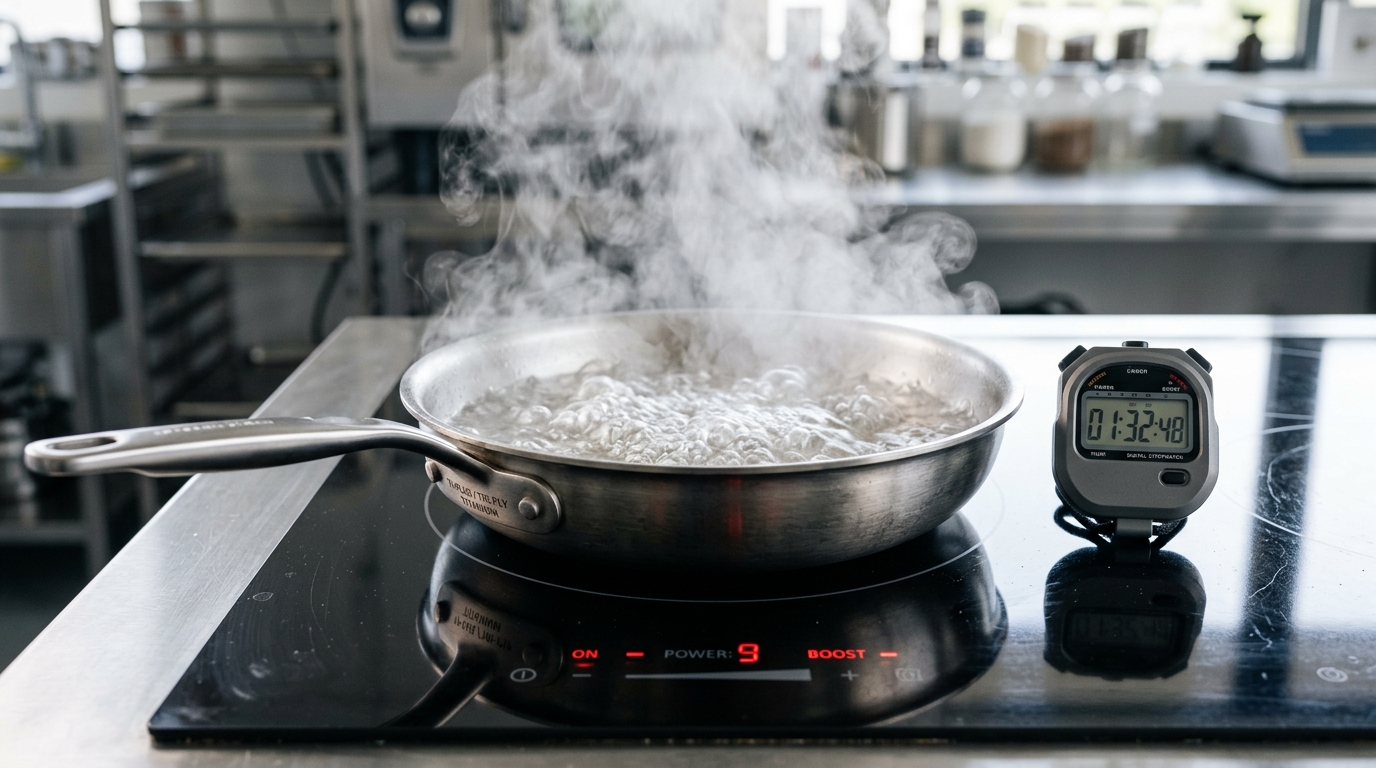
The first protocol is the 500ml Water Boil Velocity Test. Exactly 500ml of distilled water at 20°C (68°F) is poured into the pan on an induction cooktop set to 1,800 watts. A thermocouple measures elapsed time to reach a 100°C (212°F) boil. Quality tri-ply titanium pans boil water in 85 to 110 seconds, matching professional stainless steel. Poorly clad pans take over 160 seconds due to weak magnetic coupling or insufficient base thickness.
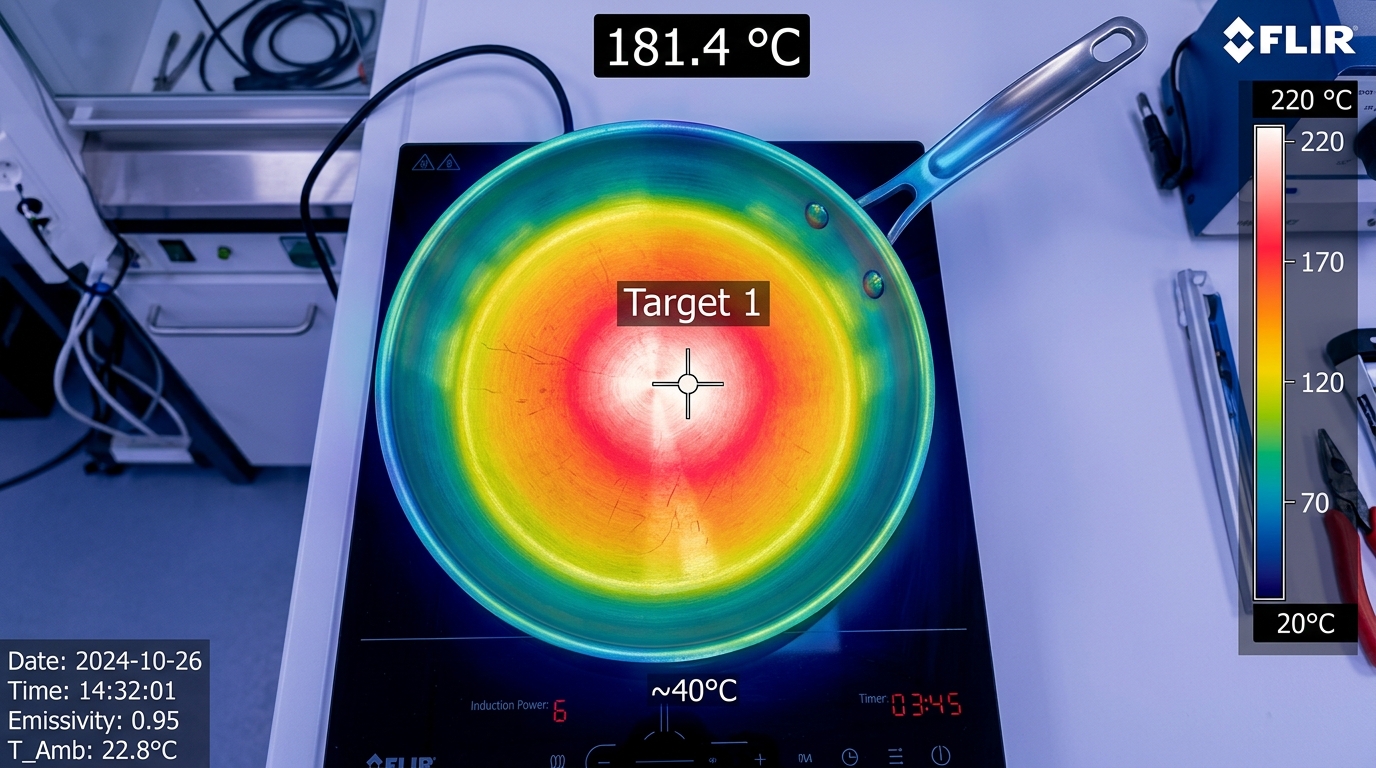
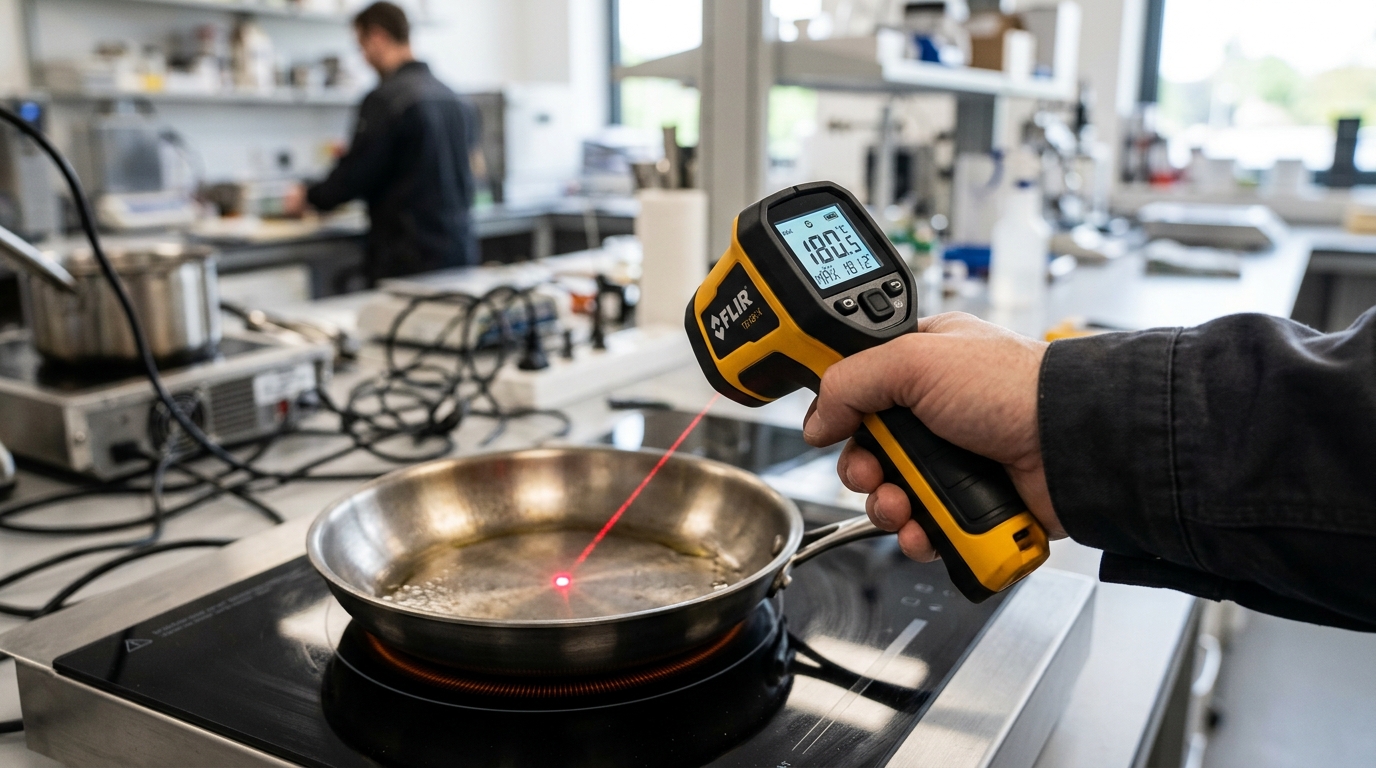
The second protocol uses Infrared Thermography to evaluate temperature variance. A thermal camera records the surface profile during 30-second, 60-second, and 120-second preheating phases at 1,200 watts. Poorly clad pans display hot rings over the burner coil with center-to-edge variances exceeding 65°C, causing titanium pan hot spots. Premium tri-ply pans keep temperature differences under 15°C across the floor, ensuring reliable browning across the entire diameter.
The third protocol is the Flour and Oil Browning Test. A light, uniform dust layer of flour or 15ml of cooking oil is heated at medium power. Even heat produces a smooth golden circle expanding outward. Poor heat distribution creates charred rings over the coil while edges stay unbrowned.
The fourth protocol measures Thermal Shock Recovery Velocity. After stabilizing the pan at 180°C (356°F), a cold 200g protein portion is added. A probe measures surface temperature drop and recovery time back to 175°C. Well-engineered multi-ply pans recover in 22 to 35 seconds, searing food cleanly rather than steaming in released juices. The table below outlines benchmarks for these four tests.
| Evaluation Test Name | Standardized Testing Protocol | Target Performance Benchmark | Failure Diagnostic Indicator |
|---|---|---|---|
| 1. 500ml Water Boil Velocity | 500ml H2O from 20°C to 100°C on 1800W continuous induction | 85 – 110 seconds | >150 seconds indicates poor magnetic coupling or weak base plate |
| 2. Infrared FLIR Delta-T | Center-to-perimeter temperature differential after 60s at 1200W | < 15°C (27°F) variance | > 45°C variance indicates deficient or missing aluminum core |
| 3. Dry Flour Surface Browning | Visual color graduation of thin flour dust layer at medium heat | Uniform radial golden brown disc | Narrow black charred ring over coil zone with raw white rims |
| 4. Thermal Shock Recovery | Rebound time to 175°C after dropping 200g cold protein at 180°C | 22 – 35 seconds | > 60 seconds causes food to boil in juices rather than sear |
5. Cooktop Power Delivery Nuances: Continuous Inverter vs. PWM Duty Cycling
Cooktop circuitry strongly impacts results when evaluating induction heat transfer speed in pure titanium pans. Induction cooktops modulate heat using either Continuous Inverter circuitry or Pulse-Width Modulation (PWM).
Basic portable induction burners use PWM on lower settings (levels 1 through 4). Instead of outputting steady low wattage, they pulse 100% power on and off in cycles. Because titanium has low heat capacity, surface temperatures spike during active bursts and cool rapidly during pauses. This cycling can scorch sauces or break delicate emulsions during gentle simmering.
Commercial and built-in induction cooktops use continuous inverters that deliver steady low power (such as 300W or 500W). Inverter cooktops provide stable heat that the aluminum core easily buffers, maintaining even temperatures on the titanium cooking surface. Apparent heating variations are often caused by cooktop pulsing rather than pan flaws.
Coil size matching is also vital. Induction burner coils range from 140 mm to 210 mm across. Magnetic flux density drops off rapidly beyond the outer perimeter of the copper coil. Placing a large 28 cm skillet with a 20 cm base over a small 14 cm burner coil excites only the pan center. Outer heat transfer then depends entirely on the aluminum core. Matching burner size to the pan base ensures fast, edge-to-edge heat distribution.
6. B2B Procurement and Chef Standard: Specifying Fast, Uniform Induction Titanium Pans
For commercial cookware buyers and brands, evaluating induction heat transfer speed in pure titanium pans informs essential manufacturing specifications. Setting proper layer thicknesses prevents performance issues and product returns.
When partnering with a custom titanium cookware manufacturer, buyers should specify:
- **Base Plate Thickness**: Require AISI 430 stainless steel at 0.6 mm to 0.8 mm thickness. Thinner 0.4 mm bases couple weakly and cause buzzing noises under high power.
- **Aluminum Core Quality**: Specify 1050 pure aluminum at 1.8 mm to 2.2 mm thickness. Pure 1050 aluminum delivers roughly 15% faster heat transfer than standard 3003 alloy.
- **Titanium Surface Grade**: Use cold-rolled TA1 pure titanium at 0.4 mm to 0.5 mm thickness, certified free of lead and cadmium.
- **Flatness Tolerance**: Specify a maximum convex cold tolerance of 0.2 mm to 0.3 mm. This prevents pan warping under rapid induction heat cycles, keeping the base flat against cooktop glass.
- **Ultrasonic Quality Inspection**: Require factory acoustic and ultrasonic bond testing on batch samples to verify zero delamination micro-voids across all three metal layers.
In commercial kitchens, chefs must adapt cooking techniques to titanium. Best practice involves preheating a pure titanium skillet on medium-low power for 90 to 120 seconds before adding oil. This gives the aluminum core time to spread calories evenly, preventing hot spots and ensuring a reliable cooking surface.
Evaluating induction heat transfer speed in pure titanium pans highlights the power of multi-metal engineering. While solid pure titanium cannot work on induction stoves alone, multi-ply clad construction turns physical challenges into cooking advantages. Combining a magnetic 430 stainless steel base for fast induction response, a 1050 aluminum core for even heat distribution, and a pure TA1 titanium surface for non-toxic cooking yields heating speeds that rival professional clad cookware. For cookware brands and home chefs, choosing full multi-ply construction and using disciplined preheating ensures fast, even cooking performance on any induction cooktop.
FAQ
Why does my pure titanium pan make a humming or buzzing noise on an induction cooktop?
A humming or buzzing sound on induction cooktops is caused by magnetic micro-vibrations known as magnetostriction. When alternating magnetic fields excite the pan's ferromagnetic base plate, the steel expands and contracts rapidly. In cheaply bonded or stamped base plates, these vibrations create an audible hum at high power settings. High-pressure roll-bonded tri-ply pans minimize this noise because continuous metallurgical bonding dampens vibration across layers.
Can an external induction converter disk make single-wall camping titanium pots heat efficiently?
An external converter plate allows a camping titanium pot to heat, but efficiency is very low. Microscopic air gaps between the flat plate and pot floor create substantial thermal resistance, slowing boil times and wasting electricity. Because single-wall titanium cannot spread heat horizontally, intense hot spots develop directly over contact points, burning food easily. True induction efficiency requires an integrated, bonded magnetic base.
How long should I preheat a tri-ply titanium pan on an induction stove before adding oil?
Preheat a tri-ply titanium pan on medium-low induction heat (800W to 1,000W) for 90 to 120 seconds before adding cooking fat. Induction heats the base plate instantly, but the aluminum core needs time to spread heat outward to the edges. A steady 90-second preheating window brings the entire titanium cooking floor to a uniform 160°C to 180°C, optimizing non-stick performance and preventing oil breakdown.