Learning how to tell if titanium cookware has hidden aluminum core does not require industrial laboratory equipment or destructive cutting. Home cooks and B2B buyers can verify whether a skillet contains a sandwiched aluminum core using five non-destructive evaluations: inspecting the rim cross-section, checking magnetic attraction, evaluating the weight-to-volume ratio, observing the ice-cube melt rate, and listening to acoustic vibration damping. A hidden aluminum core in premium titanium cookware is not an accidental defect or cheap filler; it is an intentional metallurgical engineering solution designed to overcome pure titanium's low thermal conductivity. However, deceptive retail branding often blurs the line between high-performance tri-ply clad cookware and cheap aluminum pans sprayed with nonstick titanium dust. Understanding these physical indicators helps buyers authenticate what they own, eliminate toxic leaching fears, and select the right cookware for their kitchen.
1. Visual Edge Inspection: Cut Rims Versus Rolled Sealed Rims
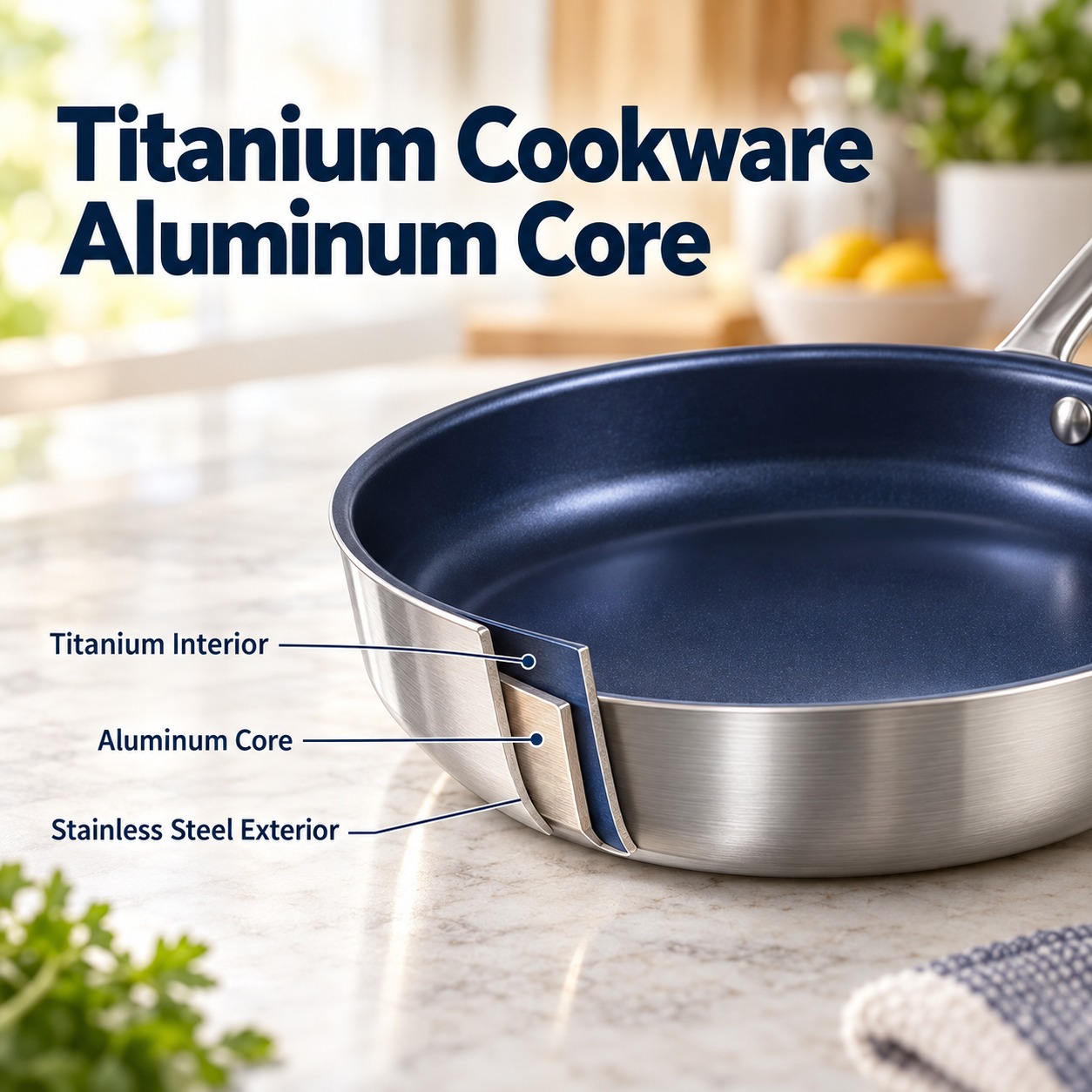
The most direct visual method when discovering how to tell if titanium cookware has hidden aluminum core is examining the exposed top rim under focused light. In standard multi-clad manufacturing, circular blanks of tri-ply composite sheet are drawn and sheared into pot bodies. If the cookware features an unsealed cut rim, the distinct metal layers are visibly exposed in cross-section. Under a 10x magnifying glass or smartphone zoom, a genuine tri-ply titanium pan reveals three parallel bands. The interior layer is a thin gray band of Grade 1 pure titanium measuring roughly 0.4 mm to 0.6 mm. The center core is a thicker silver-white layer of 1050 pure aluminum measuring approximately 1.5 mm to 2.2 mm. The exterior layer is a polished band of 430 ferritic stainless steel providing induction compatibility.
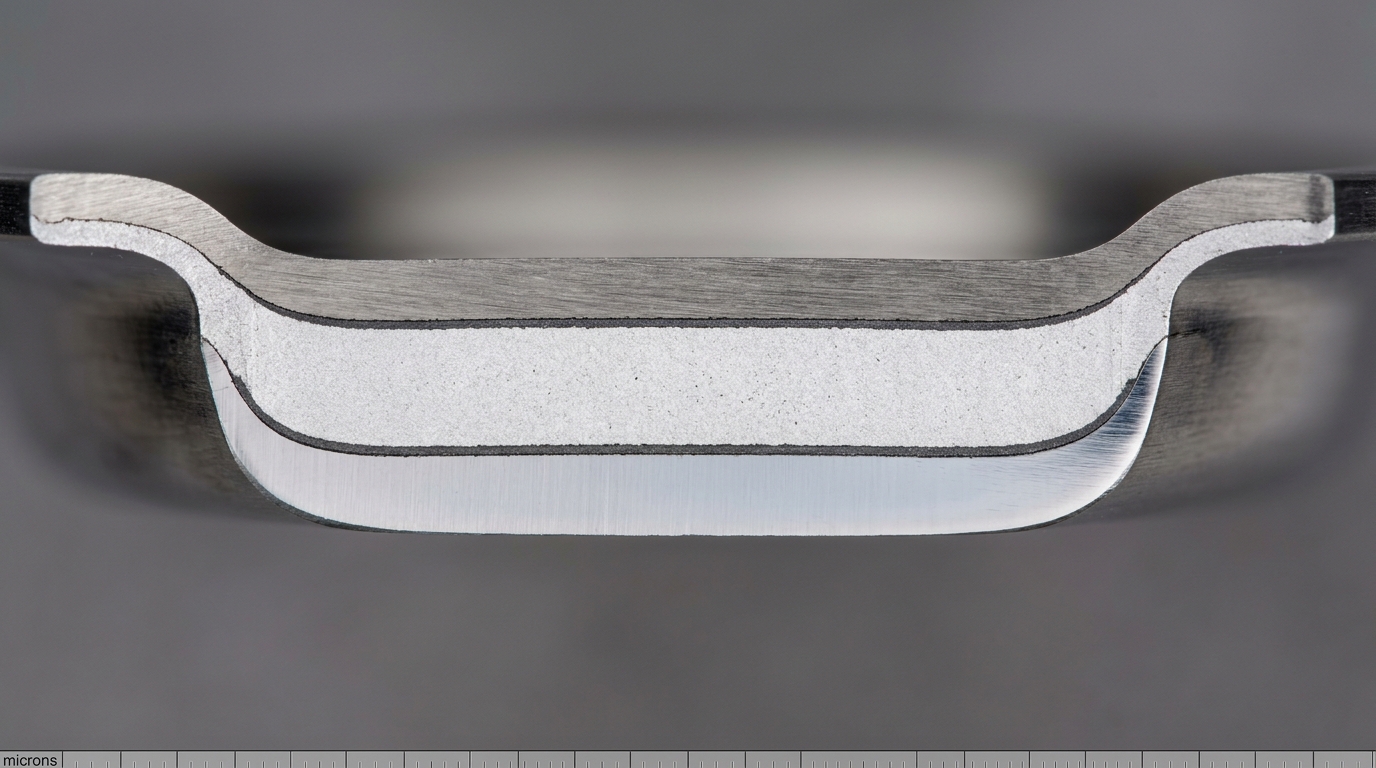
Cross-section of a tri-ply titanium pan rim exposing the Grade 1 titanium cooking layer, 1050 aluminum core, and 430 stainless steel base
Conversely, a solid pure titanium pan made from a single sheet shows no color variation, seams, or striping across its rim. The cut edge displays a continuous, monolithic medium-gray structure with identical luster from inside to outside. However, buyers must be aware of rolled or laser-sealed rims. Some manufacturers roll the outer stainless steel or inner titanium layer over the edge, completely enclosing the aluminum core to protect it from dishwasher detergents. If your pan features a rolled rim where the edge appears rounded, a lack of visible stripes does not guarantee the absence of an aluminum core. In such designs, edge inspection must be combined with the magnetic, density, and thermal tests below.
2. Weight, Density, and Physical Heft Evaluation
Evaluating physical heft is an indispensable diagnostic step when confirming how to tell if titanium cookware has hidden aluminum core. Titanium is famous for being lightweight, with a physical density of 4.51 g/cm³. While titanium is approximately 45 percent lighter than stainless steel (7.93 g/cm³), it is substantially denser than pure aluminum (2.70 g/cm³). When a skillet is constructed from solid pure titanium alone, it feels startlingly feather-light in the hand. A standard 10-inch solid pure titanium camping skillet typically weighs between 220 grams and 380 grams (roughly 0.5 to 0.8 pounds).
In contrast, a 10-inch tri-ply titanium frying pan featuring a hidden aluminum core and an induction stainless base will weigh between 950 grams and 1,350 grams (roughly 2.1 to 3.0 pounds). A functional multi-ply pan requires significant overall wall thickness (usually 2.5 mm to 3.5 mm total gauge) to ensure structural rigidity, prevent high-heat warping, and house sufficient aluminum volume for uniform heat diffusion. Furthermore, the dense 430 magnetic stainless steel exterior plate adds considerable bottom weight. If your domestic skillet feels reassuringly heavy, solid, and balanced rather than ultra-light like outdoor trail gear, that heft is a direct physical indicator of a multi-layer composite build incorporating a concealed thermal core.
| Construction Type | Weight (10-Inch Skillet) | Thermal Conductivity | Magnetic Response | Primary Use Case |
|---|---|---|---|---|
| Solid Pure Titanium | Ultra-light (220g - 380g) | Very Low (17 - 22 W/m·K) | Non-magnetic inside & out | Backpacking, boiling water |
| Tri-Ply Titanium (Aluminum Core) | Substantial (950g - 1,350g) | High & Uniform (~210 W/m·K) | Magnetic base only | Daily home cooking, searing |
| Titanium-Coated Aluminum | Moderate (600g - 850g) | High across body (~200 W/m·K) | Non-magnetic unless disc added | Budget nonstick frying |
3. Hands-On Bench Testing: Magnetic Response and Ice-Cube Melt Rate
A simple neodymium magnet provides immediate diagnostic clarity when testing how to tell if titanium cookware has hidden aluminum core. Pure Grade 1 titanium is paramagnetic with virtually zero magnetic pull, and pure aluminum is completely non-magnetic. If a pan were made entirely of solid titanium or solid aluminum, a magnet would slide off every surface. However, an aluminum core cannot couple directly with induction cooktops. Therefore, facilities such as tri-ply pure titanium cookware manufacturer plants bond a magnetic ferritic 430 stainless steel sheet onto the exterior base. Place a magnet on the inner cooking floor; it should feel inert. Then place it on the outside base: if it snaps firmly onto the bottom plate while remaining non-magnetic on the inside, you have confirmed a multi-ply clad build. Because magnetic steel cannot be welded directly to pure titanium without forming brittle intermetallics, this exterior magnetic plate paired with an inert titanium interior is conclusive proof of an intermediate bonding core, almost universally pure aluminum.
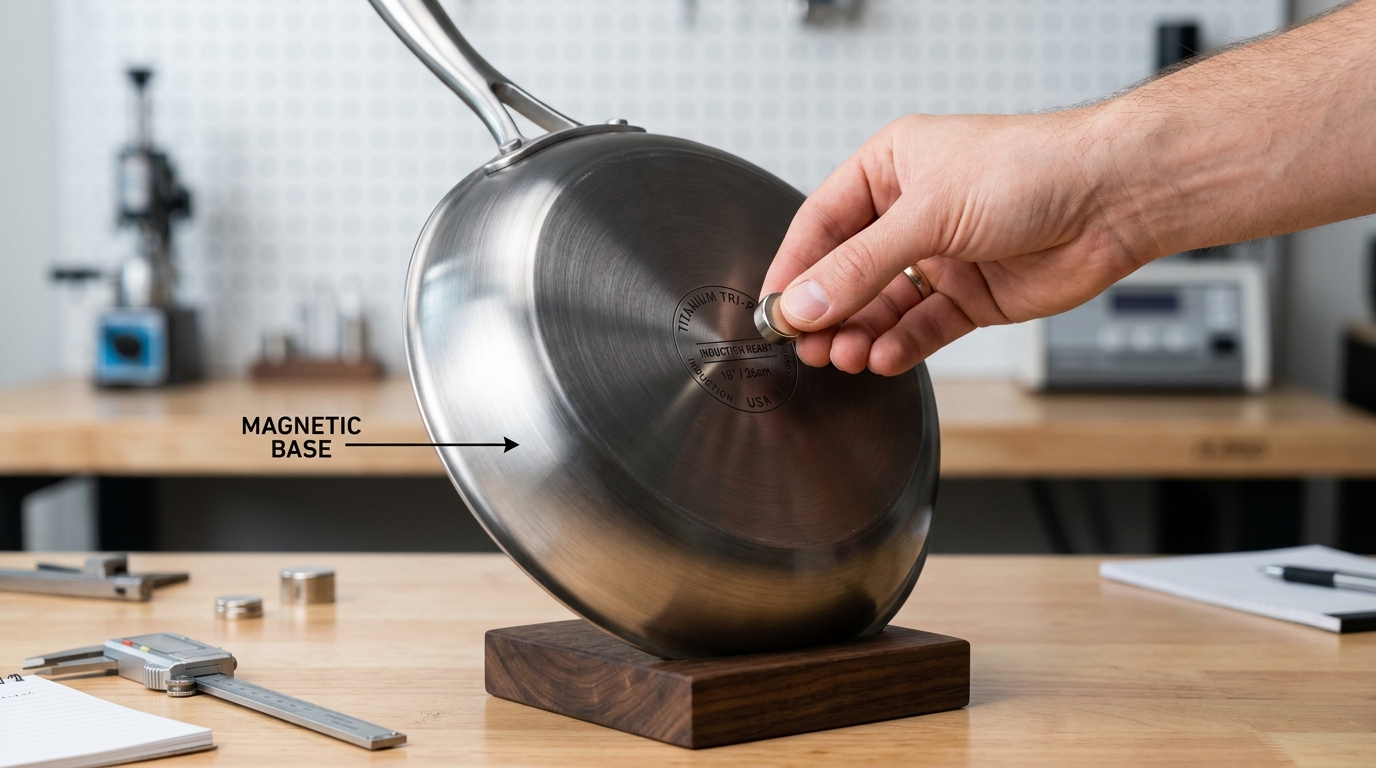
Differential magnet test confirming a magnetic ferritic stainless steel exterior bonded to an internal aluminum heat-diffusing core
Thermal physics provides an equally conclusive verification. Pure titanium is a sluggish heat conductor, with a thermal conductivity of only 17 to 22 W/(m·K). By contrast, 1050 cookware aluminum conducts thermal energy at roughly 205 to 230 W/(m·K)—over ten times faster than titanium. This extreme difference allows you to execute the ice-cube melt test at room temperature without turning on the stove. Stabilize the dry pan at room temperature (20°C to 24°C / 68°F to 75°F) and place a standard ice cube onto the center cooking floor. If the pan contains a hidden aluminum core, the high thermal conductivity of the aluminum instantly pulls ambient heat into the contact point, rapidly pooling water and melting the cube within five to ten seconds. Touching the underside directly below the ice cube feels cold almost immediately. On a solid pure titanium pan without an aluminum core, the ice cube melts sluggishly, exactly as it would on ceramic or stone, because titanium's thermal resistance prevents room-temperature energy from rapidly reaching the ice.
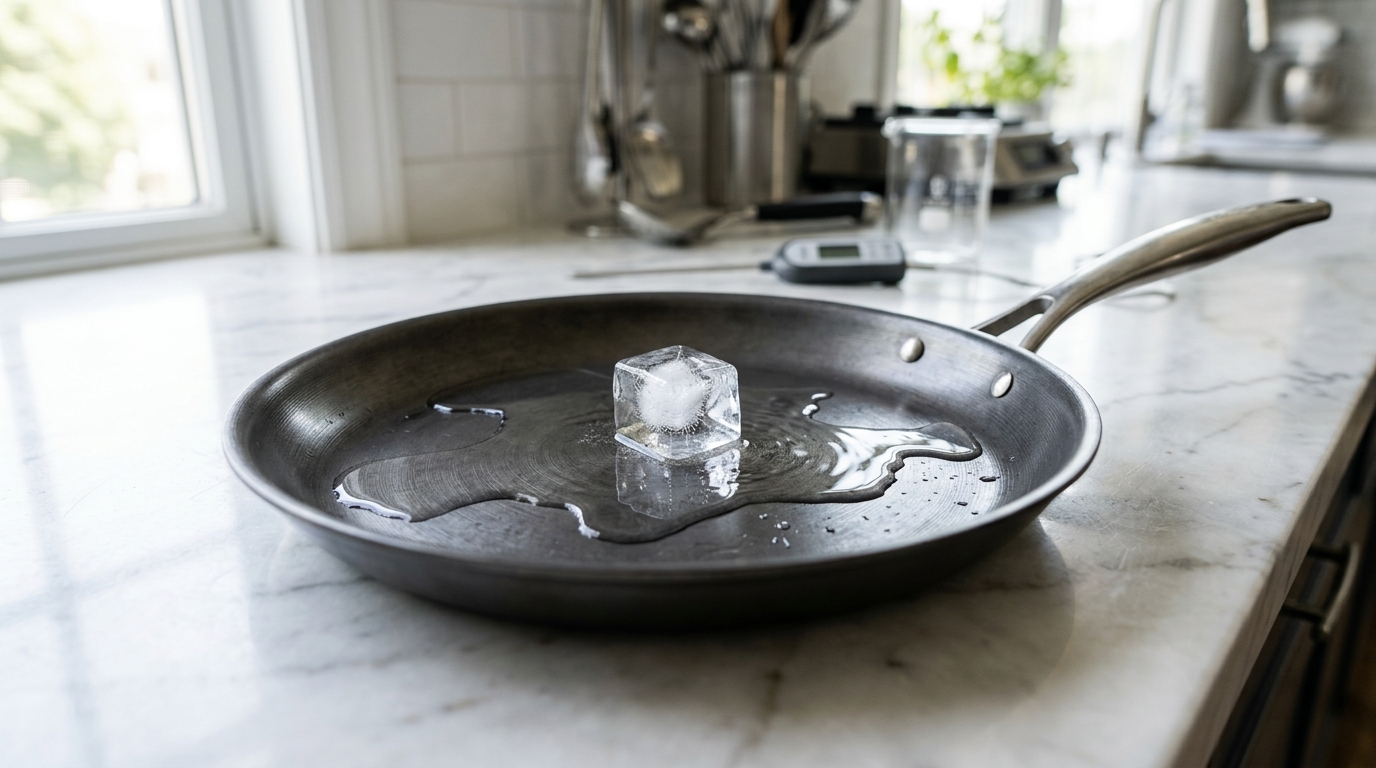
Ice-cube thermal test demonstrating rapid room-temperature heat conduction across a pan floor powered by an aluminum core
4. Acoustic Damping and the Resonance Ring Test
Acoustic resonant response is an elegant metallurgical indicator that reveals how to tell if titanium cookware has hidden aluminum core. Solid titanium possesses high mechanical elasticity and exceptionally low internal friction. When you suspend a solid pure titanium cup or single-sheet pan by its handle and tap the rim gently with a wooden chopstick or fingernail, it behaves like a fine tuning fork. It produces a loud, high-pitched, sustained chime with a lingering resonance that rings clearly for three to five seconds.
In contrast, composite multi-ply clad materials are natural sound-damping systems. In a tri-ply titanium-aluminum-steel skillet, acoustic vibrations must travel through three metals with vastly different elastic moduli and sound velocities. The central core of pure aluminum is relatively soft, acting as a mechanical vibration damper. When you tap the rim of a tri-ply pan with a wooden utensil, the sound is instantly absorbed at the metallurgical bond interfaces, producing a short, dry, muted 'clack' or dull 'thud' that dies out in less than half a second. If your pan refuses to chime and yields a muffled acoustic thud, you are holding a multi-material composite with a soft core.
| Test Method | Inspection Action | Solid Pure Titanium Pan | Tri-Ply Pan (Aluminum Core) | Titanium-Coated Aluminum |
|---|---|---|---|---|
| 1. Rim Visual | Inspect cut edge under light | Monolithic single-color gray | 3 parallel metal stripes (if cut rim) | Uniform gray aluminum body |
| 2. Weight Scale | Weigh empty 10-inch vessel | Feather-light (under 400g) | Substantial domestic heft (950g - 1350g) | Moderate weight (600g - 850g) |
| 3. Magnet Test | Touch magnet to inside & base | Zero pull anywhere | No pull inside; strong snap on base | No pull unless bottom steel disc attached |
| 4. Ice Melt Rate | Place room-temp ice on floor | Slow melting; stays localized | Rapid pooling within 5-10 sec | Rapid melting across aluminum body |
| 5. Tap Resonance | Tap rim with wooden utensil | Sustained chime / tuning fork ring | Muffled, short acoustic thud | Dull metallic tap without musical pitch |
5. Culinary Physics and Food Safety: Why Cookware Uses an Aluminum Core
After understanding how to tell if titanium cookware has hidden aluminum core, consumers frequently ask whether an aluminum core is a benefit or a hazard. From an engineering perspective, a multi-layer composite structure is the gold standard for premium kitchen performance. While pure titanium is biocompatible, acid-resistant, and entirely non-toxic, its poor thermal conductivity makes it impractical for everyday searing or delicate egg cooking. Without a heat-spreading core, delicate proteins burn in the center while outer edges stay raw. By sandwiching high-purity 1050 aluminum between Grade 1 titanium and induction stainless steel, cookware designers achieve the ideal balance: the peerless health benefits of pure titanium inside, paired with the rapid heat distribution of aluminum.
Regarding food safety, consumer anxiety usually stems from fears of aluminum leaching into food. In genuine multi-clad manufacturing, as explained in our guide to interfacial bonding in tri-ply titanium, the aluminum layer is hermetically sealed and metallurgically fused under extreme pressure and high temperature. The food-contact surface is a solid, non-porous sheet of Grade 1 pure titanium that contains zero chemical coatings, PFAS, or PTFE. Even if the surface experiences scratches over years of heavy use, you are merely scratching pure titanium metal; the underlying aluminum core sits deep within the composite matrix and never contacts food or cooking acids. For deeper context on material safety, buyers can review our technical report on titanium cookware safety and food-contact layers.
6. Avoiding Retail Scams and B2B Quality Control for Importers
A vital distinction when analyzing how to tell if titanium cookware has hidden aluminum core is recognizing deceptive marketing terminology. In mass retail channels, budget pans are often marketed under titles like 'Titanium Nonstick Pan' or 'Titanium Granite Skillet.' In nearly all such cases, the pan is simply a cheap aluminum body coated with traditional PTFE or ceramic nonstick coating into which microscopic titanium dioxide powder has been mixed to increase scratch resistance. These pans are predominantly aluminum from face to back, but the aluminum is concealed under synthetic nonstick paint, not beneath a sheet of genuine metal. A genuine tri-ply titanium pan has a true metallic luster, can be used with metal utensils without peeling, and requires proper preheating and cooking oil to release food cleanly. A titanium-coated aluminum pan feels slick and plasticky when dry, prohibits metal spatulas, and will eventually chip or flake. Buyers comparing commercial offerings should study our side-by-side analysis of titanium-coated cookware vs real titanium cookware to ensure they are investing in genuine metallurgically clad hardware rather than disposable nonstick coatings.
For brand owners and procurement managers, knowing how to tell if titanium cookware has hidden aluminum core extends into formal supplier auditing. When placing container-volume OEM or ODM orders, buyers must audit documentation before approving mass production. Reputable manufacturers provide Mill Test Certificates (MTC) proving that the food-contact layer meets ASTM B265 Grade 1 standards for pure commercial titanium, with iron content strictly below 0.20% and oxygen below 0.18%. Suppliers should also provide cross-sectional metallurgical micrographs showing defect-free interfacial bonding without voids or delamination. Importers should verify interfacial shear strength according to standard ASTM A264 or GB/T 6396 test protocols. A compliant tri-ply titanium-aluminum composite must demonstrate shear bond strength exceeding 140 MPa, ensuring that thermal shock cycles—such as rinsing a searing hot skillet with cold water—will never cause delamination. By verifying test certificates and demanding raw-edge sample coupons during pre-shipment inspections, commercial buyers ensure their private-label lines deliver authenticated, high-durability cookware that protects brand reputation.
Conclusion
Mastering how to tell if titanium cookware has hidden aluminum core empowers consumers and commercial buyers to cut through marketing hype. By observing visible layer banding along bare rims, feeling the dense multi-pound heft of a clad vessel, verifying exterior-only magnetic attraction, watching rapid ice-cube melting, and noting acoustic vibration damping, you can positively authenticate a tri-ply composite in minutes. Discovering an aluminum core in your domestic titanium pan confirms that you own a culinary-grade cooking tool engineered for superior thermal responsiveness, induction versatility, and lifetime non-toxic food contact.
Frequently Asked Questions
Q1: Can aluminum leach into my food if my tri-ply titanium cookware gets scratched?
No, aluminum cannot leach into your food from normal scratches on a genuine tri-ply titanium pan. The inner cooking surface is a solid sheet of ASTM Grade 1 pure titanium measuring roughly 0.4 mm to 0.6 mm thick—thousands of times thicker than a microscopic spray coating. Surface marks from stainless spatulas or scouring pads only scratch the top microns of the dense titanium metal. The underlying aluminum core remains completely sealed and isolated from contact with food, moisture, and cooking acids.
Q2: Why do manufacturers use an aluminum core instead of making domestic pans out of 100% solid titanium?
Manufacturers use an aluminum core because solid titanium has very poor thermal conductivity (17 to 22 W/m·K). A 100% solid titanium pan heats unevenly, creating intense hot spots directly above the burner that scorch meats and burn sauces while the sides stay cold. Additionally, pure titanium cannot be used on modern induction stovetops. Adding an aluminum core (approx. 210 W/m·K) and a magnetic stainless steel exterior creates a pan that distributes heat evenly while remaining compatible with induction cooktops.
Q3: How can I tell the difference between a real tri-ply titanium pan and a cheap titanium-coated aluminum pan?
You can tell the difference through surface texture, scratch resistance, and magnetic testing. A true tri-ply titanium pan has an uncoated bare metal surface that shows faint machining grain, can withstand metal utensils without peeling, and requires preheating and cooking oil. In contrast, a titanium-coated aluminum pan has a dark, slick, synthetic nonstick surface (PTFE or ceramic mixed with titanium dust) that scratches easily, prohibits metal utensils, and usually lacks an induction-grade magnetic exterior unless a separate steel disc is stamped on the base.