B2B titanium cookware sourcing for importers
Titanium Cookware Supplier for Importers, OEM, Wholesale, and Private-Label Brands
Direct answer for global buyers: TITAUDOU is a titanium cookware supplier focused on importer-ready tri-ply titanium cookware programs. We support OEM, ODM, wholesale, and private-label supply for cookware brands, importers, retailers, sourcing teams, and premium kitchenware projects that need verified material structure, sample consistency, packaging support, quality documentation, and stable bulk delivery.
If you are using this page as a pure titanium pots and pans importer sourcing guide, start with the product structure. TITAUDOU cookware is built with a GR1 pure titanium food-contact inner layer, a 1050 aluminum heat-conducting core, and a 430 magnetic stainless steel exterior. This gives buyers a clearer product story than coating-only titanium claims: titanium where food touches, aluminum where heat must spread, and stainless steel where induction compatibility and exterior strength are needed.
Request Supplier Quote View Titanium Pots and Pans
GR1 titanium food-contact layer
Clear material structure for importers who need verified titanium cookware claims.
ISO quality-system support
Production and inspection can be managed under an ISO9001 quality-management framework, with BSCI, FDA, LFGB, SGS, and RoHS-related documentation discussed by product scope and target market.
Importer delivery planning
Sample review, packaging proofing, QC checkpoints, shipment documents, and repeat-order files can be coordinated before bulk production.
OEM, ODM, and wholesale supply
Support for cookware sets, pans, pots, handles, lids, logo methods, manuals, color boxes, carton marks, and private-label programs.
Why Importers Choose a Specialized Titanium Cookware Supplier
Importers do not only need a factory that can make a pan. They need a supplier who can help control the full sourcing path: product structure, sample approval, compliance documents, packaging files, delivery schedule, pre-shipment inspection, and repeat-order consistency. Titanium cookware makes this especially important because buyers must separate real food-contact titanium structures from broad titanium marketing language.
Material clarity
TITAUDOU helps buyers define whether the cookware is pure titanium, titanium-coated, or tri-ply titanium composite cookware. For the main TITAUDOU cookware line, the key selling point is a GR1 titanium food-contact layer in a tri-ply structure, not a vague titanium coating claim.
Supply coordination
A supplier-facing project needs more than unit pricing. Buyers usually need samples, labels, retail packaging, instruction manuals, carton marks, shipment documents, and internal approval records before they can place repeat orders confidently.
Risk control
The largest sourcing risks are sample-to-bulk inconsistency, unclear titanium claims, unsupported compliance statements, packaging mistakes, and delivery delays. A supplier should help document the approved standard before production begins.
This supplier page is therefore built for buyers who are close to evaluation, not casual readers. The goal is to help an importer compare titanium cookware suppliers by structure, documentation, production control, packaging readiness, and delivery reliability. It does not try to repeat the manufacturer page. Instead, it keeps the same clean landing-page rhythm while answering the questions a sourcing manager would ask before approving a supplier.
Titanium Cookware Types Importers Should Compare
Many catalogs use the word titanium, but the products are not the same. The right sourcing decision depends on what touches food, how the pan conducts heat, whether the product works on induction cooktops, and whether the retail claim can be supported by documentation.
| Cookware Type | Typical Structure | Importer Advantage | What to Verify |
| Single-metal pure titanium cookware | Cookware body made from commercially pure titanium such as GR1 or Grade 2 | Simple pure-titanium positioning, lightweight feel, strong corrosion resistance | Heat distribution, induction compatibility, thickness, forming quality, and cost level |
| Titanium-coated cookware | Aluminum or stainless steel base with a coating or coating additive described as titanium | Lower price point and familiar nonstick retail language | Whether titanium is actually the food-contact surface, coating durability, PFAS wording, and claim accuracy |
| Tri-ply titanium cookware | GR1 pure titanium inner layer + 1050 aluminum core + 430 stainless steel exterior | Titanium food-contact story, better heat spreading than titanium-only cookware, and induction-ready exterior design | Layer structure, bonding consistency, inner-surface authenticity, and finished-product inspection records |
For premium kitchenware importers, tri-ply titanium cookware is often the most practical choice because it balances material differentiation, cooking performance, induction usability, and retail storytelling. TITAUDOU focuses on this structure for buyers who need more than a standard stainless steel or coated nonstick product line.
For importers, this comparison also affects sales copy. A product with a GR1 titanium food-contact layer can be described differently from a pan that only uses titanium-related particles in a coating system. Before printing packaging or launching an online listing, the buyer should confirm which wording is accurate, which documents support the claim, and which product photos or cross-section references can be used by the sales team.
TITAUDOU Supplier Capabilities for Importer Programs
TITAUDOU supports importer programs that need structured sourcing rather than one-time catalog purchasing. The supplier role is to help buyers align product requirements, packaging requirements, documentation requirements, and delivery planning before the order reaches mass production.
OEM supply
OEM supply is suitable when the buyer already has a product brief, size range, target market, packaging direction, or existing retail concept. TITAUDOU can discuss cookware diameter, depth, pot capacity, handle design, lid configuration, surface finish, logo method, packaging, instruction materials, barcode labels, and carton marks.
ODM development
ODM development is suitable when the buyer needs a supplier to help turn a market idea into a workable cookware line. TITAUDOU can review structure, set mix, cookware type, sample requirements, packaging level, certification needs, production feasibility, and the right path from pilot order to repeat order.
Wholesale and private-label supply
Wholesale supply is suitable for distributors, retailers, and sourcing teams that want to test titanium cookware demand before deep customization. Private-label supply can add brand logo, color box, product manual, carton mark, label, and market-specific documentation according to the buyer's channel.
The supplier capability also includes communication control. Importers usually need one project file that connects the quotation, product specification, approved sample, packaging file, inspection requirement, and shipment plan. Without that file, small changes can accumulate across departments. A handle finish may change, a carton mark may be missed, or a report may not match the final SKU. TITAUDOU's supplier workflow is designed to keep these commercial details visible before they become delivery problems.
Importer Sourcing Workflow: From RFQ to Repeat Order
A practical titanium cookware sourcing project should move through a controlled workflow. Skipping these steps may reduce upfront communication, but it increases the risk of bulk-goods inconsistency, packaging errors, unsupported claims, or shipment delays.
1. Share the sourcing brief
The importer provides the target market, cookware type, expected retail channel, size range, order quantity, packaging level, certification needs, and launch timeline. This allows TITAUDOU to recommend standard wholesale supply, OEM adjustment, or ODM development.
2. Confirm material structure
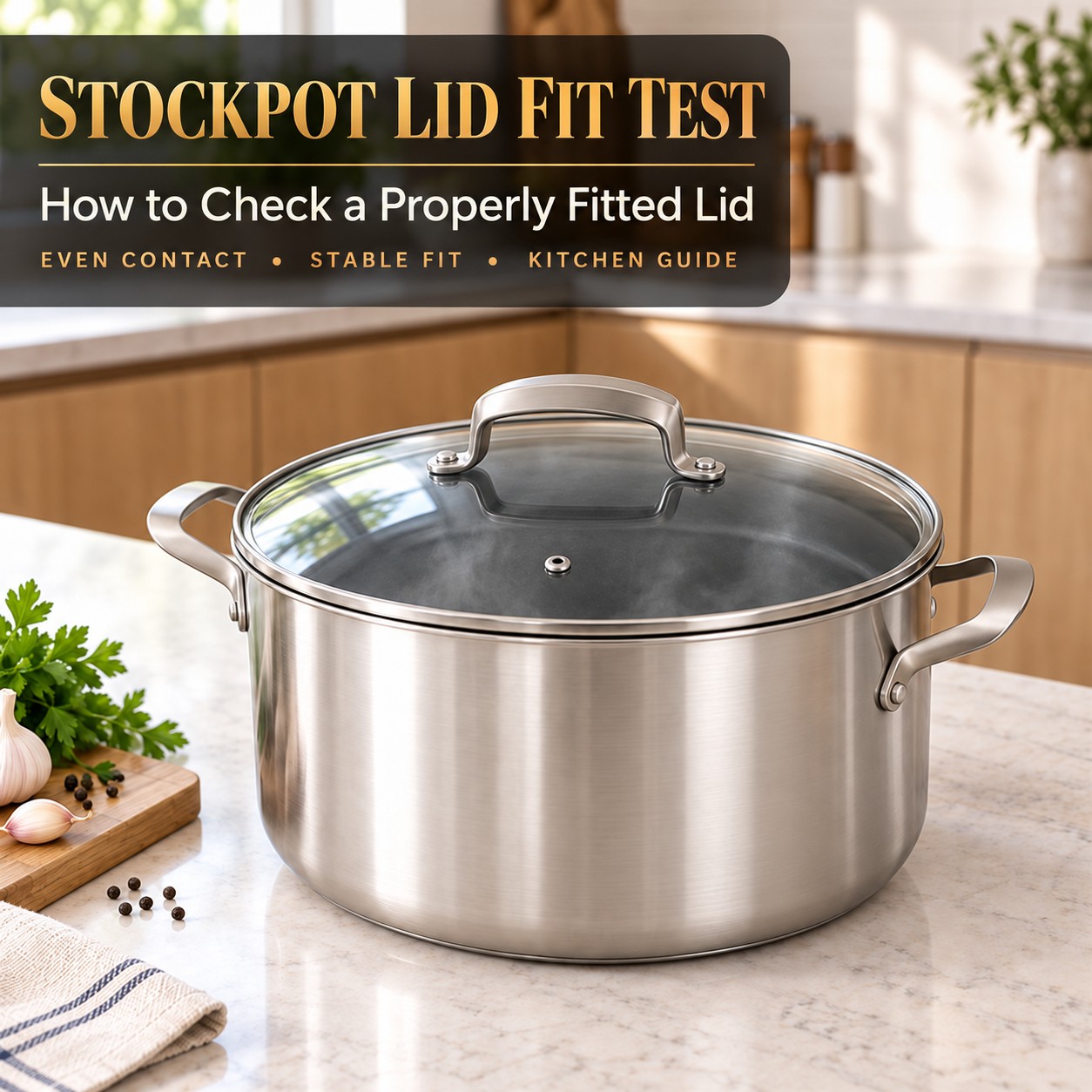
Before comparing prices, the buyer should confirm the food-contact surface, layer structure, handle material, lid material, induction requirement, and surface finish. For TITAUDOU's tri-ply cookware, the core structure is GR1 titanium inside, 1050 aluminum in the middle, and 430 stainless steel outside.
3. Review sample and packaging proof
The buyer reviews the sample for structure, finish, handle comfort, lid fit, product appearance, and packaging presentation. Packaging artwork, barcode rules, carton marks, manuals, and private-label elements should be approved before bulk production.
4. Lock the production reference
Approved samples, product parameters, packaging files, and QC requirements should be retained as the production reference. This helps prevent quiet changes between the confirmed sample and the shipped goods.
5. Inspect and ship
Inspection can include incoming material review, forming accuracy, surface finish, handle assembly, lid fit, appearance inspection, packaging check, carton-mark confirmation, and pre-shipment review. Export documents and shipment terms should be confirmed before the goods leave the factory.
This workflow is especially useful for importers building a new cookware line. The first order is not only a purchase; it becomes the reference for product photos, retail copy, customer support language, packaging design, and future reorders. If the first order is not controlled carefully, the brand may have to correct listings, replace packaging files, or renegotiate quality standards after goods are already in the market.
ISO Quality System, Certifications, and QC Documentation
For international importers, certification language must be precise. A useful document should connect to the correct product, sample, material, test basis, or production process. TITAUDOU can support buyers who need documented quality control under an ISO9001 quality-management framework, with related BSCI, FDA, LFGB, SGS, and RoHS documentation discussed according to the product scope and destination market.
ISO9001 does not replace product-specific food-contact testing. Its value is in production management: incoming material control, process control, inspection records, corrective actions, and delivery review. Food-contact documentation, when required, should be reviewed according to the actual SKU and market requirement rather than treated as a broad marketing slogan.
| QC or Document Item | Supplier Check | Buyer Value |
| Material structure review | Confirm GR1 titanium food-contact layer, aluminum core, and stainless exterior according to project specification | Reduces risk of misleading titanium claims and wrong retail positioning |
| ISO9001 quality-management support | Use documented production and inspection procedures where applicable | Gives importers a more repeatable quality-control basis for bulk orders |
| Food-contact documentation | FDA, LFGB, SGS, or related reports can be discussed by target market and product scope | Supports importer review, retailer onboarding, and responsible product claims |
| Packaging inspection | Check color box, manual, labels, barcode, carton marks, and packing method before shipment | Reduces retail receiving, marketplace listing, and customs-document problems |
| Pre-shipment review | Review quantity, appearance, carton marks, product photos, documents, and shipment readiness | Helps importers control delivery risk before goods leave the production side |
Factory Delivery Capability for Titanium Cookware Importers
Factory delivery capability is not only a capacity number. Importers need to know whether the supplier can hold the approved structure, finish, packaging, and documentation through mass production. TITAUDOU can support sample confirmation, production scheduling, packaging proofing, QC records, and export coordination for cookware programs that need repeat-order stability.
For regular projects, commercial terms can include a 500-piece-per-style MOQ for standard products, sample confirmation before bulk production, and a mass-production lead time usually discussed around 25-40 days after sample and packaging approval. Final timing depends on product shape, customization depth, tooling needs, packaging complexity, order quantity, and the production schedule at the time of quotation.
Export support can include discussion of EXW, FOB, CIF, or DDP terms according to the destination and buyer requirements. Importers should confirm carton size, gross weight, pallet requirements, labels, manuals, country-specific markings, packing list, invoice, and shipping documents before production completion.
Common sourcing risks TITAUDOU helps importers control
Unclear titanium claims
A product described as titanium cookware may be pure titanium, titanium-coated, or tri-ply titanium. TITAUDOU helps buyers explain the actual structure before building retail claims.
Sample-to-bulk inconsistency
The approved sample should not be treated as a loose reference. Product parameters, packaging files, and QC checkpoints should be retained so bulk goods follow the confirmed standard.
Weak documentation
Importers should avoid relying on broad certification language that does not connect to the material, SKU, sample, or finished product. Documentation should be reviewed according to the target market.
Packaging and delivery mistakes
Retail packaging, labels, manuals, barcodes, carton marks, and shipment terms affect receiving and launch readiness. These items should be confirmed before mass production reaches the packing stage.
A controlled supplier process does not remove every commercial risk, but it makes the risk visible earlier. The importer can confirm the material structure before writing the product page, confirm documentation before retail submission, confirm packaging before production, and confirm shipment details before the goods are released. That is the practical difference between ordinary catalog purchasing and a supplier-managed titanium cookware program.
For related technical reading, buyers can review tri-ply titanium cookware structure, compare titanium-coated cookware and real titanium cookware, and check food-grade titanium cookware documentation questions.
FAQ, Quote Request, and Related Resources
FAQ for titanium cookware importers
What should importers ask before sourcing titanium pots and pans?
Ask for the cookware structure, food-contact surface, material grade, sample process, packaging options, MOQ, lead time, QC checkpoints, and food-contact documentation for the target market. If the project uses the phrase titanium cookware, confirm whether it means single-metal pure titanium, titanium coating, or tri-ply titanium cookware.
Does TITAUDOU supply pure titanium cookware or tri-ply titanium cookware?
TITAUDOU's core cookware structure is tri-ply titanium composite cookware: a GR1 pure titanium food-contact inner layer, a 1050 aluminum heat-conducting core, and a 430 stainless steel exterior. This structure should be explained accurately in importer files, retail packaging, and online product listings.
Can TITAUDOU support private-label packaging and export delivery?
Yes. TITAUDOU can discuss private-label packaging, logo methods, manuals, barcode labels, carton marks, sample approval, QC records, and shipment coordination according to the buyer's target market, order quantity, and trade terms.
Contact TITAUDOU for supplier evaluation and quote
Send your target market, cookware type, size range, estimated quantity, packaging requirements, certification needs, and expected launch schedule. TITAUDOU will help confirm whether standard wholesale supply, OEM adjustment, or ODM development is the right sourcing path.
Email: [email protected]
Phone / WhatsApp: +86 18161904380
Address: Bawanghe Industrial Zone, Mei County, Baoji, Shaanxi Province, China
Get Supplier Quote and Sample Plan
Related titanium cookware resources
To evaluate the category before requesting a quote, review the titanium pots and pans collection, compare sourcing scope on the titanium cookware manufacturer page, or review bulk order options on the bulk titanium cookware page.