If you are comparing the best heavy thick bottom pure titanium cookware for perfectly even heating, the first point is simple: pure titanium explains the food-contact material, but the bottom structure explains the cooking performance. A pan can use safe pure titanium and still heat unevenly if the base is too thin, poorly bonded, or not designed to spread heat across the cooking surface.
This is why “what is pure titanium” should not stop at material purity. For cookware buyers, the real question is two-part: which titanium grade touches food, and how is the cookware built underneath that titanium surface? TA0-TA4 grades explain purity, strength, corrosion resistance, and suitability. Layer design, bottom thickness, flatness, and heat-spreading materials explain whether the cookware feels stable in daily cooking.
TITAUDOU’s position is specific. A cookware claim should identify the pure titanium food-contact layer, then explain the complete structure. For everyday pots and pans, a GR1/TA1 pure titanium cooking surface works better when it is supported by a heat-spreading core and a stable exterior layer. That is the difference between a material label and a cookware design.
1. The Composition and Biocompatibility of Pure Titanium
Pure titanium is defined by its high titanium content and its extremely low concentration of impurities. The main impurities found in pure titanium are iron (Fe), carbon (C), oxygen (O), nitrogen (N), and hydrogen (H). Notably, pure titanium does not contain elements like nickel, chromium, or cobalt, which are commonly found in stainless steel and other alloys but can cause allergic reactions or other health concerns in sensitive individuals.
This absence of nickel, chromium, and cobalt is one of the reasons industrial pure titanium is widely recognized for its superior biocompatibility. Unlike lower-quality metals, certified pure titanium is inert and non-reactive. This makes it suitable for medical-grade applications and premium titanium cookware. The material is inert and non-reactive, meaning it does not interact easily with biological tissues, bodily fluids, or common food ingredients.
As a result, pure titanium is favored for medical implants that must remain in the body for years without causing adverse reactions. This same property makes it ideal for use in kitchenware, where contact with food and prolonged exposure to a variety of ingredients, cleaning routines, and temperatures demand a material that is both safe and stable.

2. Pure Titanium Grades: Characteristics and Applications
In China, pure titanium is classified into five main grades, designated as TA0, TA1, TA2, TA3, and TA4. Each grade reflects subtle differences in purity and mechanical properties, which in turn affect their suitability for different applications. Here is a closer look at each grade:
2.1 TA0: The Highest Purity, Premium Grade
TA0 is the grade of industrial pure titanium with the highest purity. The titanium content is greater than or equal to 99.8%, making it an exceptionally clean and refined material. Because of its purity, TA0 is also the most expensive of the pure titanium grades.
Applications:
· Medical devices and surgical implants
· Precision instrument components
· Equipment for handling strong acids, strong bases, or highly corrosive media
· Production lines for beverages, dairy products, or pharmaceuticals
TA0 is chosen whenever absolute purity and corrosion resistance are non-negotiable, such as in environments where contamination could have serious health or safety consequences.
2.2 TA1: The Preferred Grade for Cookware and Implants
TA1 contains titanium at a level greater than or equal to 99.5%. This grade strikes an optimal balance between high purity, mechanical strength, and cost, making it the preferred material for both cookware and medical implants.
Applications:
· Cookware and tableware: TA1 is favored by major Chinese cookware brands, as Titaudou use TA1 as the raw material for their titanium cookware.
· Medical implants: Its biocompatibility and stability have made it a standard for surgical tools and implantable devices.
A notable property of TA1 is its chemical stability across the pH range of 1–13. This means it will not react with any acidic or alkaline foods, ensuring complete safety and the absence of metallic taste or contamination. When subjected to high temperatures, TA1 can also develop a range of vibrant colors—such as blue, yellow, or purple—through controlled oxidation, adding aesthetic appeal without compromising safety.
Looking for high-quality TA1 titanium products? At Titaudou, we strictly use food-grade TA1 pure titanium for our cookware series to ensure maximum safety and durability.
2.3 TA2: The International Standard for Titanium Cookware
TA2 has slightly less titanium content compared to TA1, resulting in a modest reduction in purity and price, but with an increase in mechanical strength. TA2 has become the mainstream raw material for international-grade titanium tableware and cookware.
Applications:
· Mainstream titanium cookware and utensils
· Applications requiring a balance of strength, corrosion resistance, and biocompatibility
TA2 offers high strength, excellent corrosion resistance, and remains non-reactive with food, making it a versatile and reliable choice for both domestic and industrial environments.
2.4 TA3: Enhanced Strength and Hardness
TA3 takes strength a step further compared to TA2. It is harder and stronger, though its impurity levels are slightly higher. This grade maintains good stability in environments with pH values from 2 to 12, making it robust in both acidic and mildly alkaline conditions.
Applications:
· Components requiring increased hardness and structural strength
· Specialized cookware and utensils that may be exposed to harsher handling or environments
While TA3’s chemical stability is slightly lower than that of TA1 and TA2, it still far exceeds that of most metals used for household goods.
2.5 TA4: The High-Strength Pure Titanium
TA4 is the highest strength grade among pure titaniums, featuring increased hardness and durability. Although purity is somewhat lower, its resistance to corrosion and mechanical wear is exceptional.
Applications:
· Structural parts that require both high strength and corrosion resistance
· Specialized industrial or engineering applications
· Less commonly used for everyday cookware, but crucial for demanding environments
3. Why Pure Titanium Grade Alone Does Not Guarantee Even Heating
The TA0-TA4 grade system explains purity and mechanical behavior, but it does not fully explain how a pan cooks. This matters because pure titanium is stable, corrosion resistant, and light, but it does not spread heat laterally as quickly as aluminum or copper. If a pure titanium pan is made as a thin single-metal sheet, the area directly above the flame or induction coil may become hotter than the outer cooking area.
For boiling water, steaming, outdoor cups, and lightweight camping pots, that limitation may be acceptable. For frying eggs, fish, pancakes, tofu, steak, or family meals, the cookware needs a more controlled base. This is where buyers searching for the best heavy thick bottom pure titanium cookware for perfectly even heating should look beyond the grade name and examine the bottom construction.
A thicker base does not automatically mean better performance either. A heavy bottom only helps if the added structure spreads heat, stays flat, and remains well bonded to the titanium food-contact layer. A thick but poorly designed base can still create hot spots, slow response, or warping. The useful question is not “how heavy is it?” but “what does the bottom thickness actually do?”
| Cookware Structure | Food-Contact Material | Even-Heating Behavior | Best Use |
| Thin single-wall pure titanium | Pure titanium throughout | Can heat quickly but may show stronger hot spots | Camping, boiling, lightweight travel |
| Pure titanium with added thick base | Pure titanium cooking surface | Better stability if the base spreads heat and stays flat | Saucepans, soup pots, daily cookware |
| Tri-ply titanium cookware | GR1/TA1 pure titanium inner layer | More balanced when aluminum core and exterior layer are well bonded | Everyday frying, family cooking, induction-ready designs |
4. What “Heavy Thick Bottom” Should Mean in Pure Titanium Cookware
A proper heavy thick bottom is not just extra metal for marketing weight. In cookware, the bottom must do four practical jobs: keep the base flat, reduce sudden hot spots, support stable simmering, and distribute heat across a larger cooking area. If the cookware is also intended for induction, the exterior base must have the right magnetic response.
For pure titanium cookware, this usually means the designer must separate two functions. The inner titanium layer provides the safe food-contact surface. The middle layer or base structure provides heat spreading. The outer layer provides stove compatibility, strength, and base stability. When these functions are mixed together vaguely, buyers end up with confusing claims such as “titanium technology” or “titanium effect” without knowing what actually touches food.
This is also why the best heavy thick bottom pure titanium cookware for perfectly even heating should not be judged by titanium percentage alone. A fully single-metal titanium pot can be very pure and very safe, but it may not be the most even-heating option for flat electric or induction cooking. A well-built tri-ply titanium design can keep pure titanium where food touches while using a better heat-spreading layer beneath it.
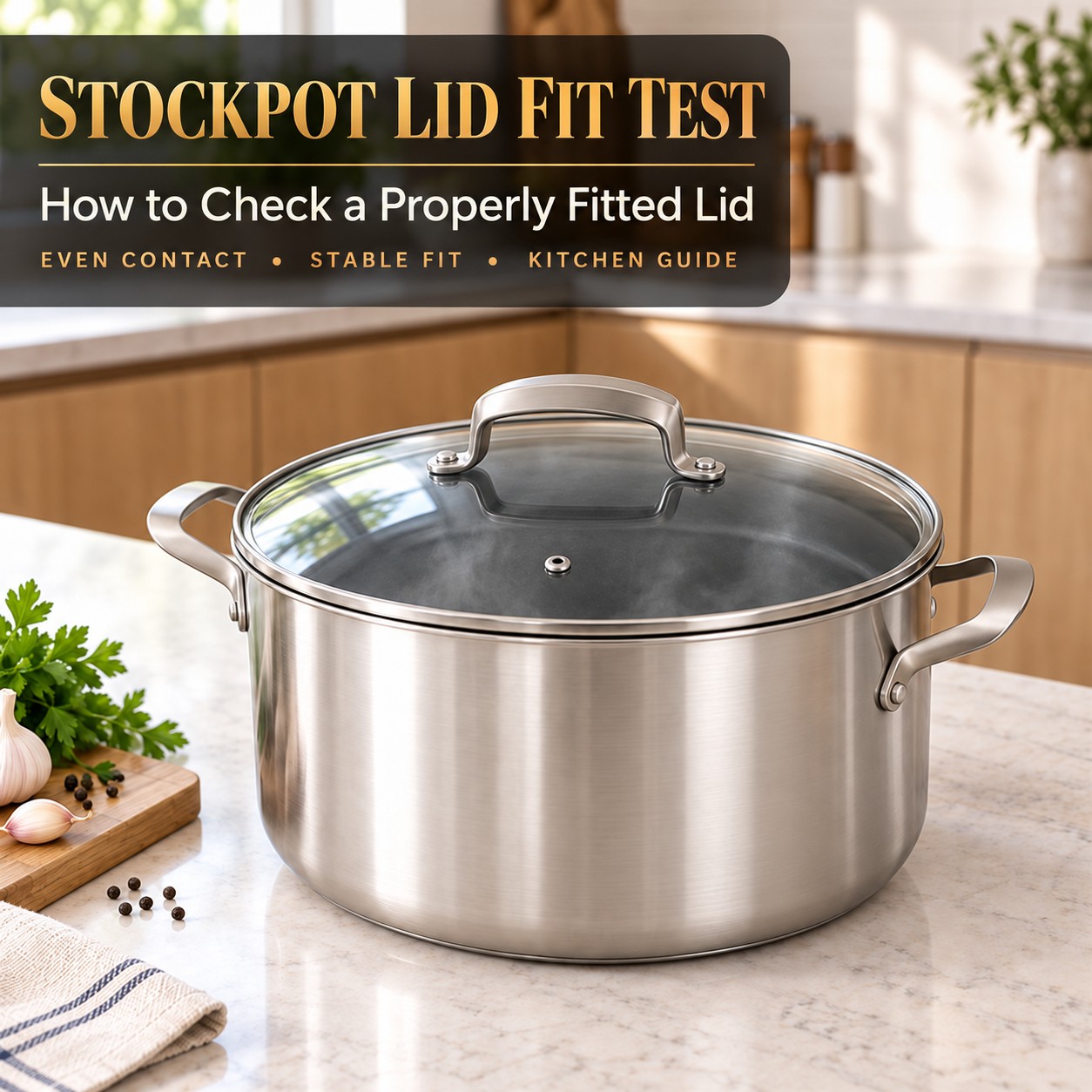
For large family pots, this logic becomes even more important. A wide pot bottom covers a larger burner area, holds heavier food, and experiences more thermal stress. A flat, stable, thick base helps prevent rocking, scorching at the center, and weak heating at the edge. For a practical product example, see TITAUDOU’s 360mm flat-bottomed titanium pot, which shows why size and base structure must be considered together.
5. How TITAUDOU Builds Even Heating into Titanium Cookware
TITAUDOU does not treat pure titanium as a slogan by itself. For cookware, the material must be connected to structure. A typical TITAUDOU tri-ply titanium construction uses a GR1/TA1 pure titanium food-contact layer, a 1050 aluminum heat-spreading core, and a 430 stainless steel exterior. Each layer has a job. Titanium handles food contact. Aluminum spreads heat. Stainless steel supports shape, exterior durability, and induction compatibility.
This structure also makes the product story easier for importers, brand owners, and serious home users to verify. Instead of asking whether the cookware is simply “pure titanium,” ask which layer is titanium, whether the cooking surface is uncoated, what material spreads heat below it, and whether the exterior base is suitable for the target stove. Buyers comparing induction designs can also read why induction-compatible titanium cookware needs the right base structure.
On selected products, TITAUDOU also uses titanium molecular hardening technology to raise the surface hardness of the titanium cooking layer to about HV700-900. This does not change titanium into a coating, and it should not be described as magic nonstick. Its practical value is durability: a harder titanium surface is more tolerant of metal utensils, steel wool cleaning, and repeated daily use than an ordinary soft untreated surface.
For OEM and private-label projects, this gives TITAUDOU a more defensible specification: real titanium where food touches, a heat-spreading layer where cooking performance depends on it, and a manufacturing route that can be discussed through drawings, sample checks, and test reports. Buyers who need supplier-level details can review the titanium cookware manufacturer page before requesting samples.
| Buyer Check | Why It Matters | What to Ask TITAUDOU or Any Supplier |
| Food-contact grade | Confirms the material touching food is real pure titanium | Is the inner layer TA1/GR1 pure titanium, and is it uncoated? |
| Bottom structure | Explains flatness, heat spreading, and stove compatibility | What is the core material, exterior material, and total base thickness? |
| Surface treatment | Affects scratch resistance, cleaning tolerance, and long-term appearance | Is the titanium surface hardened, polished, brushed, or untreated? |
| Finished-product testing | Material grade alone does not prove the completed pan | Can the supplier provide food-contact migration or compliance reports for the actual SKU? |
6. FDA, LFGB, and Food-Contact Safety: Material Proof vs. Finished Product Proof
No matter how advanced or pure the material, cookware and tableware claiming to be food-safe must be verified as finished products. A raw material certificate or material test report can help confirm titanium identity, but it does not automatically prove the completed pan, welded rim, handle area, surface treatment, decoration, or production residue.
For the United States, buyers usually look for food-contact compliance that supports the product’s intended use. For Europe and demanding import programs, LFGB-style migration testing may also be requested. The useful report should identify the exact SKU, material structure, food-contact surface, test simulant, time, temperature, detection limit, and report date. A broad “FDA approved” claim without context is weaker than a finished-product report tied to the actual cookware.
This distinction is important for thick-bottom cookware because the finished article includes more than titanium sheet. A tri-ply pot may include pure titanium inside, an aluminum core, stainless steel outside, handles, rivets or welded parts, exterior finishing, and packaging contact considerations. The safe claim should therefore be based on the actual food-contact surface and the completed product, not on one material word.
7. Practical Buying Checklist for Pure Titanium Cookware
If you are buying pure titanium cookware for health, the grade matters. If you are buying it for daily cooking performance, structure matters just as much. A good product description should not only say “pure titanium.” It should explain the grade, layer construction, base design, stove compatibility, surface treatment, and test evidence.
For frying pans and wide-bottom pots, ask whether the base is flat and stable after repeated heating. For induction, ask whether the exterior layer is magnetic and whether the base diameter matches common burner zones. For large family pots, ask whether the bottom is thick enough to reduce center scorching without making the pot unnecessarily heavy. For cleaning, ask whether the titanium surface is ordinary untreated titanium or a hardened titanium surface that can tolerate more aggressive scrubbing.
If your priority is material comparison, start with pure titanium grade. If your priority is cooking behavior, compare structure. If your priority is sourcing, request drawings, samples, compliance documents, and production capability. TITAUDOU’s titanium cookware supplier page is the better next step for importers or brand owners who need custom specifications, packaging, and delivery planning.
For readers who want a deeper cooking-performance explanation, the companion article on titanium cookware heat distribution explains why cookware geometry, burner size, base thickness, and layer design must work together. This pure titanium guide explains the material side. The heat-distribution guide explains the cooking side.
Conclusion
Pure titanium is valuable because it is light, corrosion resistant, biocompatible, and chemically stable. TA0-TA4 grades help buyers understand purity and strength. For cookware, TA1/GR1 pure titanium is especially important because it can provide a clean, non-reactive food-contact surface.
But cookware performance is not decided by grade alone. The best heavy thick bottom pure titanium cookware for perfectly even heating needs a structure that supports the titanium layer: a flat base, controlled thickness, heat-spreading core, stable exterior, and finished-product testing. That is why TITAUDOU talks about titanium grade and cookware construction together.
Frequently Asked Questions and Answers
Q1: What is pure titanium cookware?
Pure titanium cookware uses commercially pure titanium, often TA1/GR1, at least where food touches the pan. It is valued for corrosion resistance, low reactivity, light weight, and clean food-contact behavior. Buyers should still confirm whether the entire cookware body is pure titanium or whether pure titanium is used as the inner food-contact layer in a multi-layer structure.
Q2: Does a thicker pure titanium bottom always heat more evenly?
No. Thickness helps only when the base is well designed. A good thick bottom should stay flat, spread heat, and match the stove type. For pure titanium cookware, a heat-spreading core below the titanium food-contact layer is often more useful than simply making a single titanium sheet heavier.
Q3: What is the best heavy thick bottom pure titanium cookware for perfectly even heating?
The best choice is usually cookware with a verified GR1/TA1 pure titanium food-contact surface, a heat-spreading middle layer, a stable flat base, and finished-product food-contact testing. TITAUDOU’s tri-ply titanium structure follows this logic by using pure titanium where food touches, aluminum where heat needs to spread, and stainless steel where base stability and induction compatibility matter.