Introduction
For pregnant women, nursing mothers, and children, genuine uncoated titanium cookware can be a practical everyday choice when the food-contact surface is correctly identified, the finished cookware has appropriate supporting documents, and the pan is used as intended. The useful answer is conditional. A material name alone cannot guarantee the safety of every product sold with the word titanium on its package.
The first question is what actually touches the food. A GR1 pure titanium cooking surface is different from a titanium-colored coating, a titanium-reinforced nonstick layer, or a pan whose titanium content is not disclosed. The second question is whether a report identifies the finished model and tests it under relevant food-contact conditions. The third is whether the cookware remains clean, intact, and correctly used in the family kitchen.
This article preserves a narrow purpose: helping families assess titanium cookware for pregnancy, breastfeeding, children, and baby-food preparation. It is material and purchasing guidance, not medical advice. Anyone with a diagnosed metal allergy, kidney condition, prior heavy-metal exposure, or an individual restriction from a clinician should follow that medical guidance rather than relying on a cookware article.
1. What “Safe” Means for Pregnancy, Breastfeeding, and Children
Pregnancy and early childhood justify careful purchasing, but they do not change the basic method for evaluating a pan. Safety depends on material identity, manufacturing quality, foreseeable cooking conditions, cleaning, and food-contact evidence. No cookware can improve pregnancy outcomes, protect breast milk, treat allergies, or remove every exposure risk. A responsible supplier should explain what the product is and what was tested without turning the explanation into a medical promise.
For most households, cookware material is only one part of kitchen safety. Clean hands and utensils, separation of raw and ready-to-eat foods, complete cooking, controlled cooling, and prompt refrigeration remain important. A stable cooking surface does not make undercooked meat safe, and an expensive pan does not correct poor storage. This distinction matters because material marketing can distract families from more immediate foodborne-illness risks.
Within that limited material question, commercially pure titanium is valued for corrosion resistance and low reactivity under normal kitchen conditions. It does not require a polymer nonstick coating to separate food from the underlying metal. That can simplify the food-contact story, but only if the product is genuinely titanium at the cooking surface. Families should verify the surface instead of assuming that every pan advertised as titanium has the same construction.
2. Identify the Food-Contact Surface Before Judging Safety
Titanium cookware is not one standardized construction. Solid commercially pure titanium, tri-ply cookware with a titanium inner layer, and titanium-reinforced coatings can all carry similar front-label wording. They should not share one safety conclusion because food touches different materials. A specification sheet should name the layer touching food, its grade, whether a coating is present, and how any hidden conductive core is enclosed.
| Cookware construction | What touches food | Evidence to request | Main warning sign |
|---|---|---|---|
| Single-wall pure titanium | Commercially pure titanium | Grade documentation plus finished-product food-contact testing | No disclosed grade or model identity |
| Tri-ply titanium cookware | Titanium inner layer when correctly constructed | Layer drawing, sealed-edge details, material records, and testing of the finished item | Exposed core at the rim or unclear layer order |
| Titanium-reinforced nonstick | A coating system, not bulk titanium | Coating chemistry, heat limit, care rules, and migration evidence for that system | Peeling, blistering, deep scratches, or vague “titanium technology” wording |
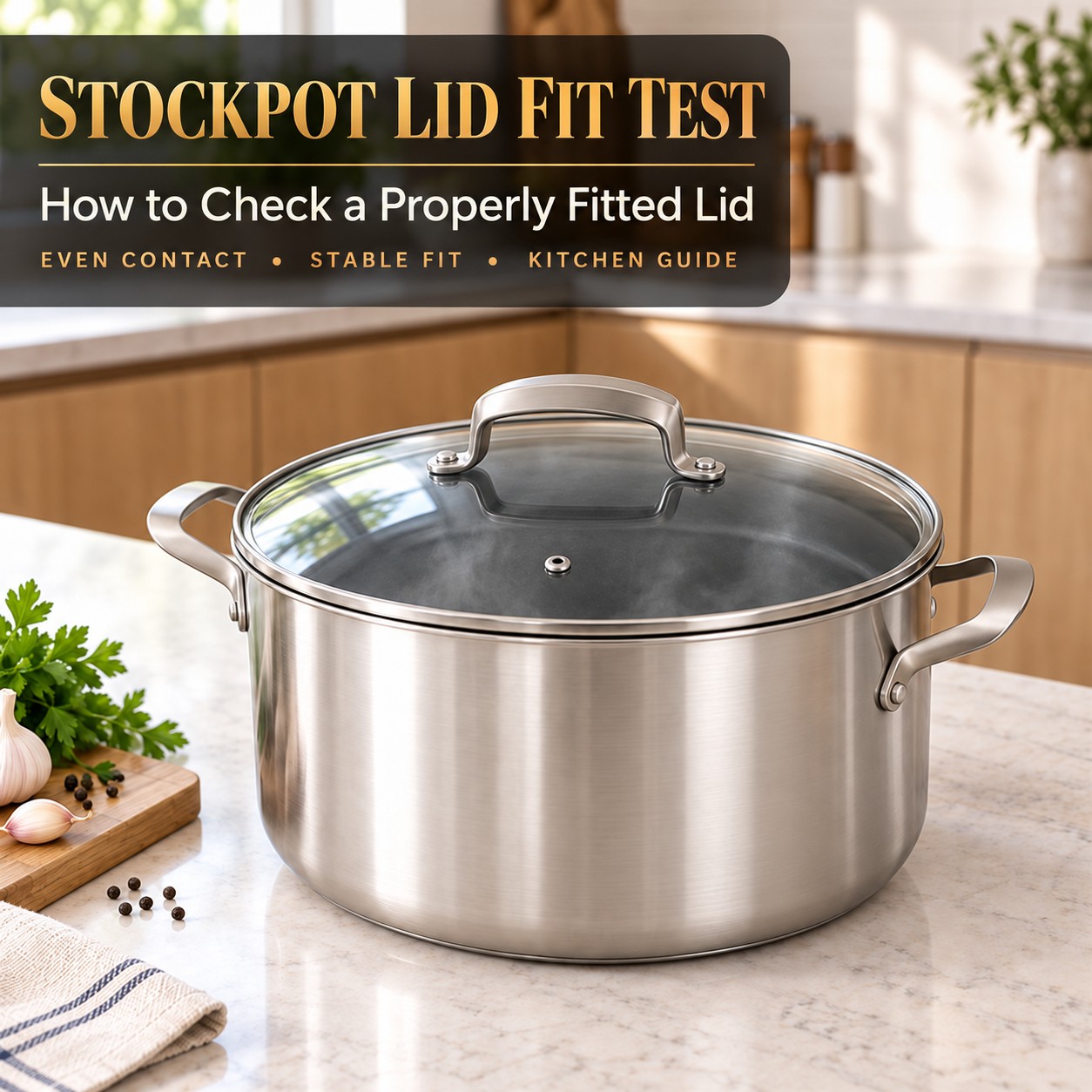
TITAUDOU specifies a GR1 pure titanium food-contact layer, a 1050 aluminum core for heat spreading, and a 430 stainless steel exterior for structure and induction compatibility. Food should contact the GR1 surface, not the hidden aluminum core. Buyers can review the broader difference between real titanium and titanium-coated cookware before applying pure-titanium care or safety claims to another construction.
3. Low Reactivity Is Not an Absolute No-Migration Promise
GR1 titanium naturally develops a thin passive oxide film that supports corrosion resistance in water, salt, and many normal food environments. This material behavior helps explain why pure titanium is used for an uncoated cooking surface. It does not prove that every finished pan, under every temperature, food chemistry, manufacturing condition, and service life, releases literally nothing measurable.
Laboratory language is narrower. A result may be below the method's reporting limit, below an applicable release limit, or not detected for the named analytes under the stated conditions. “Not detected” means the instrument and method did not measure the analyte above a defined threshold. It does not mean mathematical absence. This distinction protects pregnant women and parents from impressive wording that cannot be audited.
The analyte also matters. Titanium migration, lead or cadmium contamination, nickel release, and exposure from a damaged coating are different questions. A report that checks only lead and cadmium cannot establish the measured release of every possible substance. A report on a raw titanium sheet cannot represent joints, rims, polishing residue, packaging contamination, or other features of finished cookware.
For a detailed explanation of acidic food and metal migration, use the dedicated guide on whether titanium cookware leaches metals. This page keeps the narrower family-safety question: what evidence should a cautious household check before using a titanium pan for pregnancy meals, breastfeeding households, or children's food?
4. How to Read a Finished-Cookware Migration Test Report
Begin with sample identity. The report should identify a recognizable product, model, material construction, sample date, and report number. A generic certificate for “titanium material” is weaker than a report tied to the pan being purchased. Photographs, dimensions, client information, and batch or sample references help connect the tested object to the supplied product.
Then read the exposure conditions. A food simulant represents a type of food environment, but the simulant, temperature, contact time, test surface, and repeated-use protocol determine what the result actually covers. Acidic, aqueous, fatty, or other conditions are not interchangeable. The relevant protocol also depends on the destination market and intended use, so a buyer should not treat one test condition as universal proof for every recipe.
| Report field | What a buyer should see | Why it matters | Red flag |
|---|---|---|---|
| Sample and construction | Model, photographs, layer description, food-contact side, and report number | Connects the result to the actual cookware | Report covers only an unidentified metal coupon |
| Exposure conditions | Food simulant, temperature, time, contact area, and repeated cycles where required | Defines the cooking or storage conditions represented | A pass statement with no method or exposure details |
| Analytes and results | Named elements or substances, numerical results or ND, units, and acceptance limits | Shows what was measured and how the conclusion was reached | A logo or “passed” badge without result pages |
| Method sensitivity | Limit of detection, limit of quantification, or clearly defined reporting limit | Explains what ND can and cannot prove | ND reported without a threshold or unit |
| Laboratory competence | Laboratory identity and relevant ISO/IEC 17025 accreditation scope | Supports confidence that the stated method is competently performed | Treating laboratory accreditation as a product certificate |
The limit of detection is the lowest level the method can distinguish from background noise. The limit of quantification is the lowest level that can be measured with stated precision. These values may differ. If a report states ND, read the method sensitivity and units before interpreting it. A careful supplier should provide the complete report rather than a cropped cover page.
ISO/IEC 17025 concerns laboratory competence; it is not a cookware certificate. Confirm that the relevant test method and analytes fall within the laboratory's accredited scope. Families and importers can also compare food-grade titanium cookware standards with the separate process for reviewing lead and cadmium test reports.
5. Material Certificates and Finished-Product Evidence Do Different Jobs
A material test report can confirm the chemical composition of a titanium sheet or coil and help establish whether the metal corresponds to GR1. That is useful, but it does not cover every manufacturing step. Forming, welding, polishing, cleaning, assembly, rim finishing, storage, and packaging occur after the raw material is produced. Finished-product evidence addresses the object that reaches the kitchen.
For tri-ply cookware, the evidence chain should also match the layer drawing. The inner titanium layer, aluminum core, stainless exterior, rim, joints, and attached components should correspond to the tested construction. If the aluminum core is intended to remain enclosed, inspect the edge design and manufacturing specification instead of assuming that all clad rims are identical.
TITAUDOU identifies its food-contact layer as GR1 pure titanium, with a 1050 aluminum core and 430 stainless steel exterior. Its hardened titanium specification is HV600-800. TITAUDOU describes this as hardening the titanium surface without adding a chemical coating or another metal to the food-contact layer. The claim should remain connected to TITAUDOU products and should not be copied to ordinary soft titanium or coated cookware.
Hardness supports resistance to ordinary scratching and stronger cleaning, but it is not proof of chemical migration performance and does not make a pan medically protective. Material identity, hardness data, layer construction, and release testing answer different questions. Keeping those documents separate produces a clearer safety case than combining them into one marketing certificate.
6. Practical Use for Pregnancy Meals, Breastfeeding Households, and Baby Food
Wash new cookware before first use to remove ordinary factory, packaging, and transport residue. Use clean utensils and prepare baby food with equipment that can be washed thoroughly. After cooking porridge, milk, rice starch, egg, meat, or tomato sauce, remove residue instead of allowing repeated burned layers to accumulate. A clean, intact surface is easier to inspect and use consistently.
Control heat according to the food. Titanium's corrosion resistance does not justify burning oil, charring food, or leaving an empty pan unattended. Allow very hot cookware to cool before rinsing so that the complete pan, including any bonded layers, is not subjected to unnecessary thermal shock. Handles, lids, knobs, and decorative parts may have limits different from the metal body.
Do not apply TITAUDOU's hardened-surface cleaning guidance to a coated pan. Steel wool or an aggressive brush can damage many coating systems. If a coated surface is peeling, blistered, deeply scratched, or exposing a different base material, stop using it for pregnancy meals or children's food and follow the manufacturer's replacement guidance. The failure of a coating cannot be diagnosed from the word titanium.
For infant and child meals, food handling remains central: use safe ingredients and water, prevent cross-contact, cook foods appropriately, and refrigerate leftovers promptly. Families choosing cookware specifically for infant meals can use the separate guide to cookware for baby food. The pan supports the process; it does not replace hygiene or pediatric guidance.
7. A Purchase Decision That Sensitive Households Can Audit
A useful buying decision can be documented in a short sequence. First, identify the food-contact material and coating status. Second, match the product model to a layer drawing and material records. Third, read the finished cookware report, including its sample identity, exposure conditions, analytes, reporting limit, numerical results, and acceptance criteria. Fourth, confirm that the laboratory scope covers the method. Finally, inspect and use the cookware according to its actual construction.
Do not rely on a laboratory logo, a marketplace badge, or the phrase food grade by itself. Ask for report pages that show what was tested. Do not treat an ISO/IEC 17025 accreditation logo as proof that a specific pan passed. Do not treat a raw-metal certificate as evidence for the assembled product. When a supplier cannot connect the product, sample, method, and result, the evidence chain is incomplete.
For TITAUDOU, the product-selection sequence begins with its GR1 titanium food-contact surface and tri-ply construction, then moves to model-specific documentation, size, stove compatibility, handle design, and care. Families can review current titanium pots and pans after establishing the material requirements. Importers should request documents for the actual model and destination market before making claims on packaging or sales pages.
This approach does not promise a risk-free kitchen. It replaces vague reassurance with questions that can be answered. For pregnant women, nursing mothers, and children, that is a stronger standard: choose a stable food-contact surface, verify the finished product, use it correctly, and keep the conclusion within the limits of the available evidence.
Conclusion
Genuine GR1 titanium cookware can be a reasonable option for pregnancy, breastfeeding, children's meals, and baby-food preparation because it offers an uncoated, corrosion-resistant food-contact surface. The conclusion remains conditional: buyers must identify the surface, distinguish pure titanium from reinforced coatings, review finished-product evidence, and use the cookware within its design limits.
The most defensible claim is not that nothing can ever migrate. It is that the named finished product was tested for specified analytes under stated conditions, with results interpreted against defined reporting and acceptance limits. That wording respects both titanium's useful material properties and the higher level of care expected by families making decisions for pregnant women, nursing mothers, and children.
Frequently Asked Questions
Q1: Is pure titanium cookware safe for pregnant women and nursing mothers?
A genuine, uncoated, commercially pure titanium food-contact surface is generally a reasonable choice under normal cooking conditions. Confirm the actual construction and finished-product documentation, and follow individual medical advice when a diagnosed condition or exposure concern applies.
Q2: Does ND on a cookware test report prove that no substance can migrate?
No. ND means the named analyte was not detected above the method's stated threshold under the reported test conditions. Read the units, exposure protocol, limit of detection, limit of quantification, and reporting limit before interpreting the result.
Q3: Does the 1050 aluminum core in TITAUDOU cookware contact children's food?
In the specified TITAUDOU tri-ply construction, food contacts the GR1 pure titanium inner layer. The 1050 aluminum core is enclosed for heat spreading, and the 430 stainless steel exterior supplies structure and induction compatibility. Buyers should still match this construction statement to the exact product model.