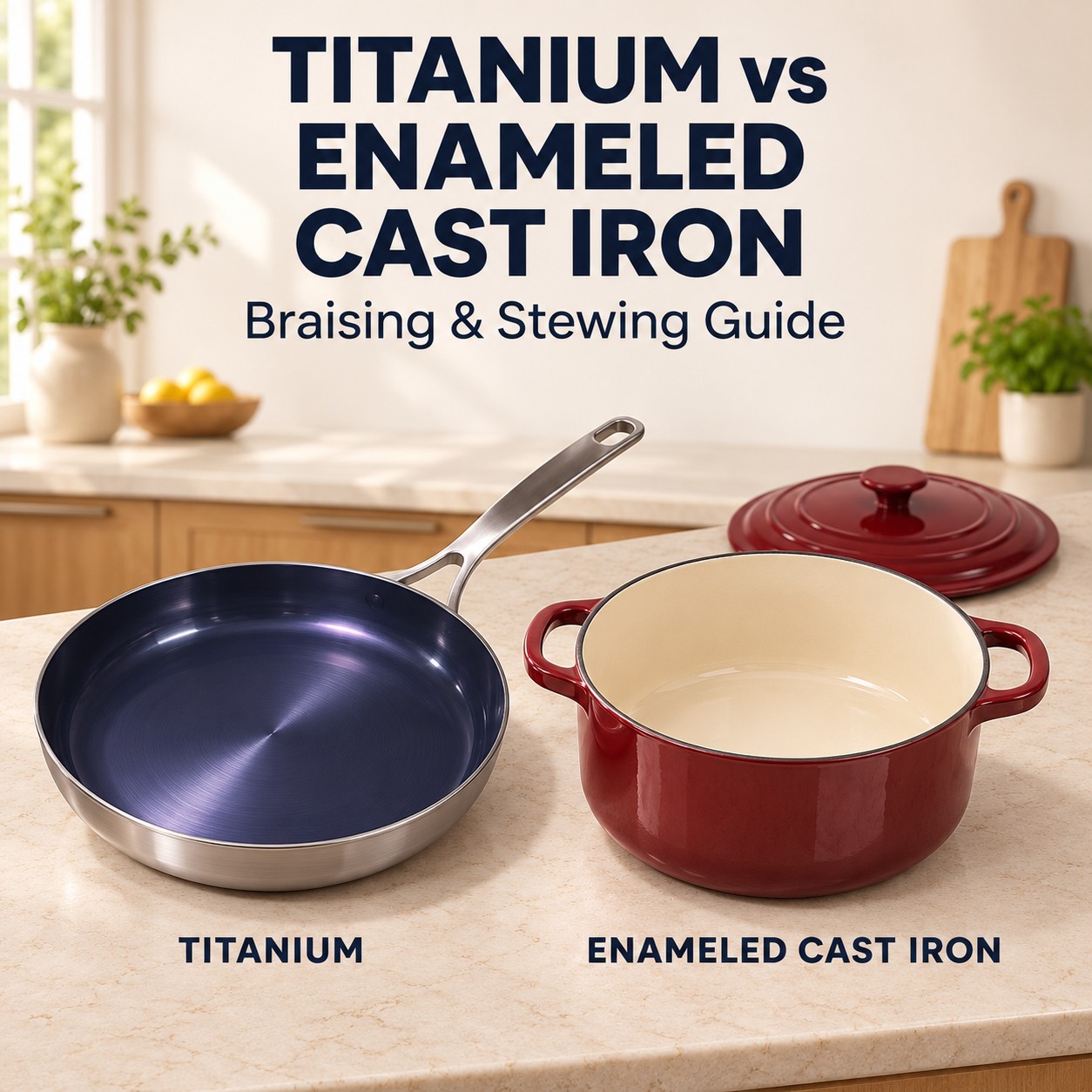
Direct Engineering Answer: For braising, slow-simmering stews, and oven-roasting, multi-clad pure titanium cookware outperforms traditional enameled cast iron by eliminating the catastrophic risk of glass enamel chipping, cutting loaded pot weight by over 50%, providing superior thermal diffusion that prevents bottom scorching, and permitting heavy-duty cleaning with stainless steel wire brushes. While enameled cast iron Dutch ovens offer massive thermal retention for low-and-slow simmering, their extreme loaded weight (exceeding 22 pounds with liquid) poses serious burn and joint-strain hazards, while their fragile porcelain glaze easily crazes, stains, and flakes into food. By applying an optional high-gloss exterior vitreous enamel over an engineered multi-clad architecture while keeping the food-contact interior 100% uncoated Grade 1 titanium, TITAUDOU delivers the rich aesthetic color of French cocottes with permanent metallurgical indestructibility.
Culinary enthusiasts and home chefs preparing slow-cooked stews, coq au vin, and braised beef short ribs have historically regarded enameled cast iron Dutch ovens as the quintessential kitchen showpiece. However, as domestic cooks manage heavier culinary workloads and demand non-toxic surfaces, many are evaluating whether upgrading to a multi-clad pure titanium braiser and stockpot collection offers a safer, more ergonomic alternative. Deciding between these two premium vessels requires analyzing how thermal conduction, structural weight, glass-ceramic coatings, and surface metallurgy interact during multi-hour cooking cycles.
1. Aesthetic Versatility: Vibrant Exterior Enamel vs. Traditional Enameled Cast Iron Colors
A primary attraction of enameled cast iron cookware has long been visual appeal. Heritage brands built global reputations by coating heavy sand castings in rich, colorful vitreous enamel glazes—ranging from cherry reds to deep marine blues and creams. In contrast, standard unclad titanium presents a utilitarian matte gray finish that lacks the vibrant elegance desired for oven-to-table dining presentation.
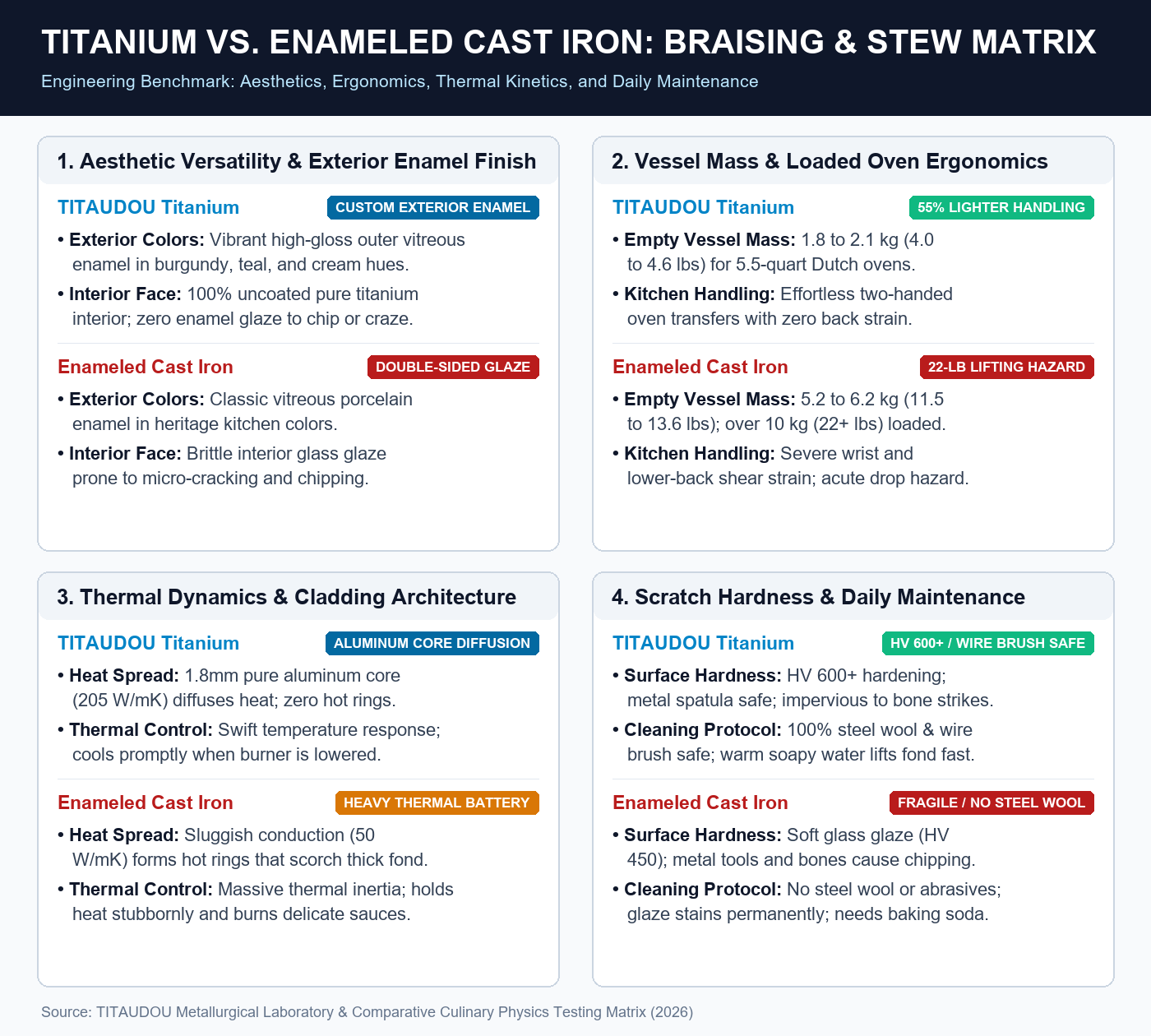
To bridge this aesthetic divide, TITAUDOU applies advanced thermal vitreous coating technology to the exterior stainless steel layer of its multi-clad vessels. This technique allows cooks to select high-gloss exterior enamel colors—including classic Burgundy reds, Mediterranean teals, and matte charcoal—without altering the food-contact interior. The exterior enamel provides vibrant presentation that transitions seamlessly from stovetop simmering to dining tables.
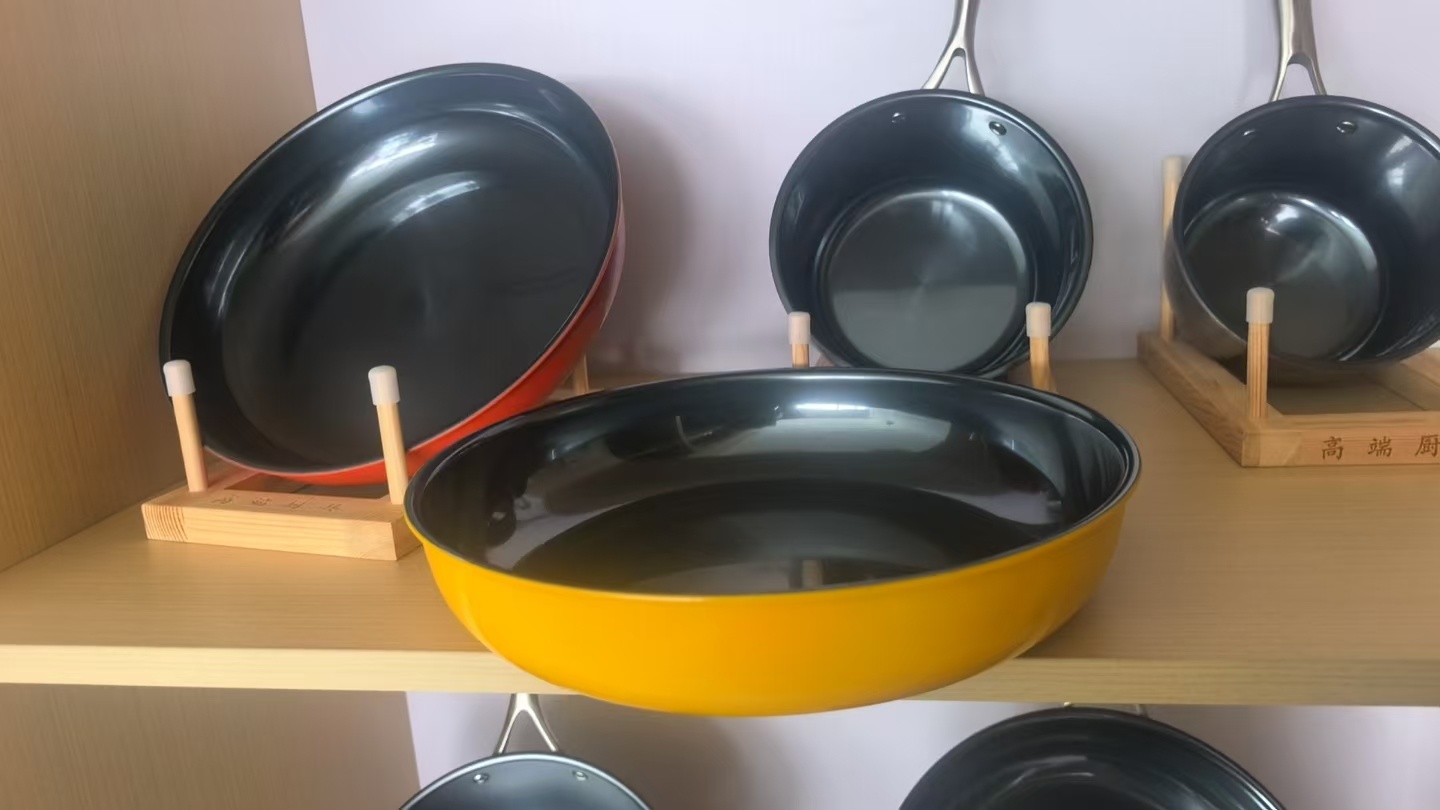
The crucial engineering distinction lies in the interior cooking surface. Traditional enameled cast iron applies the same fragile glass glaze to the interior food-contact floor, creating a vulnerable interface prone to scratching and staining. In TITAUDOU cookware, the interior remains 100% uncoated ASTM B265 Grade 1 commercially pure titanium. Cooks receive all the exterior beauty and colorful sophistication of French heritage cookware, paired with the uncompromising food safety, scratch-proof resilience, and chemical purity of bare titanium inside the pot.
2. Vessel Mass and Kitchen Ergonomics: The 22-Pound Loaded Dutch Oven Hazard
The primary physical drawback of enameled cast iron cookware is its heavy mass. With a high density of 7.10 to 7.30 g/cm³ and thick 4.5 mm to 6.0 mm mold walls required during sand-casting, an empty 5.5-quart enameled Dutch oven weighs 5.2 to 6.2 kg (11.5 to 13.6 lbs), with the heavy lid alone accounting for over 1.5 kg.
When filled with braising broth, root vegetables, and meat, a loaded 5.5-quart enameled pot reaches 9.5 to 10.8 kg (21 to 24 lbs). Transferring this scalding weight in and out of hot ovens with oven mitts places severe shear strain on lumbar discs, wrists, and elbows. For senior cooks or anyone managing arthritis or wrist strain, handling loaded cast iron presents an acute risk of hot liquid spills and fractured glass stovetops.
Featherweight Metal Density: Pure titanium possesses a natural density of 4.51 g/cm³—roughly 40% lighter than iron—allowing multi-clad braisers to provide rugged structural strength at a fraction of cast iron's bulk.
Dramatic Loaded Weight Reduction: An empty 5.5-quart multi-clad titanium Dutch oven weighs only 1.8 to 2.1 kilograms (4.0 to 4.6 pounds). Fully loaded with savory braising broth and meat, the entire assembly weighs approximately 5.8 kilograms (12.8 pounds)—less than an enameled Dutch oven weighs completely empty.
Safe Stovetop-to-Oven Transfer: Ergonomic solid cast titanium handles remain comfortable to grip, permitting confident, balanced two-handed transfers across the kitchen without fear of dropping or joint strain.
3. Cooking Performance and Heat Dynamics: Agile Multi-Clad Conduction vs. Thermal Mass
Braising requires two distinct thermodynamic stages: an initial high-temperature Maillard sear to establish rich aromatic browning, followed by hours of gentle simmering in flavorful liquids. Traditional enameled cast iron functions as a sluggish thermal battery due to its high volumetric heat capacity of 3.6 MJ/(m³·K). Once thoroughly preheated, dropping chilled meat cuts into the pot produces almost zero surface temperature drop, yielding deep searing crusts. Furthermore, inside a warm oven, its thick walls radiate steady, ambient heat that keeps stews gently bubbling.
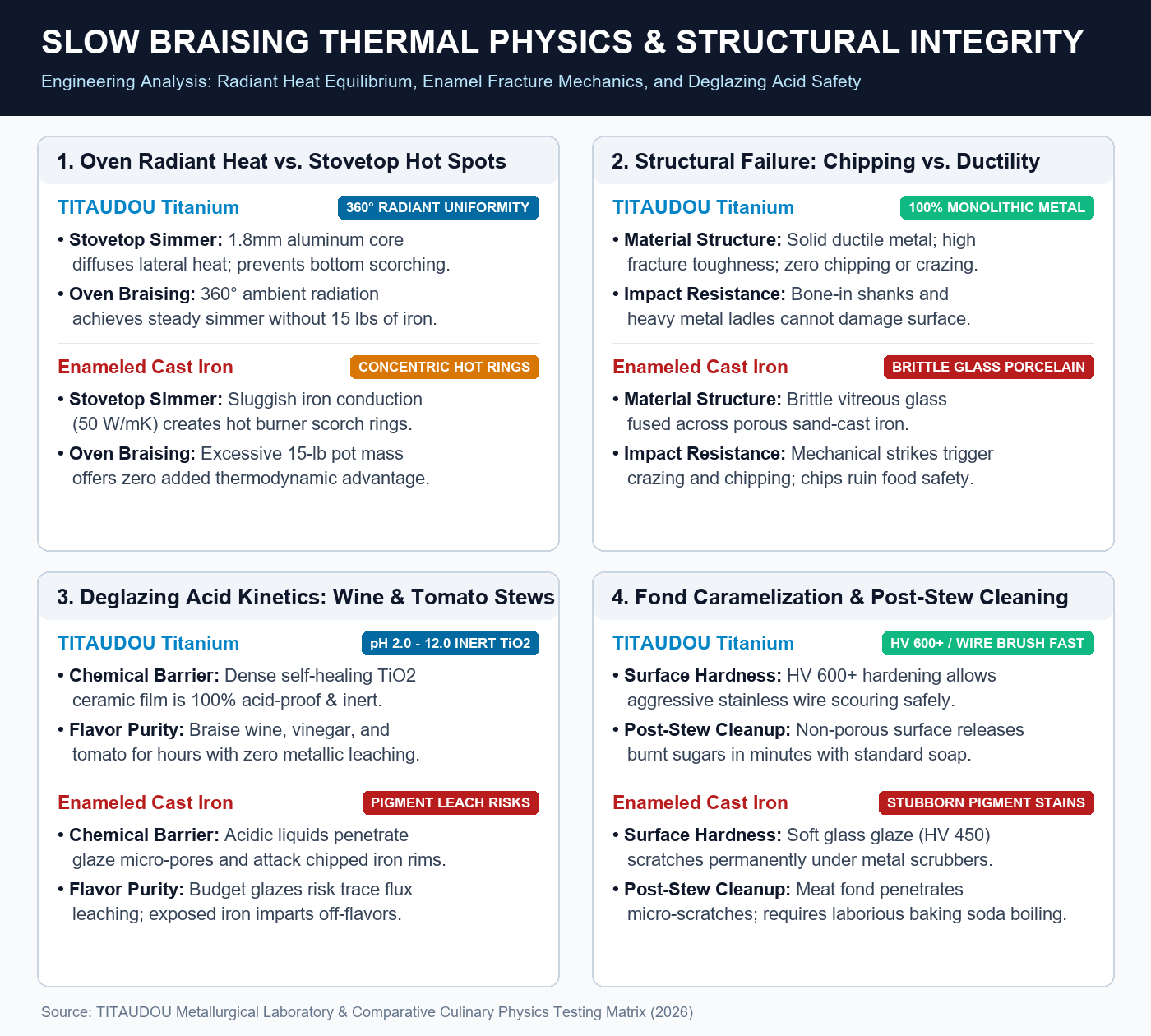
However, on a standard residential stovetop, cast iron's relatively poor thermal conductivity (50 W/(m·K)) creates a notorious cooking defect: the concentric "hot ring." Heat does not disperse rapidly outward from gas burners or induction coils, forming intense localized heat zones directly above the heat source. During slow stews containing starches, gelatin, and sugars, these heavy liquids sink and scorch in this hot ring, requiring cooks to vigilantly scrape and stir the pot floor every twenty minutes to prevent burnt off-flavors.
To resolve this issue while eliminating single-layer hot spots, TITAUDOU bonds pure Grade 1 titanium to a 1.8 mm core of high-purity 1050 aluminum delivering lateral heat transfer at 205 W/(m·K) sandwiched against a magnetic induction stainless base in an engineered 2.8 mm composite. This thick aluminum engine diffuses thermal energy horizontally across the entire pot floor within seconds, creating isothermal temperature uniformity. When simmering thick tomato ragù or beef stew on low heat, the multi-clad base prevents hot-ring scorching entirely, while the outer steel layer ensures high induction heat transfer speed on titanium pans.
| Culinary Metric | TITAUDOU Multi-Clad Pure Titanium | Traditional Enameled Cast Iron |
|---|---|---|
| Interior Cooking Face | 100% Uncoated ASTM B265 Grade 1 Pure Titanium | Vitreous porcelain glass enamel over sand-cast iron |
| Empty 5.5-Qt Pot Weight | 1.8 kg - 2.1 kg (4.0 - 4.6 lbs) — 65% lighter | 5.2 kg - 6.2 kg (11.5 - 13.6 lbs) — heavy casting |
| Loaded Stew Mass (5.5-Qt) | 5.5 kg - 6.2 kg (12.1 - 13.6 lbs) — agile transfer | 9.5 kg - 10.8 kg (21.0 - 23.8 lbs) — severe strain |
| Surface Hardness & Utensils | HV 600+ (Hardened); steel spatulas & wire wool safe | HV 450 (Glass); wooden or silicone utensils only |
| Thermal Conductivity Engine | 1050 Aluminum core (205 W/m·K); zero hot spots | Base iron (50 W/m·K); concentric burner hot rings |
| Catastrophic Failure Risk | Zero chipping; ductile solid metal; immune to drops | Enamel chipping, micro-crazing, and glass flaking |
| Post-Braise Cleanup Care | Dish soap & steel wool safe; zero permanent staining | Enamel stains easily; requires baking soda simmering |
4. Chemical Inertness and Deglazing Safety: Biocompatible Pure Titanium vs. Enamel Glaze Leaching Risks
Braising relies extensively on high-acid cooking liquids. Classic European braises call for full bottles of dry red wine (pH 3.2 to 3.6), concentrated tomato paste (pH 4.0 to 4.3), cider vinegar, or citrus reductions. Simmering acidic ingredients under a tight lid for four to six hours creates an aggressive chemical environment that ruthlessly tests cookware coatings and exposed metals.
Vitreous enamel is essentially a glass coating formulated from silica, feldspar, and metallic flux oxides. While high-grade European enamel glazes resist acids reasonably well, budget and mass-market enameled cookware frequently utilizes fluxes containing lead, cadmium, or cobalt to lower firing temperatures and impart vivid coloring. Over years of simmering acidic tomato sauces, micro-cracks allow acid to leach trace flux chemicals into food. More dangerously, if acidic liquids contact bare cast iron exposed along the raw rim or at micro-chip sites, the underlying iron oxidizes, imparting an acrid metallic tang that ruins delicate braising reductions.
Pure titanium represents the pinnacle of chemical inertness in food preparation. When exposed to ambient oxygen, Grade 1 titanium spontaneously forms an imperceptible, self-healing titanium dioxide (TiO2) ceramic passivation film that is exceptionally inert and non-reactive across acidic kitchen liquids ranging from pH 2.0 to 12.0. Whether reducing red wine vinegar or slow-cooking acidic stews overnight, titanium guarantees zero nickel, chromium, lead, or iron migration. Food flavors remain vibrant, pristine, and unadulterated, making it the premier choice for health-conscious families and individuals seeking nickel-free cookware for sensitive users.
5. Cleaning Resilience and Hardness: HV 600+ Wire-Brush Scrubbing vs. Fragile Glass Glazes
After hours of simmering, braising liquids inevitably evaporate along the perimeter of the pot, creating dark rings of caramelized sugars, rendered gelatin, and burnt meat fond. The ease with which a cook can restore the vessel to pristine condition dictates its long-term culinary satisfaction.
Cleaning enameled cast iron requires delicate care. Because vitreous enamel is brittle glass with a modest hardness of HV 400 to 450, cookware manufacturers strictly forbid stainless steel scouring pads, copper scrubbers, and wire brushes. Using metal scrubbers creates millions of microscopic scratches that dull the gloss. Once micro-scratched, braising sugars adhere aggressively and dark pigments penetrate the glaze, creating stubborn brown stains that require baking soda pastes or simmering peroxide to remove.
Proprietary Surface Hardening: TITAUDOU utilizes a specialized high-temperature metallurgical hardening process that elevates pure titanium's natural surface hardness from HV 150 to over HV 600+, far exceeding stainless steel and hardened glass.
Impervious to Stainless Steel Wool: Home cooks can aggressively scrub caramelized stews using heavy-duty steel wire balls, stainless scourers, or stiff metal brushes with zero fear of scratching or gouging the metal.
Rapid Warm-Water Fond Release: Because titanium's non-porous TiO2 barrier does not cross-link with burnt carbon molecules, soaking the warm pot in water with standard dish soap releases stubborn residue in under three minutes without specialized chemicals.
6. Daily Maintenance and Structural Integrity: Zero-Care Durability vs. Enameled Chipping and Rusting
Cookware longevity depends on resilience against everyday kitchen mishaps. While marketed as heirloom cookware, an enameled Dutch oven's lifespan is often ended by a single impact. Because vitreous enamel and cast iron expand at different rates under thermal flux, mechanical strikes cause high interfacial shear stresses that crack the brittle glass.
Braising whole bone-in shanks, oxtails, or beef ribs frequently causes dense bones to strike the pot floor during vigorous stirring. With enameled cast iron, tapping a heavy stainless steel spoon or the strike of a hard bone can create micro-fractures known as crazing, which inevitably progress into full enamel chipping. Furthermore, enameled pots feature an exposed, raw cast iron rim where the enamel is ground off during manufacturing; if left damp on a drying rack, this rim rusts aggressively, transferring orange iron oxides onto the lid and counters. Once an enameled Dutch oven chips on its interior cooking floor, it becomes permanently unusable: dangerous microscopic glass shards can dislodge into food, and exposed iron corrodes, forcing the owner to discard an expensive vessel.
Multi-clad pure titanium cookware eliminates every one of these vulnerabilities. Titanium is a high-toughness ductile transition metal with zero brittle coatings. It cannot chip, craze, crack, or flake, regardless of how aggressively you scrape it with stainless steel spatulas, bone-in roasts, or heavy ladles. Dropping the pot onto a tile floor might create a minor cosmetic dent, but the cooking surface remains 100% functionally sound and food-safe. Titanium is completely immune to moisture-induced rusting, meaning you can leave the pot soaking in soapy water overnight, rinse it, and let it air-dry on a rack without wiping—offering truly maintenance-free reliability for demanding domestic kitchens, just as observed when comparing bare cast iron vs pure titanium cookware.
Conclusion: Modernizing the Traditional Dutch Oven for Contemporary Kitchens
Enameled cast iron earned its storied culinary reputation in nineteenth-century kitchens where heavy, low-efficiency wood stoves required immense thermal mass to maintain steady temperatures. In modern domestic kitchens equipped with precision induction cooktops, responsive gas burners, and calibrated convection ovens, hauling a 22-pound scalding vessel with a fragile glass lining is an unnecessary ergonomic and safety burden.
Multi-clad pure titanium cookware modernizes the slow-cooking experience across every critical axis. By pairing vibrant exterior vitreous enamel aesthetics with an indestructible, biocompatible Grade 1 pure titanium interior, an agile 1050 aluminum conductive core, and HV 600+ surface hardening, TITAUDOU provides home chefs with the ultimate braising vessel. You achieve uniform, scorch-free heat dispersion, total freedom from enamel chipping and toxic leaching, effortless wire-brush cleanup, and an over 50% reduction in physical lifting weight. For passionate cooks seeking generational durability without back strain, pure titanium represents the definitive evolution of the Dutch oven.
Frequently Asked Questions (FAQ)
Q1: Can multi-clad titanium cookware match the oven heat retention of enameled cast iron for slow braises?
Yes. While cast iron has higher volumetric thermal mass on an open stovetop, inside a modern 300°F to 325°F (150°C to 165°C) oven, the vessel is surrounded by 360-degree radiant heat and circulating air. Once thermal equilibrium is reached, a multi-clad titanium pot maintains an identical, gentle simmer. What truly governs tender braising is moisture seal and uniform floor temperature, where titanium's aluminum core prevents bottom scorching without hauling 22 pounds of iron.
Q2: What happens if I accidentally drop or bump an enameled Dutch oven versus a titanium braiser?
Dropping or severely bumping an enameled cast iron pot will shatter or chip the brittle glass porcelain glaze, permanently exposing bare iron underneath and rendering the vessel unsafe for food due to glass shard hazards. In contrast, pure titanium is a ductile, high-strength structural metal with zero glass glazes. A severe drop might produce a minor cosmetic dent, but the pot will never shatter, chip, or compromise its biocompatible cooking surface.
Q3: Can I clean stubborn braising residue in a titanium Dutch oven with steel wool or wire brushes?
Absolutely. Unlike enameled cast iron—which is permanently scratched and dulled by abrasive scourers—TITAUDOU multi-clad titanium undergoes a proprietary surface hardening treatment that achieves a hardness exceeding HV 600+. You can vigorously scrub stubborn caramelized fond with stainless steel wool, wire brushes, or heavy scouring pads without creating scratches or damaging the pan.