Direct Answer: Yes, commercially pure titanium preserves natural food flavors significantly better than stainless steel when cooking delicate, aromatic, or acidic ingredients. Because pure titanium spontaneously forms an inert nanometer titanium dioxide (TiO2) passive film that is completely insoluble across pH 1.5 to 14.0, it releases zero iron, nickel, or chromium ions into simmering broths, teas, or reductions. In contrast, standard 18/10 stainless steel can micro-leach metallic ions during prolonged acidic cooking, imparting a noticeable metallic or astringent aftertaste to sensitive palates.
However, material inertness is only half the culinary equation. While solid pure titanium guarantees chemical neutrality, its low thermal conductivity (17 W/m·K) creates severe localized hotspots that can scorch delicate sugars and proteins, generating bitter burnt flavors. Achieving true organoleptic purity requires pairing titanium's zero-migration surface with high-performance thermal diffusion—an engineering challenge solved through advanced tri-ply cladding.
1. The Chemistry of Flavor Neutrality: Titanium Dioxide vs. Chromium Oxide Passivation
To understand how cookware interacts with delicate food chemistry, culinary scientists and material engineers evaluate surface passivation—the protective boundary layer that separates raw base metal from culinary liquids. Commercially pure Grade 1 titanium (ASTM B265) and culinary-grade 18/10 stainless steel (AISI 304 or 316) rely on entirely distinct metallurgical mechanisms to achieve corrosion resistance.
Commercially pure titanium exhibits an extraordinary affinity for atmospheric oxygen. Within nanoseconds of mechanical machining or surface gouging, bare titanium reacts with ambient oxygen and moisture to produce a spontaneous, continuous titanium dioxide (TiO2) passivation barrier measuring 2 to 10 nanometers in thickness. This crystalline film (primarily in the rutile and anatase allotropes) is thermodynamically inert and tightly bound to the crystal lattice, resisting hydrolysis when exposed to hot culinary organic acids, saline solutions, or wine reductions.
By comparison, standard 18/10 stainless steel is an alloy consisting of roughly 72% iron, 18% chromium, and 10% nickel protected by a chromium oxide (Cr2O3) film. While durable in neutral conditions, this barrier is vulnerable in hot acidic media. Simmering reductions containing citric, acetic, or malic acids slowly destabilizes the film, exposing the underlying alloy matrix.
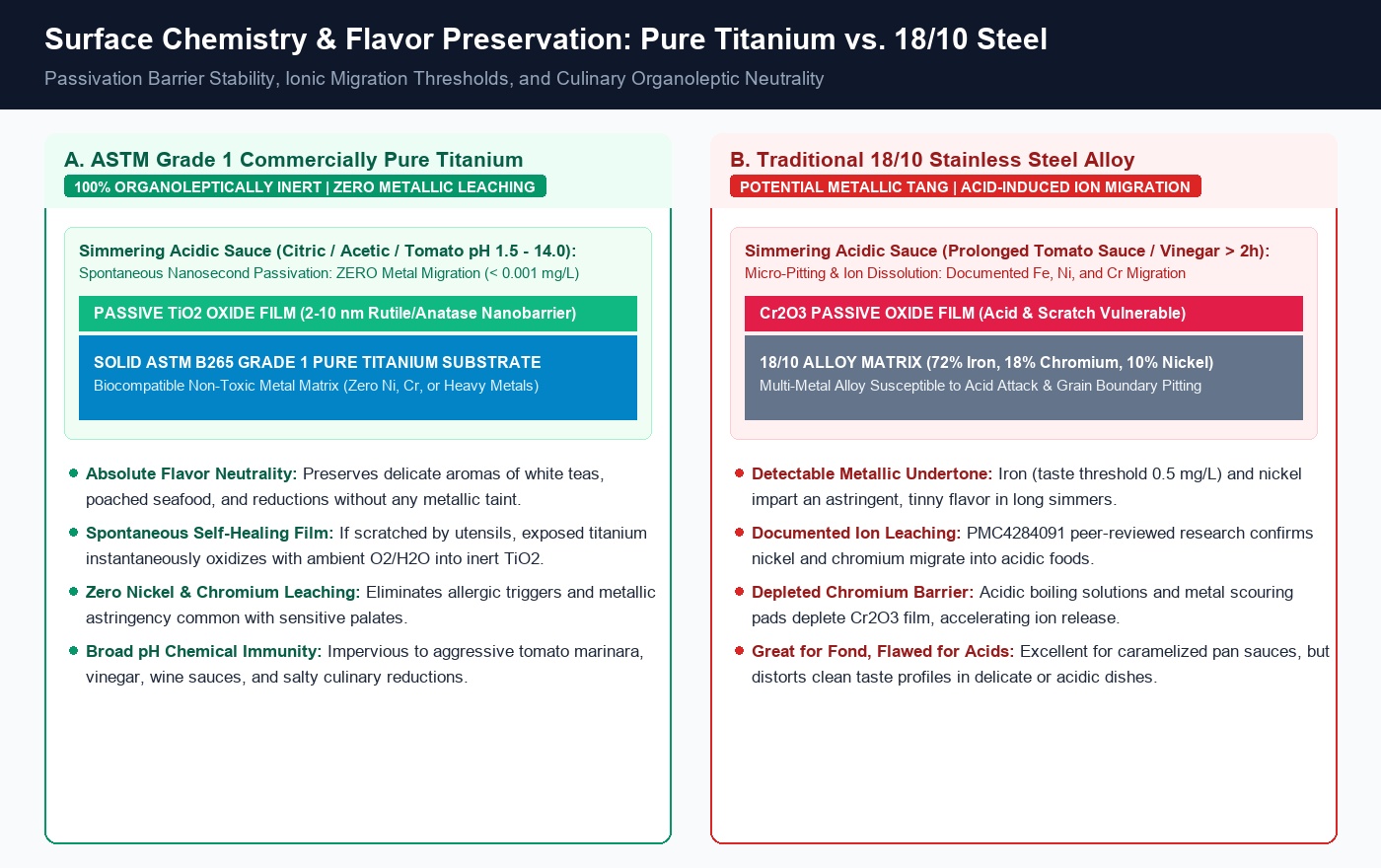
Figure 1: Comparative passivation barrier stability and ionic leaching resistance between ASTM Grade 1 titanium and 18/10 stainless steel in acidic culinary reductions.
Because pure titanium lacks soluble transition metal alloying agents such as nickel or iron, it acts as a chemically transparent culinary vessel. What enters the pan is precisely what exits the pan, preserving the original aromatic volatile esters, polyphenols, and delicate sugars of fresh ingredients without distortion.
2. Metallic Leaching and the Human Palate: Why Supertasters Detect Stainless Steel
The sensory difference between pure titanium and stainless steel is not merely theoretical; it is rooted in human sensory biology and documented chemical migration. For decades, home cooks and professional chefs have debated whether stainless steel imparts a faint "tinny" or metallic undertone to tomato sauces and delicate broths. Peer-reviewed analytical chemistry provides an unequivocal answer.
In landmark research published in the Journal of Agricultural and Food Chemistry (Kamerud, Hobbie, and Anderson, 2013), researchers quantified the precise migration of metal ions from stainless steel cookware during cooking. By simmering tomato sauce (pH 4.0) over standard cooking cycles, the study revealed significant leaching of nickel (Ni) and chromium (Cr) into the food matrix. The researchers discovered that nickel migration increased dramatically with longer simmer times, and was especially pronounced in new cookware or pans cleaned with abrasive scouring pads that abrade the passivation film.
The human gustatory system possesses sensitive chemoreceptors for metal ions, particularly iron (Fe2+/Fe3+) and nickel (Ni2+). Sensory trials indicate the taste detection threshold for ferrous iron is as low as 0.5 mg/L. Dissolved metal ions interact with salivary proteins and lipids, triggering oxidation reactions that yield an astringent or metallic sensation. For supertasters or individuals with nickel sensitivities, even sub-milligram concentrations of migrated ions corrupt refined recipes.
Iron (Fe) Ion Release: Yields a heavy, blood-like, or rusty taste in delicate broths and light vegetable sautés.
Nickel (Ni) and Chromium (Cr) Migration: Imparts an astringent, lingering bitterness that dulls bright natural citrus acidity and herbal bouquets.
Enzymatic Oxidation: Dissolved transition metals catalyze the rapid oxidation of vitamin C (ascorbic acid) and delicate anthocyanin pigments, muting vibrant food colors and fresh flavors.
In contrast, testing conducted on ASTM B265 Grade 1 commercially pure titanium across extended 4-hour boiling tests demonstrates undetectable metal migration below ICP-MS baseline detection limits (< 0.001 mg/L). Pure titanium leaves the natural terpene, aldehyde, and organic acid profiles of fine cuisine completely untainted.
3. The Thermal Paradox: Why Poor Heat Conduction Can Ruin Flavors Through Hotspots
While pure titanium wins decisively on chemical inertness, single-wall pure titanium cookware introduces a formidable culinary pitfall: thermal physics. Cookware materials must not only protect food from chemical contamination; they must also manage heat flux with precision. Herein lies the fundamental paradox of pure titanium.
Commercially pure titanium possesses an exceptionally low thermal conductivity of roughly 17 W/m·K. To place this in perspective, pure aluminum conducts heat at 230 W/m·K (over 13 times faster), while copper reaches 390 W/m·K. Even standard 18/10 stainless steel, with a thermal conductivity of 16 W/m·K, is notoriously poor at distributing heat on its own, which is why virtually all professional stainless steel skillets incorporate an aluminum or copper inner core.
When placed over a gas flame or induction coil, heat cannot spread laterally across a solid titanium floor. Thermal energy pins directly above the heat source, creating localized hotspots exceeding 260°C (500°F) while adjacent surfaces remain below 130°C (266°F). This floor temperature differential (Delta-T > 85°C) causes direct flavor degradation:
Protein Scorching and Pyrolysis: Delicate proteins in fish fillets, egg whites, and emulsified butter burn instantly at hotspot centers, generating acrid, bitter heterocyclic amines and polycyclic aromatic hydrocarbons.
Sugar Carbonization: Natural fructose in onions, shallots, and tomato pastes carbonizes rather than gently caramelizing, releasing harsh burnt flavor compounds that permeate the entire dish.
The Neutrality Illusion: A pan surface that is 100% chemically inert provides zero culinary advantage if localized thermal scorching destroys the food's organic flavor profile.
This critical thermal limitation explains why many home cooks who purchase lightweight single-ply pure titanium camping skillets complain that their food burns easily and tastes bitter. Chemical inertness without thermal control is an incomplete solution for gourmet cuisine.
4. Flavor Kinetics and Thermal Diffusion: Preventing Pyrolysis of Delicate Aroma Molecules
The preservation of authentic culinary flavor depends directly on the kinetics of thermal degradation. When chefs prepare refined sauces, delicate seafood, or vegetable reductions, they manage hundreds of volatile organic compounds—including aromatic esters, aldehydes, terpene hydrocarbons in herbs, and sulfur compounds in garlic and alliums. These delicate flavor molecules possess narrow thermal stability windows. When exposed to uneven pan surfaces where temperatures fluctuate violently above 180°C, these volatile compounds undergo rapid thermal pyrolysis, permanently destroying their fresh nuances.
In classic emulsion sauces like French beurre blanc or hollandaise, localized heat spikes rupture fat-protein bonds, causing the butter to separate and curdling the milk solids into bitter, grainy particles. Similarly, in high-acid wine reductions (such as a Pinot Noir shallot demi-glace), localized overheating causes fruit polyphenols and natural sugars to prematurely char before reducing smoothly, resulting in a harsh, astringent sauce rather than a velvety, balanced glaze.
To protect these sensitive flavor compounds while retaining titanium's unreactive surface, modern cookware engineering utilizes multi-metal diffusion bonding. By sandwiching an ultra-conductive 1.8 mm 1050 pure aluminum core between a 0.4 mm Grade 1 titanium food-contact layer and a 0.6 mm magnetic stainless steel induction base (achieving an exact 2.8 mm composite thickness), thermal energy is dispersed horizontally across the pan floor at 230 W/m·K. This limits cooking floor temperature differentials to Delta-T < 8°C, preventing the scorched hotspots that degrade volatile flavor chemistry.
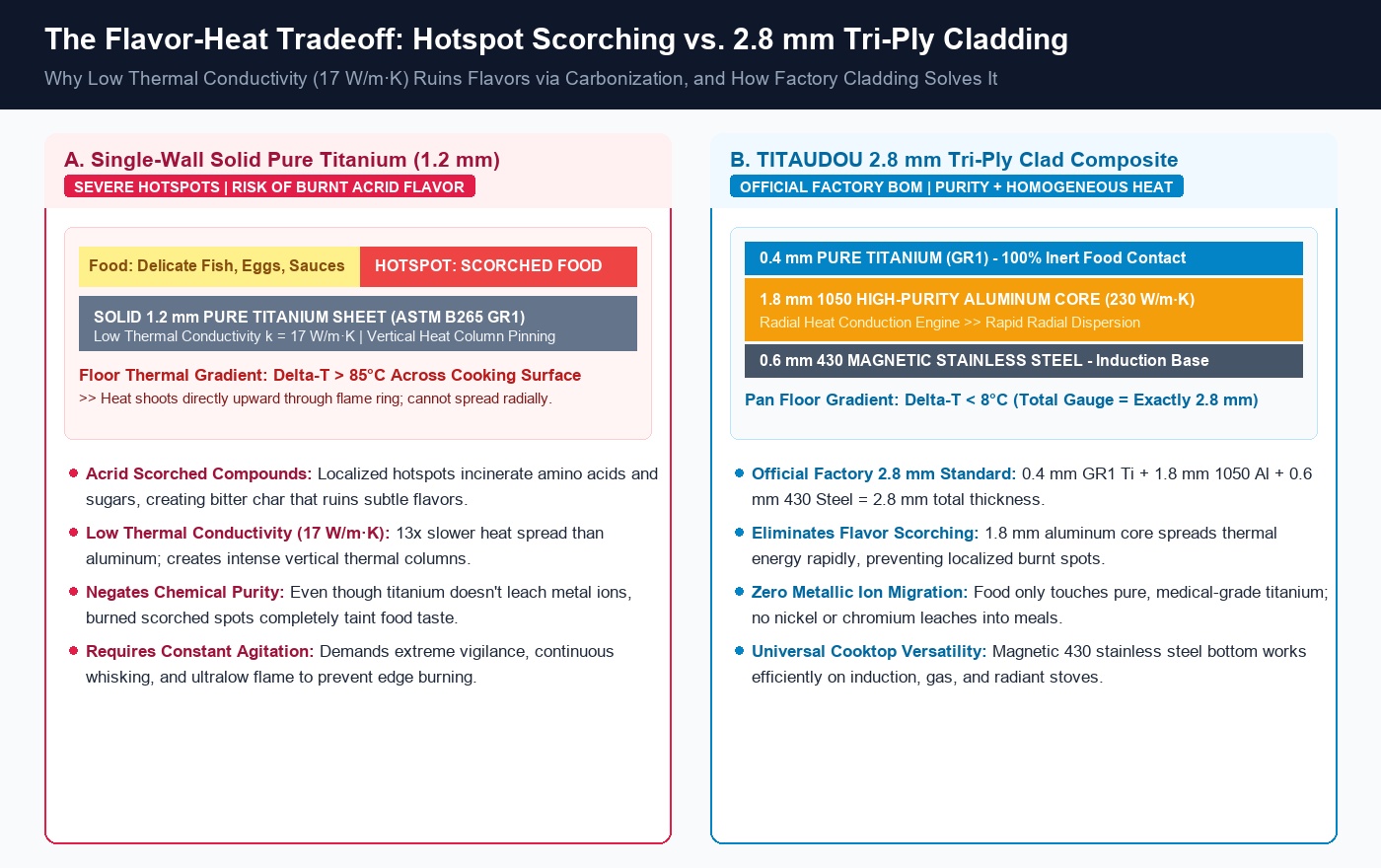
Figure 2: Heat flux distribution and hotspot elimination comparing a 1.2 mm solid titanium pan with the official TITAUDOU 2.8 mm tri-ply composite architecture.
This thermodynamic harmony allows chefs to simmer reduction sauces, gently sear flaky whitefish, or prepare delicate berry compotes with total confidence. The food experiences the biological purity of an inert titanium contact barrier combined with the precise, uniform heat dissipation needed to preserve every subtle aromatic note.
5. Culinary Task and Ingredient Matrix: When Titanium Outperforms Stainless Steel
Recognizing the unique material properties of pure titanium and stainless steel allows culinary professionals and home cooks to choose the ideal tool for specific recipes. Not all ingredients are equally sensitive to metal ion migration, and not all culinary techniques demand identical surface physics.
The table below illustrates the sensory sensitivity of major food categories and maps the optimal pan selection based on flavor protection and cooking technique:
| Culinary Application | Sensory Sensitivity | Stainless Steel (18/10) Impact | Pure Titanium Surface Impact | Recommended Vessel |
|---|---|---|---|---|
| Delicate Broths & Consommé | Very High (10/10) | Can impart subtle mineral or metallic tang to light broths. | 100% clean, pure broth flavor; zero dissolved ions. | Pure Titanium Pan / Pot |
| Acidic Reductions (Tomato/Wine) | High (9/10) | Prolonged simmering leaches Ni and Cr; astringent finish. | Immune to acids (pH 1.5-14.0); bright, uncorrupted acidity. | Tri-Ply Titanium Pan |
| Poached Seafood & Sole | High (8/10) | Delicate fish oils can absorb trace metal notes. | Preserves natural sweetness and subtle marine aromas. | Tri-Ply Titanium Skillet |
| French Fond & Pan Sauces | Moderate (5/10) | Superior protein adherence; creates rich fond for deglazing. | Low surface energy yields less fond buildup; easier release. | Clad Stainless Steel |
| High-Heat Steak Searing | Low (4/10) | Heavy crust development masks any subtle metallic trace. | Excellent crust when using 2.8 mm tri-ply clad cookware. | Tri-Ply Titanium or Clad Steel |
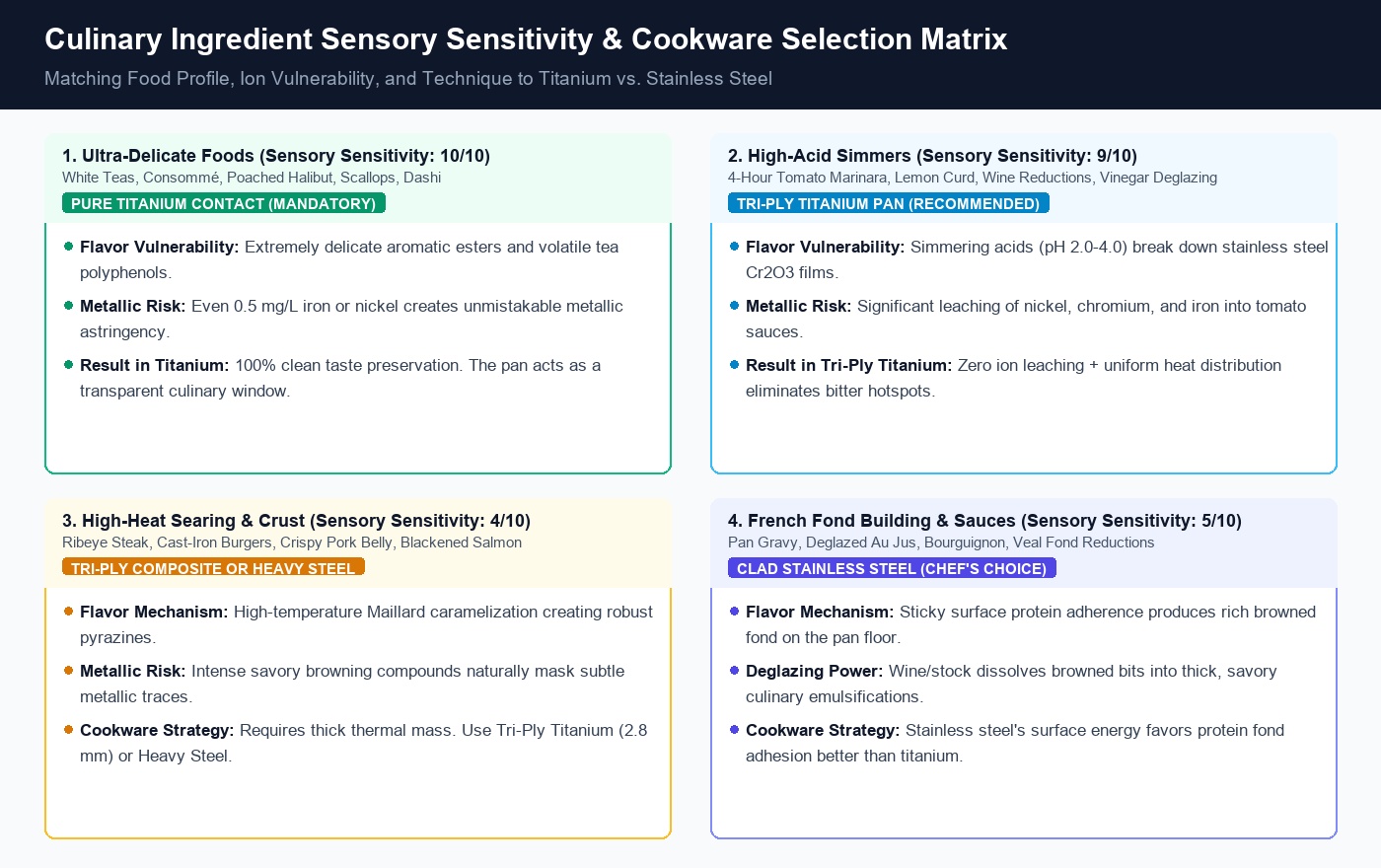
Figure 3: Quadrant mapping of culinary ingredient sensitivity, ion leaching vulnerability, and pan selection for gourmet kitchens.
As the decision matrix demonstrates, pure titanium is unparalleled when cooking clean, delicate, or high-acid preparations where the authentic aroma of the ingredient must shine through unhindered. For traditional French pan sauces requiring aggressive protein sticking and deglazing, classic multi-clad stainless steel remains an effective tool in a professional brigade.
6. Commercial Sensory Testing SOP: How Chefs and B2B Buyers Verify Flavor Purity
For executive chefs, procurement managers, and commercial cookware brand owners, verifying flavor neutrality cannot rely on subjective impressions. Quality control laboratories and commercial kitchens utilize rigorous standard operating procedures (SOPs) to evaluate metal migration and sensory neutrality prior to specifying cookware lines.
The following three-stage testing protocol allows culinary buyers to verify that a cookware sample preserves true flavor without chemical interference:
Stage 1: The Boiling Water Triangular Blind Test (ASTM E1885): Boil 500 mL of neutral deionized water in the test pan at a vigorous simmer for 20 minutes. Simultaneously boil an identical volume in an inert borosilicate laboratory glass beaker as a negative control. Allow both water samples to cool to room temperature (20°C). Conduct a blind triangle sensory evaluation with a trained panel. Water boiled on authentic Grade 1 pure titanium exhibits zero detectable taste divergence from the glass control, whereas water boiled in scoured low-grade stainless steel frequently reveals a faint mineral or metallic profile.
Stage 2: The Extended Citric Acid Simmering Challenge (EN 1388-1 / FDA Compliance): Simmer a standardized 3% citric acid solution (pH 2.2) in the vessel under reflux for 2 hours at 95°C. Analyze the resulting solution via Inductively Coupled Plasma Mass Spectrometry (ICP-MS). Authentic ASTM B265 Grade 1 titanium yields metal migration levels below 0.001 mg/L for titanium, nickel, and chromium, confirming compliance with strict European Council Resolution CM/Res(2013)9 guidelines on metals and alloys used in food-contact materials.
Stage 3: Thermal Scorching and Clean-Release Verification: Heat the skillet to 180°C and conduct the Leidenfrost water-droplet test to confirm uniform thermal distribution. Sear a delicate portion of sea bass or an egg with minimal fat. Verify that the pan develops an even, golden Maillard crust without localized black scorch spots, proving that the conductive core eliminates thermal hotspot carbonization.
Commercial cookware buyers exploring OEM and ODM manufacturing partnerships can review technical specifications in our Pure Titanium vs. Stainless Steel Guide, explore testing methodologies in the Titanium Cookware Flavor Test Guide, or examine acid resistance data in our Acidic Cooking Safety Report.
Conclusion: Choosing the Right Cookware for Pure, Uncompromised Flavors
When culinary enthusiasts and professional chefs ask whether pure titanium cookware preserves natural food flavors better than stainless steel, the metallurgical and sensory evidence provides a resounding yes. Thanks to its spontaneous nanosecond TiO2 passive barrier, commercially pure Grade 1 titanium remains 100% inert across aggressive culinary acids, eliminating the metallic ion migration, nickel transfer, and astringent aftertastes that can compromise food prepared in traditional 18/10 stainless steel.
However, preserving natural flavors requires mastering thermal physics alongside surface chemistry. While single-wall solid titanium pans risk scorching delicate recipes due to low thermal conductivity, advanced composite engineering has bridged this divide. The official TITAUDOU 2.8 mm Tri-Ply Cladding specification—uniting a 0.4 mm pure titanium food-contact layer with a 1.8 mm 1050 aluminum core and a 0.6 mm 430 stainless steel induction base—delivers both absolute chemical flavor neutrality and rapid, homogeneous heat distribution.
Whether simmering long-reduced heirloom marinara, poaching tender ocean fish, or brewing delicate ceremonial teas, investing in a high-grade titanium-surface skillet ensures your culinary creations taste exactly as nature intended: pure, vibrant, and completely uncompromised.
Frequently Asked Questions (FAQ)
Q1: Does stainless steel actually leave a metallic taste in food?
Yes, under specific cooking conditions. Peer-reviewed research demonstrates that simmering acidic foods (such as tomato sauce, wine reductions, or citrus glazes) in 18/10 stainless steel for extended periods causes measurable leaching of iron, nickel, and chromium ions. Because iron has a sensory taste threshold as low as 0.5 mg/L, sensitive palates and supertasters frequently detect a faint metallic or astringent aftertaste. In contrast, pure titanium forms an insoluble TiO2 passive barrier that leaches zero metal ions, preserving 100% clean flavor.
Q2: Can pure titanium cookware scorch delicate sauces and alter their taste?
Yes, but only in single-wall solid titanium pans. Pure titanium has a low thermal conductivity of roughly 17 W/m·K, which causes heat to concentrate directly above the burner, creating severe localized hotspots (Delta-T > 85°C). If not continuously stirred over low heat, these hotspots scorch proteins and sugars, generating bitter burnt flavors. To eliminate this issue while maintaining pure flavor, chefs use tri-ply clad titanium cookware featuring an internal aluminum core that spreads heat evenly across the entire pan floor.
Q3: Why does tri-ply titanium cookware preserve flavors better than solid pure titanium pans?
Tri-ply titanium cookware preserves flavors better because it addresses both chemical and thermal causes of flavor distortion. The TITAUDOU 2.8 mm specification utilizes a 0.4 mm pure Grade 1 titanium food-contact layer for complete chemical inertness and zero metallic migration, backed by a 1.8 mm 1050 pure aluminum core that conducts heat 13 times faster than titanium. This prevents localized scorching, carbonization, and hot spots, ensuring delicate ingredients are cooked evenly without burnt or metallic notes.