When people ask pure titanium cookware vs stainless steel which is actually better, the honest answer is: better depends on what the pan is being asked to do. Stainless steel is usually better for classic high-heat searing, fond building, pan sauces, broad availability, and familiar professional cooking. Pure titanium is usually better when the buyer cares most about a nickel-free food-contact surface, low reactivity with acidic foods, lighter handling, corrosion resistance, and a premium coating-free material story.
The practical middle ground is tri-ply titanium cookware. A well-built tri-ply titanium pan does not pretend that titanium is a better heat conductor than aluminum or copper. Instead, it assigns each metal to the job it does best: GR1 pure titanium for the food-contact layer, 1050 aluminum for heat spreading, and 430 stainless steel for exterior structure and induction compatibility. That is the material logic behind TITAUDOU's titanium pots and pans, and it is a more useful answer than saying one metal wins every category.
This comparison focuses on real pure titanium food contact and tri-ply titanium construction. It does not treat titanium-coated nonstick pans as pure titanium cookware, because a thin coating with titanium particles behaves very differently from a solid titanium food-contact layer. If you are comparing products for a household, retail line, importer program, or private-label cookware project, start with the surface that touches food, then check the heat-spreading structure, the stove compatibility, and the documentation behind the claim.
1. The Direct Answer: Better for Which Kitchen Job?
A stainless steel skillet is hard to beat when the cook wants browning, fond, deglazing, oven finishing, and a surface that behaves the way trained cooks expect. Good fully clad stainless cookware uses an aluminum or copper core to compensate for stainless steel's limited thermal conductivity. That construction gives the cook a responsive, durable, coating-free pan with strong searing behavior.
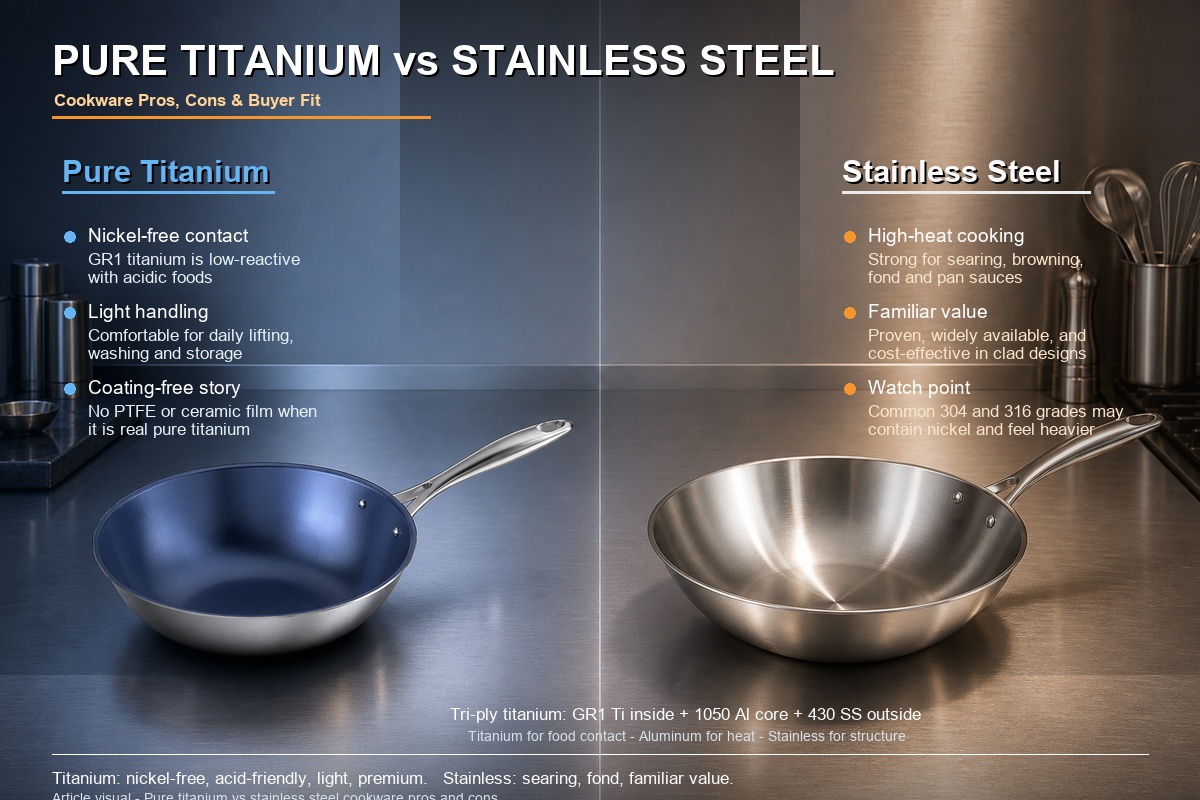
Pure titanium wins a different set of jobs. It is attractive for buyers who cook acidic foods often, dislike metallic taste, want a nickel-free food-contact surface, need lighter handling, or want a premium product story that does not depend on PTFE, ceramic, or other synthetic release coatings. Titanium is also known for strong corrosion resistance because its surface forms a stable oxide film. The Royal Society of Chemistry's titanium reference describes titanium as corrosion resistant, low density, and protected by its oxide surface, which aligns with why it is used in demanding applications beyond cookware.
So the better choice is not a slogan. Stainless steel is better for aggressive cooking technique and value. Pure titanium is better for low-reactive, nickel-free food contact and lighter daily handling. Tri-ply titanium is better when a buyer wants titanium's food-contact benefits without accepting the hot spots that can occur in thin single-ply titanium pans.
| Decision Factor | Pure or Tri-Ply Titanium Advantage | Stainless Steel Advantage |
| Food-contact safety story | Strong when the surface is verified GR1 pure titanium, coating-free, and supported by migration testing. | Mature and widely accepted, but common 304/316 food-contact grades usually contain nickel. |
| Acidic foods | Better fit for tomato, vinegar, citrus, wine, and long simmering when a low-reactive surface is the priority. | Handles acidic foods in normal use, but nickel-sensitive users may still prefer a titanium food-contact layer. |
| Searing and fond | Usable in tri-ply form, but not the strongest reason to choose titanium. | Often the stronger choice for steak, chicken skin, pan sauces, and professional-style browning. |
| Weight and handling | Titanium's lower density helps reduce handling fatigue, especially in larger pots and daily-use pieces. | Heavier weight can feel stable, but may be less comfortable for frequent lifting and washing. |
| B2B positioning | Stronger differentiation for premium, nickel-free, coating-free, health-focused, or lightweight cookware lines. | Easier sourcing, lower buyer education burden, and broad existing consumer familiarity. |
2. Food-Contact Surface: Titanium's Cleanest Advantage
The food-contact surface is where this comparison becomes concrete. Most stainless steel cookware uses 304 or 316 stainless steel on the cooking surface. These are durable and accepted materials, but they typically contain nickel. That does not make stainless steel unsafe for the general population. It does mean the material story is not ideal for nickel-sensitive users or brands that want to market a nickel-free food-contact surface.
Pure titanium gives a more direct answer. If the surface is real commercially pure titanium, such as GR1 titanium, the food touches titanium rather than a nickel-bearing stainless layer or a synthetic coating. This is why titanium is often chosen for acidic cooking, sensitive-user positioning, and clean-taste cookware. It is also why buyers should avoid vague product descriptions. A pan that says "titanium reinforced" or "titanium nonstick" may still be a coated aluminum pan, not a pure titanium surface.
For procurement teams, the verification point is simple: ask what touches the food. If the supplier cannot identify the food-contact grade, the comparison is not ready. TITAUDOU positions its tri-ply titanium cookware with a GR1 pure titanium inner layer, which gives a clearer answer than a generic stainless surface or a titanium-themed coating. The article titanium coated vs real titanium cookware explains this naming issue in more detail.
3. Heat Performance: Stainless Steel Still Has a Real Win
A fair comparison must admit where stainless steel is strong. Stainless steel cookware, especially fully clad cookware, is excellent for browning and searing because the construction usually hides an aluminum or copper heat-spreading layer inside. Stainless steel is not a great heat conductor by itself, but the best cookware designs use it as the durable cooking surface while another metal handles heat movement.
Titanium is also not chosen because it is a superior heat conductor. It is chosen because it is light, corrosion resistant, low-reactive, and strong for its weight. A thin single-ply titanium pan can heat unevenly during frying. That is why simple titanium camping pots are excellent for boiling water but not always satisfying as daily frying pans.
Tri-ply titanium cookware is the engineering response. TITAUDOU uses 1050 aluminum in the core to spread heat, because aluminum is the correct metal for that task. The GR1 titanium inner layer protects the food-contact story, while the 430 stainless steel exterior supports induction and structure. This is why tri-ply titanium cookware should be evaluated differently from thin pure titanium cookware. The material stack matters more than the headline material name.
For cooks who mainly make steak, smash burgers, chicken thighs, and pan sauces, high-quality clad stainless steel remains a strong choice. For buyers who want everyday family cooking, acidic recipes, lighter pots, and a more distinctive food-contact surface, tri-ply titanium becomes more compelling.
4. Acidic Foods, Nickel, and Long Simmering
Acidic food is one of the strongest reasons to compare titanium and stainless steel carefully. Tomato sauce, vinegar reductions, citrus marinades, wine-based sauces, pickled vegetables, and long soup simmering create a more demanding environment than boiling plain water. Stainless steel can handle these foods in normal kitchen use, but the question changes for users who are sensitive to nickel or brands that want a low-reactive cookware line.
A published study available through PubMed Central found that stainless steel cookware can release nickel and chromium into acidic foods under certain cooking conditions. That does not mean stainless steel is automatically unsafe. It means stainless steel is not the cleanest answer for every sensitive-user scenario. Pure titanium gives a more stable food-contact story because it does not rely on nickel-containing stainless steel at the cooking surface.
This is where the question pure titanium cookware vs stainless steel which is actually better has a clear answer for one group of buyers: for nickel-sensitive positioning and acidic cooking, pure titanium or titanium-lined tri-ply cookware is usually the better material choice. For a steakhouse-style pan where the buyer is not concerned about nickel, stainless steel may still be the better cooking tool.
For a broader safety discussion, see is titanium cookware safe. That page separates pure titanium, titanium-coated cookware, and tri-ply titanium so the safety claim does not depend on a vague product label.
5. Weight, Handling, and Daily Use
Cookware comparisons often over-focus on the stovetop and under-focus on the sink. A pan is lifted, tilted, washed, stacked, and stored far more often than marketing photos suggest. Titanium's lower density gives it a practical handling advantage, especially in larger pots, saucepans, woks, and family-size cookware.
Stainless steel has a reassuring weight. Many cooks like that planted feel, and heavier pans can feel stable on glass or induction cooktops. But heavy cookware also creates fatigue for older users, smaller households, people with wrist discomfort, and anyone washing multiple pans after daily meals. The better material is partly a human-factor decision, not only a laboratory comparison.
Tri-ply titanium is not as light as a thin camping pot because it includes an aluminum core and stainless exterior. That extra mass is useful. It gives the pan better heat behavior and stove compatibility. For home kitchens, the goal is not the lightest possible titanium sheet; the goal is a balanced pan that is lighter than many heavy clad stainless products while still feeling stable and cooking evenly enough for daily use.
For buyers comparing samples, test the loaded weight, not only the catalog weight. Fill the pot with water, lift it with one hand, pour from it, wash it, and check handle balance. A cookware line that feels good during real handling often performs better in customer retention than a line that only looks strong on a specification sheet.
6. Nonstick Expectations, Cleaning, and Surface Life
Neither pure titanium nor stainless steel should be sold as a magic nonstick surface. Stainless steel releases food best when the pan is properly preheated, oil is used correctly, and proteins are allowed to release naturally. Pure titanium also needs heat control and a small amount of oil for many foods. If a buyer wants the release behavior of a fresh PTFE pan, neither surface is the same product category.
The long-term advantage is different: both real stainless steel and real titanium are coating-free metal surfaces. They do not depend on a soft nonstick film that gradually loses performance. Stainless steel can tolerate strong scrubbing, though it may show rainbow tint, water spots, or stuck-on fond. Titanium can show heat color, mineral residue, and oil film, but those are usually maintenance issues rather than material failure.
TITAUDOU's blue GR1 titanium surface adds another point. The blue appearance is produced by high-temperature treatment of the titanium surface, not by paint or ceramic coating. The treated surface can reach a hardness range of about HV700-900 depending on process control and product series. That supports stronger resistance to cleaning wear than ordinary soft titanium, while still keeping a titanium food-contact surface. For release expectations, read is titanium cookware nonstick without coating?.
7. B2B Buyer Checks: Turn the Comparison Into Specifications
For importers, distributors, Amazon sellers, retail brands, and OEM/ODM buyers, the comparison should become a checklist. "Titanium" and "stainless steel" are not precise enough. The supplier must define the food-contact grade, the layer structure, the heat-spreading core, the coating status, the induction design, the handle construction, the surface treatment, and the food-contact testing path.
| Buyer Check | For Tri-Ply Titanium | Why It Matters |
| Material test report | Confirm GR1 pure titanium food-contact layer, 1050 aluminum core, and 430 stainless exterior. | Prevents vague "titanium" claims and supports accurate packaging language. |
| Coating-free declaration | Confirm the food-contact surface is not PTFE, ceramic, enamel, paint, or sprayed titanium coating. | Protects health-positioning claims and reduces customer confusion. |
| Heat and flatness testing | Check base flatness after thermal cycling and confirm the aluminum core supports practical heat spreading. | A good food-contact surface still needs stable cooking performance. |
| Food-contact compliance | Request FDA or LFGB migration testing on finished cookware where required by the sales market. | Finished-product testing is stronger than relying only on raw material claims. |
| Private-label readiness | Confirm handle options, thickness customization, laser marking, surface finish, packaging, MOQ, and sample policy. | A premium material only works commercially when the product can be repeated and documented. |
For TITAUDOU, the strongest B2B claim is not "titanium beats stainless steel everywhere." The stronger claim is more precise: GR1 titanium is used where food contact matters, 1050 aluminum is used where heat spreading matters, and 430 stainless steel is used where induction compatibility and exterior structure matter. Buyers can review product options on the TITAUDOU titanium pots and pans page or evaluate factory capability through the titanium cookware manufacturer page.
Conclusion
The clearest answer to pure titanium cookware vs stainless steel which is actually better is role-based. Stainless steel is better for high-heat searing, fond, familiar cooking technique, broad availability, and value. Pure titanium is better for nickel-free food contact, acidic foods, lighter handling, corrosion resistance, and a coating-free premium story. Tri-ply titanium is the practical titanium-side solution because it adds the heat-spreading core that single-ply titanium lacks.
For consumers, the right choice depends on what they cook most often. For B2B buyers, the right choice depends on the product position they want to own. If the goal is classic restaurant-style browning at a familiar price, stainless steel remains strong. If the goal is a differentiated cookware line built around GR1 titanium food contact, low reactivity, lighter handling, and clear material documentation, tri-ply titanium is the better direction.
Frequently Asked Questions (FAQ)
Q1: Pure titanium cookware vs stainless steel which is actually better for daily cooking?
For daily mixed cooking, tri-ply titanium is often better when the buyer values a GR1 titanium food-contact surface, lighter handling, acidic-food stability, and coating-free positioning. Stainless steel is better when the user mainly wants searing, fond, and familiar professional cooking behavior.
Q2: Is pure titanium safer than stainless steel for nickel-sensitive users?
Pure titanium is usually the cleaner choice for nickel-sensitive positioning because the food-contact layer can be nickel-free when it is verified GR1 titanium. Common stainless steel cookware grades are durable and mainstream, but they generally contain nickel.
Q3: Why does TITAUDOU use stainless steel outside if titanium is the premium surface?
Because each layer has a different job. The GR1 titanium inner layer is for food contact, the 1050 aluminum core is for heat spreading, and the 430 stainless steel exterior supports structure and induction compatibility. That combination is more practical than using one metal for every function.