The best seamless design pure titanium cookware without interior rivets is not defined by a perfectly smooth photograph or by the word 鈥渢itanium鈥?on a package. It combines a verified pure-titanium food-contact surface, an attachment system that leaves no fastener heads inside the vessel, and a handle joint tested for the load, heat, and motion expected from that specific pan.
Direct answer: a rivet-free interior is usually easier to wipe, inspect, and keep free of residue than an interior interrupted by rivet heads. However, 鈥渟eamless interior鈥?does not automatically mean that the pan and handle were formed from one piece of metal. Most products use a separate handle joined by exterior welding, an external fixture, or a removable mechanism. The strength still depends on joint geometry, wall construction, process control, and finished-product testing.
This guide explains what rivet-free construction can and cannot prove, how welded and riveted handles behave, and what consumers, importers, and private-label brands should verify before choosing a design.
1. What 鈥淪eamless鈥?and 鈥淩ivet-Free鈥?Actually Mean
In cookware, rivet-free normally means there are no rivet heads passing through the food-contact wall. Seamless interior describes the user-facing result: the inside wall remains continuous at the handle area. Neither term, by itself, proves that the complete pan is monolithic. A separate stainless steel handle can be welded to the exterior while the interior remains visually and physically uninterrupted.
A true one-piece body-and-handle construction is a different engineering category. It can remove a conventional joint, but it also changes forming difficulty, handle heat behavior, balance, packaging volume, and repair options. Buyers should not assume that one-piece is always superior. A properly engineered external joint can deliver a smooth interior while allowing the handle material and geometry to be optimized independently from the pan body.
The term pure titanium cookware without rivets also needs material clarification. Some cookware uses 鈥渢itanium鈥?only as a marketing name for a coating applied over aluminum. Other products use a solid titanium sheet, while tri-ply cookware uses a pure titanium food-contact layer bonded to a heat-spreading core and an exterior layer. Rivet-free describes the attachment layout; it does not identify the food-contact material.
| Design term | What it usually means | What it does not prove | Buyer verification |
|---|---|---|---|
| Rivet-free interior | No fastener heads pass through the cooking wall | Joint strength, coating-free construction, or one-piece forming | Inspect both interior and exterior attachment areas |
| Seamless interior | Smooth, uninterrupted food-contact surface near the handle | That the handle and pan are one piece | Ask how the separate handle, if present, is attached |
| Welded handle | A handle base or fixture is joined to the exterior by welding | Adequate weld area, penetration, or fatigue life | Review joint design and finished-load test records |
| Pure titanium contact layer | Food touches specified titanium rather than a titanium-named coating | Single-ply construction or induction compatibility | Check the material report and full layer specification |
2. Why a Smooth Interior Is Easier to Clean, but Not Self-Cleaning
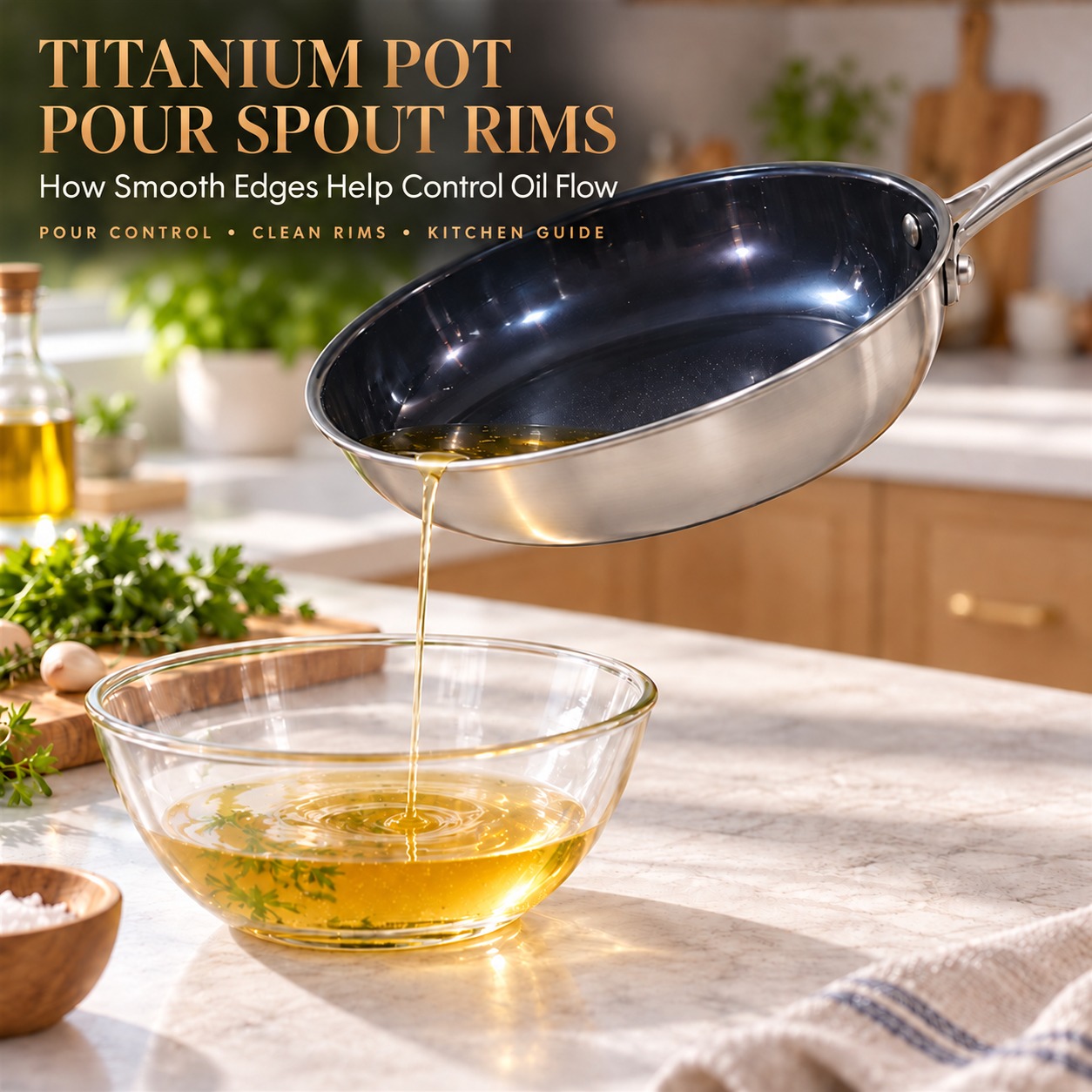
Interior rivet heads create edges where reduced sauce, egg, starch, oil, and mineral deposits can collect. Removing those features makes wiping and visual inspection more direct. This is especially useful in saucepans, milk pans, and frying pans that repeatedly handle sticky proteins or fine food particles. A cloth or sponge can follow the wall without working around raised metal heads.
That advantage should be stated accurately. A rivet-free surface does not prevent food from sticking, sterilize the pan, or guarantee hygiene. Residue can remain anywhere if cooking heat is excessive or washing is incomplete. Exterior weld transitions and handle roots also need inspection because grease can collect outside the cooking cavity. The benefit is fewer interior interruptions, not freedom from normal cleaning.
For households concerned about food cross-contact, the smoother wall can make a cleaning routine easier to perform and verify. It does not replace dedicated cookware where a clinician or allergy-management plan calls for it. Users should still wash the whole food-contact surface with suitable detergent, rinse it thoroughly, and dry the pan. TITAUDOU鈥檚 guide on how to clean titanium cookware covers residue, heat tint, and routine care in more detail.
Surface condition matters as much as attachment layout. A coating-free titanium contact layer has no polymer coating intended to wear away, but it can still show normal cosmetic marks. Buyers should separate scratches that change appearance from cracks, delamination, loose hardware, or deformation that could indicate a structural issue. A smooth interior makes those observations easier because there are fewer geometric distractions.
3. Four Ways to Attach a Handle Without Misleading Shoppers
Exterior welding is the most common route to a fixed rivet-free interior. A mounting plate or handle base is welded to the outer wall. The interior remains smooth, while the exterior joint carries lifting and twisting loads. Performance depends on the size and placement of the joined area, compatibility of the materials, heat input during welding, and the surrounding wall structure.
External screw-to-fixture systems keep screws outside the food cavity. A fixture may be welded to the pan, with the handle fastened to that fixture. This can simplify handle replacement or assembly, but the fixture-to-pan connection remains structurally important. Consumers should check for movement at both the handle screw and the underlying fixture rather than treating the absence of interior rivets as proof that no joint exists.
Removable handles use a clamping or locking mechanism. They create a clear interior and compact storage, but they add moving parts and require correct engagement every time the pan is lifted. The lock must be evaluated when clean, when exposed to cooking residue, and after repeated use. A removable design that feels convenient when empty still needs adequate security at the rated working load.
One-piece forming eliminates a separate conventional handle joint, but it is not automatically the best answer for every pot. Long metal extensions can conduct heat, feel unbalanced, or make lids and packaging less efficient. Product descriptions should name the actual construction instead of using 鈥渟eamless鈥?to imply a manufacturing method that is not present.
Traditional rivets remain a valid fifth option when a visible mechanical connection is appropriate. Engineering guidance published by the Cookware Manufacturers Association recognizes riveted, screw-to-fixture, and spot-welded handle systems. That industry framing is useful because it evaluates attachment as an engineering choice, not a marketing hierarchy.
4. Welded vs Riveted: Strength Comes From the Complete Joint
A riveted joint transfers load through formed fasteners and the surrounding holes. A welded joint transfers load through the bonded area and adjacent pan wall. Either can be durable, and either can fail if undersized, misaligned, overheated, incompletely formed, or applied to a wall that is too flexible for the intended load. The attachment label alone cannot predict service life.
The critical forces are not limited to lifting a static pan. A handle sees bending when a filled vessel is held away from the body, torsion when the cook turns or shakes it, impact when it is set down, and cyclic stress across repeated heating and cooling. Large pots add sustained weight. Woks and saut茅 pans add frequent directional movement. A small frying pan and a stockpot therefore should not inherit the same joint merely to make a product range look uniform.
Weld quality cannot be judged only by a polished exterior. Buyers need to know whether the joint has enough effective area, whether process heat changed the surrounding geometry, and whether samples remain stable after repeated loading. Rivet quality also goes beyond appearance: fastener material, compression, spacing, wall support, and hole quality all affect looseness and fatigue.
The CMA guide recommends evaluating handles under hot and cold conditions, repeated raising-and-lowering cycles, and torque. Those are industry recommendations, not claims that every product has passed the same protocol. A supplier should state its own test method, sample size, load, cycle count, acceptance criteria, and failure definition instead of borrowing an unnamed 鈥渋ndustry standard鈥?claim.
For the consumer, a practical inspection is simpler. Hold a cool, empty pan securely and check for movement, clicking, visible cracks, sharp edges, or a changing gap at the joint. Stop using a pan if the handle becomes loose or the body deforms around the attachment. Do not perform improvised overload tests at home.
5. Material Stack: Pure Titanium Inside Does Not Mean Titanium Everywhere
Single-ply pure titanium is light and corrosion resistant, but titanium distributes heat much less readily than aluminum. A thin single-layer pan can therefore develop concentrated hot areas unless the burner, thickness, and cooking method are managed carefully. A seamless interior does not correct that thermal limitation.
TITAUDOU鈥檚 tri-ply approach assigns a different job to each layer: a GR1 pure titanium food-contact surface, a 1050 aluminum core for lateral heat spreading, and a magnetic 430 stainless steel exterior for induction compatibility and external support. The aluminum is enclosed and does not serve as the food-contact surface. Read the detailed explanation of heat distribution in titanium cookware and the guide to how titanium cookware is made before comparing single-ply and clad products.
This structure also affects handle engineering. The manufacturer must control the joint without damaging layer bonding, distorting the wall, or creating an unacceptable interior mark. Material reports for GR1 titanium, 1050 aluminum, and 430 stainless steel establish composition, but they do not prove the finished handle is strong. Material evidence and finished-product evidence answer different questions.
Shoppers should be cautious with 鈥渢itanium reinforced,鈥?鈥渢itanium nonstick,鈥?or 鈥渢itanium ceramic鈥?language. Those phrases may describe a coating formulation rather than a pure-titanium cooking surface. Ask for a cross-section or bill of materials that identifies each layer and confirms whether any coating touches food. Rivet-free construction is valuable only when the underlying material claim is also clear.
6. Which Handle Design Fits Each Pan Type?
For a light frying pan or saucepan, a well-designed exterior welded handle can offer the strongest everyday benefit: a smooth interior that is easy to wipe. For a large stockpot, an importer may choose reinforced welded side handles or traditional rivets after comparing loaded-use results. A wok introduces repeated shaking and torque, while a removable-handle pan prioritizes storage and requires a reliable locking mechanism.
The table below is a selection framework, not a universal verdict. Wall thickness, total pan mass, handle length, center of gravity, expected fill weight, oven use, and target price can change the correct choice.
| Cookware type | Practical attachment direction | Main design pressure | Evidence to request |
|---|---|---|---|
| Frying pan | Exterior welded or well-riveted fixed handle | Leverage, tossing motion, balance, easy cleaning | Loaded lift, torque, heat-cycle stability, handle temperature method |
| Saucepan or milk pan | Rivet-free welded interior often suits the use case | Sticky residue around the sidewall and one-hand lifting | Interior finish, joint load test, cleaning inspection |
| Stockpot | Reinforced welded side handles or engineered rivets | High filled weight and two-hand lifting | Filled-load test, attachment deformation limits, batch inspection |
| Wok or saut茅 pan | Joint selected for repeated torque and directional motion | Shaking, twisting, and changing center of gravity | Cyclic load method, torque test, alignment after testing |
| Compact removable-handle pan | External locking fixture with no interior fasteners | Correct engagement, wear, residue, accidental release | Lock-cycle test, loaded security test, replacement instructions |
Home buyers should prioritize the pan they actually cook with rather than buying a set based on one visual feature. B2B buyers should define acceptance criteria by SKU. A single 鈥渉andle passed鈥?statement for an entire collection is weak evidence when the largest pot and smallest pan apply very different loads.
7. TITAUDOU and the B2B Verification Checklist
TITAUDOU can configure riveted or rivet-free welded 304 stainless steel handles according to pan shape, intended load, cleaning priorities, and private-label requirements. The absence of interior rivets is presented as a cleaning and inspection benefit, not as automatic proof of strength, nonstick performance, or a one-piece body.
After the cookware body is formed, TITAUDOU performs finished-product quality inspection and applicable stress verification. Products that do not meet release requirements are segregated as nonconforming inventory rather than shipped as first-quality goods. This is a conservative process statement; buyers should still agree on the exact protocol and acceptance limits for their order before mass production.
A useful sourcing file should include the material test report for the food-contact titanium, the layer specification, a drawing of the handle and attachment area, the joining method, and the finished-sample test plan. It should also define acceptable handle movement, visible joint defects, interior marks, pan-body distortion, and inspection frequency. Where oven use is claimed, the handle, grip components, and complete vessel need a documented temperature scope.
Private-label buyers should test production-representative samples, not only showroom prototypes. Record the pan model, fill or applied load, test orientation, cycle count, torque method, hot or cold condition, and result. After testing, inspect handle movement, joint cracking, wall distortion, layer separation, and base flatness. Packaging drop tests are separate because transit impacts do not reproduce cooking loads.
For product planning, browse TITAUDOU鈥檚 titanium pots and pans or review its titanium cookware manufacturing and customization capabilities. Buyers can specify surface treatment, body thickness, handle style, laser marking, private-label packaging, and related OEM or ODM details, subject to engineering review for the selected cookware form.
Conclusion: the best seamless design pure titanium cookware without interior rivets is the design whose claims can be separated and verified. Confirm the food-contact material, identify the actual handle mechanism, match the joint to the pan鈥檚 load and motion, and review finished-product evidence. A smooth interior is a meaningful convenience, but reliable cookware comes from the complete material-and-joint system.
Frequently Asked Questions
1. Does rivet-free titanium cookware mean the pan and handle are one piece?
No. It usually means no rivet heads pass through the cooking wall. The handle may be welded to the exterior, attached to an external fixture, or removable. Product documentation should identify the actual method.
2. Are welded handles always weaker than riveted handles?
No. Either system can be reliable when the joint area, pan wall, materials, and manufacturing process suit the intended load. Compare defined load, torque, heat-cycle, and inspection evidence rather than judging by the attachment name alone.
3. What should I verify when buying rivet-free pure titanium cookware?
Confirm the grade and location of the titanium, whether any coating contacts food, the full layer structure, the handle attachment method, induction compatibility where needed, and finished-product joint testing for the exact pan model.