Direct Engineering Answer: When lifting a heavy sauté pan filled with braising liquids and ingredients, culinary safety hinges entirely on the structural junction between the handle and the vessel body. While cooks evaluate cookware based on thermal distribution and non-reactive food contact, mechanical engineers evaluate cookware through cantilever beam mechanics and fatigue failure limits. In heavy-duty titanium cookware, handle load testing is an intensive metrological validation determining whether a vessel can endure decades of dynamic kitchen agitation, high-temperature thermal shock, and physical overloads without mechanical separation.
European Standard EN 12983-1 establishes mandatory mechanical benchmarks ensuring cookware handles withstand extreme bending moments, rotational torques, and cyclic fatigue far exceeding normal cooking demands. Understanding how manufacturers evaluate handle load capacity, cantilever stress distribution, and mechanical fatigue reveals why premium cookware engineering requires uncompromising metallurgical precision from the mounting baseplate to the fastening joint.
1. Cantilever Load Physics: Why Cookware Handles Experience 10x More Stress Than Food Weight
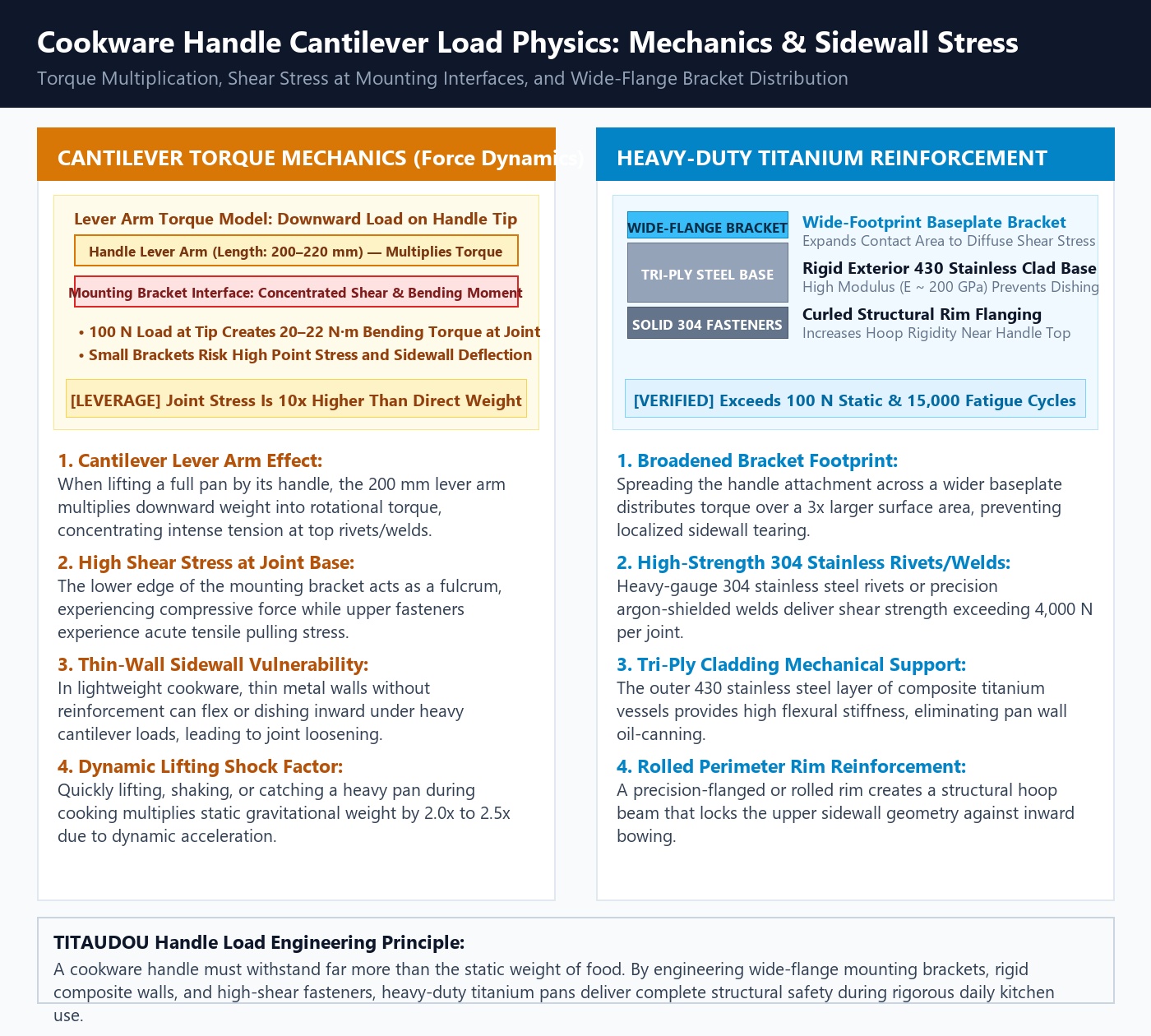
To understand why handle testing standards demand immense mechanical endurance, one must analyze the statics of a frying pan. A cookware handle behaves as a classic cantilever beam—a structural member fixed rigidly at the pan sidewall and subjected to downward force along its length. When lifting a 220 mm handle on a 3.5 kg vessel, the force at the mounting joint far exceeds the 35 N gravitational weight. Instead, the joint sustains an amplified bending moment M = F × L, where F is applied load and L is the moment arm from the vessel's center of mass.
With the center of mass situated approximately 190 mm from the junction, static bending moments reach 6.5 to 7.5 N·m, spiking beyond 18 to 22 N·m during 2.0g to 3.0g tossing accelerations. The top edge of the baseplate experiences intense tension pulling outward against fasteners, while the bottom edge experiences compressive thrust against the vessel shell.
In consumer cookware built with thin sidewalls or weak fasteners, this localized tension causes rivet hole elongation, sidewall micro-buckling, or weld nugget shear. Consequently, engineers designing commercial-grade tri-ply titanium pans calculate structural safety margins based on dynamic kinetic multipliers rather than simple static food weights.
2. Titanium Material Mechanics: Modulus of Elasticity and Sidewall Deflection Control
Evaluating handle load capacity on titanium cookware requires understanding titanium's specific mechanical metallurgy, particularly its elastic modulus. Commercially pure Grade 1 and Grade 2 titanium offer high strength-to-weight ratios, but possess an elastic modulus (E ≈ 105 GPa) roughly half that of stainless steel (E ≈ 193 to 200 GPa), resulting in greater flexural compliance under identical wall thicknesses.
Attaching a rigid handle to an ultra-thin pure titanium wall (0.8 mm to 1.2 mm) risks localized elastic dishing under downward cantilever loads. This deflection concentrates bending stress along fasteners, potentially inducing work-hardening and fatigue micro-cracks over repeated culinary cycles.
To eliminate sidewall deflection and guarantee immense handle load capacity, heavy-duty titanium cookware manufacturers implement three primary engineering solutions:
Extended Mounting Footprints: Designing wide-flange handle brackets that expand baseplate contact from a 25 mm circle to a 55 mm flange, distributing tensile prying moments across a broad arc of the vessel shell.
Multi-Layer Tri-Ply Cladding Architecture: In tri-ply composite constructions, an interior food-contact layer of pure titanium is bonded to an aluminum core (E ≈ 70 GPa) and backed by an exterior shell of magnetic 430 stainless steel (E ≈ 200 GPa). The high flexural modulus of the external steel skin provides immense rigidity, preventing sidewall oil-canning under cantilever loads while preserving pure titanium on the food surface.
Upper Rim Hoop Reinforcement: The pan's upper perimeter is formed into a rigid rolled pouring rim. This circumferential curl acts as a structural hoop stiffener directly adjacent to the upper handle bracket, resisting deflection when cantilever loads are applied.
3. EN 12983-1 Annex D: The 100 N Static Bending and Overload Strength Test
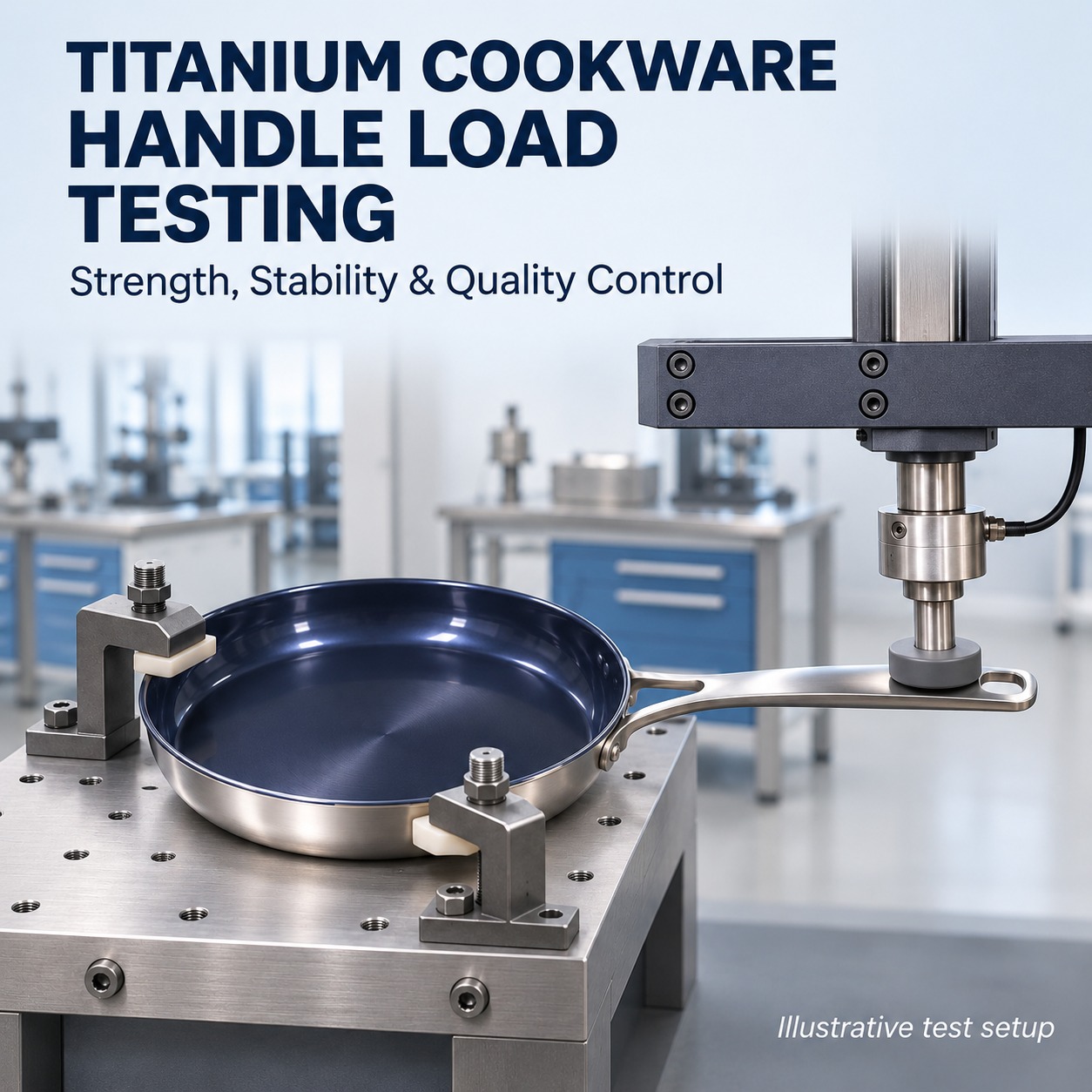
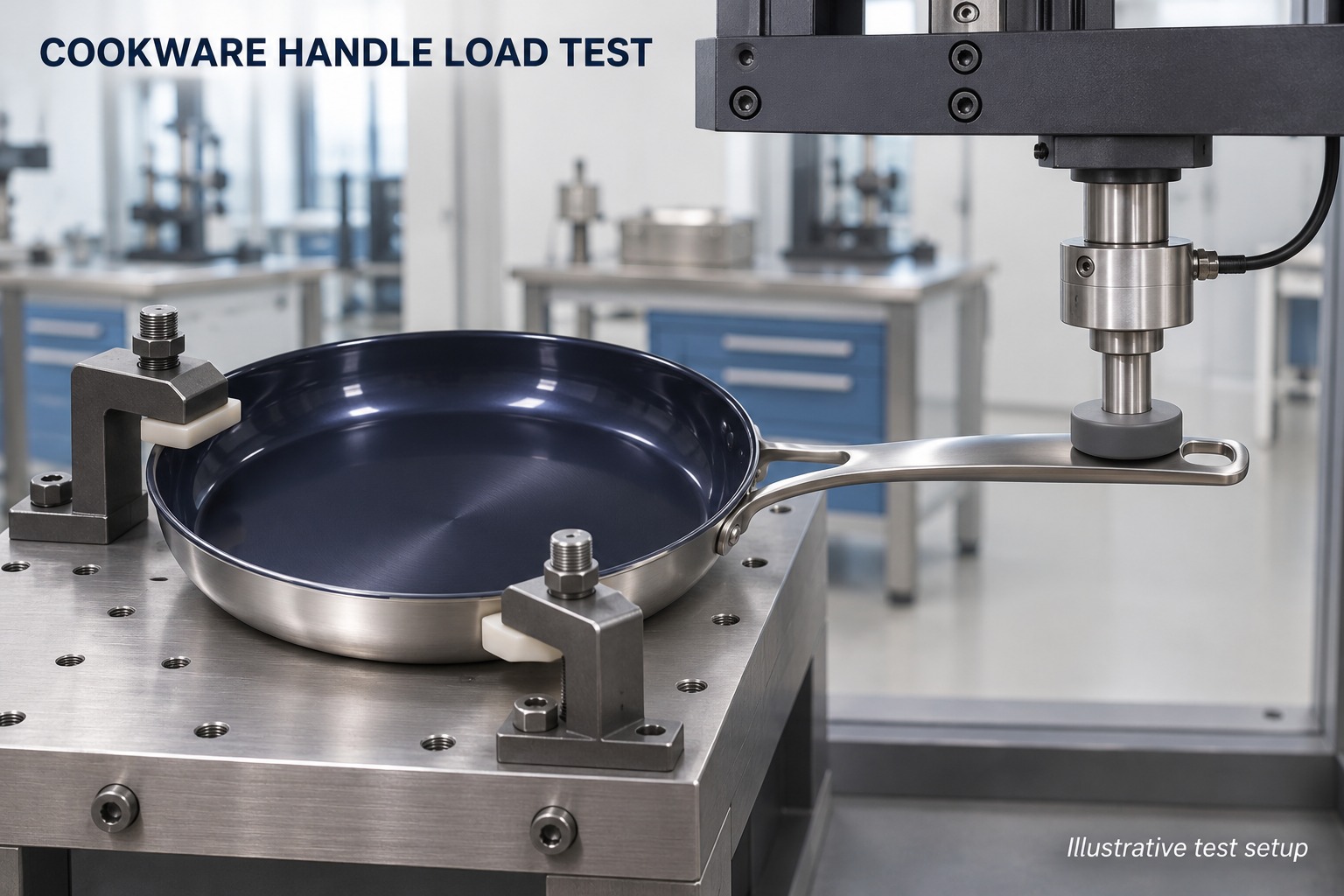
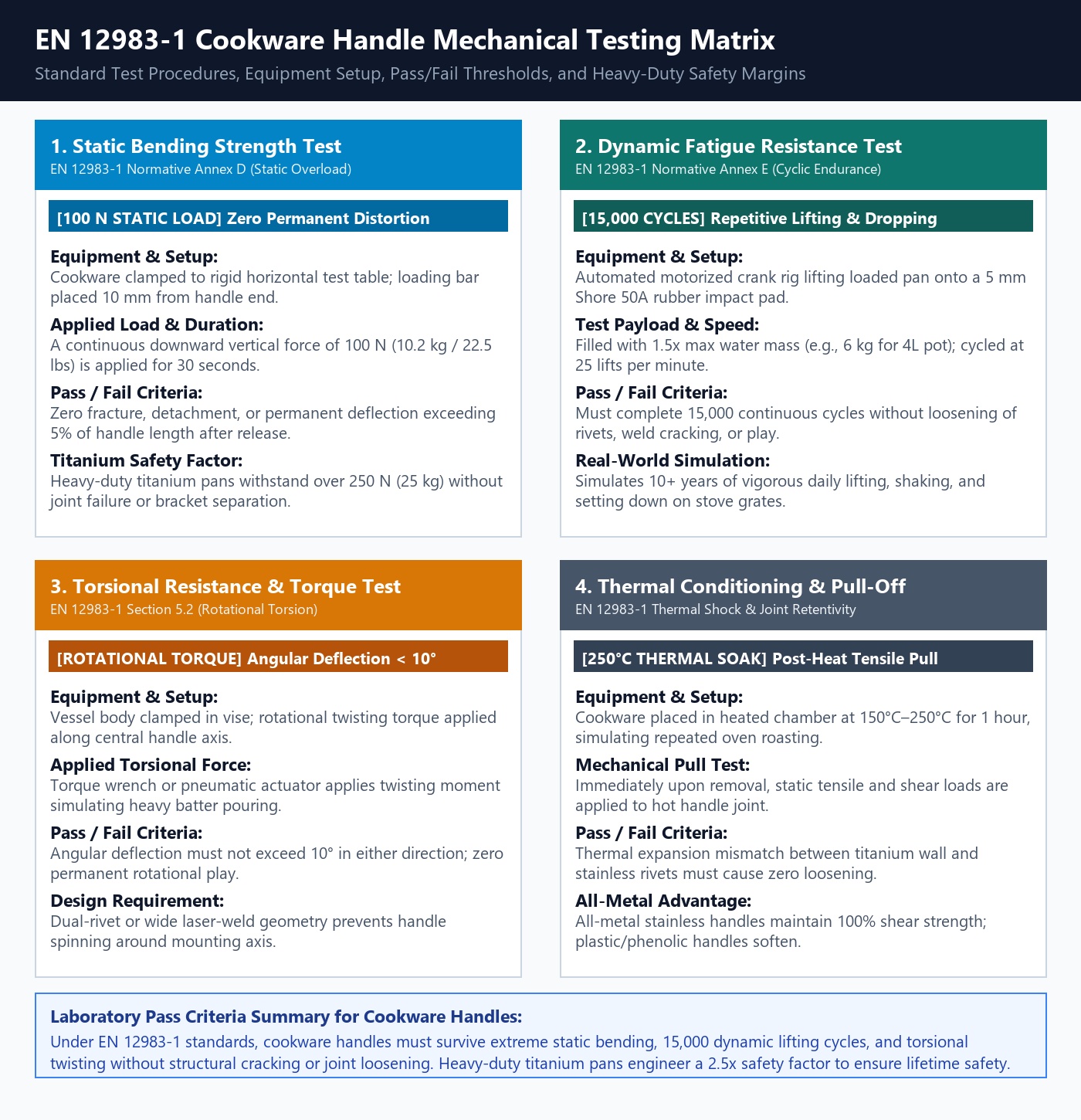
The definitive global benchmark for cookware handle structural evaluation is European Standard EN 12983-1 Annex D, specifying the Static Bending Strength Test. This protocol ensures that a cookware handle cannot bend permanently, crack, or detach from the vessel body when subjected to accidental overloads, such as an operator leaning firmly on the handle while steadying a hot pan or resting heavy cookware across adjacent vessels.
The cookware is clamped to a rigid test bed while a calibrated actuator applies a continuous vertical load of 100 N (approximately 10.2 kg force) exactly 10 mm inward from the distal handle tip, maximizing the moment arm.
The standard establishes strict mechanical duration and deflection criteria:
Load Duration: The full 100 N downward force is ramped smoothly and maintained continuously for exactly 30 seconds.
Maximum Allowable Permanent Deflection: A digital dial indicator measures handle tip position before and after a 30-second load and 60-second release; permanent plastic deflection must not exceed 5% of unsupported length L (strictly below 10 mm for a 200 mm handle).
Structural Integrity Criteria: Under 10x optical magnification, there must be zero evidence of fracture, tear-out, rivet loosening, weld shearing, or micro-cracking across the handle casting, baseplate flange, or pan sidewall.
When testing heavy-duty titanium cookware, premium designs exhibit permanent deflections far below the 5% threshold—often registering less than 0.8% permanent set (under 1.6 mm). The high yield strength of cold-formed titanium alloys and multi-ply composite shells ensures that the vessel remains entirely within its elastic deformation envelope during the 100 N static overload.
4. EN 12983-1 Annex E: The 15,000-Cycle Dynamic Fatigue and Drop Rig Protocol
While static bending tests confirm ultimate yield strength under single overloads, the vast majority of mechanical handle failures in commercial kitchens occur due to low-amplitude cyclic fatigue. Cookware handles endure continuous micro-vibrations, lifting cycles, and repetitive dynamic shocks as chefs agitate pans, transfer food between stations, and set cookware down on rigid metal surfaces. To simulate a lifetime of culinary service, EN 12983-1 Annex E establishes the rigorous Dynamic Fatigue and Handle Endurance Test.
Under Annex E, the vessel is ballasted with 1.5 times its brimful water mass (1.5 × V, or 4.5 kg for a 3.0 L pan) and clamped into an automated reciprocating rig suspended over a steel platform with a 5.0 mm vulcanized rubber pad (50 Shore A).
The automated testing machine runs a continuous cyclic routine:
Reciprocating Stroke Profile: The actuator hoists the vessel 150 mm at 25 cycles/min, releasing it into free fall onto the rubber pad to absorb abrupt deceleration before the next stroke.
Cycle Endurance Volume: Standard domestic cookware compliance requires surviving 15,000 continuous cycles without mechanical failure. For commercial heavy-duty classifications, leading manufacturers extend this endurance run to 25,000 cycles to establish superior safety margins.
The failure criteria mandated by Annex E are unequivocal: at the conclusion of 15,000 cycles, the handle assembly must remain completely rigid and functional. Any perceptible loosening of fasteners or structural separation constitutes immediate laboratory failure. In evaluating laser-welded versus riveted handle attachment methods, dynamic fatigue testing demonstrates why hermetic robotic laser welding offers superior fatigue endurance; laser fusion welds eliminate the stress-concentration notches inherent in pierced rivet holes, ensuring continuous metallurgical bonding that resists cyclic fatigue indefinitely.
5. Torsional Resistance and Thermal Soak Preconditioning Under Extreme Heat
Cookware handles must not only resist vertical bending; they must also withstand intense rotational torque. Tilting a full saucepan to pour generates an aggressive twisting moment along the handle's longitudinal axis. An undersized fastener or narrow bracket can allow unpredictable rotational twisting, presenting serious burn hazards.
To verify rotational stability, EN 12983-1 mandates the Torsional Resistance Test. Under EN 12983-1, the pan body is locked in a vice while a calibrated torque wrench applies 9.0 N·m around the handle axis. Angular deflection must remain ≤ 10 degrees, with zero permanent displacement or looseness upon release. Manufacturers achieve this through dual-rivet horizontal spacing or broad laser-welded flanges.
Because high operating temperatures reduce metal yield strength and accelerate fastener relaxation, comprehensive evaluation mandates thermal soak preconditioning:
Oven Thermal Conditioning: Cookware assemblies endure a convection furnace soak at 150°C to 250°C for at least 1 hour, simulating prolonged roasting heat absorption.
Post-Thermal Load Testing: Following thermal extraction—or rapid quench cycles evaluating thermal shock resistance in clad cookware bodies—cookware undergoes static bending and cyclic fatigue testing to ensure joints meet all 100 N benchmarks without thermal relaxation.
Thermal Dissipation Dynamics: In hollow or stay-cool stainless steel handles attached to titanium cookware, testing verifies that the thermal transition geometry retains full structural stiffness while controlling heat transmission, as documented in studies on the thermal conductivity of hollow stainless cookware handles.
| Testing Protocol | Standard Parameter (EN 12983-1) | Heavy-Duty Commercial Benchmark | Applied Stress / Load Threshold | Pass/Fail Acceptance Criteria |
|---|---|---|---|---|
| Static Cantilever Bending (Annex D) | 100 N downward force at 10 mm from tip for 30 s | 150 N downward force for 60 s | 100 N to 150 N static vertical load | Permanent deflection ≤ 5% handle length; 0 cracks, 0 detachment |
| Dynamic Cyclic Fatigue (Annex E) | 15,000 cycles at 25 cycles/min with 1.5× water mass | 25,000 to 50,000 cycles with 2.0× water mass | Dynamic 150 mm drop shock onto 5 mm rubber pad (50 Shore A) | 0 fastener play, 0 rivet loosening, 0 weld shear, 100% rigid |
| Torsional Resistance Test | 9.0 N·m rotational torque around handle axis | 14.0 N·m rotational torque around handle axis | Pure axial twisting moment applied via torque clamp | Angular rotation ≤ 10°; 0 permanent displacement after release |
| Thermal Soak Preconditioning | 1 hour at 150°C furnace soak prior to load test | 2 hours at 250°C furnace soak followed by water quench | High-temperature soak + rapid thermal differential | Retains 100% mechanical load compliance; 0 fastener relaxation |
| Fastener Shear & Pull-Off | Internal factory metallurgical qualification | Destructive tensile pull-off test (> 3,500 N force) | Direct hydraulic axial pull perpendicular to pan wall | Fastener baseplate must deform before weld or rivet shears |
6. Real-World Kitchen Safety Margins: Translating Laboratory Newtons into Culinary Peace of Mind
Laboratory benchmarks like 100 N static force, 9.0 N·m torque, and 15,000 drop cycles translate directly into vital kitchen safety margins where cookware routinely sustains heavy physical stress.
Lifting a 30 cm pan with 4.0 kg of food multiplies effective load through dynamic acceleration. If the pan bumps a prep table or sink, shock loads approach 80 to 90 N. Without substantial safety margins, everyday collisions risk sheared fasteners, bent handles, and severe burn hazards.
Furthermore, the EN 12983-1 15,000-cycle dynamic fatigue requirement represents over a decade of rigorous culinary use. In an active kitchen where a favorite frying pan is lifted, shaken, set down, and washed four times per day, 15,000 cycles accounts for over 3,750 cooking sessions. For heavy-duty titanium cookware, these safety margins provide enduring culinary confidence; because titanium is impervious to acid corrosion, chemical pitting will never degrade the metal surrounding the handle baseplate.
Conclusion: Engineering Reliable Handles for Lifetime Cookware Performance
The mechanical integrity of a cookware handle represents one of the most critical intersections of culinary ergonomics, physical safety, and metallurgical engineering. While casual observers may judge a frying pan solely by the sleekness of its cooking surface or the shine of its exterior finish, the true measure of heavy-duty cookware lies in its structural resilience under unforgiving cantilever loads, dynamic fatigue shocks, and high-temperature thermal cycling.
Adhering to EN 12983-1 Annex D and Annex E ensures handle assemblies deliver uncompromising strength. Through 100 N static overloads, 15,000-cycle fatigue drop rigs, 9.0 N·m torque tests, and thermal preconditioning, engineers eliminate failure modes before cookware reaches the stove. For titanium pans, wide mounting flanges, rim stiffeners, and tri-ply cladding conquer elastic compliance, transforming lightweight cookware into lifetime culinary instruments.
Frequently Asked Questions (FAQ)
Q1: Why do European EN 12983-1 standards require testing handle loads up to 100 N when food rarely weighs that much?
The 100 N (approximately 10.2 kg / 22.5 lbs) static load requirement in EN 12983-1 Annex D provides a critical structural safety factor accounting for dynamic leverage and human overloads. A cookware handle behaves as a cantilever beam, meaning the rotational bending moment at the mounting joint is significantly higher than the simple resting weight of food. Furthermore, cooks frequently press downward on handles to steady pans while whisking or searing, or accidentally knock cookware against countertops. The 100 N test ensures the handle can withstand these peak shock loads and downward forces without bending permanently or detaching.
Q2: How does titanium's lower modulus of elasticity affect handle mounting compared to stainless steel or cast iron?
Commercially pure titanium has a modulus of elasticity (Young's modulus) of approximately 105 GPa, roughly half that of stainless steel (193 to 200 GPa). While titanium is exceptionally strong against permanent plastic deformation, its lower modulus means it flexes more under load. If attached to a narrow handle bracket, thin titanium sidewalls can experience localized elastic dishing under heavy cantilever forces. Premium manufacturers solve this by utilizing wide-flange mounting brackets that spread load across a larger surface area, incorporating upper rolled rim stiffeners, or utilizing tri-ply clad composite structures with an exterior stainless steel layer that provides high flexural rigidity.
Q3: What causes handle rivets or weld joints to fail prematurely during high-volume cooking?
Handle joints fail primarily due to low-amplitude cyclic fatigue, thermal expansion mismatches, and localized stress concentrations rather than single catastrophic overloads. Repeatedly lifting, tossing, and dropping heavy cookware subjects fasteners to alternating tensile and shear micro-strains. In riveted pans, repeated differential thermal expansion between dissimilar metals can cause rivet holes to gradually ovalize, introducing mechanical play that accelerates wear. In poorly executed welds, micro-voids or heat-affected zone embrittlement can initiate fatigue cracks during high-temperature thermal cycling. This is why rigorous standards mandate 15,000-cycle dynamic drop testing to ensure joints maintain 100% rigidity over decades.