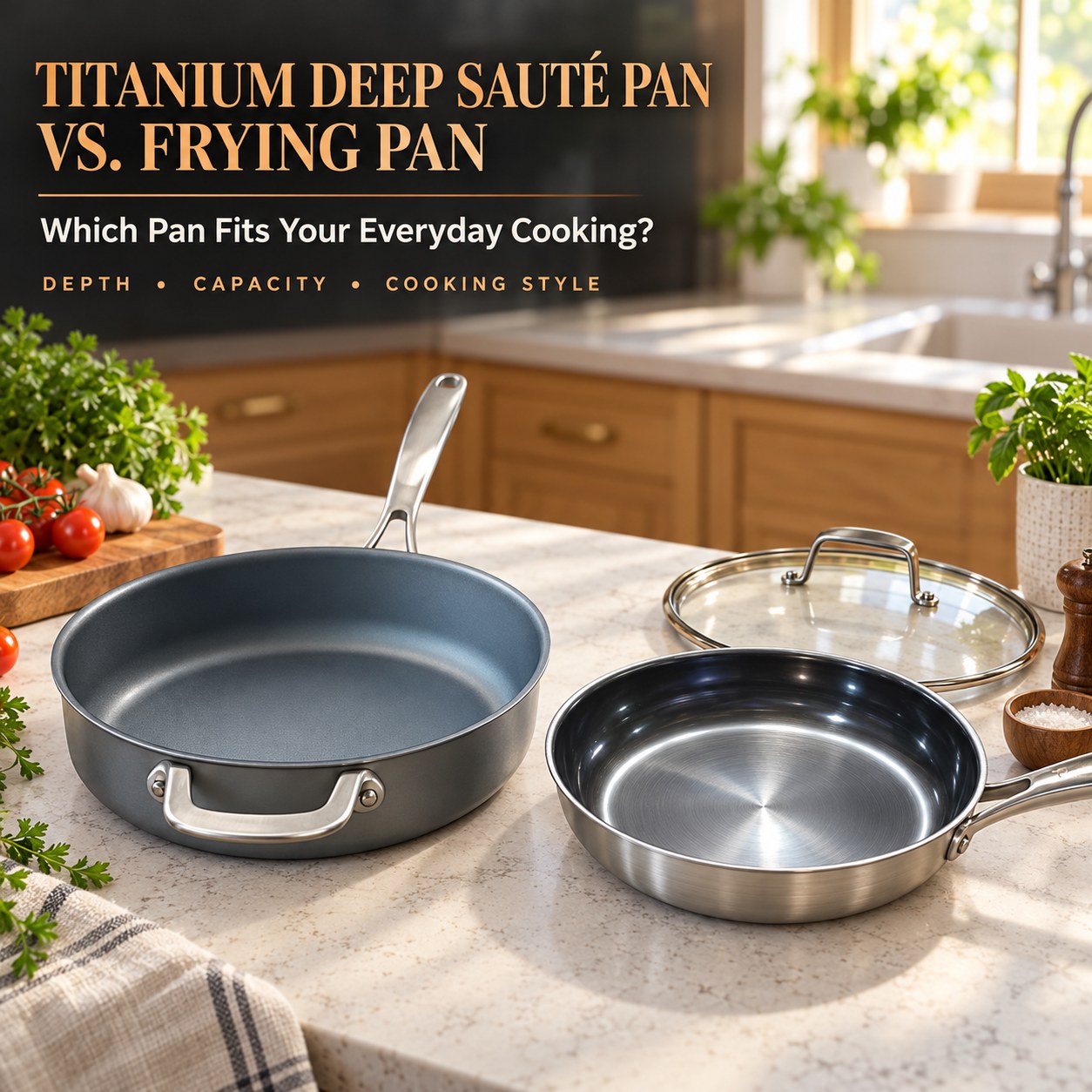
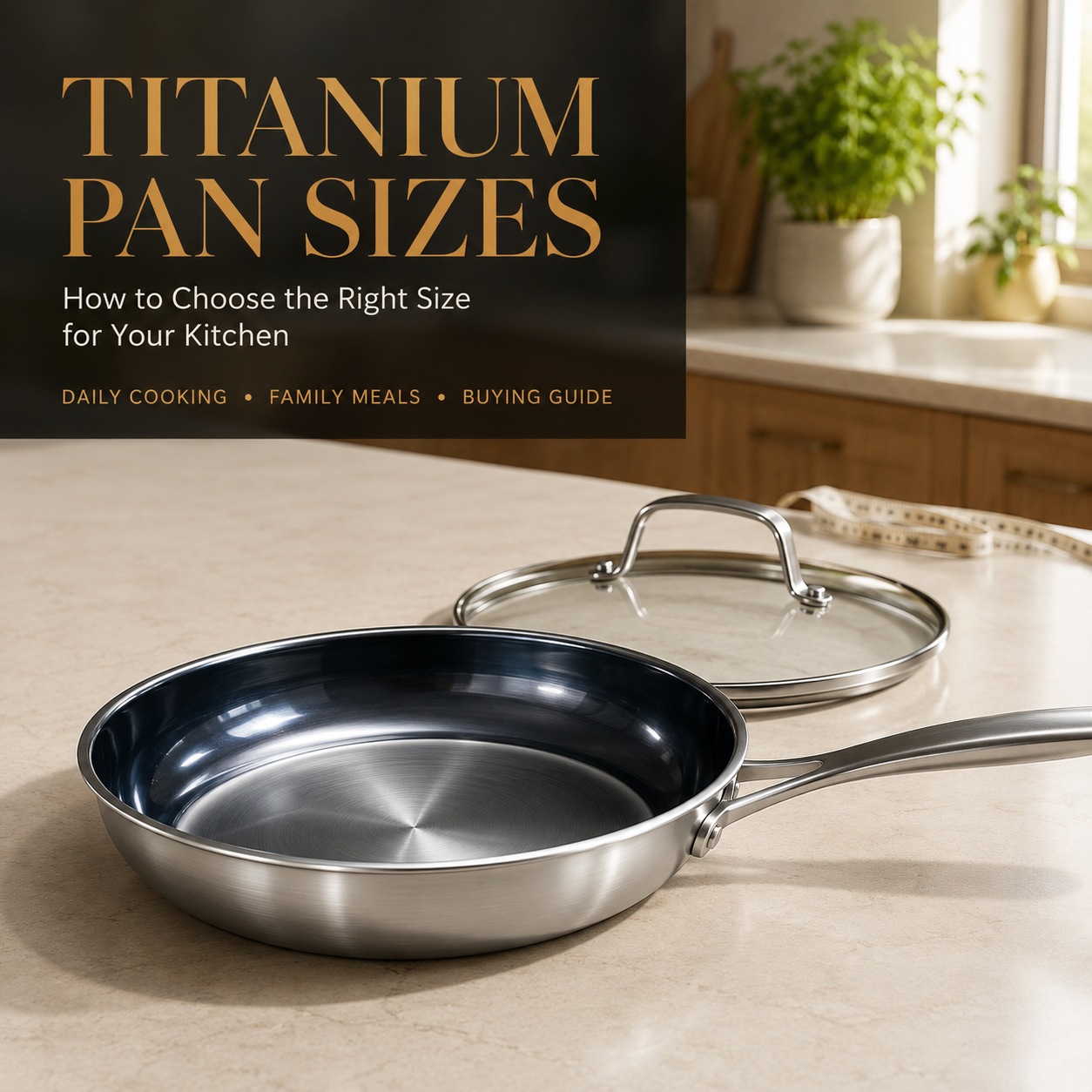
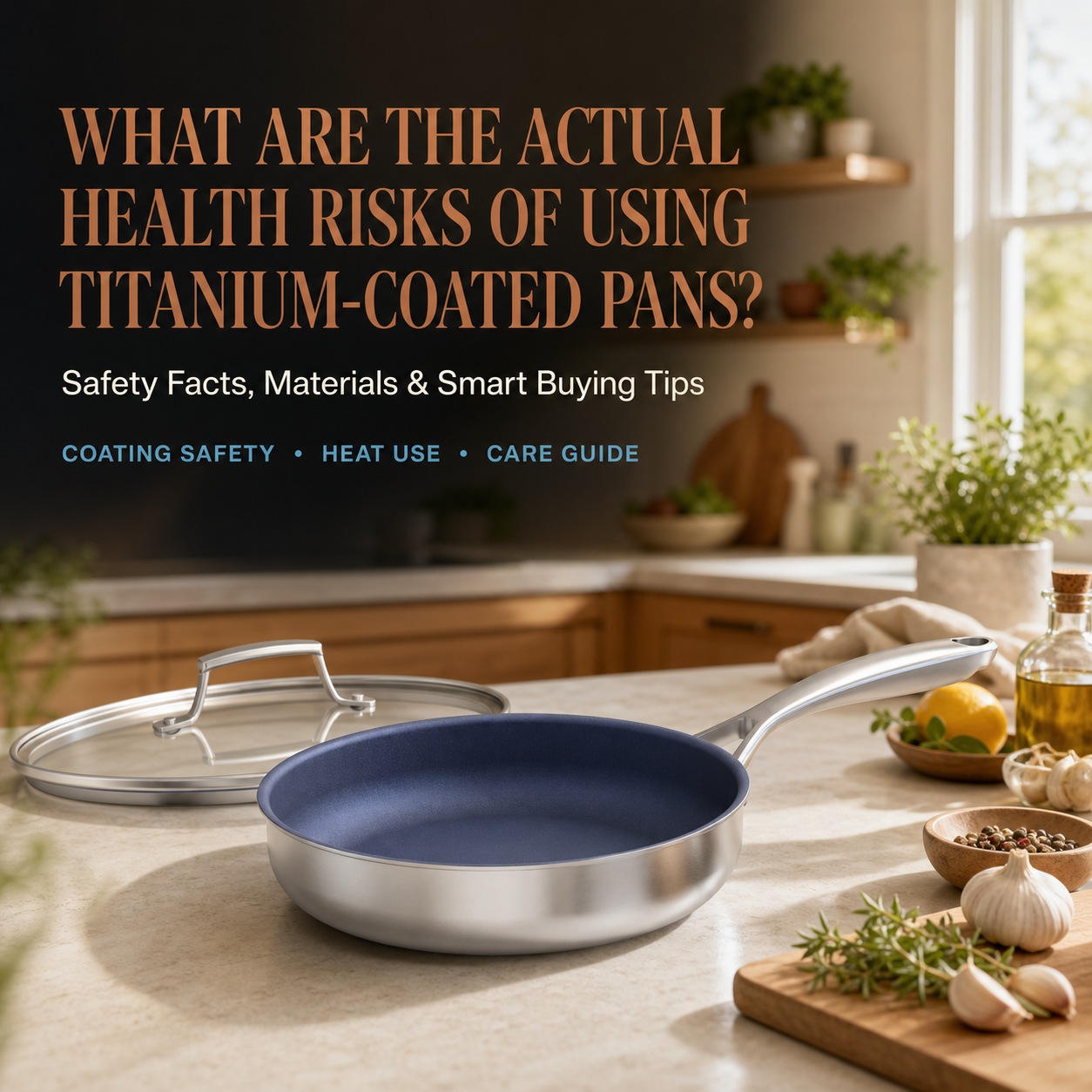
No. Do not pour cold water into a very hot pure titanium pan or a tri-ply titanium pan. Titanium is a stable cookware material, but a hot pan and cold water create a fast temperature change across the cooking surface, aluminum core, stainless exterior, rim, and base. That mismatch can stress the whole construction. The sensible routine is to let the pan cool first, then wash it with warm water. This is the practical answer to thermal shock resistance pouring cold water into hot pure titanium pan: resistance is not permission to quench a smoking-hot pan.
The question matters because "titanium cookware" can describe very different products. A thin single-wall camping pot, a titanium-coated nonstick pan, and a TITAUDOU pan with a titanium cooking surface and a multi-layer body do not react to heat in the same way. For daily cooking, the useful decision is not whether titanium has a high melting point. It is whether the complete pan is heated evenly, allowed to cool sensibly, and used within the limits of its construction.
1. What happens when cold water hits a hot titanium pan?
A pan does not cool all at once. When cold water lands on a hot cooking surface, the wet area contracts faster than the rest of the body. The base may still be hot, the sidewall may be cooler, and the handle attachment may be at another temperature again. That uneven movement is thermal shock. In a severe case it can contribute to a base that no longer sits perfectly flat, a subtle rocking motion on a glass cooktop, or stress at the rim and bonded interfaces.
The risk rises with an empty pan heated for a long time, a high-output burner, a small amount of cold water on one spot, a cold sink, or repeated abuse over many cooking sessions. It is lower when the pan was used at a controlled temperature and has already rested, but the correct habit is the same: avoid abrupt cooling. A pan can look fine after one incident and still be subjected to unnecessary stress. That is why the safe rule is based on the temperature change, not on whether a visible defect appears immediately.
This does not mean a cook must never add liquid to a hot pan. Adding a measured amount of stock, wine, sauce, or room-temperature water while cooking can be a normal part of deglazing or making a sauce. The pan remains on the burner, the liquid has a culinary purpose, and the temperature change is moderated by food and liquid already in the pan. Flooding an empty or near-empty, smoking-hot pan under a cold tap is different: the cooling is concentrated, difficult to control, and often affects the base as well as the cooking surface. Treat cooking liquid as part of a recipe, not as a way to cool cookware quickly.
2. Why multi-layer construction needs realistic heat management
Titanium, aluminum, and stainless steel have different jobs and do not expand or conduct heat in exactly the same way. In a well-made clad pan, the layers are bonded so that the body works as one cooking tool. The titanium food-contact layer provides a low-reactivity, coating-free surface; the aluminum layer spreads heat more effectively than titanium alone; and the stainless layer supports the exterior and can provide induction response. That combination improves day-to-day cooking, but it also means that violent heating and cooling is a whole-pan issue, not a titanium-only issue.
The most vulnerable moment is usually not a normal change from medium to low heat. It is a large temperature difference combined with an uneven heat pattern. For example, the centre of a pan may be much hotter than its rim after an empty preheat, while a gas burner may place more energy under one area and induction may concentrate heat through the magnetic base design. Cold water then removes heat first from the area it touches. Repeated uneven cycles can reveal a weak bond, a base that moves slightly, or a pan whose contact with a flat cooktop is no longer consistent. Good manufacturing reduces these risks; controlled use keeps them from being needlessly created at home.
| Cookware construction | What changes under fast cooling | Practical care decision |
|---|---|---|
| Thin single-wall titanium pot | A thin wall heats and cools quickly, so local hot spots and shape changes matter. | Let it rest before rinsing; do not use cold water to force cooldown. |
| Titanium-coated nonstick pan | The coating, substrate, and bond line may all have separate limits. | Follow the coating maker's care instructions and avoid thermal shock. |
| Tri-ply titanium pan | The layers distribute heat well, but abrupt temperature differences can still load the bonded body. | Use controlled heat, cool naturally, and wash when the pan is warm rather than smoking hot. |
A quality tri-ply pan should be evaluated as a bonded structure. For a deeper explanation of layer order, bonding quality, and the questions a buyer should ask, see TITAUDOU's tri-ply titanium cookware guide. The important limitation remains simple: good construction reduces normal-use risk; it does not turn thermal shock into a recommended cleaning method.
3. Pure titanium, tri-ply titanium, and the daily-cooking difference
The earlier comparison between iron, stainless steel, and titanium still matters. Iron cookware can retain heat well but may require rust prevention. Stainless cookware is familiar and durable, but it is heavier and often uses a different food-contact metal. A thin pure titanium vessel is very light and corrosion resistant, yet titanium alone is not the strongest heat-spreading choice for a frying pan. A tri-ply titanium design is the practical middle ground: it retains a titanium cooking surface while adding an aluminum heat-spreading layer and a stainless exterior.
This distinction matters when readers ask about a "pure titanium pan." A pan can have a pure titanium or GR1 titanium food-contact layer without being one solid piece of titanium throughout. That is not a weakness when it is described honestly. It is how the pan can offer more even cooking than a thin single-layer titanium vessel. For a balanced materials comparison, read pure titanium cookware versus stainless steel. The answer depends on cooking habits, food-contact priorities, and the full construction, rather than one headline material name.
4. What TITAUDOU thermal-shock testing means, and what it does not mean
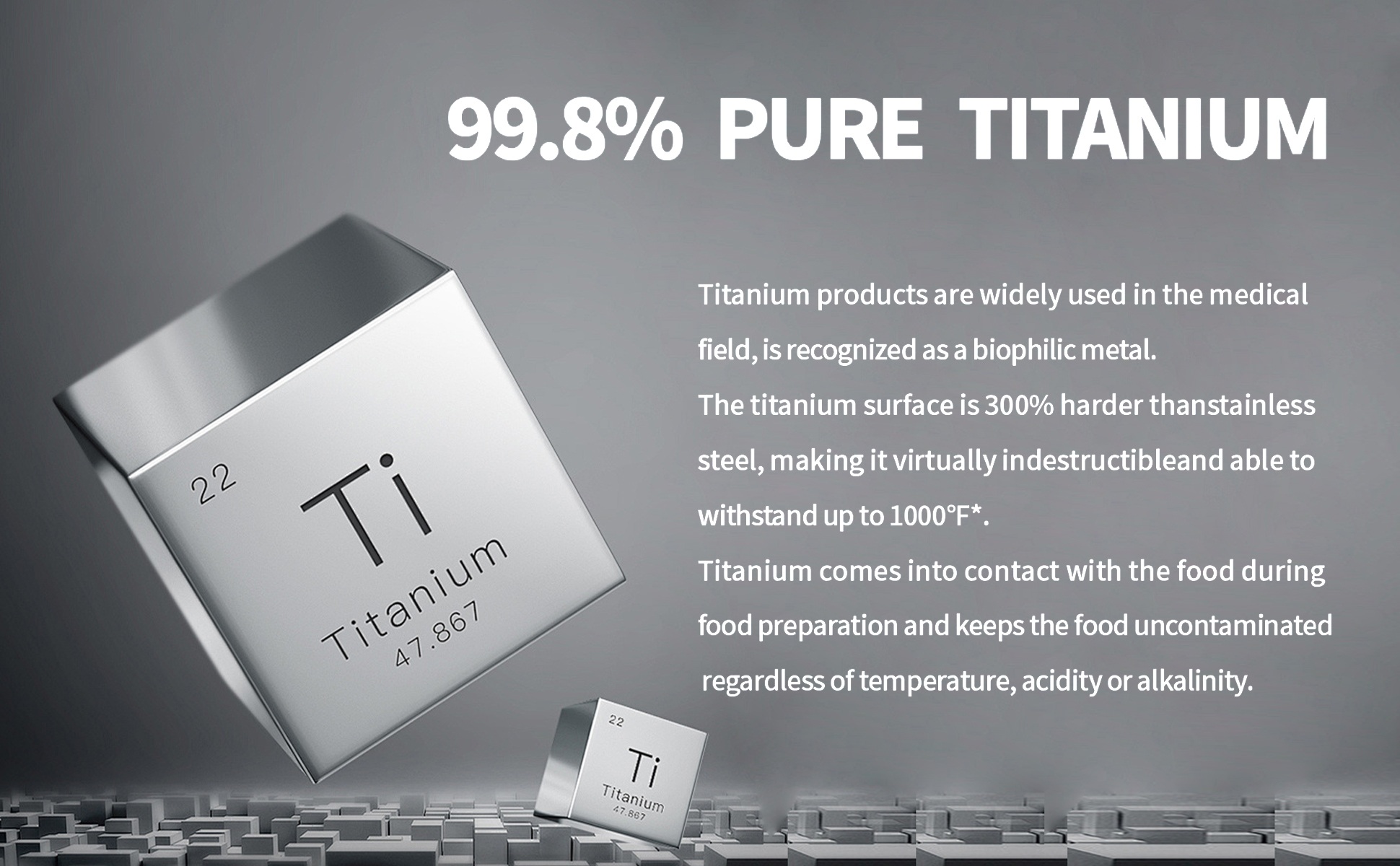
TITAUDOU states that its cookware body is made from a titanium-aluminum-stainless three-layer composite that is roll-bonded before pan forming. TITAUDOU also states that thermal-shock or heat-cycle testing is part of its material and product validation. This is the technically useful wording. The relevant question is not whether a raw material was "generated" under a test, but whether the bonded layers and finished pan are checked after controlled heating and cooling for flatness, visible separation, rim condition, and other signs of interface stress.
That validation supports manufacturing control. It does not mean an empty pan can be heated until smoking and then plunged into cold water without consequence. A meaningful test claim needs a defined method: starting and ending temperatures, heating source, cooling medium, number of cycles, pan geometry, and acceptance criteria. For an OEM, distributor, or buyer whose specification depends on thermal shock resistance, the right request is a test record for the approved SKU, together with base-flatness and layer-bond inspection results. A broad claim without those conditions is not enough for procurement or for a consumer guarantee.
The inspection should also match the risk. A three-layer blank can be checked for layer order, thickness, interface continuity, and visible voids before it is shaped. A formed frying pan needs additional checks because forming, rim finishing, handle fitting, and base geometry can introduce stresses that a flat material sample cannot show. After a controlled heat cycle, useful observations include base flatness, stable contact on a reference surface, rim condition, exposed-edge finish, surface appearance, and any evidence of blistering or delamination. The appropriate temperature range and cycle count depend on pan size, thickness, and intended stove type, so a single number should not be copied across every model.
For consumer communication, the honest message is therefore two-part: TITAUDOU uses a roll-bonded three-layer structure and subjects the construction to stated validation; users should still avoid sudden cold-water quenching. This is more credible than an absolute durability slogan because it identifies both the engineering control and the operating limit.
This approach is stronger than saying titanium is "unafraid of high heat." Cookware quality is demonstrated by controlled design and verification, followed by sensible use. The same principle applies to all clad cookware: testing can show that a pan withstands defined cycles, while daily care avoids unnecessary extremes.
5. A safer cooling and cleaning routine after high-heat cooking
After searing, stir-frying, or reducing a sauce, move the pan off the active burner and let it rest on a heat-safe surface. Do not put a hot base on a wet counter or directly into a cold sink. Wait until the pan is comfortably warm rather than extremely hot, then use warm water and a soft sponge or brush. If food is stuck, add warm water after the pan has cooled enough to handle, let it loosen, and clean without scraping aggressively at one spot.
| Situation | Do this | Avoid this |
|---|---|---|
| The pan is very hot after searing | Remove it from heat and allow a natural rest. | Running cold tap water over the cooking surface or base. |
| Browned food is stuck to the surface | Let the pan cool, then soak with warm water and mild detergent. | Using a temperature shock as a shortcut for cleaning. |
| The pan has changed colour after heat | Allow it to cool and assess the surface under normal light. | Assuming colour alone proves structural damage. |
Controlled preheating also helps. Start at low to medium heat, add food or oil at the appropriate point for the recipe, and increase power only when needed. Long empty overheating creates a larger temperature gap to manage later. For step-by-step cleanup after the pan has cooled, use this titanium cookware cleaning guide.
If timing is important, transfer the food to a serving dish first and leave the empty pan in a safe, dry place for several minutes. Do not rely on the handle temperature alone: the handle may be cooler than the centre of the pan. Once the surface is warm rather than intensely hot, warm water is a better first rinse than cold water. This small pause protects the pan and makes cleaning safer for the person at the sink as well.
6. Inspect the pan after an accidental cold-water rinse
One accidental rinse does not automatically mean the pan is ruined. Let it return to room temperature, dry it, and inspect it calmly. On a flat cooktop or a known flat surface, check whether the base rocks. Look for a persistent raised or dipped centre, a changed rim, visible separation at an exposed edge, or a new noise when the pan is placed on the stove. These signs matter more than a momentary hiss when water first touched the pan.
Heat colours are a separate issue. A blue, gold, or rainbow tone can be a surface-oxide colour change and does not by itself demonstrate warping or delamination. Do not use harsh grinding or chemicals before you understand what changed. See why titanium cookware changes colour for surface-care guidance. If the base is no longer stable, stop using it on a smooth glass cooktop until the condition has been assessed.
A quick functional check is more useful than guessing from appearance. Put the clean, cool pan on the intended cooktop or a verified flat surface and press gently at opposite edges. If it rocks, if oil now runs sharply to one side, or if a new gap is visible at a rim or handle fitting, document the condition and contact the supplier with the SKU and photos. Do not try to bend a multi-layer pan back by force. An apparently simple correction can create more stress at the bonded interfaces.
7. Buy and use the pan based on the complete specification
For everyday cooks, the useful checklist is simple: identify the actual cooking-surface material, choose a pan with a heat-spreading structure appropriate to the stove, preheat with control, and cool it gradually. For buyers and private-label programs, ask for more than a material label. Confirm the layer stack, bonded-body coverage, finished-pan thickness, induction compatibility, base-flatness check, and the heat-cycle or thermal-shock validation method tied to the chosen SKU.
Do not rely on claims that a pan "will never warp." No cookware maker can responsibly promise that against unlimited heat and abrupt cooling. A better standard is a well-specified pan, verified production controls, and realistic care. For the separate causes of base movement and prevention steps, read does titanium cookware warp?.
Conclusion
A titanium cooking surface and a well-made tri-ply body can be excellent for daily cooking, but neither changes the basic rule of thermal management. Let a hot pan cool before washing. TITAUDOU's stated three-layer roll-bonded construction and thermal validation are relevant quality controls, yet the strongest customer guidance remains practical: use controlled heat, avoid empty overheating, and never treat cold-water quenching as normal cookware care.
Frequently Asked Questions
1. Can I pour cold water into a hot pure titanium pan?
No. Let the pan cool first, then wash it with warm water. This avoids an unnecessary temperature difference across the pan body and its bonded layers.
2. Does thermal-shock testing mean a TITAUDOU pan cannot warp?
No. Defined thermal testing can support manufacturing validation, but it is not a promise against every misuse condition. Avoid long empty overheating and sudden cold-water cooling, and ask for the relevant test method when a documented performance requirement matters.
3. Is colour change after high heat the same as thermal-shock damage?
Usually not. Titanium can show heat-related oxide colours without structural damage. Check for rocking, a changed base shape, or visible edge separation rather than treating colour alone as evidence of a damaged pan.