If you want to know how to properly preheat a pure titanium skillet before cooking, the short answer is: start with a clean dry pan, use low to medium heat, wait until a few drops of water bead and glide, lower the heat slightly if needed, then add oil and food. Pure titanium does not need a long cast-iron-style warm-up, and it should not be left empty over high heat while you prepare ingredients.
Preheating matters because titanium behaves differently from coated aluminum, cast iron, and stainless steel. A real pure titanium food-contact surface is coating-free and corrosion resistant, but it is not a magic nonstick layer. Food release still depends on surface temperature, moisture removal, oil timing, and patience. When the pan is too cold, proteins bond before the surface stabilizes. When the pan is too hot, oil smokes and food can scorch before it has time to release.
This guide explains preheating for pure titanium and tri-ply titanium cookware in practical kitchen terms. It is written for home cooks, brand owners, importers, and OEM buyers who need clear instructions, not vague claims that titanium cookware is automatically nonstick. For a broader product view, TITAUDOU's titanium pots and pans use a GR1 pure titanium food-contact layer, a 1050 aluminum heat-spreading core, and a 430 stainless steel exterior for induction compatibility.
1. The Direct Answer: Use a Short, Controlled Preheat
The correct preheat for a titanium skillet is controlled, not extreme. Put the empty clean skillet on the burner, choose low or medium heat, and give the metal enough time to become evenly warm. For many daily cooking tasks, that means roughly one to three minutes, but the real signal is behavior, not a clock. A small splash of water should form moving beads rather than instantly flattening into steam. After that, add oil, spread it thinly, and begin cooking when the oil looks fluid and lightly shimmering.
The phrase how to properly preheat a pure titanium skillet before cooking should not be interpreted as "make the pan as hot as possible." Overheating an empty pan darkens oil, increases smoke, and can make delicate foods stick harder. Titanium cookware rewards moderate heat because food chemistry still follows ordinary rules: water must evaporate, oil must form a thin barrier, and proteins need time to set before being moved.
A useful mental model is "warm the metal, then manage the food." With eggs, pancakes, fish, tofu, and lean chicken, preheat gently and use enough fat to cover the contact area. With meat searing, preheat a little longer and make sure the food surface is dry before it touches the pan. With vegetables, preheat less aggressively because water from the vegetables will quickly pull heat from the surface. The goal is not one fixed temperature for every recipe; it is a repeatable decision process.
2. Why Pure Titanium Needs Heat Control, Not Cast-Iron Seasoning
Many cooks ask about titanium preheating because they are comparing it with cast iron. That comparison is only partly useful. Cast iron is heavy, slow to respond, and often used with a polymerized seasoning layer. Pure titanium is different. It is selected for corrosion resistance, low reactivity, light handling, and a clean metal surface, not because it should be treated like a seasoned cast-iron skillet.
A pure titanium surface does not require seasoning in the traditional cast-iron sense. Oil can help release food, but that is not the same as building a permanent seasoning film. Telling customers to "season titanium like cast iron" often leads to overheating, sticky residue, and disappointed users. A better instruction is simple: clean the pan well, preheat moderately, add oil at the right time, let food release naturally, then wash the surface fully after cooking.
This distinction also matters for brands. If the product is described as coating-free pure titanium, the user manual should not imply that a hidden nonstick coating exists or that the pan will behave like PTFE. A more credible explanation is that titanium is a durable food-contact metal, while food release comes from correct technique. The article is titanium cookware nonstick without coating explains this difference in more detail.
3. Pure Titanium vs Tri-Ply Titanium: Preheat the Actual Structure
The right preheat habit depends on the pan structure. A thin single-ply titanium camping pan and a tri-ply titanium frying pan should not be treated as the same tool. Titanium has relatively low thermal conductivity compared with aluminum, so a thin titanium-only pan can show hot spots if the burner is narrow or the flame is too strong. Structure and heat management matter.
Tri-ply titanium cookware solves a different problem. In TITAUDOU's construction, the GR1 pure titanium inner layer is the food-contact surface, the 1050 aluminum core spreads heat, and the 430 stainless steel exterior gives structure and induction compatibility. The cook still touches and cleans titanium on the inside, but the pan does not depend on titanium alone to move heat across the base. That is why tri-ply titanium can be easier to preheat evenly than a very thin pure titanium sheet.
This is also why how to properly preheat a pure titanium skillet before cooking is not only a user question; it is a product-design question. A buyer should ask whether the cookware is single-ply titanium, titanium-coated aluminum, or real tri-ply titanium. A coated pan follows coating temperature limits. A single-ply pan needs more careful burner matching. A tri-ply titanium pan should be preheated like a responsive clad pan: moderate heat first, then food-specific adjustment. For a deeper explanation of heat behavior, see TITAUDOU's guide on titanium cookware heat distribution.
| Cooking Task | Preheat Level | Oil Timing | Practical Sign |
| Eggs and pancakes | Low to medium-low | Add oil or butter after gentle preheat, then wait briefly. | Butter foams without browning immediately; eggs set before sliding. |
| Fish, tofu, lean chicken | Medium-low to medium | Add oil after the pan passes a mild water-drop check. | Food releases after the first side forms a thin crust. |
| Steak and seared meat | Medium to medium-high after gradual warming | Add high-smoke-point oil after the pan is hot. | Oil shimmers; meat sizzles on contact without burnt oil smell. |
| Vegetables and aromatics | Medium | Add oil after preheat, then add food soon after. | Aromatics sizzle gently, not sharply or unevenly. |
4. Step-by-Step Routine for Daily Cooking
Start by cleaning and drying the skillet. Old oil film, starch residue, and mineral spots can interfere with food release. A pan that looks slightly cloudy may still cook well, but a sticky film from overheated oil should be removed before the next preheat. Place the pan on a burner that matches the base diameter. A flame that climbs around the sides or a small induction zone under a large base can create uneven heating before the cook even adds food.
Turn the stove to low or medium heat. On gas, use a steady flame that stays under the base. On induction, avoid jumping straight to boost mode. On glass electric, allow more time because the heating element cycles and the surface responds slowly. After the pan warms, test with a few drops of water. If the drops sit flat and boil weakly, wait a little longer. If they bead and move, the pan is ready for most foods. If they explode into steam immediately, the pan is too hot; lower the heat and wait before adding oil.
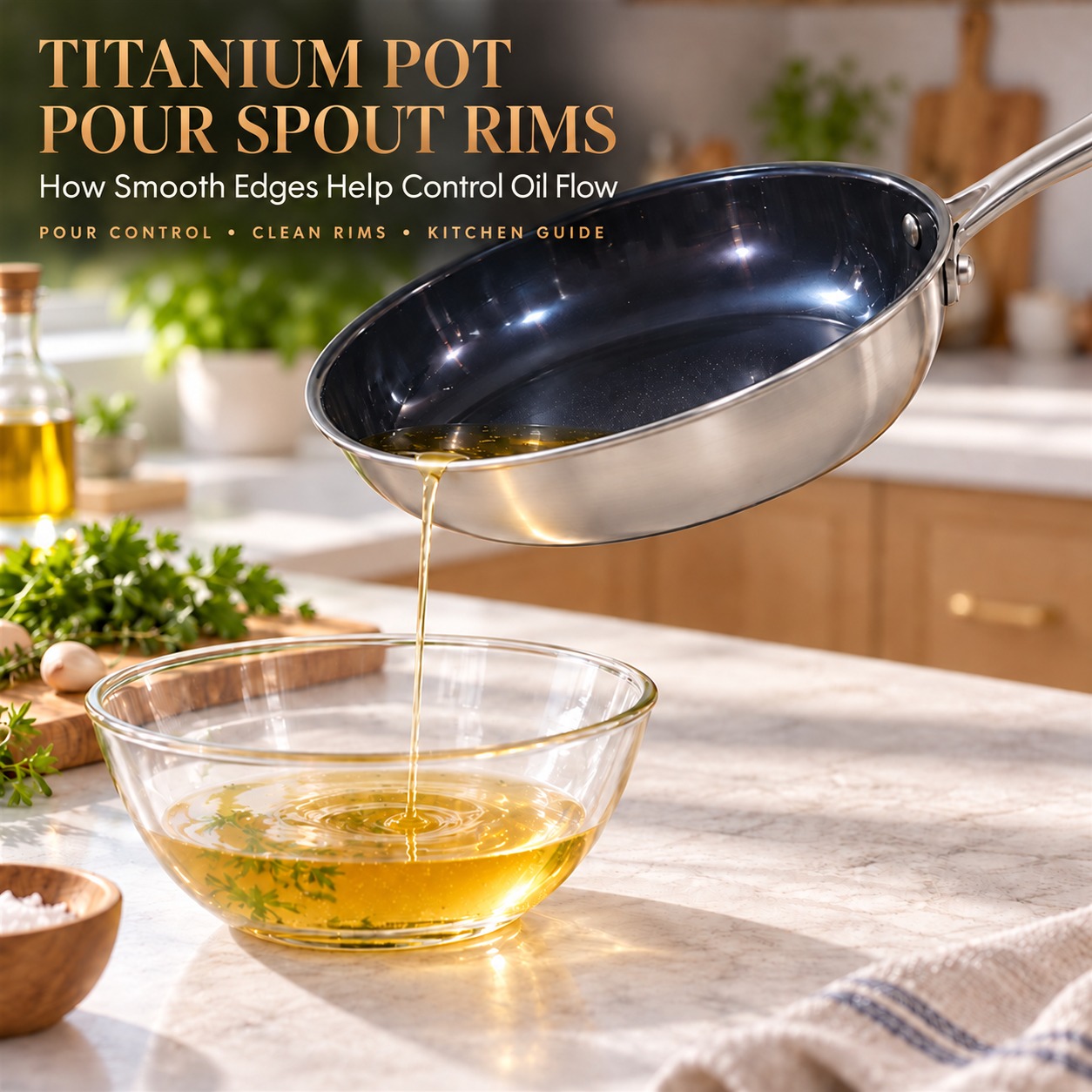
Add oil after the pan is warm, not at the beginning of a long preheat. This reduces smoking, gummy residue, and burnt flavors. Tilt or brush the oil so it covers the cooking zone. Then add food that has been patted dry. Moisture is one of the most common reasons food sticks because the pan must evaporate water before browning can begin.
Once the food is in the skillet, do less. Do not scrape, drag, or flip too early. Proteins often grip the surface first, then release when the seared layer forms. If you force the food before that moment, you tear the surface and leave residue behind. This is why correct preheating and patience are a pair. The article on why eggs stick to titanium pans explains this timing problem for the most sensitive everyday food.
5. The Water-Drop Test and Oil Timing
The water-drop test is useful because it gives visual feedback. A cold pan makes water spread and simmer. A properly preheated pan makes the droplets pull together and move. An overheated pan makes water flash away too violently. The test is not a laboratory thermometer, but it helps users stop guessing. For delicate food, use a mild version of the test and then reduce the heat slightly before adding oil. For searing, allow stronger heat, but still avoid smoking oil before food is added.
Oil timing is just as important as pan temperature. Oil added to a cold pan may sit in a thicker layer while the metal warms unevenly. Oil left in an empty hot pan too long may smoke and polymerize into a sticky varnish. The practical answer is to preheat the clean metal first, add oil shortly before the food, and start cooking while the oil still looks fresh. If the oil smells burnt, wipe out the pan after it cools and restart. Burnt oil is not seasoning; it is residue.
Different fats behave differently. Butter works better with lower heat or with a small amount of neutral oil. Olive oil can be used for moderate cooking, but it should not be pushed until it smokes. High-smoke-point oils are better for searing. No oil choice turns a titanium skillet into a disposable nonstick pan, but the right fat at the right moment gives a reliable release layer.
6. Troubleshooting: Sticking, Smoking, Warping, and Uneven Heat
When a titanium skillet disappoints, the cause is usually visible in the first few minutes. If food sticks immediately, the pan may be too cold, too dry, dirty with old residue, or overloaded with wet food. If oil smokes before cooking begins, the pan is too hot or the oil was added too early. If browning happens only in a ring, the burner is too small, the heat is too high, or the pan is a thin single-ply design that cannot spread heat broadly enough for that burner.
Users also confuse preheating with thermal abuse. Putting any empty pan over maximum heat for a long time can discolor surfaces, burn residual oil, and create temperature differences across the base. A well-made tri-ply titanium skillet is designed for normal cooking heat, not for empty-pan stress tests. If a pan rocks or spins on a glass stove after repeated overheating, the issue may be base flatness or thermal stress.
| Problem | Likely Cause | Fix |
| Eggs grip and tear | Pan too cold, too little fat, or eggs moved too early. | Use lower heat, preheat gently, add enough fat, and let the surface set. |
| Oil smokes before food enters | Pan overheated or oil added too early. | Cool slightly, wipe if needed, then add fresh oil just before cooking. |
| Food browns in one narrow zone | Burner mismatch, excessive heat, or thin single-ply construction. | Use a burner closer to the base size and consider tri-ply titanium for frying. |
| Sticky brown film after cooking | Oil overheated and polymerized into residue. | Clean fully before next use; do not treat burnt residue as seasoning. |
Cleaning is part of preheating because yesterday's residue becomes today's sticking problem. A pure titanium surface can tolerate more assertive cleaning than a coated nonstick surface, but technique still matters. Let the pan cool enough to handle, soak if residue is stubborn, and use a non-abrasive pad for routine cleaning. If the product is TITAUDOU's hardened pure titanium surface, stronger physical cleaning is part of the product advantage, but users should still avoid creating burnt-on oil through unnecessary high empty heat. For cleaning details, see the guide on how to clean titanium cookware.
7. B2B Guidance: Write Preheating Into the Manual
For importers, wholesalers, private-label cookware brands, and e-commerce sellers, preheating instructions directly affect reviews, return rates, customer service questions, and how buyers understand the product category. If a titanium skillet is sold as "nonstick" without explaining technique, users may expect PTFE-like release. If it is sold only as "pure titanium" without explaining heat behavior, users may overheat it and blame the material.
A good manual should answer how to properly preheat a pure titanium skillet before cooking in one simple routine, then add food-specific guidance. It should say to start low or medium, use the water-drop test, add oil after the pan is warm, avoid long empty high-heat preheating, and allow proteins to release before turning. It should also separate pure titanium, titanium-coated nonstick, and tri-ply titanium so customers do not transfer the wrong care rules from one product type to another. TITAUDOU's guide to titanium-coated vs real titanium cookware is useful training material for this distinction.
For OEM and ODM programs, the preheating guide should match the actual construction. A thin outdoor titanium pan, a thicker titanium pot, and a tri-ply titanium skillet need different customer education. TITAUDOU can support cookware programs with material structure explanation, surface-treatment options, handle choices, laser marking, packaging customization, and private-label documentation. The practical value is not only manufacturing the pan; it is helping the buyer reduce misuse by explaining the product honestly.
Conclusion
Learning how to properly preheat a pure titanium skillet before cooking is mostly about restraint. Use a clean dry pan, warm it gradually, confirm readiness with a water-drop check, add oil shortly before food, and avoid forcing food before it naturally releases. That routine gives pure titanium cookware the best chance to perform as intended: durable, coating-free, corrosion resistant, and practical for daily cooking.
The bigger lesson is that titanium cookware should be explained by structure. Single-ply titanium needs careful heat control. Titanium-coated nonstick follows coating limits. Tri-ply titanium uses GR1 pure titanium for food contact and an aluminum core for heat distribution, which makes preheating more predictable. For brands and buyers, clear preheating instructions are part of the product quality, not an optional blog topic.
Frequently Asked Questions (FAQ)
Q1: How long should I preheat a pure titanium skillet?
Most daily cooking only needs a short low-to-medium preheat, often about one to three minutes depending on the stove and pan structure. Use the water-drop test and oil behavior instead of relying only on time.
Q2: Should I add oil before or after preheating titanium cookware?
For most skillet cooking, preheat the clean metal first, then add oil shortly before adding food. This helps avoid smoking oil, sticky residue, and the false idea that burnt oil is a useful seasoning layer.
Q3: Does knowing how to properly preheat a pure titanium skillet before cooking make it fully nonstick?
No. Correct preheating improves food release, but pure titanium is still a coating-free metal surface, not a PTFE-style nonstick coating. Use moderate heat, enough fat, dry food surfaces, and patience before flipping.