Can pure titanium pans go directly into a hot oven? In most normal kitchen use, the pure titanium cooking surface can handle oven heat, but the whole pan is only oven-safe when every part of the product is designed for that temperature. The metal surface is not the weak point. Handles, knobs, glass lids, silicone parts, coatings, adhesives, and the way the pan is built are usually the real limits.
This upgraded guide keeps the original use-and-care purpose of the article, but answers the oven question more directly. It explains when a pure titanium pan can move from stovetop to oven, when it should not, and how consumers, importers, and cookware brands should verify the claim before writing “oven safe” into product pages, manuals, or packaging.
1. The Short Answer: Titanium Metal Is Heat Stable, But the Whole Pan Must Be Rated
A genuine pure titanium food-contact surface is highly heat stable compared with the temperatures used in a home oven. Normal baking, roasting, and finishing a dish in the oven do not come close to the melting point of titanium. That is why titanium is used in demanding industrial and medical applications, and why it can be a practical surface for cookware that sees repeated heat cycles.
However, cookware safety is not decided by one metal layer alone. A pan is a system. The inside may be GR1 pure titanium, the core may spread heat, the exterior may support induction or glass stovetops, and the handle may use stainless steel, silicone, plastic, wood, or a mixed structure. A glass lid may have a knob or vent that fails before the metal body has any problem. This is why a responsible answer should be: pure titanium can tolerate oven heat, but the product must be confirmed oven-safe as a complete pan.
For TITAUDOU buyers, the useful question is not only “is titanium oven safe?” The better question is: what exactly touches food, what carries the heat, what parts are attached to the body, and what temperature has the finished cookware been designed to handle? If a product page does not answer those questions, the oven-safe claim is incomplete.
2. Directly Into a Hot Oven: What Changes Compared With Slow Heating?
Putting a room-temperature pan into a preheated oven is different from heating a pan slowly on the stovetop. The outside air, oven rack, pan walls, handle attachment points, and any lid hardware may heat at different speeds. The issue is not that titanium suddenly becomes unsafe. The issue is thermal stress across the complete product, especially when the pan has several materials bonded together.
In normal cooking, direct oven transfer is common. A cook may sear chicken on the stovetop and finish it in the oven, roast vegetables in a shallow pan, or keep a dish warm before serving. Those are reasonable tasks if the pan is designed for them. The risk increases when the oven is extremely hot, the broiler is on, the pan is empty for too long, or the handle contains heat-sensitive parts.
Avoid the simple mistake of judging oven safety by color or weight. Titanium is light, and a light pan may feel less intimidating than cast iron, but light weight does not automatically mean weak heat resistance. At the same time, a premium-looking handle does not guarantee oven compatibility. If the handle is not rated, treat the pan as stovetop-only until the supplier confirms otherwise.
A useful home check is to separate the recipe question from the product question. The recipe may only need a short oven finish, but the product still has to survive repeated heating without loose hardware, softened grips, or confusing care instructions. If you cannot find a clear oven rating, do not guess based on the word titanium. Use the pan on the stovetop, contact the seller, or choose a model with a published oven-use statement.
| Oven situation | Usually acceptable when | Main caution |
|---|---|---|
| Baking or roasting at normal oven heat | The finished pan, handle, and lid are rated for oven use | Use dry oven mitts; handles become very hot |
| Stovetop sear followed by oven finish | The base is flat, clean, and not overheated while empty | Do not shock a hot pan with cold water after removal |
| Broiler or direct top heat | The supplier explicitly allows broiler use | Many lids, knobs, and handles are not safe under direct radiant heat |
| Empty pan left in a very hot oven | Only if the use is specified and time is controlled | Unnecessary dry heating can discolor surfaces and stress parts |
3. Pure Titanium vs. Titanium-Coated Cookware in the Oven
The phrase titanium cookware can hide several different products. A pure titanium cooking surface is not the same as a titanium-colored coating, a titanium-reinforced PTFE coating, or a ceramic coating promoted with titanium language. This distinction matters more in a hot oven because coatings, binders, and decorative layers may have lower temperature limits than bare metal.
A solid or bonded pure titanium food-contact layer does not peel like a sprayed nonstick film. It may change color after heat exposure because titanium oxide film thickness can shift under high temperature, creating gold, blue, purple, or rainbow tones. That color change is not the same as coating failure. If the pan is a coated nonstick product, however, scratches, overheating, or aging may damage the functional layer. For that separate risk, read the guide on titanium-coated pan health risks.
TITAUDOU’s stronger position is structure transparency. Selected cookware uses a real GR1 pure titanium food-contact surface rather than a titanium coating. That surface is chosen for low reactivity, corrosion resistance, and long service life. When the pan is built as a tri-ply structure, the inner titanium layer protects food contact while the heat-spreading layer supports cooking performance. Buyers can compare product families from the titanium pots and pans category before deciding which model fits oven use.
4. Handles, Lids, Knobs, and Edges Are the Real Oven-Safe Checkpoints
If a buyer asks whether pure titanium pans go directly into a hot oven, the inspection should start away from the cooking surface. Look at the handle. A stainless steel handle may tolerate oven heat better than plastic, but it also becomes hot enough to burn skin. A silicone grip may be comfortable on the stovetop but limited in the oven. A wood handle may not be suitable at all. A detachable handle may need to be removed before oven use.
For TITAUDOU three-layer titanium cookware, the correct oven-use choice is a steel handle. Do not use a wood handle for hot-oven cooking. Steel handles are better suited to direct oven exposure because they can be rated as part of the full metal system. Wood handles can char, dry out, crack, or become unsafe long before the titanium surface itself has any issue.
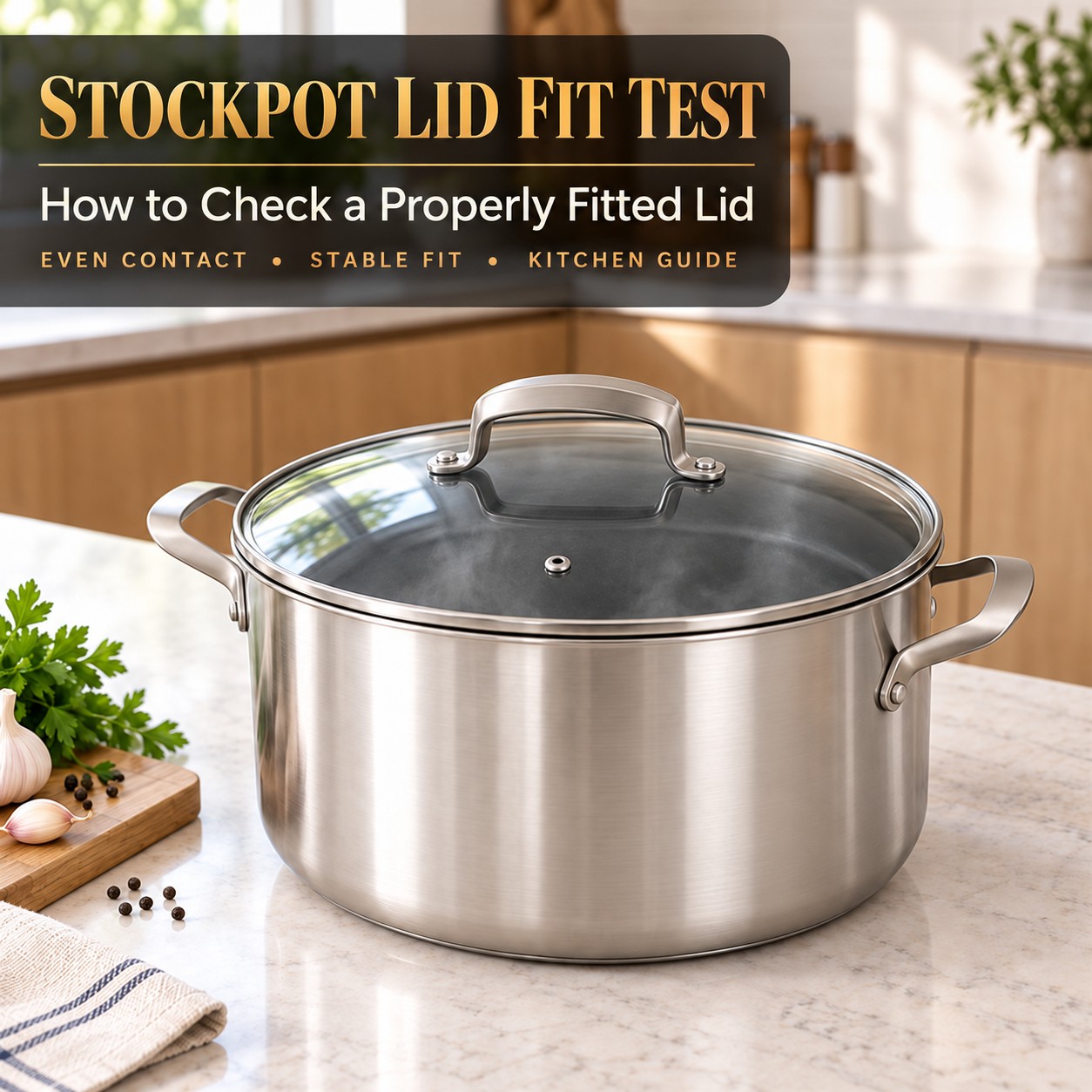
The lid needs the same attention. Tempered glass, vents, knobs, seals, and decorative rims each have their own limits. A metal pan body may be safe for roasting while its glass lid is not safe for broiling or high heat. If the recipe requires a covered oven braise, check the lid rating separately instead of assuming the pan body rating applies to the full set.
Edges and attachment points also matter. A well-built multi-layer pan should have stable bonding and clean finishing around the rim. Poor edge sealing can trap residue, create cleaning problems, or expose non-food-contact layers. Rivets, welds, and screws should be suitable for repeated heating. If your main concern is handle heat transfer during daily cooking, see why titanium cookware handles get hot.
This is also where many marketplace listings become weak. They may say “titanium pan” in the title but fail to identify the handle material, lid material, or oven limit. For a consumer, that creates uncertainty. For a B2B buyer, it creates labeling risk. A private-label brand should not approve packaging artwork until the supplier confirms whether the rating applies to the pan body only, the pan with lid, or every accessory in the retail box.
5. How to Move a Titanium Pan From Stovetop to Oven Safely
A practical oven routine is simple. First, confirm the pan and all attached parts are oven-rated. Second, use moderate stovetop heat to preheat the pan instead of blasting an empty pan on the highest burner. Third, add food or oil at the right time, then transfer the pan carefully to the oven with dry mitts. Fourth, place the pan on a stable rack, leaving enough clearance around the handle. Fifth, after cooking, rest the pan on a heat-safe surface and let it cool before washing.
Do not move a very hot pan straight into cold water. Titanium itself resists corrosion, but sudden temperature change can stress a multi-material cookware system. It can also create steam burns or damage the sink area. Let the pan cool until it is safe, then clean it with warm water, mild detergent, and a suitable sponge. If food burns during oven finishing, use the steps in how to clean titanium cookware rather than attacking the surface while it is still hot.
Some discoloration after oven use is normal on bare titanium. Heat tint is usually cosmetic, not a safety failure. Users who want to restore a brighter surface should use a gentle cleaning method matched to the confirmed surface type. For polished surfaces and rainbow heat marks, the polished titanium surface finish guide explains safer restoration options.
| Part to verify | What to ask the supplier | Why it matters |
|---|---|---|
| Food-contact surface | Is it GR1 pure titanium, coating, ceramic, or PTFE-reinforced? | Oven behavior differs sharply between bare metal and coatings |
| Pan body | What is the layer structure and bonding process? | Multi-material pans need stable construction through heat cycles |
| Handle and knob | What is the confirmed oven temperature limit? | These parts often limit oven use before titanium does |
| Manual and packaging | Does the oven-safe claim match the actual product configuration? | B2B claims must be consistent across sales pages, labels, and instructions |
6. TITAUDOU Manufacturing Notes for Oven-Safe Claims
For importers and private-label brands, “oven safe” should not be copied from a generic material description. It should be tied to the specific model. A frying pan with a stainless handle may have a different oven limit from a saucepan with a lid, a pot with side handles, or a skillet with removable silicone parts. If the product changes, the claim should be checked again.
TITAUDOU’s cookware position is strongest when it explains both the titanium surface and the full construction. The food-contact side can be real pure titanium. The middle layer can improve heat spreading. The exterior can be selected for stove compatibility and strength. The handle system, rim, lid, and packaging instructions then define how the finished product should be used in the oven.
Surface hardening can support daily durability, scratch resistance, and cleaning tolerance on applicable titanium surfaces. TITAUDOU’s hardening technology rearranges titanium molecules under high temperature, raising an ordinary titanium surface from about HV150-200 to about HV600-800 on selected processes and models. That is a surface-performance claim, not permission to ignore handle, lid, or product-rating limits. To understand the hardness side separately, see what makes titanium cookware scratch resistant.
For TITAUDOU three-layer titanium cookware, the recommended oven temperature should not exceed 500°C. Above that level, the middle aluminum layer may start to delaminate, and the cookware structure can be damaged. That limit is not about the titanium surface melting. It is about protecting the bonded tri-ply construction so the pan keeps its shape, bond strength, and cooking performance over time. If a supplier cannot state this limit clearly, the oven-safe claim is too vague.
A defensible B2B oven-safe statement should include the tested product version, the maximum recommended oven temperature, whether the lid is included in that rating, whether broiler use is allowed, and whether detachable accessories must be removed. That level of detail protects the buyer and the brand better than a vague “high temperature resistant” sentence.
For sample approval, the practical test should match real use. Heat the pan with food or a cooking medium, transfer it to a preheated oven for the intended time, let it cool naturally, then inspect the base, rim, handle joint, lid fit, and surface appearance. Repeat the cycle if the product will be sold as suitable for regular oven finishing. Record whether any handle becomes loose, any decorative part changes, or any instruction conflicts appear. That record gives the oven-safe claim a real product basis.
7. Final Use and Care Decision
So, can pure titanium pans go directly into a hot oven? Yes, when the product is built and rated for oven use as a complete pan. The pure titanium surface is not the part that normally creates concern. The real decision depends on the handle, lid, knob, exterior finish, bonding, accessories, and the supplier’s finished-product instructions.
For home cooks, the safest habit is to treat oven transfer as a controlled step, not a casual toss into heat. Check the rating, remove non-oven accessories, use mitts, avoid direct broiler heat unless approved, and cool the pan before washing. For buyers and brands, ask for product-specific documentation before using oven-safe language in listings or manuals.
Titanium cookware works best when its strengths are described precisely. It can offer a clean food-contact surface, corrosion resistance, light handling, and long service life. It should not be marketed as magic metal that removes every design limit. A good oven-safe titanium pan is not just titanium. It is titanium plus the right structure, verified parts, and clear care guidance.
Frequently Asked Questions
Q1: Can pure titanium pans go directly into a hot oven from the stovetop?
They can when the finished pan is oven-rated, including the handle and any lid. The titanium cooking surface can handle normal oven heat, but the complete product configuration decides whether direct oven transfer is appropriate.
Q2: Will a pure titanium pan be damaged or release chemicals in the oven?
A genuine uncoated pure titanium surface should not behave like a synthetic coating in normal oven use. It may develop heat color, but that is different from peeling. Coated titanium-labeled pans must be judged by their coating system and temperature rating.
Q3: Can I put a titanium pan under the broiler?
Only if the supplier specifically allows broiler use for that exact model. Broilers create intense direct radiant heat, and lids, handles, knobs, silicone parts, and decorative components may fail even when the metal pan body is heat stable. For TITAUDOU three-layer titanium cookware, stay within the stated oven limit of 500°C and use a steel handle instead of a wood handle if the cookware is meant for oven transfer.