Evaluating the industry trends and potential of titanium cookware reveals a structural transformation across the global housewares sector. Once confined to ultralight backpacking mess kits, pure and multi-ply clad titanium cookware is rapidly capturing mainstream domestic, maternal, and commercial kitchen market share. Valued at $2.29 billion in 2023 and reaching $2.75 billion in 2025, the global titanium cookware market is projected to reach $3.92 billion to $4.00 billion by 2030, expanding at a compound annual growth rate (CAGR) of 7.9%—nearly triple the growth rate of conventional stainless steel and aluminum cookware.
This expansion is propelled by three converging macroeconomic forces: tightening global regulatory bans on per- and polyfluoroalkyl substances (PFAS/PTFE), breakthroughs in tri-ply metallurgical roll-bonding that resolve titanium's native thermal conductivity limits, and consumer migration toward "buy-it-for-life" non-toxic kitchen assets. For kitchenware brand owners, retail procurement directors, and OEM/ODM distributors, understanding these empirical market trajectories, regional demand engines, and engineering standards is essential for capturing high-margin growth through 2030.
1. Global Market Trajectory: From $2.29 Billion to $3.92 Billion by 2030 (7.9% CAGR)
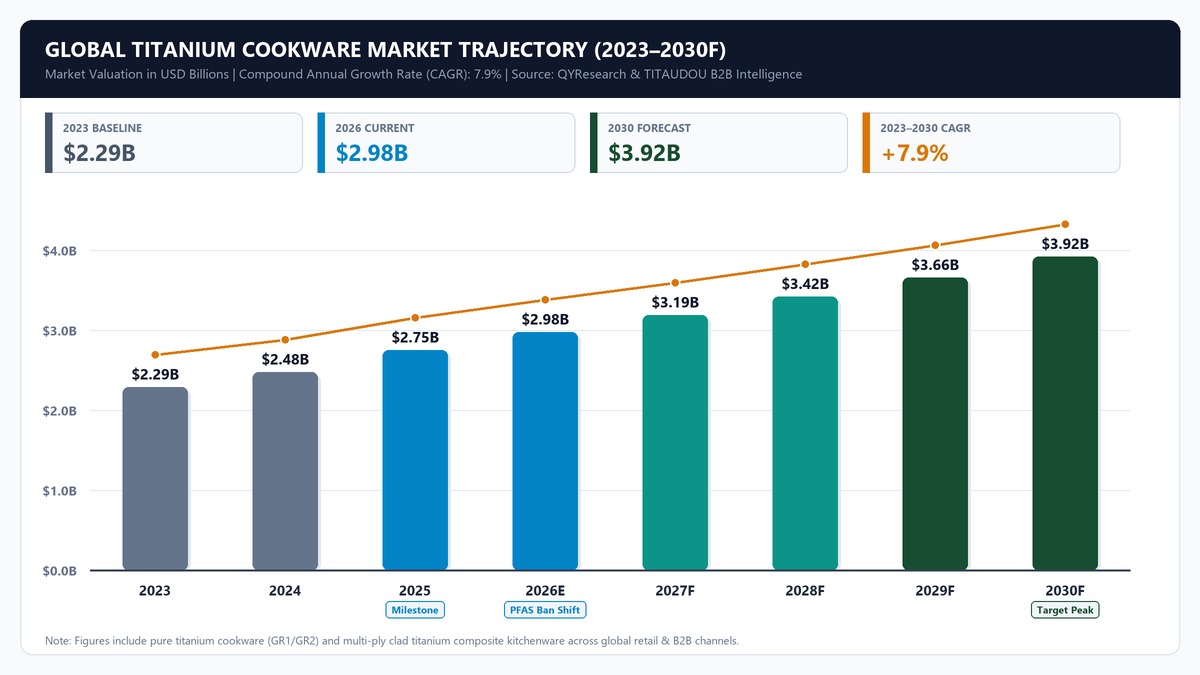
While the broader legacy kitchenware market has entered a mature stock-replacement phase with low single-digit growth (2.5% to 3.2% annually), the titanium cookware segment exhibits sustained counter-cyclical acceleration. According to aggregated industry tracking from QYResearch and global trade data, total market revenue expanded from $2.293 billion in 2023 to approximately $2.75 billion in 2025, and is on track to reach $2.98 billion in 2026 before climbing to $3.918 billion by 2030.
 \n
Figure 1: Global Titanium Cookware Market Size Trajectory (2023–2030F), illustrating the 7.9% CAGR expansion to $3.92 billion.
Unlike previous cookware fads driven by superficial cosmetic colors, the current titanium expansion is characterized by simultaneous growth in unit volume and average selling price (ASP). Three fundamental market mechanics underpin this trajectory:
- Accelerated Replacement of Short-Lived Pans: Households accustomed to replacing degraded PTFE or sol-gel ceramic pans every 18 to 24 months are shifting capital toward permanent, uncoated metallic vessels. Over a 10-year horizon, a $160 pure titanium skillet delivers a lower total cost of ownership than five $45 chemical non-stick pans.
- E-Commerce Premiumization & Live Demonstration: Digital direct-to-consumer (DTC) channels and social commerce platforms have shortened the buyer education cycle. Visual demonstrations of metal spatulas, thermal shock resistance, and zero-coating food release have propelled online titanium kitchenware turnover to triple-digit year-over-year growth in major retail markets.
- Cross-Category Ecosystem Expansion: Brands that initially launched a single pure titanium frying pan or wok are achieving high repeat purchase rates by expanding into stockpots, saucepans, steamers, and kitchen utensils.
2. Regional Demand Dynamics: Asia-Pacific Manufacturing vs. Western Replacement Cycles
Analyzing the industry trends and potential of titanium cookware requires examining regional divergence. Global demand is anchored by three primary economic blocs—Asia-Pacific, North America, and Europe—each driven by distinct culinary habits, regulatory frameworks, and supply chain structures.
 \n
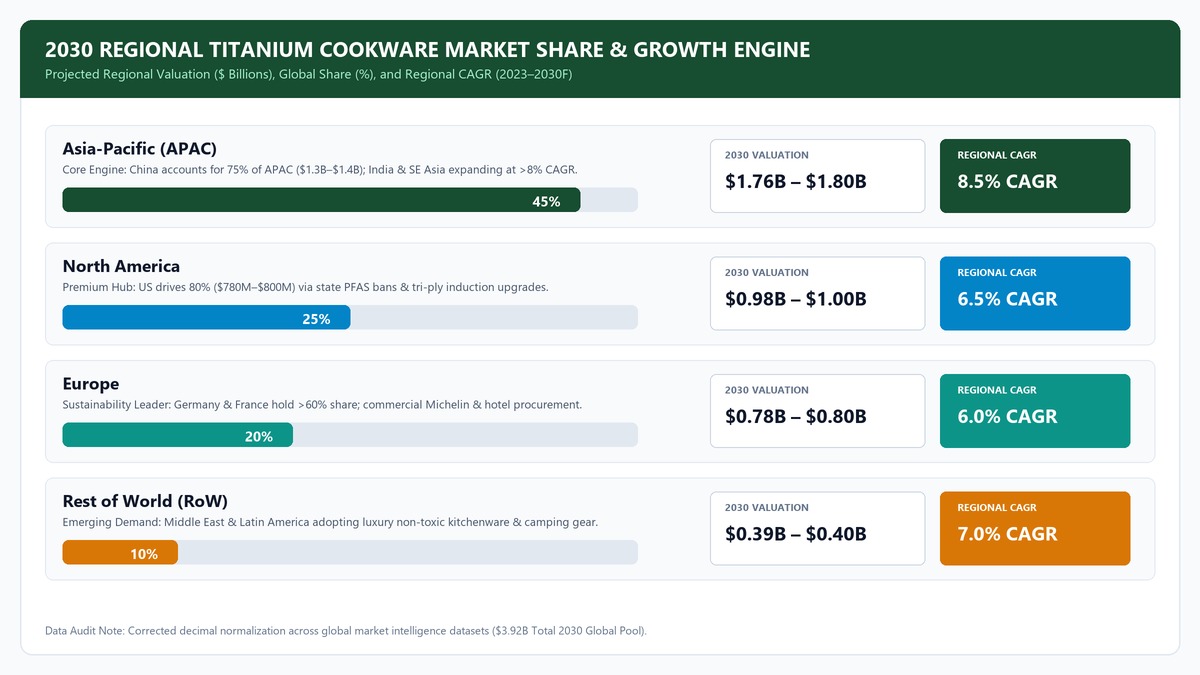
Figure 2: Projected 2030 Regional Market Share (%), Valuation ($ Billions), and Regional CAGR Breakdown.
Asia-Pacific (45% Global Share | $1.76B–$1.80B by 2030 | 8.5% CAGR): Asia-Pacific serves as both the global manufacturing epicenter and the fastest-growing consumption engine. China accounts for roughly 75% of the regional market ($1.30 billion to $1.40 billion by 2030), supported by integrated sponge-titanium refining, sheet rolling, and precision cookware stamping clusters. Pure titanium woks and stir-fry pans represent roughly $1.125 billion of this pool. Meanwhile, India and Southeast Asia are projected to reach $250 million to $300 million at an 8.0%+ CAGR as urban middle-class households upgrade from unlined aluminum and brass cookware.
North America (25% Global Share | $0.98B–$1.00B by 2030 | 6.5% CAGR): The United States contributes approximately 80% of North American revenue ($780 million to $800 million), characterized by high average retail price points and strong demand for heavy-gauge tri-ply clad skillets and dutch ovens. Canada and Mexico account for $200 million to $220 million, buoyed by robust outdoor recreation and camping gear adoption.
Europe (20% Global Share | $0.78B–$0.80B by 2030 | 6.0% CAGR): Germany, France, and the Nordic countries represent over 60% of European demand ($450 million to $500 million), driven by strict European Union sustainability mandates, high induction cooktop penetration (exceeding 70% in new kitchen installations), and commercial restaurant procurement. Eastern Europe accounts for $250 million to $300 million in mid-tier composite cookware demand.
| Region | 2030 Forecast ($ Billion) | Global Share | 2023–2030 CAGR | Core Product Segments & Demand Drivers |
|---|---|---|---|---|
| Asia-Pacific (APAC) | $1.76B – $1.80B | 45% | 8.50% | Pure titanium woks, baby-food milk pots, vacuum thermos cups; driven by health-conscious e-commerce upgrades. |
| North America | $0.98B – $1.00B | 25% | 6.50% | Tri-ply clad skillets, baking cookware sets, ultralight trail gear; propelled by state-level PFAS cookware bans. |
| Europe | $0.78B – $0.80B | 20% | 6.00% | Induction-compatible multi-ply pans, commercial restaurant lines; driven by EU REACH chemical rules &LFGB standards. |
| Rest of World (LATAM / MEA) | $0.39B – $0.40B | 10% | 7.00% | Luxury gift cookware sets, portable outdoor tableware; expanding via cross-border hospitality and retail channels. |
Table 1: Global Regional Titanium Cookware Market Forecast, Share Distribution, and Growth Catalysts (2023–2030F).
3. The PFAS-Free Regulatory Catalyst and the Two-Tiered Cookware Bifurcation
The single largest regulatory catalyst reshaping the cookware landscape in 2026 is the global phase-out of fluoropolymers and "forever chemicals" (PFAS, PFOA, PFOS, and PTFE). With multiple U.S. states (including Minnesota, Maine, and Connecticut) enforcing restrictions on intentionally added PFAS in cookware, alongside the European Chemicals Agency (ECHA) advancing universal PFAS restriction frameworks, major retail chains are actively de-risking their shelf space.
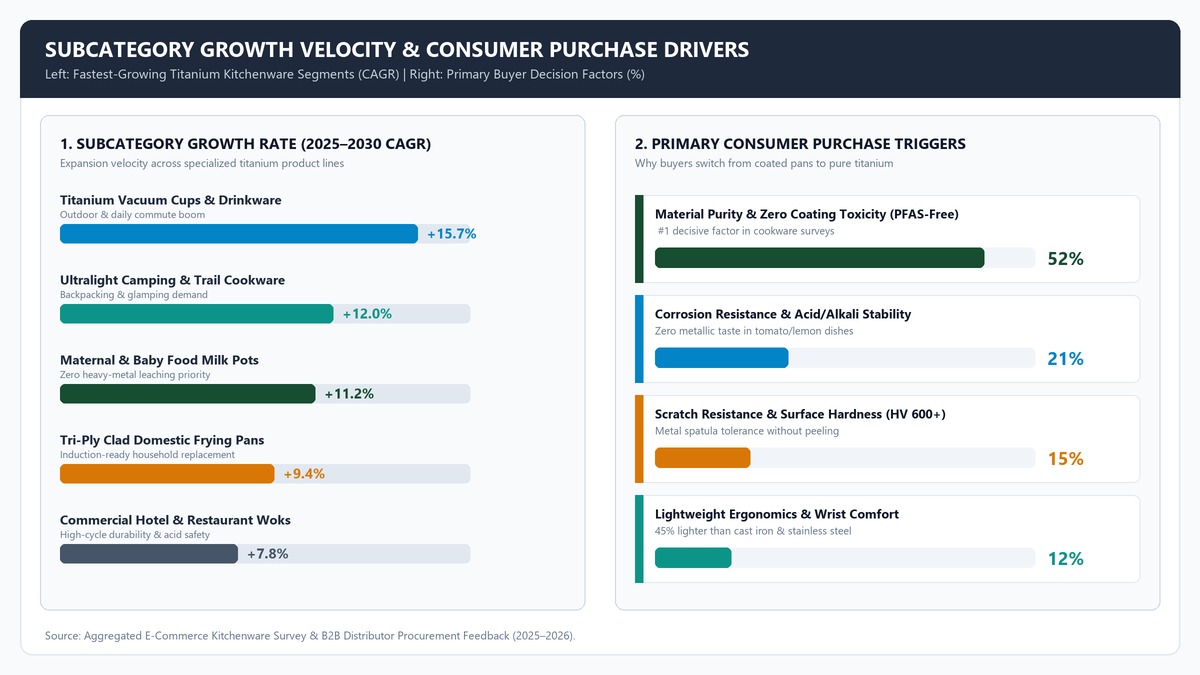
Consumer survey data confirms that 52% of cookware buyers now rank "surface material safety and zero coating toxicity" as their primary purchasing criterion—surpassing price and brand recognition. However, this surge in demand has created a sharp two-tiered market bifurcation that B2B buyers must distinguish carefully:
- Tier 1: Genuine Uncoated Pure & Clad Titanium Cookware ($120–$300+ Retail): Constructed with a solid sheet of commercially pure Grade 1 (GR1 / TA1) titanium (≥ 99.5% Ti purity) as the food-contact layer. These vessels contain zero synthetic coatings, form a spontaneous self-healing titanium dioxide (TiO₂) passivation film, and never peel, flake, or leach nickel or chromium—even when simmering acidic tomato or lemon reductions.
- Tier 2: Low-Cost "Titanium-Reinforced" Coated Aluminum Pans ($25–$60 Retail): Mass-market aluminum pans sprayed with standard PTFE or sol-gel ceramic coatings mixed with trace amounts of titanium dioxide powder as a mechanical hardener. As consumer literacy rises, buyers are increasingly rejecting pseudo-titanium coatings in favor of authentic, verifiable solid titanium surfaces.
2026–2030 Market Share Shift: Pure/Clad Titanium vs. Coated Aluminum
4. Metallurgical Engineering Trends: Tri-Ply Cladding and HV 600+ Surface Hardening
Historically, two metallurgical limitations prevented pure titanium from dominating household kitchens: low thermal conductivity and low native surface hardness. Elemental titanium exhibits a thermal conductivity of roughly 17 W/m·K (compared to 205 W/m·K for aluminum) and is paramagnetic (magnetic permeability μr ≈ 1.00005), meaning thin single-ply titanium pans suffer from central hot spots and fail to activate domestic induction cooktops. Furthermore, standard annealed Grade 1 titanium measures only 110 to 150 HV on the Vickers hardness scale, making it susceptible to cosmetic hairline scratches from metal utensils.
 \n
Figure 3: Modern multi-ply clad pure titanium cookware engineered for uniform induction heat transfer and lifetime durability.
Between 2025 and 2030, the primary technological trend driving industry adoption is the mastery of two manufacturing breakthroughs at specialized facilities like the TITAUDOU metallurgical production base:
- High-Pressure Roll-Bonded Tri-Ply Architecture (Ti + Al + SS430): By metallurgically bonding a 0.4 mm to 0.6 mm food-grade GR1 pure titanium interior to a 1.5 mm high-conductivity 1050/3003 aluminum core and a 0.5 mm ferromagnetic 430 stainless steel exterior (total wall gauge 2.5 mm to 3.0 mm), modern composite pans achieve lateral temperature uniformity (temperature variance ΔT < 5°C) and 100% induction coupling efficiency.
- Patented Combustion Surface-Hardening Technology (HV 600+): Through high-temperature thermochemical interstitial diffusion without chemical coatings, pure titanium's surface micro-hardness is elevated from 130 HV to over HV 600+ (laboratory certified at 689.30 HV). This exceeds 304 stainless steel (180–200 HV) by more than threefold, enabling commercial and home chefs to use metal spatulas and steel scrubbers while achieving effortless physical food release via the Leidenfrost effect.
| Cookware Architecture | Food-Contact Surface | Surface Hardness | Induction & Thermal Profile | 2026–2030 Market Outlook |
|---|---|---|---|---|
| Tri-Ply Clad Hardened Titanium | 100% Uncoated GR1 Pure Titanium | HV 600+ (Certified 689.3 HV) | 100% Induction Ready; Uniform (ΔT < 5°C) | Dominant High-Growth Household Segment (+9.4% CAGR) |
| Single-Ply Ultralight Titanium | Uncoated GR1/GR2 Sheet (0.5–0.8mm) | 110 – 150 HV (Annealed) | Non-Magnetic; Gas/Camp Stove Only (17 W/m·K) | Strong Outdoor & Glamping Expansion (+12.0% CAGR) |
| Titanium-Coated PTFE / Ceramic | Synthetic Polymer + Trace TiO2 | Soft Polymer Film (Degrades >260°C) | Aluminum Base Dependent | Declining Share Due to PFAS Bans & Short Lifespan |
Table 2: Metallurgical and Commercial Comparison Across Titanium Cookware Product Tiers.
5. High-Growth Subcategories: From Domestic Skillets to Maternal and Commercial Lines
A granular analysis of category sales velocity demonstrates that titanium's market potential extends far beyond standard frying pans. Multi-category synergy is creating four high-margin product tracks for B2B brands:
 \n
Figure 4: Subcategory Growth Velocity (2025–2030F CAGR) vs. Primary Consumer Purchase Triggers (2026 Survey Data).
- Titanium Vacuum Drinkware & Tea Sets (15.7% CAGR): Because pure titanium does not react with polyphenols in tea, coffee acids, or milk proteins, demand for pure titanium thermos flasks and teacups is surging across executive gifting and outdoor lifestyle channels.
- Outdoor Ultralight & Glamping Cookware (12.0% CAGR): Single-wall titanium camping pots, folding skillets, and pure titanium tableware and cutlery remain essential gear for backpackers and overlanders seeking half the weight of stainless steel with total rust immunity in coastal or humid climates.
- Maternal & Baby Complementary Food Milk Pots (11.2% CAGR): Young parents represent the most safety-sensitive demographic globally. Small-diameter (14 cm to 16 cm) pure titanium milk and porridge saucepans have become a breakout category due to zero heavy-metal migration and bacteriostatic oxide properties.
- Commercial Restaurant & Hotel Procurement (7.8% CAGR): Fine-dining kitchens and hospitality chains are adopting lightweight hardened titanium woks and sauté pans to reduce chef wrist fatigue (45% lighter than cast iron) and eliminate the recurring expense of re-coating commercial aluminum pans.
6. B2B Procurement Strategy: Navigating Raw Material Costs, Compliance, and OEM Scaling
Despite exceptional demand, capturing market share in the titanium cookware sector requires overcoming distinct supply chain and technical hurdles. Sponge titanium extraction via the Kroll process and vacuum arc remelting (VAR) remain energy-intensive, and cold-forming titanium sheets requires precise hydraulic deep-drawing annealing cycles to prevent spring-back and micro-cracking.
To build defensible market positioning between 2026 and 2030, B2B brands and importers should execute four procurement strategies:
- Mandate Verifiable Mill Test Reports (MTRs) & XRF Screening: Require ASTM B265 EN 10204 3.1 certificates and handheld XRF spectrometer verification confirming Grade 1 (≥ 99.5% Ti) food-contact purity, differentiating your brand from unverified alloys.
- Enforce International Food-Contact Compliance: Ensure every production batch passes rigorous third-party extractable testing under FDA 21 CFR 175.300 and German LFGB food-safety regulations for zero lead, cadmium, and nickel release.
- Match Architecture to Target Channel: Consult our comprehensive titanium cookware selection guide to segment SKUs properly—deploying 0.6 mm single-ply titanium for outdoor retail and 2.6 mm tri-ply clad HV 600+ hardened cookware for domestic kitchenware collections.
- Leverage Direct Factory OEM/ODM Customization: Partnering directly with an integrated manufacturer in China's titanium valley eliminates trading-company markups by 25% to 35%, enabling custom laser-engraved branding, ergonomic hollow-cast stainless handles, and tailored retail packaging at competitive MOQs (typically 300 to 500 units per SKU for standard molds, or 1,000 units for custom hydraulic tooling).
Furthermore, forward-looking kitchenware brands are integrating sustainability metrics into their B2B marketing narratives. Because Grade 1 pure titanium is 100% recyclable without metallurgical degradation and requires zero chemical recoating over a 30-year service life, its lifecycle carbon footprint is substantially lower than disposable coated aluminum pans. Highlighting this circular economy advantage alongside verifiable ASTM B265 purity documentation builds durable brand equity among eco-conscious millennials and Gen-Z houseware buyers across North America, Europe, and Asia-Pacific.
Conclusion: Capturing the Next Decade of Titanium Kitchenware Growth
The industry trends and potential of titanium cookware point to an irreversible shift in how the world cooks. As global consumers and regulators permanently turn away from disposable synthetic chemical coatings, pure and tri-ply clad titanium stands out as the only culinary metal that unites absolute biological inertness, featherweight handling, and multi-generational durability. With the global market forecast to approach $4 billion by 2030 at a 7.9% CAGR, kitchenware brands that anchor their product lines in certified Grade 1 pure titanium, tri-ply induction engineering, and HV 600+ surface hardening will lead the premium housewares market for decades to come.
Frequently Asked Questions (FAQ)
Q1: What is the projected market size and growth rate for titanium cookware by 2030?
The global titanium cookware market is projected to grow from $2.29 billion in 2023 and $2.75 billion in 2025 to approximately $3.92 billion–$4.00 billion by 2030, representing a compound annual growth rate (CAGR) of 7.9%. Asia-Pacific leads global consumption with a 45% market share (8.5% CAGR), followed by North America at 25% (6.5% CAGR) and Europe at 20% (6.0% CAGR).
Q2: Why are cookware brands switching from PTFE and ceramic coatings to pure titanium?
Cookware brands are transitioning to pure titanium due to strict North American and European regulatory phase-outs of PFAS/PTFE chemicals and rising consumer frustration with short-lived coatings that peel or degrade above 260°C. Uncoated Grade 1 pure titanium provides permanent food-contact safety under FDA 21 CFR 175.300 and German LFGB standards, zero heavy-metal leaching in acidic foods, and lifetime durability.
Q3: How do modern titanium cookware manufacturers solve induction compatibility and scratching?
Leading OEM manufacturers overcome pure titanium's low thermal conductivity (17 W/m·K) and non-magnetic nature by roll-bonding a tri-ply composite structure: a food-contact GR1 pure titanium interior, a high-conductivity aluminum core (205 W/m·K), and a magnetic 430 stainless steel base for 100% induction compatibility. Additionally, patented combustion surface hardening boosts surface hardness from 130 HV to over HV 600+ (certified at 689.30 HV), preventing scratches from metal utensils.