1. Introduction: Why Most "Tri-Ply Cookware Set" Results Are Stainless Steel
Search for a tri-ply cookware set and most results will point to stainless steel sets. That makes sense because tri-ply stainless steel cookware has been a mainstream premium category for many years. The typical structure is stainless steel inside, aluminum in the middle, and magnetic stainless steel outside. It gives home cooks durable cookware, induction compatibility, and better heat spreading than single-layer stainless steel.
What is missing from many search results is the next material question: what happens when the food-contact layer is titanium instead of stainless steel? A tri-ply titanium cookware set uses the same structural logic of three functional layers, but changes the interior layer to pure titanium. That change affects food-contact behavior, acid resistance, product positioning, sourcing requirements, and brand differentiation.
This difference matters for both home buyers and B2B cookware buyers. A home buyer may compare tri-ply stainless steel with titanium because they want a healthier, non-coated cooking surface. A brand, importer, or wholesaler may compare the two because tri-ply stainless steel sets are crowded in retail channels, while tri-ply titanium sets can create a more differentiated premium line.
This article does not claim that every titanium set is automatically better than every stainless steel set. The better answer is more specific. A stainless steel tri-ply set can be excellent for everyday cooking, searing, and broad affordability. A titanium tri-ply set can be stronger for buyers who want a pure titanium food-contact layer, acid-food confidence, and a distinctive health-focused story. The right choice depends on target buyer, price point, SKU plan, and supplier capability.
We will define what a tri-ply cookware set is, compare stainless steel and titanium structures, explain the right piece configuration for home and B2B markets, show how structure affects heat and induction performance, and list sourcing checks that help buyers avoid vague “3-ply” claims. For structure background, read our full guide to tri-ply titanium cookware.
2. What Is a Tri-Ply Cookware Set? Structure, Standard Pieces, and Buyer Expectations
A tri-ply cookware set is a set of pots and pans built with three functional layers. The inner layer touches food, the middle layer spreads heat, and the outer layer provides strength, durability, and cooktop compatibility. In most stainless steel sets, the inner layer is stainless steel, the core is aluminum, and the exterior is magnetic stainless steel. In a tri-ply titanium structure, the food-contact layer is pure titanium, the core is aluminum, and the exterior is usually stainless steel.
The reason tri-ply construction became popular is simple: no single common cookware metal does everything perfectly. Stainless steel is durable and attractive, but it does not spread heat as evenly as aluminum. Aluminum spreads heat well, but it is soft and not usually the preferred exposed food-contact surface for premium cookware. Titanium is corrosion-resistant and non-reactive, but it also benefits from a heat-spreading core. A layered structure lets each material do the job it is best at.
A cookware set also has a second question: what pieces should be included? A starter set may include a frying pan, saucepan, stockpot, and lids. A larger household set may include a saute pan, wok, milk pan, soup pot, steamer, or additional lids. Retailers often count lids as pieces, so buyers should read set contents carefully. A “10-piece set” may contain six vessels and four lids, not ten separate pans.
For consumers, the expected benefits are clear: even heating, induction compatibility, oven-safe construction when handles and lids allow it, durable handles, stable lids, and a non-coated cooking surface. For B2B buyers, expectations go further. They need repeatable piece configuration, SKU logic, packaging efficiency, certification documents, MOQ clarity, and a supplier that can keep the same structure stable across production batches.
A useful entry set often focuses on the pieces buyers actually use daily: a frying pan, a medium saucepan, a larger soup pot, and matching lids. A family set may add a wok or saute pan. A premium set may include a steamer insert or larger stockpot. The best set is not always the one with the highest piece count. It is the one with the most useful pieces for the target buyer.
For titanium cookware, this is especially important because material and forming costs are higher than ordinary aluminum or basic stainless steel. Brands should avoid adding rarely used pieces just to increase the piece count. A smaller, better-designed tri-ply titanium set can feel more premium than a large set padded with low-use accessories.
3. Tri-Ply Stainless Steel vs. Tri-Ply Titanium Cookware Set: 5 Key Differences
The main difference between a tri-ply stainless steel set and a tri-ply titanium set is the food-contact layer. In stainless steel cookware, food touches stainless steel. In tri-ply titanium cookware, food touches pure titanium. That shift changes the health story, acid-food positioning, cleaning expectations, and product differentiation.
Stainless steel is proven, familiar, and durable. It performs well when the pan is properly preheated and the user understands oil temperature. However, some buyers are concerned about nickel sensitivity or long contact with acidic foods. For most consumers, quality stainless steel is widely accepted for cookware, but titanium gives brands a stronger non-reactive food-contact story when the titanium layer is real and documented.
Heat distribution depends mostly on the core and construction, not only the inner surface. Both stainless steel tri-ply and titanium tri-ply structures typically rely on aluminum for heat spreading. The difference is how the inner layer behaves at the food surface and how the full structure is designed. A well-made tri-ply titanium set can cook evenly when the aluminum core is continuous and properly bonded. A poorly made set, whether stainless or titanium, can still have hot spots.
Induction compatibility depends on the exterior magnetic layer and base design. Many tri-ply stainless sets use a magnetic stainless exterior. A tri-ply titanium set can do the same by using a magnetic stainless outer layer. Buyers should verify whether the entire vessel is clad or whether only the bottom has a magnetic disc. A full-body clad structure is usually positioned as more premium and more consistent than a local bottom-disc design.
Weight and handling are also important. Titanium is known for strength-to-weight advantages, but finished cookware weight depends on the total layer stack, size, handle, lid, and thickness. A buyer should not accept a universal weight claim without the actual sample. In practice, a tri-ply titanium set can be designed for a lighter premium feel, but this must be verified by real product specifications.
Price positioning differs as well. Tri-ply titanium cookware usually costs more than mainstream tri-ply stainless steel because titanium material, bonding, forming, and quality control are more specialized. The premium can be justified when the brand needs a differentiated health-focused product line. It may not be necessary for a buyer who simply wants an affordable daily stainless steel set.
| Comparison Factor | Tri-Ply Stainless Steel Set | Tri-Ply Titanium Cookware Set | Buyer Meaning |
|---|---|---|---|
| Food-contact layer | Usually 304 or 316 stainless steel | Pure titanium interior when properly specified | Titanium gives a clearer non-coated, non-reactive food-contact story |
| Heat distribution | Aluminum core improves heating compared with single-layer stainless | Aluminum core also spreads heat while titanium contacts food | Core continuity and bonding quality matter more than marketing claims |
| Induction compatibility | Often uses magnetic stainless exterior or base | Can use magnetic stainless exterior with titanium interior | Verify full-body clad vs bottom-disc construction |
| Product positioning | Familiar, mainstream premium cookware category | More differentiated health-focused premium category | Titanium is better for brands seeking a distinct material story |
| Cost logic | Mature supply chain and broad retail competition | More specialized material and production requirements | Higher price must be supported by structure proof and documentation |
4. How to Choose the Right Pieces for Your Tri-Ply Titanium Cookware Set
Choosing a tri-ply titanium cookware set should begin with use cases, not with the largest piece count. A small household or apartment buyer may need only a frying pan, a saucepan, and a soup pot. A family buyer may need a larger frying pan, wok, stockpot, saucepan, and lids. A premium retail buyer may expect a coordinated set with matching handles, lids, packaging, and a clear care guide.
For a starter set, the most practical configuration is often a frying pan plus one or two pots. This set is easier to price, easier to ship, and easier for consumers to understand. It can work well for a brand testing market demand before launching a larger line. A starter set also reduces the risk of adding expensive pieces that do not sell.
For a family set, the configuration should cover frying, boiling, simmering, reheating, and soup cooking. A wok may be important in Asian markets, while a saute pan or stockpot may be more important in North American and European channels. Buyers should not copy a stainless steel set configuration blindly. Titanium’s premium price means each piece should earn its place.
For B2B buyers, SKU planning is critical. A brand can launch a 3-piece trial set, a 5-piece core set, and an 8-piece premium set rather than trying to launch every possible piece at once. This reduces inventory pressure and helps sales teams explain the line clearly. It also allows the brand to test which pieces customers actually reorder.
Regional habits matter. North American buyers often expect frying pans, saucepans, saute pans, and stockpots. European buyers may care strongly about induction compatibility, dishwasher guidance, and food-contact documentation. Southeast Asian and East Asian buyers may care more about wok shapes, light handling, gas compatibility, and soup pots. These are market tendencies, not fixed rules, so final configuration should follow the buyer’s channel data.
Brands should also decide whether lids count as pieces in marketing. Counting lids is common in retail cookware, but it can frustrate buyers if the value is unclear. A more transparent product page lists both the piece count and the number of actual vessels. For example: “8-piece set: 5 cookware bodies and 3 lids.”
For TITAUDOU customization, buyers can start with a practical set architecture and adjust handle style, lid type, packaging, and documentation. The goal is to create a set that fits the target market rather than a set that simply looks large on a product page.
5. How Structure Impacts Performance: Heat, Safety, and Induction Compatibility
Structure determines performance. A real tri-ply cookware set is not just three materials listed in a brochure. The layers must be chosen, bonded, formed, and finished correctly. If the aluminum core is too limited, the pan may heat unevenly. If the exterior is not magnetic where induction needs it, induction performance suffers. If the inner layer is not what the seller claims, the health and safety story becomes weak.
In a tri-ply titanium cookware set, the GR1 titanium interior is used as the food-contact layer. Titanium naturally forms a stable oxide surface and is known for corrosion resistance. This is why it is attractive for buyers who cook acidic foods such as tomato, vinegar, lemon, or wine-based sauces. However, the buyer should still ask for material reports and food-contact documentation rather than relying only on the word titanium.
The aluminum core handles heat distribution. Titanium and stainless steel are not chosen primarily for heat spreading. Aluminum is used because it moves heat efficiently across the pan. The exact grade and thickness should be part of the specification. A continuous core in a full-body clad structure can help reduce hot spots and improve sidewall heating compared with a simple base-only structure.
The stainless exterior supports strength, durability, and induction compatibility when the stainless grade is magnetic. A buyer should verify cooktop compatibility with samples. Induction performance depends on the exterior material, base flatness, pan diameter, induction hob design, and finished construction. Claims such as “works on all induction cooktops” should be supported by sample testing.
The biggest trap is bottom-only composite construction sold as full tri-ply. A bottom-disc pan may work adequately for some cooking tasks, but it is not the same as full-body clad cookware. The sidewalls may not heat the same way, and the product story is weaker for premium retail. Buyers should ask whether the tri-ply structure runs through the full body or only the base.
Another trap is titanium coating confusion. A pan may say titanium because the coating contains titanium reinforcement or uses titanium-colored marketing. That is not the same as a pure titanium inner layer. If the buyer wants the food-contact benefit of titanium, the supplier must confirm the actual inner material and show a cross-section or material report.
Safety and performance are connected to verification. A good supplier should be able to explain the material stack, provide sample cross-sections when needed, support food-contact documentation, and recommend care instructions that match the structure. Without that verification, performance claims remain marketing language.
6. B2B Guide: Planning OEM/ODM Tri-Ply Titanium Cookware Sets
For OEM/ODM buyers, a tri-ply titanium set is not only a product. It is a program. The buyer must plan SKU structure, packaging, certification, target retail price, MOQ, sample schedule, and after-sales care language. These decisions should be made before final quotation because each one affects cost and production planning.
Start with SKU architecture. A simple program may include a starter set, family set, and premium set. The starter set gives the sales team a lower entry price. The family set becomes the main retail product. The premium set gives distributors or retailers a higher-value option. This three-tier strategy is often easier to manage than launching many random piece combinations.
Packaging should match the market. Neutral packaging may work for wholesale distribution or private bulk supply. Branded color boxes may be better for retail shelves and e-commerce. Premium sets may require inserts, manuals, care cards, QR codes, and clear structure diagrams. Packaging is not only decoration; it is part of the buyer’s understanding of why the product costs more.
MOQ and customization costs should be handled as quote variables, not universal promises. Logo method, handle design, lid design, new mold requirements, sample testing, and packaging all affect the quote. Instead of assuming a fixed MOQ or fixed tooling fee, buyers should ask the supplier to separate unit price, tooling, sample, packaging, documentation, and freight assumptions.
Certification requirements depend on target market. A US-focused program may need different documentation from an EU-focused program. Food-contact documentation, material reports, packaging compliance, dishwasher claim testing, and induction testing may all be relevant. Buyers should define the target market before asking for final pricing.
Care language should be planned early. If the set uses pure titanium interior and stainless exterior, the cleaning instructions differ from coated nonstick cookware. If wooden handles are used, dishwasher and oven claims may change. If glass lids are included, thermal and packaging requirements change. These details should be consistent across product page, manual, carton, and customer-service scripts.
A good OEM/ODM plan answers these questions: Which pieces are included? Which layers are used? What market is targeted? What certifications are required? What retail price is expected? What packaging is needed? What is the first order quantity and annual forecast? With those answers, a supplier can offer more realistic structure and pricing options.
To discuss OEM/ODM options for a tri-ply titanium cookware set, visit the titanium cookware supplier page. Clear specifications help TITAUDOU recommend the right set configuration rather than quoting a generic cookware set.
A tri-ply titanium set should also be planned around customer education. Stainless steel tri-ply sets are familiar, so the customer already understands the basic idea of stainless steel with an aluminum core. Titanium tri-ply sets need clearer explanation because many buyers have seen titanium used in coatings, camping pots, or marketing language. The product page, insert card, and sales materials should explain that the titanium layer is the food-contact surface, not a decorative coating.
Set planning should include a care story. Stainless steel customers often expect preheating, oil control, and possible sticking. Titanium customers may expect health benefits, acid-food confidence, and easier cleaning. If the set is uncoated, the brand should not promise nonstick behavior like PTFE cookware. Instead, it should explain the value clearly: no synthetic coating on the titanium surface, strong corrosion resistance, and improved heat spreading from the aluminum core.
B2B buyers should also consider channel fit. A premium department-store set may need polished finishes, heavier packaging, and stronger brand storytelling. An online direct-to-consumer set may need clearer comparison images, set contents, weight information, and care videos. A wholesale distributor may prefer fewer SKUs, simpler packaging, and easy reorder logic. The best tri-ply titanium cookware set is not the same for every channel.
Another practical question is replacement and expansion. If a customer buys a starter set, can they later add a matching saucepan, wok, or stockpot? If a retailer tests a 5-piece set, can the supplier later support an 8-piece or 10-piece set with the same handle design and finish? Consistency across the line helps a brand look mature instead of experimental.
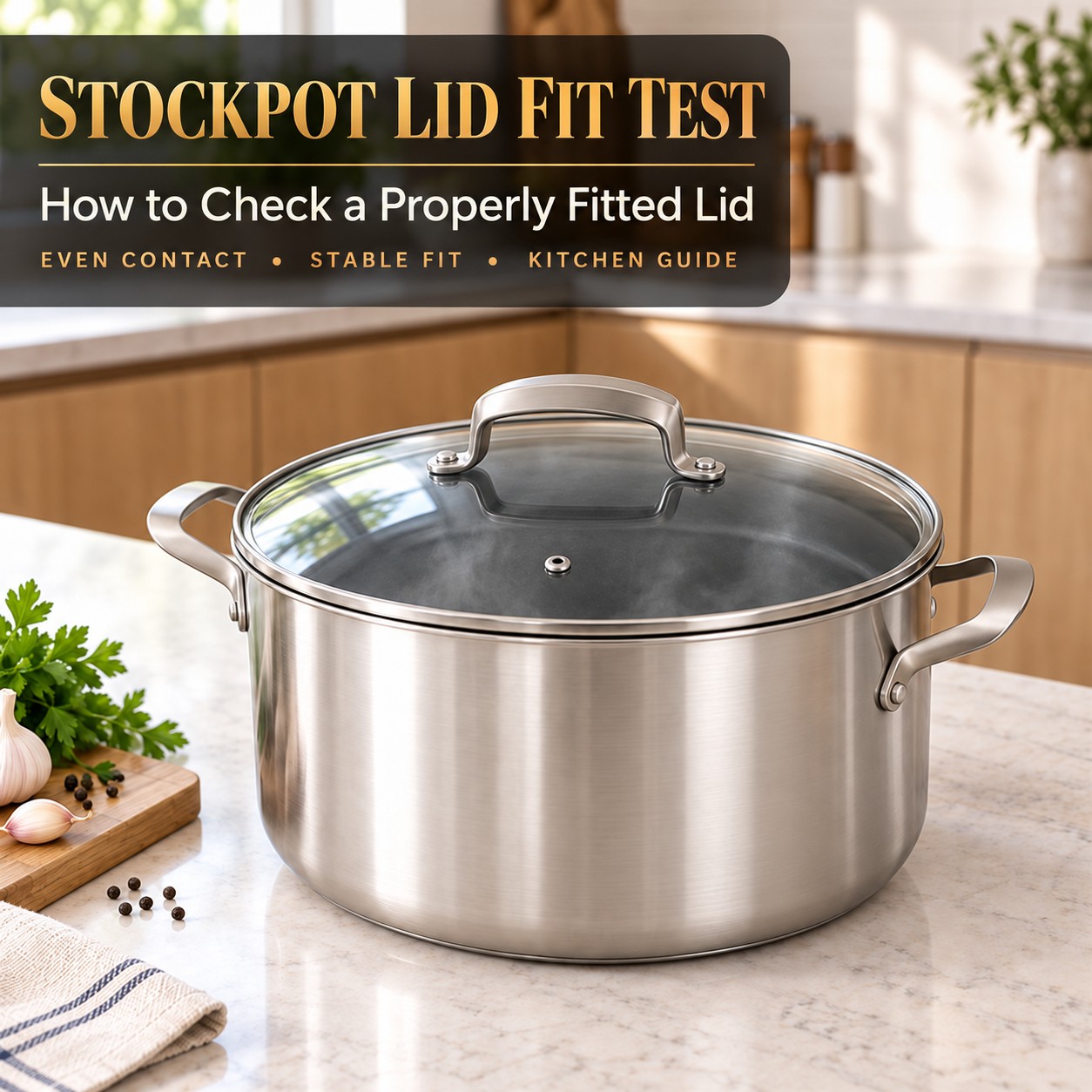
Quality control should be planned for the set as a whole. A frying pan may pass inspection while a saucepan has lid-fit problems or a stockpot has balance issues. Each vessel type needs its own inspection points: base flatness, handle angle, rim smoothness, lid fit, interior finish, exterior scratches, carton protection, and barcode or label accuracy. A cookware set creates more inspection complexity than a single pan.
For buyers comparing stainless steel and titanium sets, the practical decision is positioning. Stainless steel wins when the buyer wants a familiar, price-competitive, widely accepted set. Titanium wins when the buyer needs a clearer premium difference, a pure titanium food-contact story, and a stronger health-focused identity. Both can be good products, but they should not be sold with the same message.
| Set Planning Item | Home Buyer Question | B2B Buyer Question | Why It Matters |
|---|---|---|---|
| Piece count | Do I actually use every piece? | Which set size fits the channel? | Avoids inflated sets with low-use pieces |
| Food-contact layer | Is the cooking surface titanium or stainless? | Can the supplier document the layer? | Prevents titanium coating confusion |
| Heat structure | Will it heat evenly on my stove? | Is the clad body full-body or base-only? | Supports performance claims and pricing |
| Packaging | Is the set protected and easy to understand? | Does packaging match retail, wholesale, or DTC? | Affects damage rate, presentation, and cost |
| Care instructions | How should I clean and preheat it? | Are claims consistent across manual and product page? | Reduces returns and misuse complaints |
7. Red Flags to Avoid When Buying Tri-Ply Cookware Sets
The first red flag is vague “3-ply” wording. A listing may say 3-ply, tri-ply, or layered cookware without explaining whether the structure is full-body clad or bottom-disc composite. For premium cookware, this distinction matters. Full-body clad construction usually means the layered structure extends through the body, while bottom-disc construction focuses the layered structure at the base.
The second red flag is titanium wording without a titanium food-contact layer. If the product says titanium but the actual surface is a coating, the buyer should treat it as titanium-coated cookware, not tri-ply titanium cookware. Coatings may be useful, but they have different durability, care, and safety questions than a pure titanium inner layer.
The third red flag is unclear induction compatibility. Some cookware works on induction because the bottom has a magnetic disc. Other cookware uses a magnetic stainless exterior. Both can be valid when honestly described, but they are not the same product structure. Buyers should test samples on real induction cooktops and confirm base flatness after heating.
The fourth red flag is no cross-section proof. For a premium layered cookware set, the supplier should be able to show structure through a cross-section image, sample cut, technical drawing, or material explanation. If the supplier cannot explain the layers, the buyer cannot verify the value.
The fifth red flag is unrealistic health language. Claims such as “100% safe in every situation” or “never releases anything” are too broad. A better claim identifies the real food-contact layer, food-contact documentation, and proper use conditions. Responsible wording builds more trust than exaggerated promises.
The sixth red flag is piece-count padding. A large set may look impressive, but if it contains too many low-use accessories or counts every small lid as a major piece, the buyer may not get better value. Brands should focus on useful pieces, clear vessel count, and strong structure.
The seventh red flag is a quote that excludes important requirements. A low unit price may not include packaging, testing, documentation, sample shipping, inspection, or custom work. B2B buyers should compare complete quote packages rather than headline unit prices.
8. How to Source a High-Quality Tri-Ply Titanium Cookware Set
Sourcing a high-quality tri-ply titanium cookware set begins with material verification. Ask for documentation for the titanium inner layer, aluminum core, and stainless exterior. The supplier should explain the purpose of each layer and how the structure supports cooking performance. If the claim is pure titanium food contact, the material report should support that claim.
Next, verify the bonding process. Ask whether the structure is full-body clad or bottom-disc composite. Ask how the supplier controls bonding quality, edge finish, and delamination risk. A premium set should have a consistent structure across frying pans, saucepans, stockpots, and other vessels, not only one sample piece.
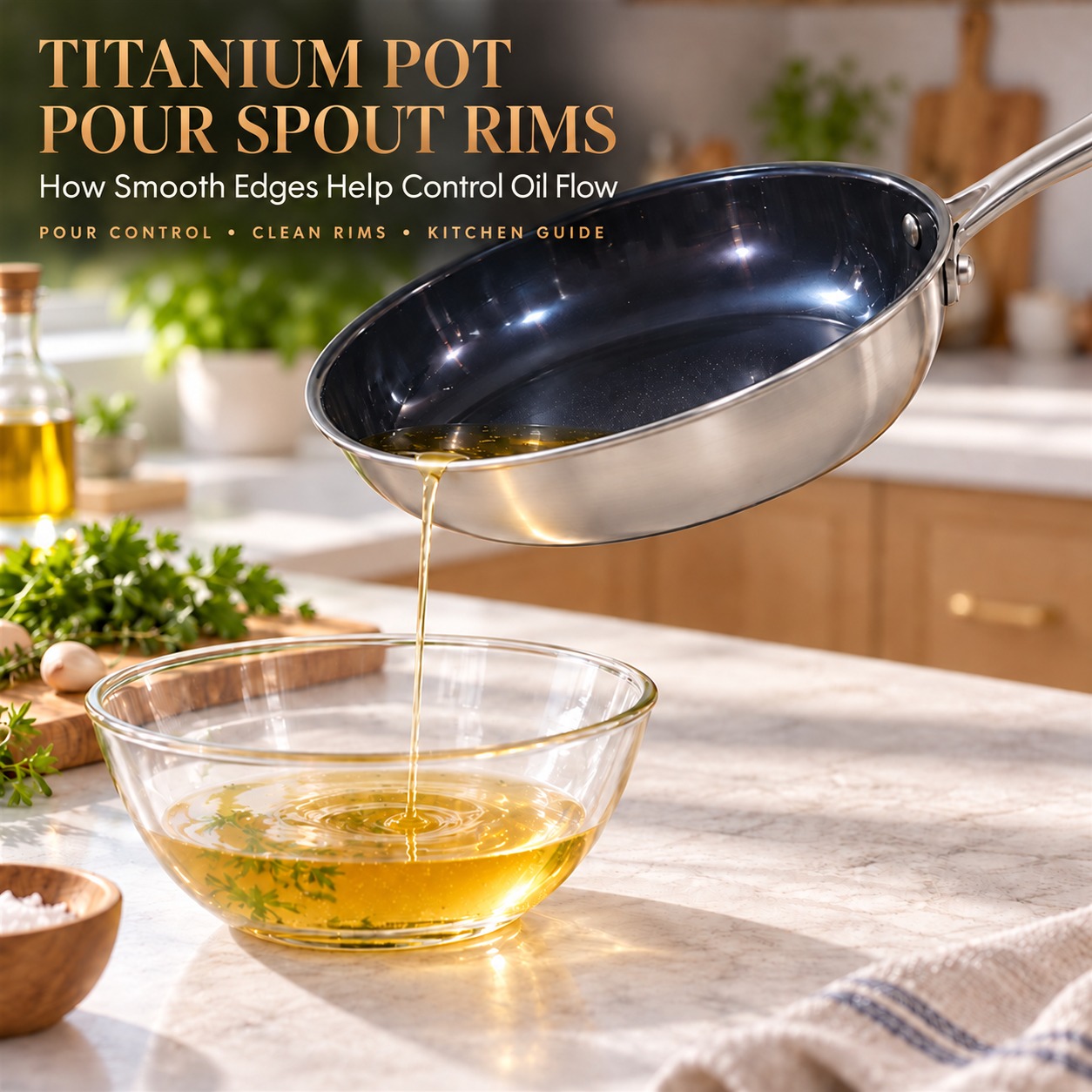
Request samples and test them in realistic conditions. Test heating evenness, induction response, handle comfort, lid fit, pouring behavior, cleaning, exterior finish, and packaging protection. For a cookware set, every piece should be tested, not only the hero frying pan. A saucepan, wok, and stockpot may reveal different forming and balance issues.
Check the set configuration against your target buyer. A North American e-commerce set may need different pieces from a European retail set or Southeast Asian gas-stove set. If your buyer values induction compatibility, test induction performance. If your buyer values light handling, measure finished weight. If your buyer values acidic-food safety, check food-contact documentation and interior material.
Prepare a clear inquiry sheet. Include cookware types, sizes, target layer structure, handle design, lid design, finish, packaging, target market, certification requirements, MOQ, annual forecast, and expected launch schedule. This prevents vague quotes and helps the supplier propose realistic options.
Review after-sales risk before ordering. Ask how the supplier handles scratches, discoloration, water spots, induction complaints, handle defects, and packaging damage. Premium cookware buyers expect clear care guidance. A supplier that can help build care instructions is more valuable than one that only provides a unit price.
Finally, compare quotes by specification, not by label. Two suppliers may both quote “tri-ply titanium set,” but one may use full-body clad construction while another uses a limited base structure. One may include documentation and packaging while another excludes them. A fair comparison requires aligned specifications.
For related pricing logic, see our guide to titanium cookware price. It explains how structure, MOQ, packaging, and documentation affect wholesale quotes.
9. Conclusion and FAQ: Is a Tri-Ply Titanium Cookware Set Worth It?
A tri-ply titanium cookware set can be worth it when the buyer wants more than another stainless steel set. Stainless steel tri-ply cookware remains a strong mainstream option, but the category is crowded. A tri-ply titanium cookware set gives brands a more differentiated story: pure titanium food contact, aluminum heat spreading, stainless exterior, induction potential, and premium health-focused positioning.
For home buyers, the value depends on priorities. If the main goal is low price and familiar cooking behavior, tri-ply stainless steel may be enough. If the goal is a non-coated titanium food-contact surface with better heat distribution than single-layer titanium, tri-ply titanium is a stronger upgrade. For B2B buyers, the value depends on whether the product line can support a premium position and whether the supplier can document the structure.
The best decision is not based on the word tri-ply alone. It is based on layer structure, piece configuration, supplier verification, sample testing, packaging, and target market. A clear specification will protect both the buyer and the final customer.
A final sourcing point is sales training. A tri-ply titanium cookware set needs a simple explanation that sales teams can repeat: titanium touches food, aluminum spreads heat, stainless steel supports strength and induction use. If the team cannot explain that in one sentence, customers may see only a higher price and compare the product unfairly with ordinary stainless steel sets.
Retail pages should also show the set contents clearly. Use one image for the full set, one image for the layer structure, one image for induction compatibility, and one image for the exact pieces included. This reduces confusion about lids, vessels, and accessories. It also helps buyers understand why the set is different from standard tri-ply stainless steel cookware.
For wholesale buyers, reorder stability is just as important as launch quality. Ask whether the supplier can keep the same material structure, handle design, finish, and packaging over multiple batches. A cookware set that changes visibly between orders creates retailer complaints and weakens brand trust.
For home users, the choice should be practical. If you cook mostly with high-heat stainless steel techniques and want the lowest price, a standard tri-ply stainless set may be enough. If you want a premium non-coated titanium food-contact layer and a set that stands apart from common stainless offerings, a tri-ply titanium cookware set is the more distinctive option.
This is the real gap in the current tri-ply cookware set market. Most search results help buyers choose among stainless steel sets. Fewer explain how titanium changes the food-contact story, sourcing requirements, and brand positioning. That is where a tri-ply titanium set can compete without pretending to be another ordinary stainless steel set.
To review product options, visit TITAUDOU titanium pots and pans or contact us for custom tri-ply titanium cookware set planning.
Buyers should also decide how the cookware set will be demonstrated. A stainless steel tri-ply set is easy to explain because the market already knows the category. A tri-ply titanium set needs a clearer demonstration: show the layer structure, show the titanium interior, show the induction-ready exterior, and show the practical pieces in the set. This turns a material claim into a visible product advantage.
For distributors, the reorder plan should be part of the first conversation. If the first order sells well, the supplier must be able to repeat the same construction and finish. A change in handle shape, exterior polish, lid fit, or packaging can create inconsistency across batches. Stable repeat production is one of the real differences between a sample maker and a long-term cookware supplier.
For private-label brands, the safest launch path is usually a focused set rather than an oversized set. Start with the pieces customers understand, make the structure proof clear, and collect feedback before expanding. A focused tri-ply titanium cookware set can build trust faster than a large set that is expensive, hard to explain, and difficult to keep in stock.
For layer-count basics, see 3-ply vs 5-ply cookware.
For stainless clad safety details, see tri-ply stainless steel cookware safety.
Frequently Asked Questions (FAQ)
Q1: What is included in a standard tri-ply cookware set?
A: A standard set usually includes core daily pieces such as a frying pan, saucepan, soup pot or stockpot, and matching lids. Larger sets may add a saute pan, wok, steamer, milk pan, or Dutch oven. Buyers should check how many actual cookware bodies are included because lids are often counted as pieces.
Q2: Is tri-ply titanium cookware better than tri-ply stainless steel?
A: It depends on the buyer’s priority. Tri-ply stainless steel is familiar, durable, and widely available. Tri-ply titanium cookware is stronger for buyers who want a pure titanium food-contact layer, acid-food confidence, and a differentiated premium product line. The best choice depends on target price, cooking habits, and supplier verification.
Q3: What should brands check before sourcing a tri-ply cookware set?
A: Brands should check layer structure, full-body clad vs bottom-disc construction, material reports, induction compatibility, piece configuration, handle and lid design, packaging, target-market documentation, MOQ, sample testing, and after-sales care instructions.