If you are asking is tri-ply stainless steel cookware safe, the practical answer is yes when the pan is made correctly, the food-contact stainless steel surface is suitable for cookware, and the bonded layers remain intact during normal use. Tri-ply stainless steel is one of the most common premium cookware structures because it combines a durable stainless cooking surface with a heat-spreading core.
The safety question usually comes from two concerns. First, many tri-ply pans use an aluminum core, so buyers wonder whether aluminum can reach food. Second, stainless steel may contain nickel, so sensitive users ask whether long cooking, acidic foods, or daily exposure matter. These are reasonable questions, but they need a structural answer rather than a simple yes or no.
This guide explains how tri-ply stainless steel cookware is built, why the aluminum core is normally not a food-contact problem, when nickel matters, how acidic foods affect the discussion, and what home cooks, importers, distributors, and private-label buyers should verify before calling a product safe.
1. Quick Answer: Is Tri-Ply Stainless Steel Cookware Safe?
Yes, tri-ply stainless steel cookware is generally safe for normal cooking when the inner layer is food-grade stainless steel and the product is properly bonded. The aluminum core is sealed between stainless steel layers. It is used to spread heat, not to touch food. Under normal use, food contacts the stainless interior, not the aluminum core.
The more important question is the stainless steel grade that touches food. Many stainless cookware interiors use 304 or 316 stainless steel. These grades are valued for corrosion resistance, but they usually contain nickel. For most users, this is acceptable and widely used. For nickel-sensitive users, it deserves more attention, especially with acidic foods and long simmering.
A careful safety answer should therefore avoid broad claims such as “zero risk” or “completely non-toxic under every condition.” A stronger and more accurate answer is this: well-made tri-ply stainless steel cookware is a safe and durable option for most cooking, but buyers should verify the food-contact stainless grade, bonding quality, rim finish, and compliance documents.
2. What Tri-Ply Stainless Steel Means
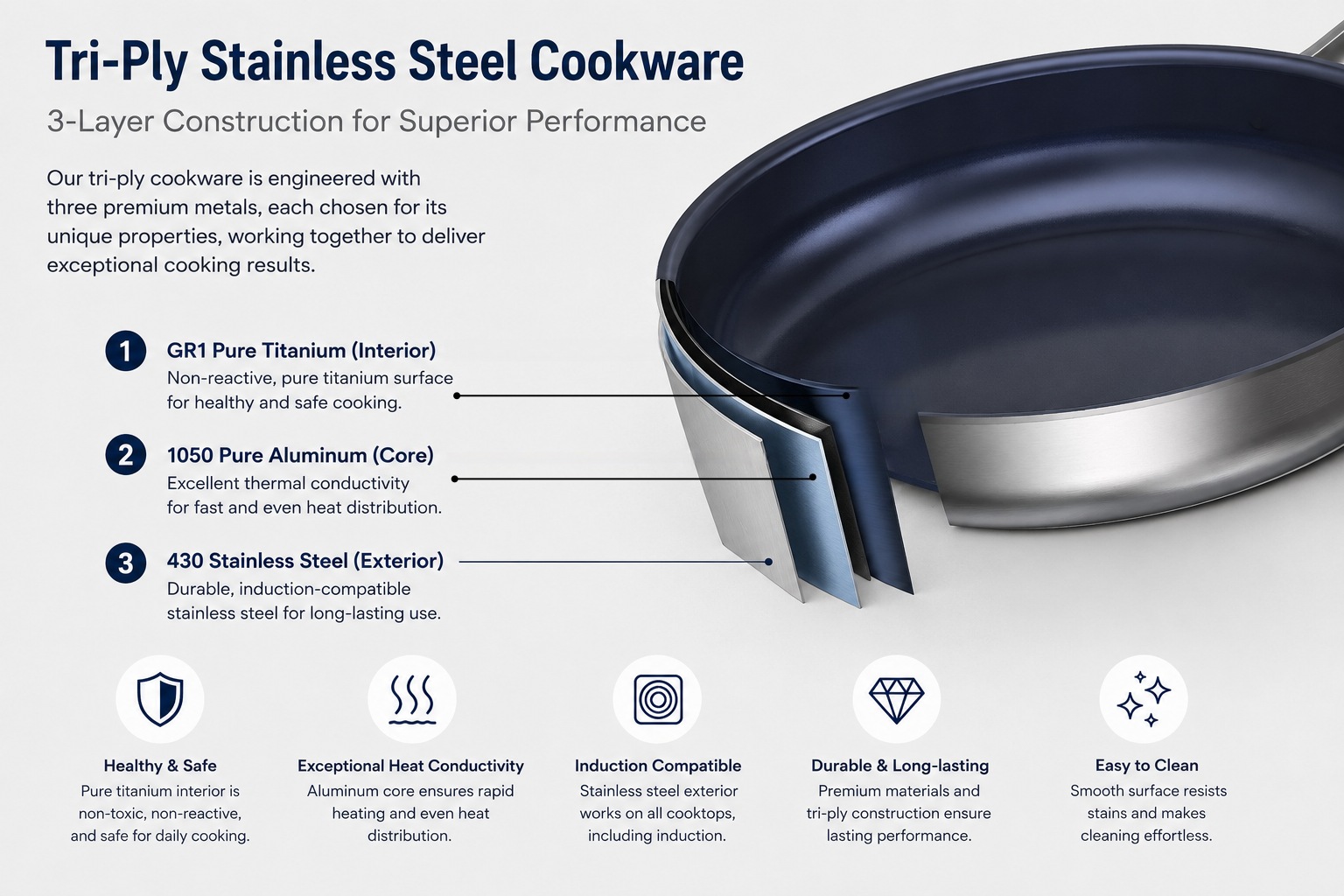
Tri-ply cookware is made from three bonded layers of metal. The common structure is stainless steel on the inside, aluminum in the middle, and stainless steel on the outside. The inner stainless layer handles food contact. The middle aluminum layer improves heat distribution. The outer stainless layer adds strength and, when magnetic stainless is used, supports induction compatibility.
This structure is different from a thin single-layer stainless steel pan. Stainless steel is durable and corrosion resistant, but it does not spread heat as efficiently as aluminum. A thin stainless-only pan can develop hot spots, scorch sauces, or brown food unevenly. The aluminum core helps the entire pan respond more evenly to heat.
The word tri-ply can also be used loosely in the market, so buyers should ask whether the cookware is full-clad or only disc-bottom bonded. Full-clad cookware has the layered structure through the base and sidewalls. Disc-bottom cookware has a bonded heat-spreading disc attached to the base. Both can be useful, but they are not the same construction and should not be marketed as identical.
| Layer | Common Material | Main Function | Safety Meaning |
|---|---|---|---|
| Inner cooking surface | 304 or 316 stainless steel in many cookware products | Touches food and resists corrosion | This is the most important layer for food-contact safety |
| Middle core | Aluminum is common | Spreads heat and reduces hot spots | Should be enclosed and should not contact food |
| Outer layer | Often 430 magnetic stainless steel | Adds structure and supports induction use | Touches the cooktop, not the food |
| Rim and edge | Finished cross-section of the bonded body | Shows manufacturing quality | Poor finishing can expose rough edges or trap residue |
3. Aluminum Core, Bonding Quality, and Rim Safety
In a properly made tri-ply stainless steel pan, the aluminum core is not a safety problem because it is not the food-contact surface. The aluminum sits between stainless layers. It improves thermal performance while staying separated from food. This is why many quality stainless cookware brands use aluminum cores even in premium cookware lines.
The aluminum question becomes relevant only when the construction is poor or the cookware is badly damaged. If a pan delaminates, has an unfinished sharp edge, exposes inner material at the rim, or is manufactured with weak bonding, confidence drops. The issue is not simply “aluminum exists in the pan.” The issue is whether the core is fully enclosed and whether the finished product remains stable during use.
For consumers, the practical inspection is simple. Look for a smooth base, stable flatness, clean rim finishing, no gaps between layers, no bulging, no loose handle, and no sharp exposed edges. For B2B buyers, the inspection should go further: request cross-section photos, layer thickness, bonding process information, and sample testing after heating and washing cycles.
4. Nickel, Chromium, and Stainless Steel Toxicity
Nickel is the main reason stainless steel safety deserves a more detailed discussion. Many stainless steel grades used in cookware contain nickel because nickel improves corrosion resistance and surface stability. Common consumer phrases such as 18/10 and 18/8 indicate chromium and nickel content in many stainless products.
For most users, nickel-containing stainless steel cookware is practical and widely accepted. It is common in household cookware, restaurant kitchens, utensils, and food-processing equipment. But some people are nickel-sensitive. For them, the question is not whether tri-ply stainless steel is broadly safe for everyone. The question is whether their personal sensitivity makes a nickel-containing food-contact surface unsuitable.
Cooking conditions also matter. Acidic foods, salt, long simmering, repeated use, and new stainless surfaces can increase discussion around nickel and chromium migration. A PubMed-indexed study reported that stainless steel cookware can contribute nickel, chromium, and iron to food under certain cooking conditions. That does not mean every stainless pan is dangerous. It means safety claims should be careful and should not ignore sensitive users. Reference: stainless steel cookware and nickel/chromium release.
Intact, food-grade tri-ply stainless steel cookware is not considered toxic for normal cooking. The structure is widely used because it is durable, washable, corrosion resistant, and compatible with many cooking styles. The aluminum core is enclosed, and the stainless surface is designed to handle direct food contact.
The word toxic is often too broad for cookware decisions. A material can be appropriate for normal cooking while still requiring correct manufacturing, reasonable use, and clear instructions. Stainless steel can be a safe food-contact surface, but users should still avoid extreme abuse, deep pitting, long acidic storage, and continued use of a pan that is visibly damaged.
The safest wording for a manufacturer is not “this pan can never release anything.” The better wording is that the finished cookware should meet applicable food-contact requirements for its intended market and use. FDA describes cookware and food preparation surfaces as food-contact related materials or surfaces, depending on composition and use. Reference: FDA food-contact substances information.
5. Acidic Foods and Long Simmering
Acidic foods are where cookware material questions become more serious. Tomato sauce, lemon, vinegar, wine reductions, fruit sauces, and salty soups can place more chemical stress on cookware than plain water. Good stainless steel handles acidic foods much better than raw aluminum or unlined copper, but long simmering can still matter for nickel-sensitive users.
For most households, cooking tomato sauce or vinegar-based dishes in a quality tri-ply stainless pan is acceptable. The better practice is to cook in the pan and store leftovers elsewhere. Long storage is not the same as cooking. If acidic food sits in the pan overnight, contact time increases and the surface remains exposed to moisture, salt, and acid.
For brands, the correct claim should be precise. “Suitable for normal acidic cooking” is stronger than “absolutely no metal release.” If the product is sold into strict markets, the brand should connect acidic-food claims to finished-product food-contact testing or migration testing where applicable. Generic raw material certificates are helpful, but they do not fully replace finished-product evaluation.
6. Tri-Ply Stainless Steel vs Regular Stainless Steel
Tri-ply stainless steel usually performs better than regular single-layer stainless steel because it spreads heat more evenly. A thin stainless-only pan may be durable, but it can heat unevenly and require more careful control. Tri-ply construction reduces hot spots by adding a heat-spreading core.
This matters for safety in a practical way. A pan with better heat distribution is less likely to burn oil in one small area, scorch sauce, or create frustrating sticking patterns. Food safety is not only about metal chemistry. It is also about whether the pan helps users cook within reasonable temperatures.
Full-clad tri-ply cookware has the layered structure through the base and sidewalls. Disc-bottom cookware has a bonded heat-spreading disc attached to the base. Both can be useful, but they should not be described as the same construction. If the product is full-clad, the supplier should be able to show the layered sidewall and rim.
| Feature | Single-Layer Stainless Steel | Tri-Ply Stainless Steel | Buyer Check |
|---|---|---|---|
| Heat distribution | Can be uneven if the pan is thin | Usually better because of the aluminum core | Ask about thickness and base flatness |
| Food-contact surface | Stainless steel | Stainless steel | Confirm whether it is 304, 316, or another grade |
| Aluminum concern | Usually none if no aluminum is used | Core is enclosed and should not touch food | Check rim finish and bonding quality |
| Construction type | Single metal body | Full-clad or disc-bottom bonded | Do not market disc-bottom as full-clad |
| Best use | Boiling, simple cooking, budget cookware | Sauces, sauteing, searing, daily premium cooking | Match construction to cooking use |
7. Tri-Ply Stainless Steel vs Tri-Ply Titanium
Tri-ply stainless steel and tri-ply titanium can both use a layered structure with a heat-spreading aluminum core. The difference is the food-contact surface. In tri-ply stainless steel, food touches stainless steel. In tri-ply titanium cookware, food touches titanium.
That difference matters for nickel-sensitive users and for brands that want a low-reactive material story. Titanium does not rely on nickel for corrosion resistance, so a titanium food-contact layer can be easier to explain to users who avoid nickel-containing stainless interiors. Stainless steel remains familiar, durable, and cost-effective, while titanium offers a more specialized premium position.
The goal is not to say stainless steel is bad. It is to separate use cases. Tri-ply stainless steel is a strong general-purpose cookware structure. Tri-ply titanium is better when the selling point is low-reactive food contact, nickel avoidance, and product differentiation for premium cookware buyers.
8. Heat Control, Cleaning, and Buyer Verification
Tri-ply stainless steel heats more efficiently than many users expect. Medium heat is enough for most cooking. High heat is useful for boiling water or specific searing tasks, but repeated empty heating can discolor the surface, warp thinner cookware, or burn oil residues. Heat control is part of long-term safety and performance.
When cooking proteins, preheat the pan, add oil, and wait until the food releases naturally before forcing it loose. When making sauces, use moderate heat and stir to avoid scorching. For salty water, add salt after water is hot and stir so salt does not sit directly on the surface. These habits protect the stainless layer and reduce cosmetic issues.
After cooking, let the pan cool before washing. Sudden thermal shock can affect flatness over time. Rainbow heat tint, white mineral spots, and light discoloration are usually cleaning or heat-control issues, not signs of toxicity. More serious warning signs include deep pitting, delamination, sharp exposed edges, or a base that no longer sits flat.
Daily cleaning should be simple: warm water, mild detergent, and a non-abrasive sponge. For stuck food, soak first. For mineral marks or rainbow tint, a diluted vinegar rinse or a stainless cleaner can help if the manufacturer allows it. Avoid harsh scraping that damages the surface or creates rough areas.
Dishwasher use depends on the manufacturer. Stainless steel itself can usually tolerate washing, but repeated dishwasher cycles may dull the finish, affect handles, or leave mineral marks. If the cookware has rivets, special handle materials, or polished surfaces, handwashing may preserve appearance better.
Do not use cookware as a long-term storage container for acidic foods. This is good practice for many cookware materials, not only stainless steel. Cook in the pan, serve from the pan if needed, then transfer leftovers to glass, ceramic, or appropriate food-storage containers.
For importers, distributors, and private-label brands, the safety question should be document-based. A supplier should be able to identify the food-contact stainless grade, aluminum core, exterior grade, bonding method, layer thickness, rim finish, and intended market compliance. If the supplier only says “safe stainless steel” without details, the claim is too weak for a serious product line.
Ask for finished-product food-contact testing, not only raw material certificates. Raw material reports can confirm material composition, but the finished pan includes forming, polishing, cleaning, assembly, handles, rivets or welding, edge treatment, and packaging claims. The final product is what customers use.
Before approving or buying a tri-ply stainless steel line, ask these questions. What grade touches food? Is the product full-clad or disc-bottom? Is the aluminum core fully enclosed? Is the rim smooth and finished? Does the pan sit flat after heating? Is there a finished-product food-contact report? Are nickel-sensitive users addressed honestly? Are care instructions clear?
For TITAUDOU readers comparing material systems, tri-ply stainless steel is useful as a reference point. It explains why layered cookware works. It also shows where tri-ply titanium can create a different food-contact story for buyers who want titanium inside instead of stainless steel. For related products, see TITAUDOU titanium pots and pans.
Tri-ply stainless steel cookware is safe and practical for most users when it is made from suitable food-contact stainless steel, bonded correctly, and used normally. The aluminum core is not the main safety issue because it should be sealed inside the pan. The more important questions are stainless grade, nickel sensitivity, acidic-food use, bonding quality, and finished-product documentation.
For general household and commercial cooking, tri-ply stainless steel remains one of the most reliable cookware constructions. For users who want to avoid nickel as a food-contact material, or for brands looking for a more differentiated premium material story, tri-ply titanium cookware may be a stronger alternative.
The best buying decision is not based on one label. It comes from understanding the layer structure, the food-contact surface, the real use case, and the evidence behind the supplier’s claims.
Frequently Asked Questions (FAQ)
Q1: Is tri-ply stainless steel cookware safe?
A: Yes. It is generally safe when the food-contact stainless surface is suitable for cookware, the bonded layers are intact, and the pan is used normally. The aluminum core is enclosed and should not touch food.
Q2: Is the aluminum core dangerous?
A: No in normal use. The aluminum core improves heat distribution and is sealed between stainless layers. It becomes a concern only if the pan is poorly made, severely damaged, or delaminated.
Q3: Is tri-ply stainless steel toxic?
A: Intact food-grade tri-ply stainless steel is not considered toxic for normal cooking. Nickel-sensitive users should check the stainless grade and avoid long acidic storage in the pan.
Q4: Is tri-ply stainless steel better than regular stainless steel?
A: Usually yes for stovetop cooking because the aluminum core spreads heat better than thin single-layer stainless steel. It is especially useful for sauces, sauteing, and browning.