When buyers compare titanium cookware vs ceramic, they are usually asking which material is safer, lasts longer, cooks more reliably, and makes better sense for daily use. The answer depends on one important detail: what actually touches the food. Many ceramic pans are not solid ceramic vessels. They are metal pans with a ceramic-style nonstick coating. Many titanium pans are also not solid titanium. Some are titanium-reinforced nonstick pans, while others use a real titanium cooking surface.
This difference matters because ceramic cookware is often judged by early nonstick convenience, while titanium cookware is judged by the stability and durability of the food-contact surface. Ceramic-coated pans can feel excellent when new, but their performance depends heavily on coating condition. Real titanium cookware is not the same as a slick nonstick pan, but it offers a stronger long-term material story when the surface is genuine titanium.
This guide compares ceramic and titanium cookware by safety, coating wear, heat performance, cleaning, lifespan, cost, and buying checks. It is written for home cooks, importers, cookware distributors, and private-label buyers who need a practical answer rather than a marketing slogan.
1. Quick Answer: Titanium Cookware vs Ceramic
Choose ceramic cookware if your priority is easy release at a lower entry price. A ceramic-style coating can work well for eggs, pancakes, fish, and low-oil cooking when the pan is new and used on low to medium heat. The tradeoff is that the useful life of the pan depends on the coating. Once the surface wears, scratches, loses release, or becomes harder to clean, the pan no longer performs like it did at the beginning.
Choose titanium cookware if your priority is a durable, corrosion-resistant, low-reactive food-contact surface. Real titanium does not behave like traditional nonstick. Food release depends more on preheating, oil control, and cooking technique. But the value is different: the cooking surface is not a temporary ceramic coating that slowly loses its original slickness.
For many buyers, the strongest titanium option is tri-ply titanium cookware. It keeps titanium on the food-contact side and uses a heat-spreading core to improve cooking performance. That matters because thin pure titanium can be light and stable but may not spread heat as evenly as clad cookware.
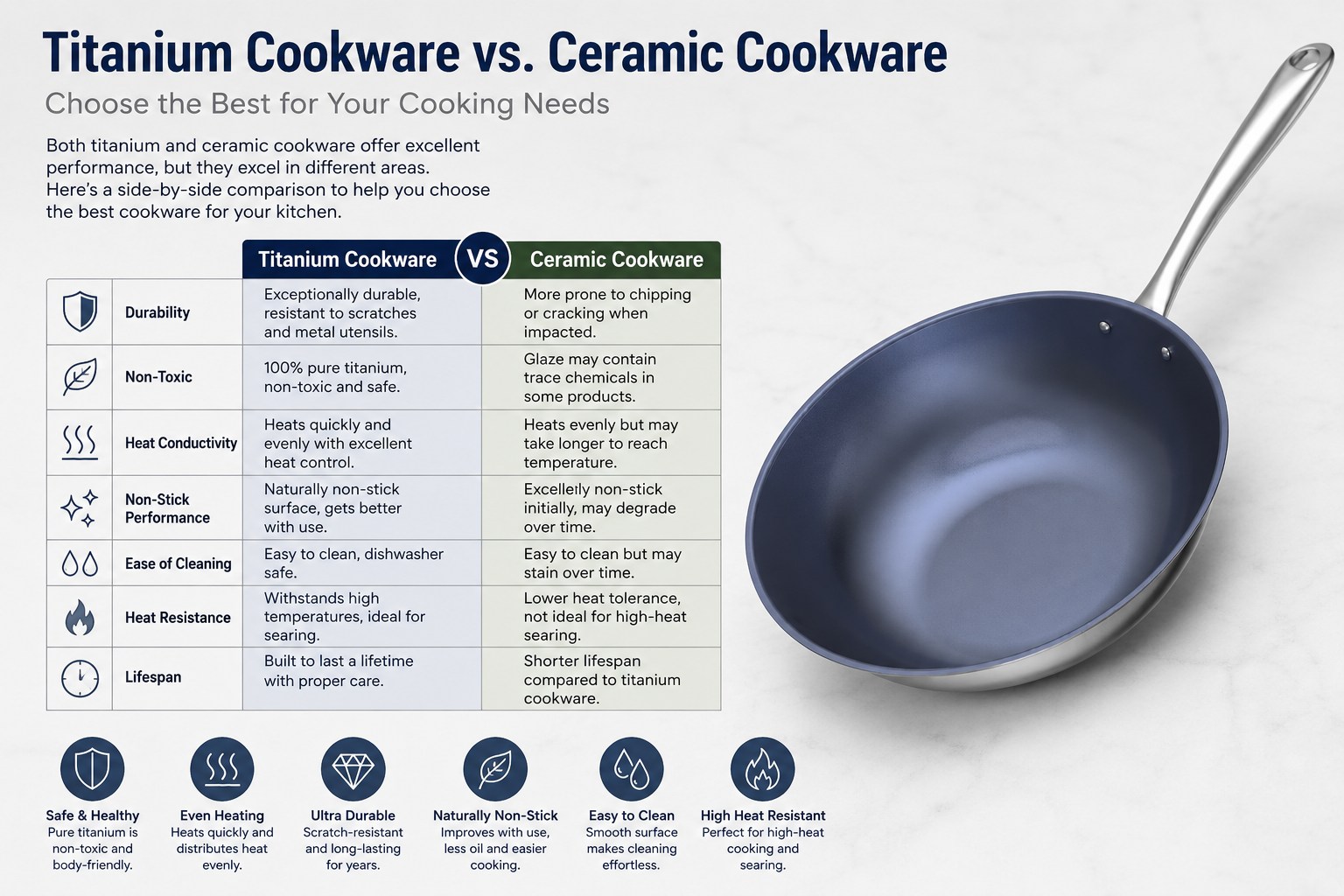
| Decision Factor | Titanium Cookware | Ceramic Cookware | Practical Takeaway |
|---|---|---|---|
| Food-contact surface | Best when the inner surface is real titanium or titanium-lined clad construction | Usually a ceramic-style coating over aluminum or another metal body | Compare the surface, not only the marketing name |
| Food release | Technique-based; not the same as slick nonstick | Often very easy when new | Ceramic wins early convenience |
| Durability | Strong when the titanium surface is genuine and well formed | Performance depends on coating wear | Titanium is stronger for long-term use |
| Heat behavior | Depends on construction; tri-ply improves heat distribution | Should usually be kept at low to medium heat | Do not judge only by maximum temperature claims |
| Best buyer | Durability-focused users, nickel-sensitive positioning, premium product lines | Budget users and cooks who want easy release now | Match the material to the actual use case |
2. What Ceramic Cookware Really Means
In the modern cookware market, ceramic cookware usually means ceramic-coated cookware, not a solid ceramic pot. A ceramic-coated pan commonly has a metal body, often aluminum, with a sol-gel style ceramic coating applied to create a smooth nonstick-like surface. This coating is the part that touches food, so its quality, thickness, curing, and wear resistance matter more than the word ceramic alone.
Ceramic coatings are popular because they are often promoted as PTFE-free and PFAS-free alternatives to traditional nonstick coatings. That can be attractive to consumers. However, it does not mean every ceramic-coated pan has the same formulation, testing, durability, or heat tolerance. Some coating systems are proprietary, so professional buyers should ask for finished-product food-contact documentation instead of relying only on broad claims.
The main limitation is wear. Ceramic-style coatings can lose easy-release performance over time, especially with overheating, abrasive cleaning, metal utensils, stacked storage, or repeated dishwasher use. A worn coating does not automatically mean a pan is dangerous, but it does change the safety and performance discussion because the barrier between food and the base metal may no longer be in ideal condition.
This is also why user reviews of ceramic cookware can be divided. A buyer who cooks gently and replaces pans regularly may be satisfied. A user who expects restaurant-style durability from a low-cost coated pan may be disappointed. Ceramic cookware should be positioned as convenient coated cookware, not as a lifetime material solution.
3. What Titanium Cookware Really Means
Titanium cookware also needs careful definition. A product called titanium may be pure titanium, titanium-lined, tri-ply titanium, titanium-coated, or titanium-reinforced nonstick. These are not the same. For SEO and buyer education, this distinction should be clear because searchers often use titanium cookware as a broad phrase while expecting a safer or more durable food-contact surface.
Real titanium cookware means the food-contact surface is titanium. Titanium is valued for corrosion resistance, low reactivity, light weight, and a stable surface oxide layer. It is often used in demanding environments, but cookware claims still need to be tied to finished-product quality, not just the reputation of the raw material.
Titanium-reinforced nonstick is different. In those pans, titanium may be part of a coating system or marketing phrase, while the food-contact experience still behaves like coated nonstick cookware. That can be useful, but it should not be confused with a real titanium cooking surface. For related buyer education, see titanium-coated cookware vs real titanium cookware.
The clearest product description is specific about construction. Pure titanium cookware is one category. Titanium-lined cookware is another. Tri-ply titanium cookware adds a bonded structure, often to improve heat distribution. Titanium-reinforced nonstick belongs in a coated cookware category. These differences should be visible in product pages, catalogs, packaging, and sales training.
4. Safety: Stable Metal Surface vs Coating Condition
The safety comparison is not simply titanium good, ceramic bad. Both materials can be appropriate when manufactured correctly and used as intended. The more useful comparison is stable metal surface versus coating-dependent surface. With real titanium cookware, the key question is whether the food-contact layer is actually titanium and whether the product is properly finished. With ceramic cookware, the key question is whether the coating remains intact and supported by reliable testing.
The FDA treats cookware and food-preparation surfaces as part of the broader food-contact materials discussion, depending on composition and use. That is why strong safety claims should connect to intended use and compliance evidence, not only to advertising words such as natural, non-toxic, or chemical-free. Reference: FDA food-contact substances information.
Ceramic coatings are often discussed as sol-gel coatings. The American Ceramic Society has noted that ceramic-coated cookware is not the same as solid ceramic cookware and that coating composition and behavior can vary. That does not mean ceramic-coated pans should be dismissed. It means buyers should evaluate real formulation, wear behavior, temperature guidance, and finished-product testing. Reference: American Ceramic Society on ceramic-coated cookware.
The most reliable safety language is conditional and evidence-based. Instead of saying one material is completely safe under every condition, say the product is suitable for its intended cooking use when manufactured, tested, and maintained correctly. This wording is more credible for consumers and safer for brands because it avoids unsupported absolute claims.
This is especially important for export pages and B2B catalogs. Retail buyers may ask simple questions, but distributors and compliance teams need material identity, test standards, and clear use instructions. A page that separates real titanium, titanium-reinforced coating, and ceramic-coated cookware is more trustworthy than a page that treats every surface claim as equal.
5. Durability, Scratches, and Lifespan
Durability is where titanium cookware usually has the stronger long-term case. A genuine titanium cooking surface may discolor, develop normal use marks, or require better cooking technique, but those changes are not the same as a nonstick coating losing its original release. If the surface is real titanium and the pan is built well, the product can remain useful for a long time.
Ceramic cookware has a different lifespan pattern. It often performs best early, then gradually loses easy-release behavior. The decline can be faster if the pan is overheated empty, cleaned with abrasive pads, washed aggressively, or used with metal utensils. Many consumers become disappointed because they expected permanent nonstick performance from a coating that should be treated as a wear layer.
For professional buyers, durability should be tested instead of assumed. Ask for abrasion testing, dishwasher guidance, heat-cycle performance, coating adhesion data, and after-use photos. For titanium cookware, ask for food-contact layer confirmation, thickness, bonding quality, rim finish, and whether the construction is pure titanium, titanium-lined, or tri-ply titanium.
Retail pricing should also reflect expected life. A ceramic pan that costs less but needs replacement sooner may still be a good value for casual users. A titanium pan that costs more can be a better value when the buyer wants a longer service life, fewer coating complaints, and a more premium material position.
6. Heat Performance and Cooking Results
Heat performance depends on the full cookware structure, not only the surface material. Ceramic-coated pans often use aluminum bodies, so they can heat quickly and evenly. This is one reason they feel easy in daily cooking. However, the coating should usually be protected from unnecessary high heat, especially empty preheating and repeated overheating.
Titanium has a different challenge. Pure titanium is light and corrosion resistant, but it is not the best heat spreader. A thin pure titanium pan may develop hot spots or require more attention on the stove. Tri-ply titanium solves much of this problem by adding a conductive core while keeping titanium as the food-contact surface.
Cooking results also depend on expectations. Ceramic cookware is easier for users who want low-stick cooking with little technique. Titanium cookware is better for users who accept stainless-style cooking habits: preheat correctly, use enough oil, let proteins release naturally, and avoid forcing food too early. Titanium is a material choice, not a magic nonstick shortcut.
For sauces, soups, acidic foods, and repeated daily cooking, titanium has a clear positioning advantage because it can be explained as a low-reactive metal surface. For delicate low-fat cooking, ceramic may feel easier at first. The best recommendation should therefore match the food, heat level, user habits, and expected replacement cycle.
For restaurants, rental kitchens, and heavy home users, repeatability matters more than the first-week nonstick feel. A ceramic pan may be pleasant at the beginning, but staff training, utensil control, and cleaning habits can shorten coating life. Titanium cookware asks for more cooking technique, but it is easier to position as a durable daily tool when the surface is genuine and the structure is well designed.
7. Cleaning, Maintenance, and Daily Use
Ceramic pans should be treated gently. Use low to medium heat, silicone or wood utensils, soft sponges, and careful storage. Avoid sudden overheating, aerosol sprays that leave residue, aggressive scouring, and stacking without protection. When the surface loses release, cleaning becomes harder and the pan may need replacement even if it still looks usable.
Titanium cookware is usually more forgiving as a food-contact surface, but it still needs proper use. Let the pan cool before washing, soak stuck food before scrubbing, and avoid treating discoloration as a safety failure. Residue can often be handled with warm water, mild detergent, or a gentle baking soda paste if the manufacturer allows it.
Neither material should be sold with exaggerated promises. Ceramic is not permanent nonstick. Titanium is not automatically nonstick. The better user experience comes from accurate expectations and clear care instructions. Brands that explain this honestly reduce returns, negative reviews, and customer confusion.
8. Buyer Checklist and Final Recommendation
Before choosing between titanium cookware and ceramic cookware, ask what touches food, how the product is tested, what heat range is recommended, how long the surface is expected to perform, and what the warranty actually covers. If a ceramic pan is chosen, the buyer should understand that coating condition controls long-term performance. If a titanium pan is chosen, the buyer should confirm that titanium is the real food-contact surface.
For home cooks, ceramic is a practical short-term choice when easy release and price matter most. Titanium is a better long-term choice when durability, corrosion resistance, low-reactive cooking, and material transparency matter more. For importers and private-label brands, titanium can also create a clearer premium product story when supported by real construction details and finished-product testing.
The final verdict is straightforward: ceramic cookware wins on early nonstick convenience and entry price, while real titanium cookware wins on long-term material stability and product differentiation. For buyers who want titanium with improved heat distribution, tri-ply titanium is usually the most balanced option. For related product options, see TITAUDOU titanium pots and pans.
If the product is being developed for wholesale or OEM/ODM supply, the decision should also consider complaint risk. Coated pans are easier to sell with simple nonstick messaging, but coating expectations can create returns if users overheat or scratch the surface. Real titanium cookware requires better education, but it gives the brand a more durable and differentiated material platform.
| Use Case | Better Choice | Reason | What to Verify |
|---|---|---|---|
| Eggs, pancakes, and very low-oil cooking | Ceramic cookware | Easy release when the coating is new | Coating warranty, heat limits, and utensil guidance |
| Daily durable cooking surface | Titanium cookware | Does not depend on a temporary ceramic coating | Real titanium food-contact layer |
| Premium cookware line | Tri-ply titanium | Combines titanium surface with better heat distribution | Layer structure, bonding, and finished-product testing |
| Lowest initial price | Ceramic cookware | Usually more affordable at retail | Expected coating lifespan |
| Buyer transparency | Titanium cookware | Material story is easier when the surface is genuine titanium | Avoid confusing titanium-reinforced nonstick with real titanium |
Frequently Asked Questions (FAQ)
Q1: Is titanium cookware safer than ceramic cookware?
A: Real titanium cookware can offer a more stable long-term food-contact surface, while ceramic cookware depends on coating condition. Both should be judged by finished-product quality and intended use.
Q2: Does ceramic cookware last as long as titanium cookware?
A: Usually not. Ceramic-coated pans often lose easy-release performance as the coating wears, while genuine titanium surfaces are more durable when the cookware is made properly.
Q3: Is ceramic cookware non-toxic?
A: Ceramic-coated cookware can be appropriate for normal use when made and tested properly, but broad non-toxic claims should be treated carefully. Buyers should check coating type, heat guidance, and food-contact documentation.
Q4: Which is better for daily cooking?
A: Ceramic is easier for low-stick cooking when new. Titanium is better for long-term durability, low-reactive cooking, and premium positioning, especially in tri-ply titanium construction.