For international kitchenware brand owners, commercial cookware importers, and hospitality procurement directors, the global cookware market has reached a critical strategic inflection point. Consumer demand for non-toxic, PFAS-free culinary vessels has propelled titanium to the pinnacle of commercial kitchenware. However, because authentic titanium is a capital-intensive refractory metal requiring specialized manufacturing infrastructure, procurement executives face a fundamental supply chain decision: should their company procure inventory through traditional third-party trading intermediaries, or is sourcing direct from a titanium cookware manufacturer the only viable pathway to secure long-term market profitability, uncompromised product quality, and supply chain defensibility?
Navigating cross-border manufacturing requires balancing commercial landed costs against catastrophic quality liabilities. When intermediate brokers and trading companies obscure factory origins and inflate FOB unit prices, establishing a direct manufacturer relationship is an essential risk mitigation strategy. By sourcing direct from a titanium cookware manufacturer like TITAUDOU, brands unlock transparent bill-of-materials costing, certified raw material traceability, agile engineering, and exclusive technologies like molecular crystal rearrangement surface hardening. This comprehensive guide dissects the quantifiable economic, metallurgical, and operational benefits of factory-direct procurement.
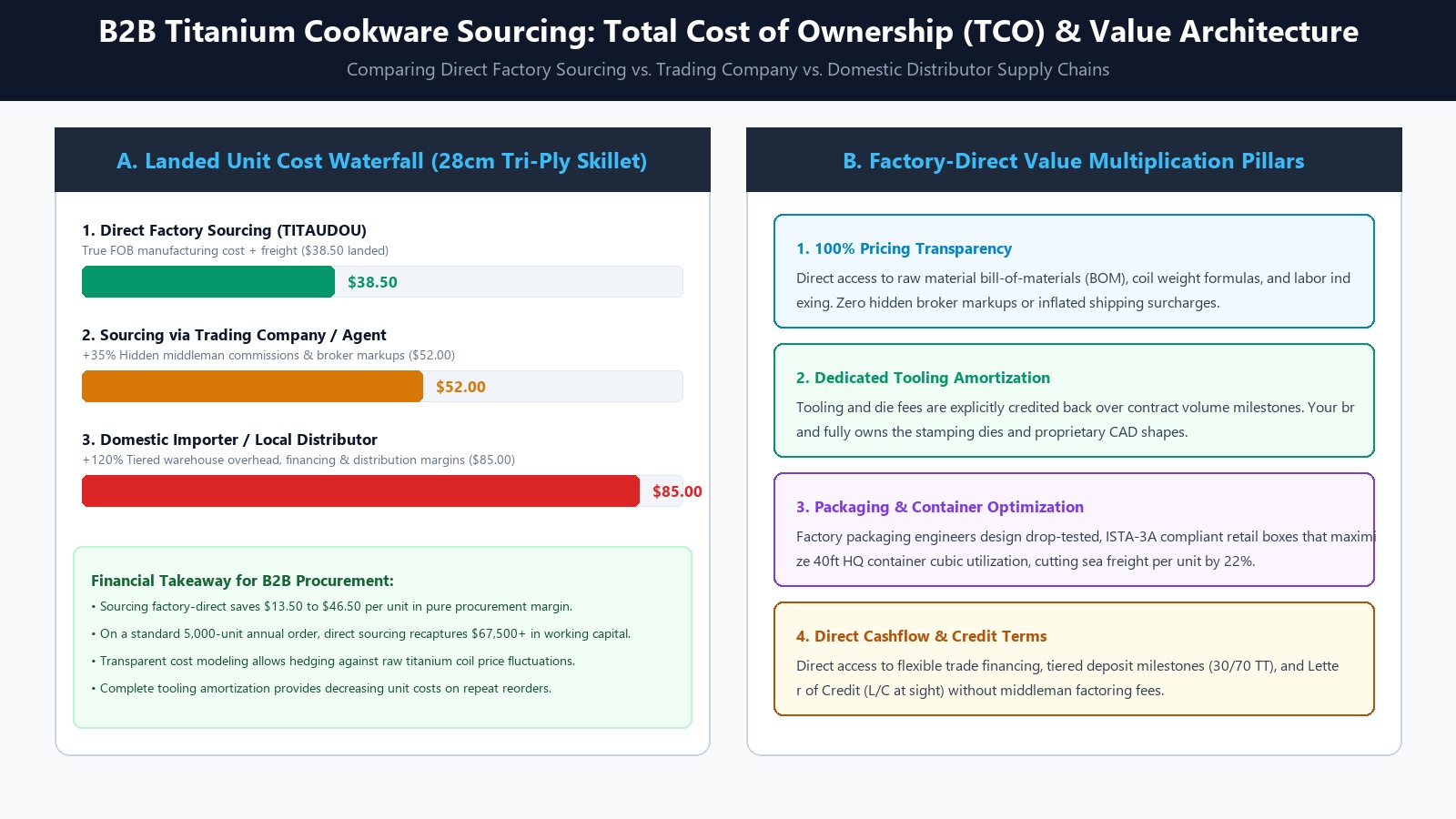
Figure 1: Landed unit cost waterfall comparing direct factory procurement with intermediate trading companies and domestic distributors, demonstrating where hidden procurement margins are recaptured.
1. The Strategic Procurement Shift: Why Global Cookware Brands Bypass Middlemen
For decades, international kitchenware procurement followed a multi-tiered distribution model. Brands relied on trading houses and export brokers to manage overseas manufacturing relationships. While this middleman layer provided an initial buffer against logistics, it introduced systemic inefficiencies that modern e-commerce and retail margins can no longer absorb.
The foremost vulnerability of working through intermediary trading companies is information opacity. Sourcing agents deliberately conceal the actual factory floor to protect their commercial commission, creating an artificial communication silo. When a brand requests critical design modifications—such as adjusting a pan sidewall draft angle, modifying handle rivet pitch, or specifying induction base thickness—the technical inquiry passes through multiple sales representatives rather than reaching tooling engineers. This communication friction results in costly tooling errors, extended lead time delays, and chronic misunderstandings regarding production tolerances.
Consequently, forward-thinking kitchenware enterprises have transitioned to direct manufacturer partnerships. By connecting corporate procurement teams directly with production plant managers and metallurgical engineers, brands achieve unhindered supply chain transparency. Buyers gain real-time visibility into machine scheduling, raw titanium coil inventory levels, and labor indexing. To explore how direct manufacturing infrastructure transforms commercial partnerships, review our dedicated production overview at TITAUDOU: Premium Titanium Cookware Manufacturer & OEM/ODM Supplier.
2. Total Cost of Ownership: Quantifying the Factory-Direct Financial Advantage
When evaluating international procurement proposals, sophisticated buyers analyze the Total Cost of Ownership (TCO) rather than isolated initial quotations. Intermediary trading entities routinely inflate ex-factory production costs by adding a 15% to 30% gross margin markup. On premium titanium cookware lines—where raw titanium master coil represents a substantial portion of the bill of materials—this broker premium severely erodes retail profitability or inflates the final shelf price beyond competitive consumer thresholds.
By sourcing direct from a titanium cookware manufacturer, procurement executives capture the true baseline FOB manufacturing price. In a typical production run of 5,000 units of a high-performance 28cm tri-ply titanium frying pan, eliminating third-party agent markups recaptures between $67,500 and $115,000 in gross working capital. This substantial capital reserve can be redeployed into domestic retail marketing, brand customer acquisition, or expanded inventory stocking. Furthermore, direct manufacturing relationships unlock flexible commercial financing terms, including structured 30/70 Telegraphic Transfer (T/T) milestones and confirmed Irrevocable Letters of Credit (L/C at sight) without factoring surcharges.
Beyond unit price reductions, factory-direct collaboration delivers significant secondary freight and logistics economies. TITAUDOU in-house packaging engineers design custom, ISTA-3A transit-certified retail gift packaging engineered specifically around the internal dimensions of standard 40ft High Cube (HQ) sea freight shipping containers. By eliminating wasted airspace and optimizing pallet carton nesting, factory-engineered packaging increases total container load capacity by 18% to 22%, dramatically lowering the net ocean freight cost per unit. Importers seeking volume price matrices and container optimization data can consult our detailed guidelines at Bulk Titanium Cookware for Wholesale Orders and Private Label Brands.
| Procurement Dimension | Direct Titanium Manufacturer (TITAUDOU) | Intermediate Trading Company / Agent | Domestic Wholesale Distributor |
|---|---|---|---|
| Unit Pricing & Markup | True Baseline FOB Cost (Zero Markup) | +15% to +30% Hidden Broker Margin | +80% to +150% Tiered Wholesale Markup |
| Material Purity & MTR | EN 10204 3.1 Certified ASTM Grade 1 | Generic Material Claims; High Fraud Risk | Often Rebranded Coated Aluminum Pans |
| Prototyping Lead Time | 7 to 14 Days (Direct CNC / 3D Tooling) | 45 to 60 Days (Email Relay Friction) | No Custom Prototyping (Stock Only) |
| Tooling & Mold Ownership | 100% Client Legal Ownership (Amortized) | Often Retained by Agent or Subcontractor | Non-Applicable; Off-the-Shelf Catalogs |
| Surface Technology | Proprietary Molecular Hardening (HV 600+) | Standard Soft Annealed Ti (HV 130) | Standard PTFE or Sol-Gel Ceramic Coatings |
| Quality Recourse & Warranty | Direct Batch Replacement & Root-Cause CAPA | Finger-Pointing Between Agent & Factory | Limited Domestic Return Window Only |
As articulated in the comparative analysis above, the economic differential between supply channels extends far beyond initial invoice totals. Direct factory sourcing structures a lean, transparent commercial foundation where capital is invested directly into material excellence and engineering precision rather than administrative friction.
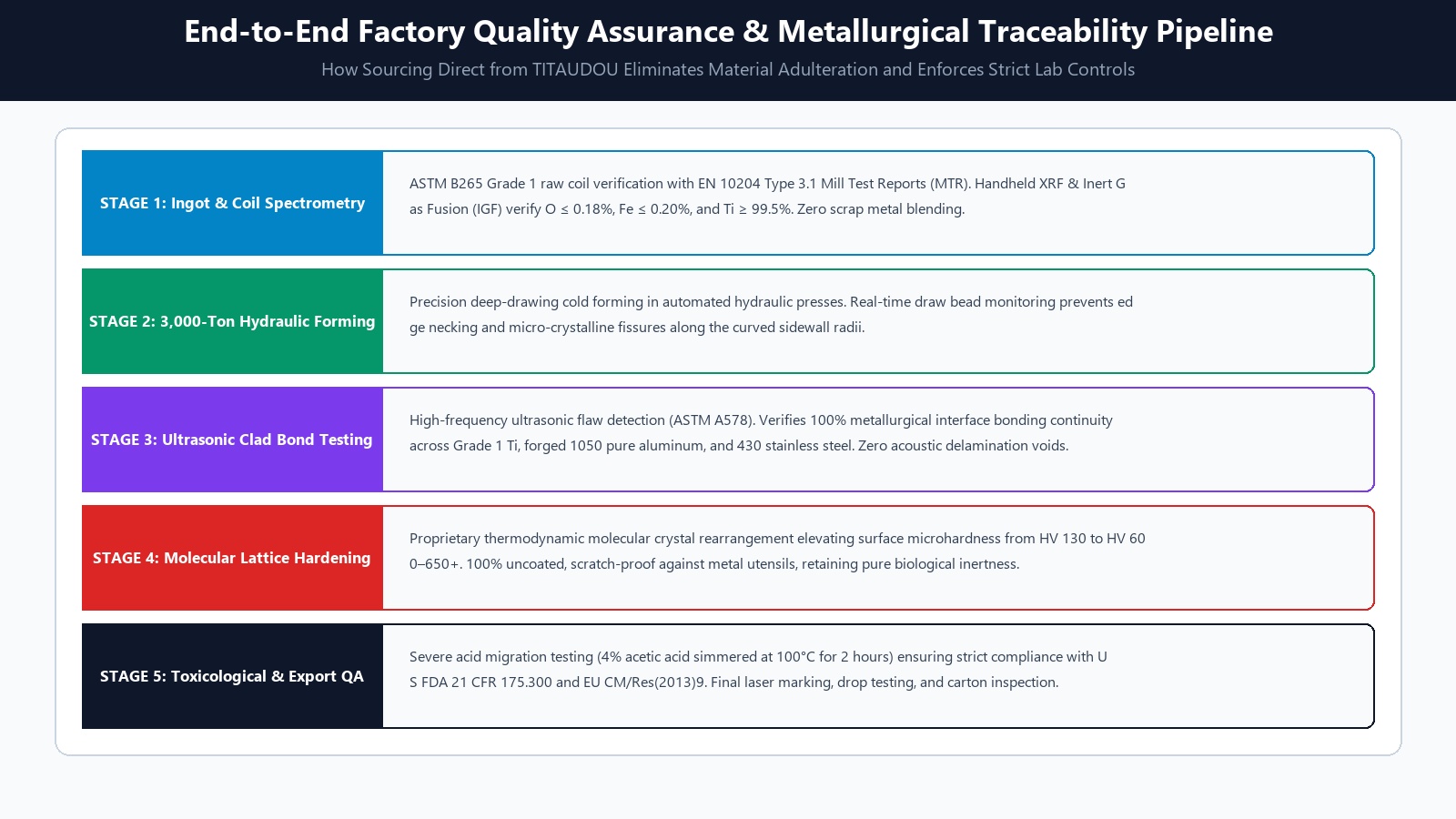
Figure 2: The end-to-end factory quality assurance pipeline, tracing metallurgical verification from raw vacuum-arc melted ingots through ultrasonic clad testing to FDA acid migration testing.
3. Uncompromising Quality Control: Mill Test Reports, Metallurgy, and Material Traceability
In the global cookware trade, material adulteration represents an immense legal, brand, and consumer liability. Because raw titanium sponge and cold-rolled sheets trade at substantial cost premiums compared to aluminum and 304 stainless steel, unscrupulous trading vendors frequently execute fraudulent substitutions. Brokers routinely market cookware stamped as "Titanium" that in reality utilizes cheaper, higher-impurity Grade 2 industrial scrap, or worse, standard aluminum pans coated in synthetic gray fluoropolymer paint infused with microscopic titanium dioxide dust.
When a brand relies on third-party trading intermediaries, auditing raw material purity becomes virtually impossible. In contrast, sourcing direct from a titanium cookware manufacturer guarantees end-to-end metallurgical chain-of-custody. A genuine manufacturer maintains direct master coil supply contracts with primary titanium smelters. For every incoming heat lot, the factory secures and validates a certified Mill Test Report (MTR) conforming to EN 10204 Type 3.1 standards.
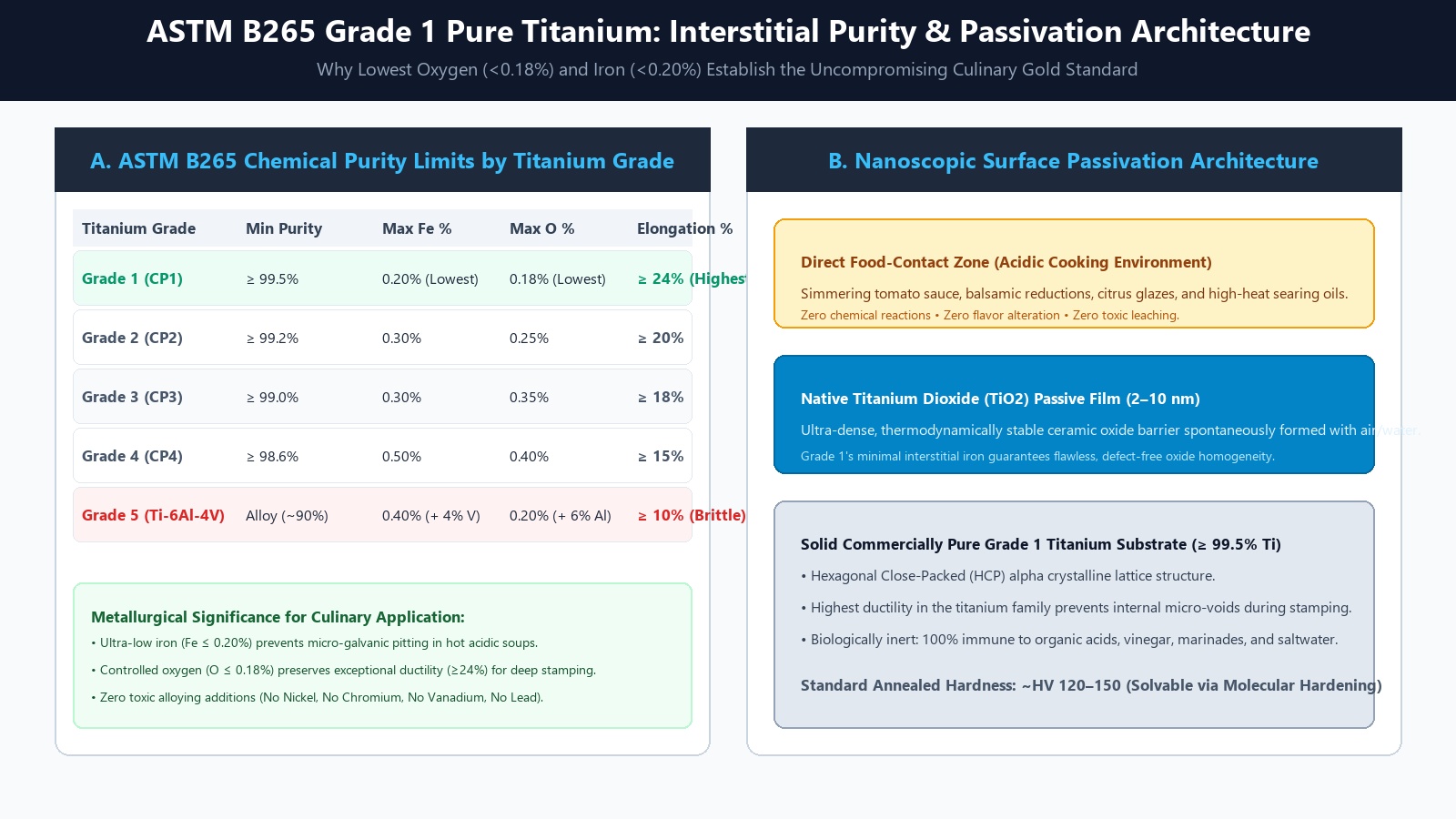
At TITAUDOU, quality control begins in our metallurgical testing laboratory. Technicians utilize calibrated handheld X-ray Fluorescence (XRF) analyzers and Optical Emission Spectrometry (OES) to confirm that the food-contact metal layer strictly meets ASTM B265 Grade 1 standards: base titanium content ≥ 99.5%, iron (Fe) capped below 0.20%, and interstitial oxygen (O) restricted below 0.18%. Furthermore, because multi-layer composite pans require bonding titanium with pure aluminum and induction-compatible stainless steel, our plant conducts high-frequency ultrasonic non-destructive testing (in accordance with ASTM A578). This guarantees 100% metallurgical interface bonding continuity without internal delamination voids. Finished production lots undergo rigorous heavy-metal migration testing under aggressive 4% acetic acid simmer protocols, certifying full compliance with US FDA 21 CFR 175.300 and European Resolution CM/Res(2013)9. For detailed metallurgical criteria, review our technical guide on Why Grade 1 Titanium Is the Gold Standard for Food-Contact Titanium Cookware.
4. Engineering Agility and Proprietary Technology Access: Prototyping and Molecular Hardening
In consumer kitchenware, commercial success hinges upon rapid time-to-market and distinct product differentiation. When communicating through trading agents, prototyping a bespoke cookware silhouette requires 45 to 60 days. The middleman must relay 3D CAD files to external toolmakers, negotiate quotes, and ship iterations across multiple forwarding channels.
Direct factory collaboration compresses the product development lifecycle into a streamlined 7 to 14-day turnaround. TITAUDOU in-house mechanical design engineers interface directly with client industrial designers via direct video conference and collaborative CAD modeling. Utilizing precision CNC 5-axis machining centers and in-house 3D wax handle printing, our plant produces functional, deep-drawn prototype samples within a single workweek. Structural engineers perform Finite Element Analysis (FEA) to simulate metal flow, ensuring that vessel floor-to-sidewall transition radii do not experience excessive tensile hoop stresses during deep drawing. Understanding the mechanics of deep-drawing cold fabrication is explored in our process breakdown at How Pure Titanium Cookware Is Made: GR1 Sheet, Blanking, Deburring, and Deep Drawing Quality.
Crucially, sourcing direct from a titanium cookware manufacturer grants client brands direct access to proprietary metallurgical surface technologies that third-party agents cannot license or replicate. Standard commercial Grade 1 titanium exhibits an annealed surface microhardness of roughly HV 120 to HV 150, making it susceptible to cosmetic scuffing from stainless steel spatulas and scrubbers. To solve this dilemma, TITAUDOU pioneered our patented molecular crystal rearrangement surface hardening technology. Operating directly upon the hexagonal close-packed atomic lattice of pure Grade 1 titanium without adding synthetic sprays, glazes, or coatings, this process elevates the cooking surface microhardness to an extraordinary HV 600 to HV 650+. Brand partners direct-sourcing from our facility gain an exclusive market advantage: marketing 100% uncoated, non-toxic pure titanium cookware that withstands aggressive metal utensils and commercial scouring without scratching.
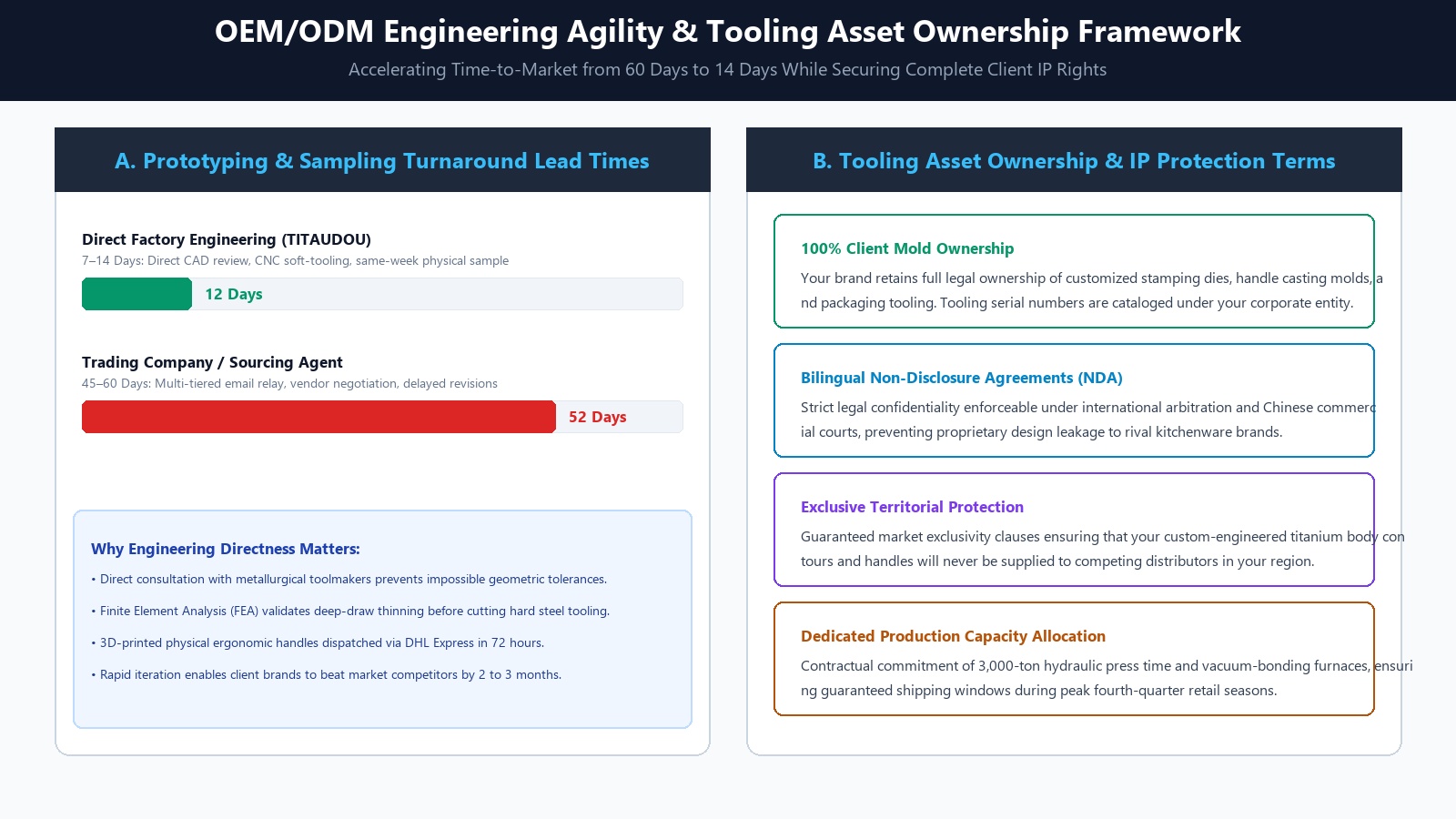
Figure 3: OEM/ODM prototyping lead times and the tooling asset security architecture comparing direct manufacturer execution with broker intermediary delays.
5. Protecting Proprietary Assets: Tooling Ownership, IP Security, and Custom Branding
For culinary brands, proprietary intellectual property (IP) represents a core enterprise valuation driver. Distinctive ergonomic handles, non-drip rim contours, or custom induction base patterns constitute unique brand identifiers. When procuring through third-party sourcing brokers, tooling asset ownership frequently becomes legally ambiguous. Brokers often register stamping dies and casting molds under their own trading company name or an undisclosed subcontractor, leaving the brand vulnerable to extortionate reorder price increases or unauthorized catalog resale.
When establishing a direct contract with a verified manufacturer, tooling ownership is crystal clear. Contractual agreements explicitly assign 100% legal mold and die ownership to the client brand upon initial tooling fee payment. Every precision tungsten carbide stamping die, hydroforming fixture, and handle die-casting mold is stamped with a unique client asset serial number, maintained in climate-controlled die storage vaults, and dedicated exclusively to the client's production runs. Furthermore, manufacturers routinely execute formal tooling amortization agreements, refunding the tooling fee incrementally on a per-unit rebate schedule across production volume milestones.
Direct manufacturing partnerships also enforce robust legal and commercial safeguards. Bilateral Non-Disclosure Agreements (NDAs) enforceable under international commercial arbitration and Chinese civil courts strictly protect client 3D STEP files, trademarked logos, and proprietary packaging designs from unauthorized disclosure. Crucially, direct manufacturers grant formal territorial exclusivity covenants for custom-developed silhouettes, ensuring that your proprietary titanium cookware designs will never appear under a competing brand name in your target retail territory. Importers building dedicated branded programs can review comprehensive terms at Titanium Cookware Supplier for Importers, OEM, Wholesale, and Private-Label Brands.
6. The B2B Factory Audit and Supplier Evaluation Blueprint
Before executing high-value purchase orders, professional procurement teams must conduct rigorous on-site or third-party factory qualification audits. Because many export trading entities maintain slick marketing websites with staged photography depicting facilities they do not own, procurement executives must know how to distinguish an authentic, capital-equipped titanium manufacturer from an intermediary storefront.
A comprehensive B2B supplier evaluation audit should systematically investigate four critical factory capabilities:
1. Heavy Hydraulic Stamping Infrastructure: Deep drawing unalloyed Grade 1 titanium and multi-ply clad blanks requires heavy tonnage. An authentic titanium cookware plant operates automated double-action hydraulic presses rated at 1,500 to 3,000 metric tons. Facilities operating only lightweight 200-ton eccentric presses are fundamentally incapable of deep-drawing seamless titanium cookware bodies without structural failure.
2. Vacuum-Annealing and Bonding Furnaces: Titanium forming generates severe work-hardening. To relieve internal crystalline stresses without atmospheric embrittlement, the manufacturer must operate industrial high-vacuum annealing furnaces maintaining vacuum levels below 10^-3 Pa. Inspecting vacuum furnace capacity confirms true in-house manufacturing pedigree.
3. In-House Metallurgical Metrology Lab: Legitimate manufacturers maintain on-site quality inspection laboratories equipped with optical emission spectrometers, digital Vickers microhardness testers (ASTM E384), coordinate measuring machines (CMM) for dimensional circularity, and continuous boiling acid migration test stands. Requesting live video demonstrations of lab spectrometers during unannounced factory audits immediately filters out broker facades.
4. Social and Regulatory Compliance: Top-tier international retailers mandate social ethical compliance. Verify valid ISO 9001 quality management certifications, ISO 14001 environmental management audits, and BSCI or SMETA Sedex social responsibility audit reports. Sourcing from a fully certified manufacturing partner protects your brand against catastrophic customs delays and regulatory import seizures. Comprehensive testing standards are detailed in Food Grade Titanium Purity Standards for Home Cookware.
Conclusion
In the final analysis, sourcing direct from a titanium cookware manufacturer is the cornerstone of a defensible, high-margin kitchenware enterprise. By bypassing intermediate brokers and trading entities, international brand owners eliminate 15% to 30% in unnecessary procurement markups, secure authentic ASTM Grade 1 material pedigree backed by certified EN 10204 3.1 Mill Test Reports, accelerate custom tooling prototyping into a 14-day cycle, and guarantee 100% legal ownership of valuable mold assets. In a competitive market where discerning consumers demand absolute health safety and durable culinary performance, partnering directly with an authentic manufacturing pioneer like TITAUDOU transforms your supply chain from an opaque operational vulnerability into your greatest commercial competitive advantage.
Frequently Asked Questions (FAQ)
Q1: What is the typical Minimum Order Quantity (MOQ) when sourcing direct from a titanium cookware manufacturer?
When working directly with primary manufacturers like TITAUDOU, baseline MOQs typically range from 500 to 1,000 units per size for existing open-tooled silhouettes with custom laser branding and retail packaging. For fully bespoke OEM projects requiring custom hydraulic stamping dies and cast handles, initial MOQs generally start at 1,000 to 2,000 units to achieve optimal material blanking efficiency. Furthermore, manufacturers frequently accommodate mixed-container load (FCL) orders across multiple pot and pan sizes to support brand catalog launches.
Q2: How do factory-direct manufacturers protect overseas clients against material fraud?
Direct manufacturers provide uncompromised raw material traceability that intermediary trading agents cannot supply. Every master coil heat lot is accompanied by a certified EN 10204 Type 3.1 Mill Test Report (MTR) detailing exact spectrometer chemical compositions (confirming ASTM Grade 1 purity ≥ 99.5%, Fe ≤ 0.20%, O ≤ 0.18%). Manufacturers conduct in-house XRF spectrometry and ultrasonic clad bonding inspections, backing finished inventory with certified US FDA 21 CFR 175.300 and European LFGB food-contact test documentation for seamless customs clearance.
Q3: How does custom mold tooling ownership and amortization work during factory-direct procurement?
Under factory-direct contracts, client brands retain 100% legal ownership of all custom-developed stamping dies, hydroforming fixtures, and handle molds upon payment. Tooling assets are cataloged with dedicated serial numbers and protected by strict bilingual Non-Disclosure Agreements (NDAs). To support client growth, manufacturers routinely structure tooling amortization rebate terms, crediting a designated dollar amount per unit back to the client on every production batch until the initial tooling fee is 100% refunded.