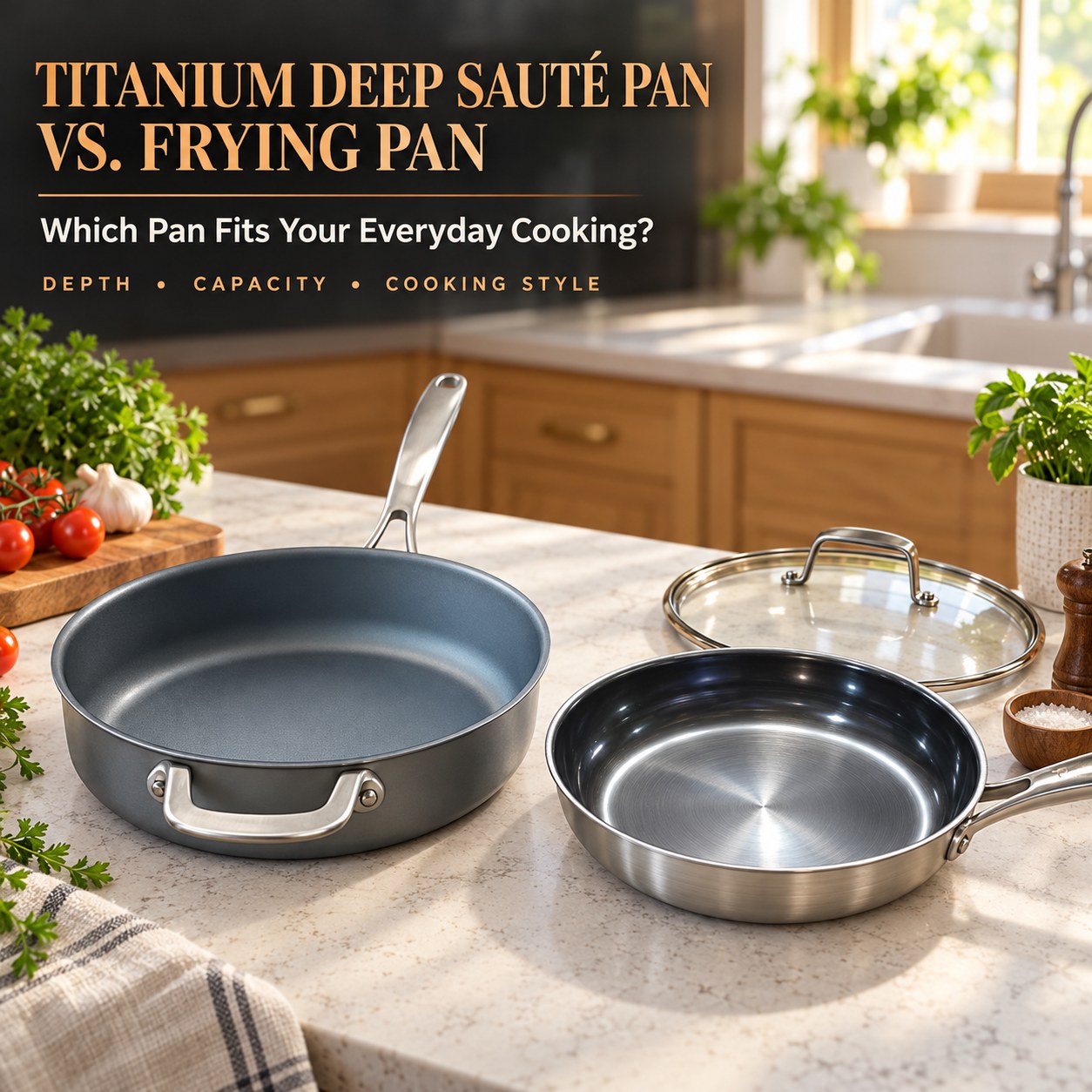
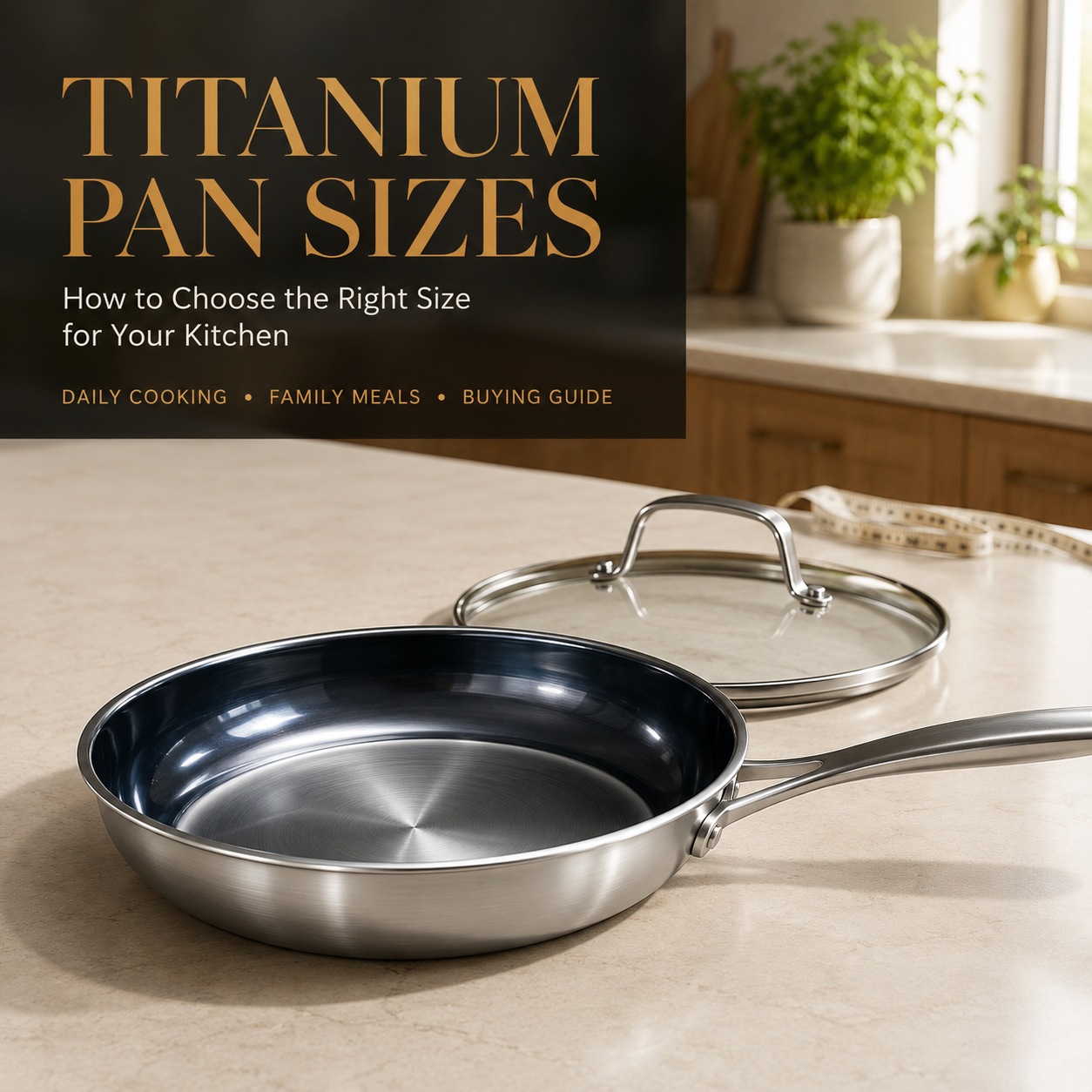
Assessing pour spout precision and dripless rims on titanium pots is not a search for a magic metal. A clean pour comes from a controlled rim profile, a stable hand position, a sensible fill level, and a stream that separates from the pan at the right moment. Titanium can be an excellent food-contact material, but it does not change the basic behavior of liquid. Water, stock, oil, and sauce can wet a metal edge and follow it down the outside of a pot when the edge is too round, irregular, damaged, or used at an awkward angle.
For a buyer, the useful question is not whether a pot is advertised as “100% dripless.” It is whether the pot delivers a repeatable, controlled pour for its intended liquid and user. That requires looking at the formed spout or rim, the condition of the edge, the way the lid seats, and the handle balance when the pot is loaded. This guide separates those checks so a product team can compare samples fairly instead of relying on a marketing phrase.
1. A Dripless Claim Has Practical Limits
No cookware material can guarantee that every liquid will leave every rim without a trace. A thin stream of water may pour cleanly from a basic saucepan, while a warm oil-and-water mixture or a thick tomato sauce can cling to the same edge. Pouring speed, vessel angle, surface cleanliness, and how much liquid is left in the pot all change the result. The word “dripless” is therefore best treated as a controlled-pour design objective, not an unconditional promise.
This distinction matters when assessing pour spout precision and dripless rims on titanium pots. A rim should guide the main stream into the receiving vessel and reduce liquid tracking down the exterior sidewall under a defined test. It should not be claimed to eliminate every final drop after every pour. A transparent specification states the test liquid, fill condition, pour direction, and acceptable observation rather than making an absolute statement that cannot be repeated in normal kitchens.
The handle is part of the same system. A long or rear-heavy handle can make a filled pot difficult to rotate with one hand. When the wrist tires, users tend to slow down, flatten the pouring angle, or correct the motion midway. The stream then broadens and may return along the outer wall. The principles in our lightweight titanium cookware handling guide are relevant here: empty weight alone does not predict how controlled a pot feels when it is carrying hot liquid.
2. Compare a Formed Spout with a Continuous Rolled Rim
A formed pouring spout and a full-circumference rim solve different problems. A pressed or drawn spout gives the stream a preferred direction. It can be useful for a small saucepan, milk pan, tea pot, or stock vessel where the user repeatedly pours into a narrow opening. A continuous flared or rolled rim gives the user more freedom to pour from different points around the pot. It is common on cookware that must be convenient for both left- and right-handed use.
| Rim approach | Best use | Inspection focus |
|---|---|---|
| Dedicated formed spout | Controlled pouring into a cup, bowl, or narrow vessel. | Left-right symmetry, smooth tip, predictable stream direction, and a lid designed for the local rim geometry. |
| Continuous flared or rolled rim | Everyday saucepots, stockpots, frying pans, and two-handed use. | Continuous profile, clean separation point, absence of burrs, and consistent flow from more than one position. |
| Sealed tri-ply edge | Layered cookware where edge integrity and a cleanable finish are essential. | No exposed core, no open seam, no sharp interruption, and a profile that matches the approved sample. |
A spout does not automatically make lid fit impossible, but it can make a standard circular lid interface harder to engineer. The correct evaluation is specific: place the intended lid on the pot, rotate it gently, and check that it seats consistently without rocking, a wide local gap, or a sharp mismatch at the spout. A continuous rim does not automatically pour cleanly either. If the final edge is over-polished into a wide rounded surface, the liquid can remain attached to the rim instead of separating into the receiving vessel.
3. Treat Edge Sealing and Pour Control as Related but Separate Checks
Tri-ply cookware adds a second issue: what is visible at the cut edge. In a construction with a titanium food-contact layer, an aluminum heat-spreading core, and an exterior stainless layer, a raw cut edge can expose the core. That is not the same question as whether the rim pours cleanly. An edge may have an acceptable pouring shape but still need a better closed finish; conversely, a sealed edge may still perform poorly if its profile is uneven.
For the applicable tri-ply product series, TITAUDOU uses sealed-edge construction to enclose the aluminum core between the titanium interior and stainless exterior. A continuous sealed edge is intended to keep the layers protected at the rim and make the transition easier to clean. Together with a consistent lip profile, it can help reduce oil or sauce tracking onto the outside wall during normal pouring. It is not a promise that no liquid will ever touch the exterior, and it should be assessed with the same repeatable pour test used for any other cookware.
This is why assessing pour spout precision and dripless rims on titanium pots should include edge integrity. Acidic foods and strongly alkaline dishwasher detergents can be demanding environments for an exposed aluminum edge. The practical concern is not that aluminum “molds”; it is that an exposed or pitted layer, a poorly closed seam, or a delaminating edge can become harder to clean and can depart from the approved construction. Buyers comparing tri-ply samples should confirm the layer order and edge finish, as explained in our tri-ply titanium cookware guide.
4. Test with More Than Cold Water
A fast cold-water pour is only a screening check. It may show a visibly crooked spout, but it does not tell a buyer how the rim behaves with a sauce-like fluid, with a pot that is nearly full, or with a less confident user. A useful incoming-sample test uses safe, room-temperature liquids and repeats the same procedure for every sample. Do not ask an untrained person to perform this test with boiling soup or a vessel filled to the brim.
| Test variable | What to do | What to record |
|---|---|---|
| Liquid behavior | Use clean water first, then a safe thicker test liquid that represents sauce-like flow. | Whether the main stream stays focused, breaks late, or returns down the exterior wall. |
| Fill condition | Repeat at a moderate fill and at a high but safe fill below the rim. | Side overflow, loss of control, and changes in stream width as the pot is tilted. |
| User direction | Pour from the intended spout and, for an all-round rim, from more than one position. Include the non-dominant hand only when it is safe. | Directional bias, splashing, handle twist, and whether the user can stop the pour cleanly. |
| Repetition | Use the same receiving vessel, setup, fill level, and pour action for each sample. | Photos or video of the rim, exterior wall, and receiving vessel after each test. |
The result should be compared against an approved sample or written acceptance criterion, not against a vague impression. “No visible runback after the defined room-temperature test” is a usable internal condition if the exact method is attached. “Dripless” without a method is not. This type of comparison is particularly important for an OEM or private-label order, where a buyer must be able to identify a production difference before goods are packed.
Keep the evidence with the lot record. One short video taken from a favorable angle is not a reliable acceptance method. Use the same pot orientation, receiving vessel, camera position, operator instruction, and cleaning condition when comparing a first article, a pre-production sample, and finished goods. If a stream changes after polishing, rim rolling, lid fitting, or handle assembly, record that change instead of assuming the previous result still applies. This disciplined approach to assessing pour spout precision and dripless rims on titanium pots turns a subjective kitchen impression into a repeatable quality check.
5. Use Three Simple Factory Checks Before the Flow Test
First, look across the rim at eye level. A formed spout that is visibly asymmetric can direct the stream sideways, while an uneven rolled rim can create a local high point that holds liquid. Compare the left and right shoulders of a spout, or inspect the rim profile around the full circumference. The appropriate tolerance is model-specific, so the drawing and approved sample must govern the decision rather than an invented universal millimeter limit.
Second, use a careful touch inspection. With clean hands and appropriate protection, move a fingertip slowly around the rim to find a sharp burr, torn edge, raised seam, or abrupt interruption. A burr is not merely a cosmetic flaw. It can cut a user, catch a cleaning cloth, create an inconsistent flow path, and make the product feel unfinished. Do not use a sharp object to probe the edge, because that can damage the sample and invalidate the inspection.
Third, check the intended lid. A locally formed spout can pull the opening slightly out of round if the forming process is poorly controlled. Set the lid in place, rotate it lightly, and observe whether it rocks, leaves an irregular gap, or catches at one point. A pour spout need not create a steam leak when the lid and rim are designed as a matched set. If the product has a specific vent, that feature should be evaluated separately rather than mistaken for an accidental lid-fit defect.
6. Judge the Loaded Pot, Not Just the Empty Rim
A clean rim cannot compensate for a pot that becomes difficult to control when full. The required wrist rotation depends on handle length, handle angle, grip section, pot diameter, wall height, lid weight, and where the center of mass moves as liquid leaves the pot. An evaluation that only shows an empty pan being tipped over a sink provides little information about normal use.
For cookware intended for everyday soup, sauce, or tea use, ask whether the handle gives enough clearance from the hot body and whether the pour can begin without an abrupt wrist movement. Where a pot has a helper handle, test a two-hand pour as well. A controlled two-hand pour can be safer than forcing a one-hand action on a large vessel. The product dimensions, capacity, and intended heat source should be considered together with the rim; our titanium cookware thickness guide explains why a single construction number cannot replace this broader product assessment.
Assessing pour spout precision and dripless rims on titanium pots also means checking whether the product fits the actual application. A narrow tea pot may benefit from a directional spout. A wide shallow pan may be better served by an all-round rim and a helper handle. Neither format is universally better, and a design that works for clear water may not be the best choice for sauce, stock, or oily cooking liquid.
7. Put the Pouring Requirement into the Product Specification
A reliable buying decision ends with a record that a factory and buyer can both use. The product specification should identify the exact SKU, rim or spout design, intended lid, layer construction, edge finish, inspection points, and the room-temperature pour test. It should state whether the sample is evaluated for a targeted spout, a continuous rim, or both. It should also identify the action to take if an open seam, sharp burr, crooked spout, or unacceptable exterior runback is found.
For a tri-ply titanium pot, include the required sealed-edge finish in the drawing or approved-sample record. That makes the requirement auditable instead of leaving it as a general promise. Buyers can then connect rim quality to the broader construction checks for the food-contact titanium layer, aluminum heat-spreading core, and exterior stainless layer. The titanium cookware materials guide can help distinguish this layered construction from a titanium-coated pan before specifications are compared.
Conclusion
Assessing pour spout precision and dripless rims on titanium pots is a practical evaluation of geometry, finish, load control, and repeatability. Look for a clean, continuous edge; a spout or rim that matches the intended use; a lid that seats correctly; and a documented pour test that includes more than water. For applicable TITAUDOU tri-ply cookware, sealed-edge construction helps protect the layer transition and, combined with a controlled rim profile, can help reduce oil and sauce streaks on the outer wall. The correct claim remains a controlled, reduced-drip pour under defined conditions, not an impossible promise of zero droplets.
FAQ
1. Does titanium itself stop a pot from dripping?
No. Titanium can be suitable for cookware, but pouring behavior depends mainly on the rim or spout geometry, edge finish, liquid type, fill level, and user control. Evaluate the full product rather than assigning the result to the base metal.
2. Does a dedicated pour spout always make lid fit worse?
No. A spout changes the local rim geometry, so it requires a lid designed and checked for that geometry. A matched pot and lid can seat correctly; an uncontrolled forming process can create rocking or an irregular gap.
3. What should a buyer verify on a sealed tri-ply rim?
Verify that the core is not visibly exposed, the edge is smooth and continuous, the rim matches the approved sample, and the pot passes the agreed pour and lid-fit checks. A sealed edge improves construction integrity, but it should still be assessed for real pouring behavior.