A lightweight titanium frying pan for weak wrists should not be judged by material name alone. The real question is whether the pan is light enough to lift when food is inside, balanced enough to tilt without twisting the wrist, and easy enough to clean without heavy scrubbing. Pure titanium can help because it offers high strength at a lower weight than many traditional cookware structures, but the handle, pan size, wall thickness, and cooking surface matter just as much as the metal itself.
The original version of this article introduced TITAUDOU titanium cookware as a competitive product because of its proprietary surface technology, lightweight structure, blue titanium oxide surface, and easy-clean behavior. Those points are still useful, but buyers need a more practical explanation. A person with limited wrist strength does not only ask, "Is titanium strong?" They ask whether the pan is tiring to hold, whether the handle feels secure, whether a 10 inch pan is easier than a 12 inch pan, and whether food residue can be cleaned without force.
This guide explains how to evaluate a pure titanium frying pan for weak-wrist cooking, senior-friendly home use, and product development. It is not medical advice, and cookware cannot treat wrist pain, arthritis, or reduced grip strength. It can, however, reduce unnecessary handling burden when the product is designed with the right weight, thickness, balance, and handle shape.
1. Why Weight Is Only the First Part of Weak-Wrist Cookware Design
A pan that feels light when empty may still feel awkward when it contains oil, vegetables, eggs, meat, or sauce. For weak wrists, the important factor is loaded handling. A lightweight titanium body helps because less base material means less dead weight before food is added. On the old page, the product was described as approximately 1 kg excluding the lid, with a total thickness of about 2.0 mm. That is a meaningful product claim because many buyers compare cookware by hand feel before they compare technical diagrams.
Still, low weight can create a second problem if the pan becomes too thin, unstable, or difficult to control on the stove. A weak-wrist buyer usually needs a pan that is light, but not flimsy. The base should sit flat, the sidewall should resist distortion under normal home cooking, and the handle should not make the pan feel nose-heavy. For this reason, TITAUDOU's 2.0 mm structure should be explained as a balance between handling comfort and functional rigidity, not just as a number.
For an everyday lightweight titanium frying pan for weak wrists, the best starting point is usually a moderate pan size. A smaller pan reduces lifted weight and turning force, while a larger pan gives more cooking area but places more food farther from the wrist. Buyers should think about their most common task. Frying one or two eggs, reheating vegetables, or making a small portion usually favors a compact pan. Batch cooking or searing larger portions may justify a larger pan, but it may need a helper handle or two-hand lifting habit.
| Buyer Need | What to Check | Why It Matters for Weak Wrists |
| Daily light cooking | Empty weight, loaded balance, pan diameter | Lower weight reduces lifting effort, while a moderate diameter reduces wrist torque. |
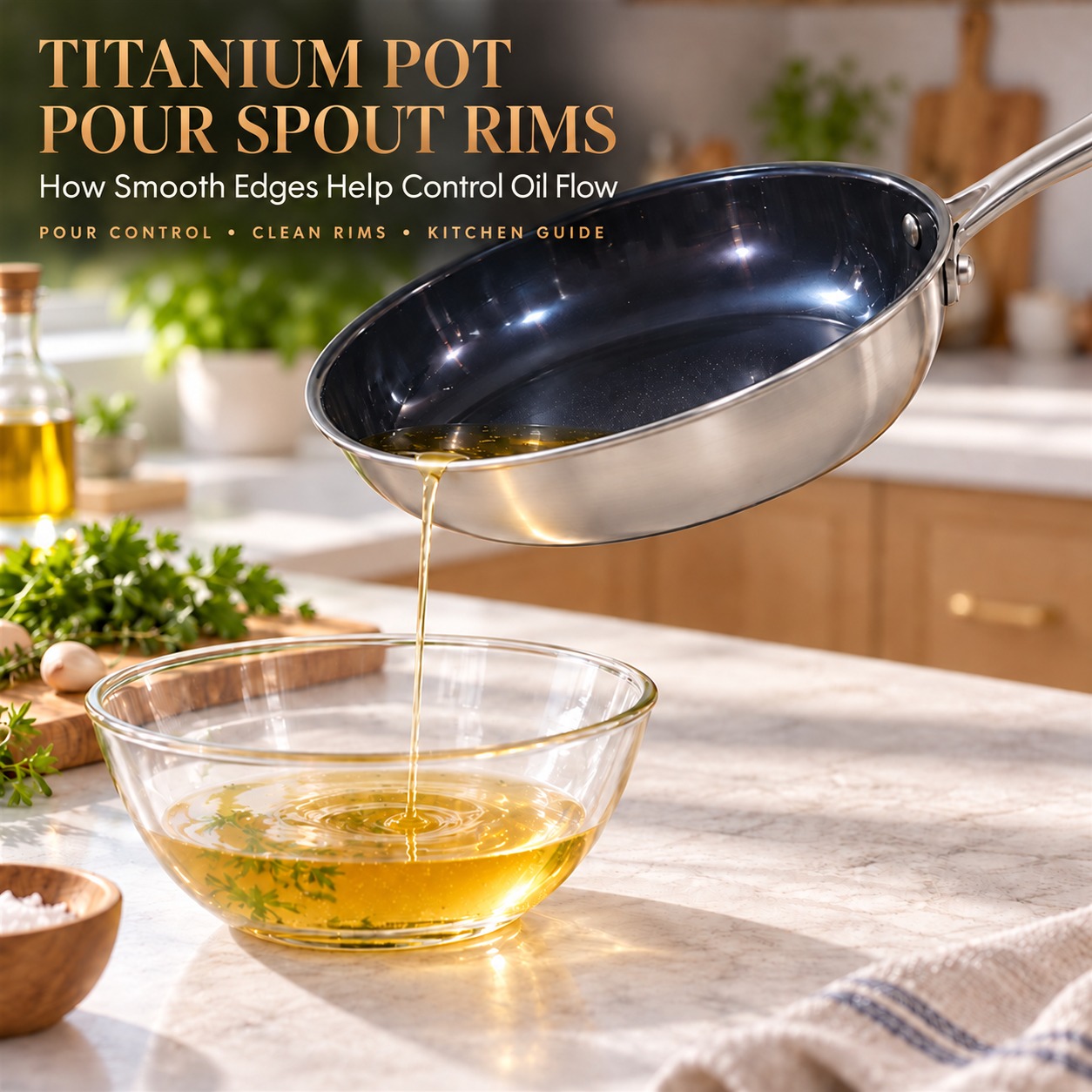
| Safer tilting and pouring | Handle angle, rim shape, helper handle option | The user can control the pan with less twisting and can use two hands when needed. |
| Easy cleaning | Surface treatment, residue release, cleaning instructions | Less scrubbing can matter as much as lower pan weight for people with limited hand strength. |
2. Pure Titanium, Titanium Coating, and Tri-Ply Titanium Are Not the Same
One reason buyers become confused is that the word titanium is used in several different ways. A pure titanium frying pan uses titanium as the main food-contact material or body material. A titanium-coated pan may use aluminum or another base metal with a coating that includes titanium-related particles or branding. A tri-ply titanium pan may combine titanium with stainless steel or aluminum layers to improve heat distribution or induction compatibility. These products can all be marketed with similar language, but they do not feel the same in the hand.
For weak-wrist handling, pure titanium has a strong advantage when the buyer wants low weight, corrosion resistance, and a surface that does not rely on a thick middle aluminum layer. The old TITAUDOU article stated that similar products may use a 3.0 mm or thicker structure because of the middle aluminum layer, while this product design reduces total thickness to about 2.0 mm through its proprietary surface technology. That is exactly the kind of detail a buyer needs, but it should be tied to practical use: lower weight can make the pan easier to lift, especially when the user cooks small meals often.
There is a tradeoff. Titanium has lower thermal conductivity than copper, aluminum, and carbon steel. A thin pure titanium pan can feel responsive and light, but heat control needs attention. It is better to describe the pan as easy to handle and easy to clean, not as a magic solution that cooks exactly like heavy multi-ply cookware. For buyers comparing material behavior, the pure titanium cookware guide and the titanium cookware thickness guide are useful supporting pages.
3. Ergonomic Handle Design Matters as Much as the Pan Body
A weak wrist often struggles less with the absolute weight of the pan and more with the leverage created by the handle. A long, narrow, slippery handle can make a pan feel harder to control than its scale weight suggests. A better ergonomic handle gives the hand a more secure grip, keeps the wrist closer to a neutral position, and reduces the need to squeeze tightly during lifting or tilting. This is why handle diameter, shape, surface texture, attachment method, and heat behavior should be part of the product specification.
For a lightweight titanium frying pan for weak wrists, an ergonomic handle should be wide enough to grip without pinching, long enough to provide control, and shaped so the pan does not roll in the hand. A smooth metal handle may look clean, but a buyer should check whether it becomes slippery with oil or dish soap. If the product is designed for senior-friendly home use, a slightly broader gripping surface may be more useful than a minimalist restaurant-style handle.
Heat transfer is another practical issue. Titanium and stainless handles can still become hot depending on stove size, flame spread, cooking time, and handle geometry. Buyers should not assume any metal handle stays cool in every condition. The safer product page should explain when a handle may heat up and when a mitt is still needed. For this topic, link to the detailed article on whether titanium cookware handles get hot so the weak-wrist article can stay focused on handling rather than repeating every heat-transfer detail.
4. How Size, Thickness, and Balance Affect Everyday Wrist Load
The best size depends on the meal. An 8 inch frying pan can be easy to lift, but it may be too small for family cooking. A 10 inch pan is often the most practical weak-wrist compromise because it gives enough cooking surface for daily meals without the extra leverage of a large pan. A 12 inch pan is useful for batch cooking, but it becomes harder to tilt when food collects at the far side. This is why a buyer should ask what the pan will do most often before choosing size.
Thickness also affects the feel. A 2.0 mm pure titanium structure can keep weight low, but the product still needs enough rigidity for normal cooking, washing, storage, and repeated heating. A thicker layered structure may improve some heat-distribution characteristics, but it can add weight. The decision is not simply "thinner is better" or "heavier is better." For weak wrists, the correct choice is the lightest structure that still stays stable, flat, and suitable for the intended stove.
| Pan Choice | Weak-Wrist Advantage | Tradeoff to Check | Best Fit |
| Small pure titanium frying pan | Lowest lifting burden and easiest storage. | Limited cooking area; food may crowd quickly. | Eggs, small breakfasts, reheating, single portions. |
| 10 inch lightweight titanium frying pan | Good balance between usable area and manageable wrist load. | Still needs proper handle shape and stable base. | Most daily weak-wrist cooking tasks. |
| Large frying pan or deeper saute shape | More capacity and less crowding. | Higher loaded weight and more twisting force during tilting. | Family meals when a helper handle or two-hand lifting is available. |
For buyers comparing TITAUDOU products, the titanium metal frying pan page should provide product-specific dimensions, while the broader titanium pots and pans category can help compare cookware formats. If the buyer is developing a private-label SKU, the same size logic should be used before confirming tooling or packaging.
5. Easy Cleaning Is Part of Ergonomics, Not a Separate Feature
People often discuss weak wrists only in terms of lifting, but cleaning can be the harder daily task. Scrubbing stuck oil, burnt protein, or dried sauce can put more strain on fingers and wrists than moving the empty pan. This is where TITAUDOU's original easy-clean claim deserves a more careful explanation. The old page described a tightly packed ultra-thin anti-adhesive oil film and physical non-stick behavior. That idea should be presented as easier residue release under proper use, not as a guarantee that every food will slide off without oil or technique.
A pure titanium pan should be preheated and used with the right amount of oil for the food. Eggs, fish, and starch-heavy foods are more likely to stick if the pan is too cold, too dry, or overheated unevenly. The realistic benefit is that the surface can be cleaned without depending on a fragile synthetic non-stick coating, and many grease stains can be handled with water, mild detergent, and soaking rather than aggressive scraping. This matters for weak-wrist users because less forceful cleaning reduces repeated hand stress.
The blue tone described in the old article should also be explained plainly. Titanium can form a colored oxide layer under heat. If the cookware surface is already designed with a blue titanium appearance, normal color change may be less visually obvious than on a bright silver metal surface. This is a cosmetic and surface-behavior point, not proof of food safety by itself. Food-contact safety should be supported by material selection, production control, and buyer-requested test reports when required.
6. OEM and Wholesale Buyers Should Specify the Weak-Wrist Use Case Early
For importers, cookware brands, and private-label buyers, "lightweight" should be written into the product brief before sampling begins. A factory cannot optimize for weak-wrist handling if the buyer only requests a general titanium frying pan. The brief should state target diameter, target empty weight, wall thickness range, handle shape, handle attachment method, lid requirement, packaging weight, and whether a helper handle is needed. It should also define the end user: senior home cooks, small-kitchen users, campers, premium health-conscious buyers, or daily family cooks.
This is where TITAUDOU's manufacturing background becomes useful. The original article mentioned a research and development process, intellectual-property protection, and proprietary Tao Jing Nano Technology. Those claims should be tied to verifiable buyer outcomes: stable surface behavior, reduced thickness target, easier cleaning, and a pan that can be sampled and adjusted before bulk order. If a buyer wants a lightweight titanium frying pan for weak wrists, the sample review should include real lifting, tilting, pouring, and washing tests, not only appearance photos.
A practical sample checklist includes five questions. Does the empty pan feel balanced from the handle? Does the pan remain controllable with typical food weight inside? Can the user pour oil or sauce without twisting the wrist sharply? Does the handle become uncomfortable during normal cooking time? Can common residue be cleaned after soaking without hard scraping? These checks are simple, but they prevent a common mistake: approving a pan that looks premium in product photos but feels tiring in daily use.
Wholesale buyers should also be careful with marketing wording. It is acceptable to describe a product as lightweight, easier to handle, easy to clean, or suitable for buyers who prefer lower cookware weight. It is risky to claim that the cookware cures wrist pain, treats arthritis, prevents injury, or replaces professional medical advice. If the sales page targets seniors or weak-wrist users, the strongest content is usually practical and measurable: weight, diameter, handle grip, cleaning method, surface material, and care instructions. Buyers who need custom samples can contact TITAUDOU through the contact page with their target pan size and handling requirements.
Conclusion
The best lightweight titanium frying pan for weak wrists is not simply the pan with the word titanium in its name. It is the pan that combines lower body weight, stable thickness, a secure ergonomic handle, easy-clean surface behavior, and a size that matches the user's real cooking habits. Pure titanium can be a strong material choice because it allows a lighter cookware structure while maintaining corrosion resistance and durability, but it still needs honest guidance about heat control, food release, and handle safety.
For daily home cooking, a compact or medium pure titanium frying pan is usually easier to manage than a large pan. For OEM and wholesale projects, weak-wrist handling should be specified during sample development instead of added as a late marketing claim. TITAUDOU's lightweight 2.0 mm titanium cookware concept, surface treatment, and easy-clean positioning give the old product advantages a clearer use case: cookware that is easier to lift, easier to control, and easier to maintain when the buyer wants less strain from everyday cooking tasks.
FAQ
1. Is a lightweight titanium frying pan for weak wrists better than stainless steel?
It can be better for handling if the titanium pan is lighter and well balanced. Stainless steel can offer familiar heat performance, especially in multi-ply cookware, but it is often heavier. The better choice depends on whether the buyer values lower wrist load, heat distribution, induction needs, or familiar cooking technique most.
2. Should weak-wrist users choose an 8 inch, 10 inch, or 12 inch titanium frying pan?
A 10 inch pan is usually the most practical starting point because it balances cooking space and manageable lifting. An 8 inch pan is easier for small meals, while a 12 inch pan is better for larger portions but can become harder to tilt when loaded with food.
3. Does pure titanium cookware mean food will never stick?
No. Pure titanium cookware can be easy to clean and may support physical non-stick behavior when used correctly, but food release still depends on preheating, oil, food type, and heat control. It is more accurate to call it easy-clean and coating-free than to promise perfect non-stick performance in every cooking situation.