Introduction: The Sizzle, The Heat, and The Hidden Risks
We have all been there. You are preheating your pan for a stir-fry or a seared steak. The oil starts to shimmer, perhaps even smoke slightly. You toss in the ingredients, and the kitchen fills with that satisfying sizzle. But if you are using an aluminum pan, there is a question that might be nagging at the back of your mind: Is this safe?
Aluminum is the workhorse of the kitchen. It is lightweight, conductive, and affordable. However, a growing concern among home cooks and health-conscious individuals revolves around a critical question: Is aluminum cookware safe for high-heat cooking? Does that intense heat cause the metal to break down? Are you inadvertently seasoning your food with aluminum ions along with salt and pepper?
A growing concern among home cooks revolves around a critical question: is aluminum cookware safe for high-heat cooking? While standard pans degrade quickly, many kitchens rely on anodized aluminum cookware. But does that intense heat cause the metal to break down? Are you inadvertently seasoning your food with toxic aluminum ions?
This article digs deep into the metallurgy of your cookware. We will look at the data: from the thermal stability of hard anodized aluminum cookware to the specific temperature thresholds where safety becomes a risk. We will also explore 100% non-toxic, heavy-metal-free cookware alternatives (like pure titanium) to ensure your family's health
1. Is Aluminum Cookware Safe at High Temperatures? Understanding the Limits
To understand safety, we must first talk about numbers. Aluminum does not just "melt" instantly, but its structural integrity and chemical stability change drastically as the temperature climbs.
The Threshold for Pure Aluminum
Standard, untreated aluminum pans (often found in budget camping sets or older kitchenware) have a relatively low safety ceiling.
The Safe Zone (≤180°C / 356°F): Pure aluminum is generally stable here. This covers boiling water, simmering sauces, and gentle sautéing.
The Danger Zone (>250°C / 482°F): Once you cross this line, the physical properties of the metal begin to shift. The pot is liable to warp, creating an uneven cooking surface (hot spots). More importantly, the natural, thin oxide layer that protects the aluminum begins to crack and degrade.
The Threshold for Anodized Aluminum
Anodized aluminum cookware is a different beast. It has undergone an electrochemical process to thicken its protective layer.
High-Heat Tolerance (Up to 300°C / 572°F): A high-quality hard anodized pan can withstand searing temperatures much better than raw aluminum.
The Breaking Point (>400°C / 752°F): Even the toughest anodized layer has limits. Exceeding 400°C—which can happen if a dry pan is left on a high burner—can degrade the anodized seal. Once that seal is compromised, aluminum leaching increases significantly.
The Data Speaks:
Research indicates a non-linear relationship between heat and leaching. When a pure aluminum pot's temperature rises from 100°C (boiling) to 200°C (frying), the amount of aluminum released doesn't just double—it skyrockets. At 200°C, pure aluminum leaching is approximately 5 times higher than at 100°C. Conversely, high-quality anodized pans show a much smaller increase, roughly 2 times the baseline, demonstrating their superior stability.
2. How High Heat Affects Aluminum Leaching into Food
Why does heat make such a difference? It comes down to atomic activity. As temperature rises, the kinetic energy of the aluminum atoms increases. This heightened activity makes the metal more "eager" to react with the food in the pan, allowing atoms to break through the passive oxide layer.
The Mechanism of Migration
When the pan temperature exceeds 150°C, the stability of the aluminum lattice weakens. If you introduce acidic foods (like tomatoes or vinegar) or salty liquids at this temperature, the leaching effect is compounded. The heat acts as a catalyst, accelerating the chemical reaction that dissolves aluminum into your meal.
Cooking Methods and Leaching Rates
Your cooking style dictates your risk level
Deep Frying (Oil temp 180-200°C):
Oil is an excellent heat conductor. Sustained frying in an aluminum vessel can result in aluminum leaching rates 3 to 4 times higher than simple boiling. The longer the food stays in the hot oil in contact with the metal, the higher the migration.
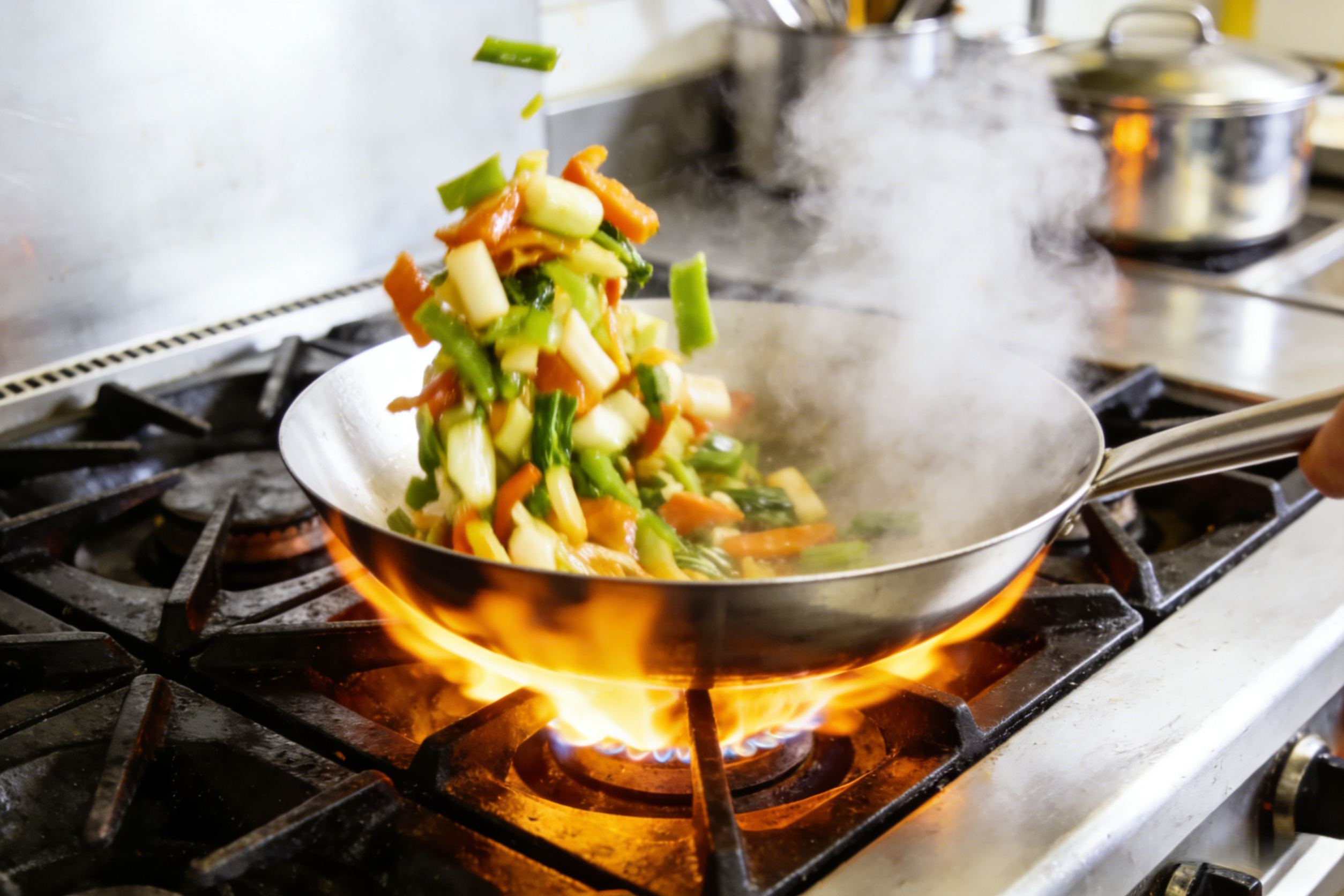
Stir-Frying / "Wok Hei" (Pan temp 220-250°C):
This is the most aggressive environment for cookware. The rapid heating and high surface temperatures required for a good stir-fry can cause leaching levels to be double that of pan-frying. The friction of the spatula against the hot metal further risks abrading the protective layer, exposing fresh aluminum to the food.
The WHO Standard
To put this in perspective, the World Health Organization (WHO) has established a Provisional Tolerable Weekly Intake (PTWI) for aluminum.
The Limit: ≤2mg per kg of body weight per week.
The Reality: For a 60kg (132lb) adult, this means a maximum of 120mg per week.
While a single meal from an aluminum pan won't poison you, daily high-heat cooking in degraded cookware can contribute significantly to exceeding this limit, especially when combined with aluminum from other sources (processed foods, antiperspirants, etc.).
3. Pure vs. Hard Anodized Aluminum Cookware: Which is Better?
When shopping, you will often see the terms "Aluminum" and "Hard Anodized" thrown around. They are chemically similar but functionally worlds apart.
The Anodization Shield
Anodization is not a coating like Teflon; it is an integration. Through an electrochemical bath, the surface of the aluminum is converted into aluminum oxide (Al₂O₃)
Thickness: This layer is typically 5-20μm thick.
Hardness: It boasts a hardness of HV400, which is roughly 4 times harder than pure aluminum and harder than many grades of stainless steel.
Performance Comparison
Feature | Pure Aluminum Cookware | Hard Anodized Aluminum Cookware |
Leaching Risk | High, especially with acidic/salty foods. | Low (approx. 1/10th of pure aluminum). |
Heat Tolerance | Low (<180°C). Prone to warping. | High (up to 300°C). Maintains shape. |
Durability | Soft, scratches easily. Life: 1-2 years. | Scratch-resistant. Life: 5-10 years. |
Reactivity | Reacts with tomato, vinegar, wine. | Chemically inert (unless scratched). |
Buying Advice: Always look for the label "Hard Anodized". If a pan is simply labeled "Aluminum" or "Alloy" without the mention of anodization, it is likely untreated or has a weak coating that will fail under high heat.
4. Identifying Low-Quality Aluminum Cookware: Red Flags to Avoid
Not all cookware is created equal. The market is flooded with cheap aluminum pans that pose health risks. Here is how to spot the lemons.
4.1. Surface Defects
Inspect the cooking surface under good light. If you see:
Micro-scratches: Even on a "new" pan, this suggests soft metal.
Pitting: Small divots indicate poor casting or low-quality alloy.
Uneven Color: The anodized layer should be uniform. Blotches suggest the electrochemical process was rushed, leaving weak spots where leaching can occur.
4.2. The Weight Test
Aluminum is light, but it shouldn't feel like a toy.
The Red Flag: If a pot feels incredibly light—roughly 1/3 the weight of a similar-sized stainless steel pan—the walls are likely too thin. Thin aluminum heats up too fast, creating "hot spots" that burn food and warp the pan instantly upon contact with cold ingredients.
4.3. Hidden Impurities
This is the invisible danger. Cheap, unregulated aluminum cookware (often found in discount bins) may use recycled scrap aluminum. This "dirty" aluminum can contain trace amounts of Lead, Cadmium, and Arsenic. Under high heat, these heavy metals are far more dangerous than aluminum itself. If the price seems too good to be true, it probably is.
4.5. How to Protect Your Aluminum Cookware from High-Heat Damage
If you own aluminum cookware, you can mitigate risks by changing how you manage heat.
Master the Fire Control
The biggest mistake home cooks make is blasting the heat to "High" immediately.
The 200°C Limit: Aim to keep your cooking temperature below 200°C.
The Water Drop Test: Sprinkle a few drops of water on the pan. If they sizzle and evaporate immediately, you are around 100-120°C. If the drops form a ball and skid across the surface (the Leidenfrost effect), your pan is approaching 180°C-200°C. This is your cue to add food immediately or lower the heat. Do not let it get hotter.
Use a Heat Diffuser
For gas stoves, the flame creates intense localized heat that can exceed 400°C at the contact point. Placing a heat diffuser plate (usually cast iron or steel) between the flame and your aluminum pot ensures the heat spreads evenly. This prevents the bottom of the pot from warping and protects the oxide layer from thermal shock.
Avoid Thermal Shock
Never take a ripping hot aluminum pan and plunge it into cold water. The rapid contraction can crack the microscopic structure of the anodized layer. Let the pan cool naturally on the stove before washing.
6. Cleaning and Maintenance Tips for Aluminum Cookware
Proper maintenance extends the life of the anodized layer, keeping the barrier between the metal and your food intact.
The "Soft Touch" Cleaning Method
Tools: Use soft cellulose sponges or microfiber cloths. Never use steel wool, copper scrubbers, or green abrasive pads (like Scotch-Brite), as these will strip the anodized layer in a matter of washes.
Detergent: Use neutral pH dish soap. Highly alkaline detergents (often found in dishwasher tablets) can chemically corrode aluminum oxide. Hand washing is always preferred.
Dealing with Burnt-On Food
If you burn food, don't scrape it
① The Soak: Fill the pan with warm water and 2 tablespoons of baking soda.
② The Wait: Let it sit for 30 minutes. The baking soda breaks down the carbon bonds of the burnt food.
③ The Wipe: Gently wipe away the residue with a soft cloth.
④ Lemon Trick: For stubborn stains, boil water with a few lemon slices in the pan for 10 minutes. The mild acidity helps lift grime without damaging the hard anodized surface.
Storage and Seasoning
After drying, wipe a very thin layer of vegetable oil over the surface. This acts as a micro-barrier against oxidation. Store pans in a dry, ventilated area. If stacking pans, place a paper towel or felt protector between them to prevent friction scratches.
7. Health Risks of Excessive Aluminum Intake from Cookware
Why is leaching a problem? While aluminum is the most abundant metal in the earth's crust, our bodies have no biological need for it.
Neurological Concerns
The link between aluminum and Alzheimer’s disease has been debated for decades. While a definitive causal link is not fully proven, studies have shown that aluminum is a neurotoxin that can accumulate in brain tissue. Long-term, excessive intake is associated with memory decline, "brain fog," and slower reaction times.
Bone Health
Aluminum mimics calcium in the body. When absorbed, it can deposit in bone tissue, interfering with the remodeling process. It competes with calcium for absorption, potentially leading to reduced bone density and increasing the risk of osteoporosis. This is a critical concern for children, the elderly, and post-menopausal women.
Metabolic Burden
Your kidneys are the filter for aluminum. For healthy individuals, the kidneys excrete most ingested aluminum. However, for those with reduced renal function or kidney disease, the body cannot clear the metal fast enough. This leads to accumulation, increasing the toxic load on the body.
8. Alternatives to Aluminum Cookware for High-Heat Cooking
If the temperature limits and maintenance of aluminum seem too demanding, it might be time to look at aluminum vs steel cookware or other alternatives.
Stainless Steel
The professional standard. High-quality tri-ply stainless steel (which usually has an aluminum core inside steel layers) offers the best of both worlds.
Pros: Can withstand temperatures well over 400°C. Non-reactive. Durable.
Cons: Food sticks easily without plenty of oil.
Cast Iron
The king of heat retention.
Pros: Adds dietary iron to food. immense thermal stability. Perfect for searing.
Cons: Heavy. Requires maintenance (seasoning). Reacts with acidic foods if not well-seasoned.
The Titanium Upgrade: The Safest Cookware for High-Heat Cooking
If you find yourself constantly worrying, "is aluminum cookware safe once it gets a tiny scratch?", it is time to eliminate the risk entirely. While even the best hard anodized aluminum cookware has temperature limits and a finite lifespan, Pure Titanium Cookware offers the ultimate peace of mind. 3-layer titanium cookware
Unlike aluminum, titanium is 100% biologically inert and food-grade—it is the same material used in medical implants.
① Zero Health Risks: Absolutely no metal ion leaching, no risk of Alzheimer's links, and no heavy-metal exposure, even when cooking highly acidic tomato sauces.
② High-Heat Mastery: Pure titanium heats rapidly and handles extreme searing temperatures without warping or toxic off-gassing.
③ Lightweight Durability: It offers the lightweight maneuverability of anodized aluminum cookware but with the indestructible strength of steel.
? Stop risking your family's health with degrading aluminum.[Explore our premium Pure Titanium Pots and Pans here]
9. Final Verdict: Use Aluminum Cookware Safely for High-Heat Cooking
So, is aluminum cookware safe? The answer is a nuanced "Yes, but..."
Pure aluminum should be retired from high-heat duties. It is too unstable, warps too easily, and leaches too much metal when pushed past 180°C. Keep it for boiling water, but keep it away from the stir-fry station.
Hard Anodized Aluminum Cookware is a safe, reliable tool if treated with respect. It can handle the heat of everyday cooking (up to 300°C) and, thanks to its oxidized shell, keeps leaching to a minimum. However, it is not invincible.
Actionable Takeaways:
① Check Your Gear: Inspect your current aluminum pans. If you see deep scratches or silver aluminum showing through the dark grey anodized layer, replace them immediately.
② Watch the Heat: Never preheat an empty aluminum pan on "High." Stick to medium-high and use the water drop test.
③ Dietary Defense: Since some aluminum intake is unavoidable, maintain a diet rich in Vitamin C, Calcium, and Magnesium. These nutrients compete with aluminum for absorption and help your body flush it out.
For pan-care questions after high-heat use, see whether aluminum pans need seasoning.
For ceramic-coated pans on open flame, see ceramic cookware on gas stoves.
Frequently Asked Questions (FAQ)
Q: Can I use metal utensils on hard anodized aluminum?
A: It is not recommended. While hard anodized surfaces are tough, metal utensils can create microscopic scratches over time. These scratches compromise the seal and increase aluminum leaching. Stick to wood or silicone tools.
Q: Does cooking acidic food in aluminum really matter?
A: Yes, significantly. Acidic foods like tomato sauce, lemon juice, or vinegar act as a solvent for aluminum. Cooking these in aluminum cookware (even anodized) for long periods can result in a metallic taste and high aluminum ingestion. Use stainless steel or titanium for acidic sauces.
Q: Is aluminum cookware banned in Europe?
A: No, it is not banned. However, several European countries have strict guidelines regarding the labeling and manufacturing standards of aluminum cookware to ensure the anodized layers are sufficient to prevent excessive leaching.
Q: Is aluminum cookware safe if the coating is scratched?
A: No. Once the surface of hard anodized aluminum cookware or its non-stick coating is scratched, the raw, reactive aluminum core is exposed to your food. This significantly increases the risk of aluminum leaching, especially when cooking acidic foods. It is highly recommended to replace scratched pans or upgrade to scratch-resistant pure titanium.
Q: How long does hard anodized aluminum cookware last?
A: High-quality anodized aluminum cookware typically lasts 3 to 5 years with proper care. However, frequent high-heat cooking and washing with harsh detergents will degrade the anodized layer faster. Once you notice discoloration or deep scratches, its safety is compromised.