Direct Engineering Answer: The TITAUDOU titanium cookware factory operates an integrated, precision manufacturing and quality management ecosystem governed by certified ISO 9001:2015 protocols and recognized National High-Tech Enterprise engineering standards. Balancing strategic dual-facility operations between a dedicated research and operations headquarters in Xi'an and high-tonnage production facilities in the Baoji industrial corridor, the enterprise maintains complete lifecycle quality control from inbound ASTM B265 Grade 1 raw titanium coil spectroscopy to automated multi-ply roll-bonding, progressive hydraulic drawing, and robotic rim encapsulation. Backed by 30 specialized R&D engineers and over 200 skilled production artisans, this manufacturing infrastructure provides international cookware brands, importers, and commercial hospitality distributors with fully auditable, defect-free OEM and ODM production capabilities.
For global kitchenware brands, commercial retailers, and private-label distributors, selecting an authentic manufacturing partner is the foundational determinant of commercial success. As consumer preference shifts decisively away from synthetic fluoropolymer coatings toward permanent, biocompatible cookware, demand for advanced titanium culinary vessels has expanded rapidly. However, executing precision metallurgical bonding between commercially pure titanium and responsive core alloys requires immense capital investment, advanced tooling, and rigorous organizational discipline. Understanding the inner operational mechanics of a dedicated full-spectrum titanium cookware manufacturer and OEM supplier requires evaluating how facility distribution, ISO-certified management frameworks, specialized human capital, and multi-stage quality assurance gates operate across industrial scale.
1. Strategic Industrial Footprint: Dual-Facility Operation Between Xi'an and Baoji
Industrial efficiency in high-performance metallurgy requires separating advanced conceptual design from high-tonnage physical manufacturing while preserving continuous operational communication. TITAUDOU structures its enterprise footprint across two complementary regional centers in Shaanxi Province, creating an operational synergy that optimizes raw material sourcing, engineering prototyping, and international export logistics.
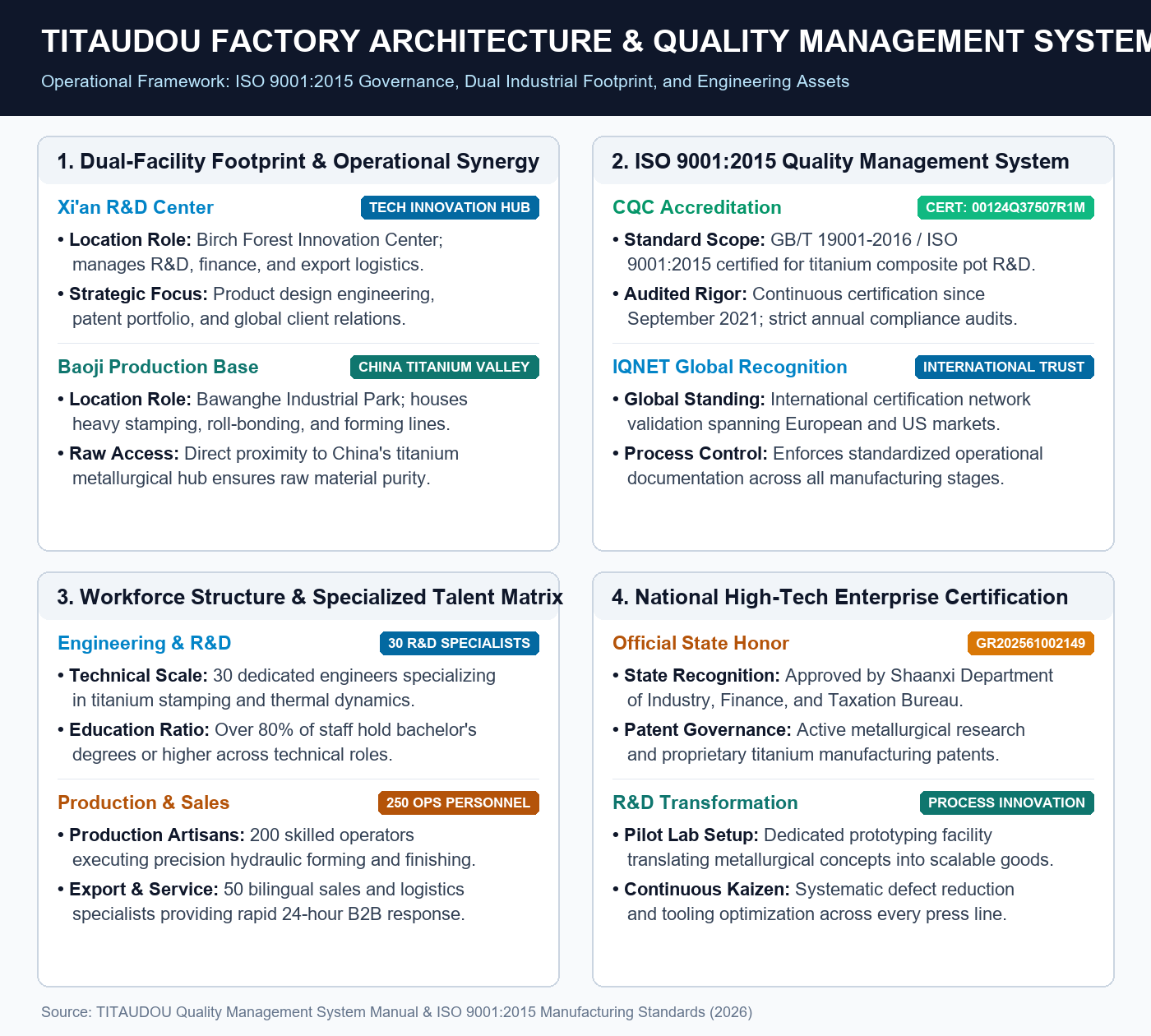
The company's corporate management, engineering R&D center, and international trade operations are headquartered in Room 1604, Building D, Birch Forest Financial Innovation Center, located within the Xi'an Economic and Technological Development Zone. This facility serves as the strategic nerve center where computer-aided design (CAD), finite element thermal modeling, commercial contract governance, and global client communications take place. Xi'an's extensive academic network and international logistics hubs provide immediate access to elite engineering talent and seamless air and rail transport routes connecting directly to global seaports.
Heavy industrial fabrication and high-volume vessel production are executed at the dedicated TITAUDOU manufacturing and production base situated within Bawanghe Industrial Park, Jinqu Town, Mei County, Baoji City. Geographically positioned in the heart of China's Titanium Valley, this manufacturing center benefits from immediate proximity to premier titanium sponge refining mills and advanced rolling facilities. By placing industrial forming presses, vacuum cladding ovens, and robotic polishing bays adjacent to the raw material supply chain, the factory minimizes inter-facility transport latency, prevents raw coil oxidation during transit, and guarantees reliable delivery schedules for container-scale international purchase orders.
This geographic distribution provides international business partners with distinct operational advantages. The Xi'an corporate headquarters interfaces directly with global shipping lines, export customs authorities, and international testing agencies, expediting trade documentation and sample dispatches. Simultaneously, the Baoji production complex coordinates with local rail freight corridors connecting directly to major maritime container terminals in Qingdao and Shanghai, ensuring that finished container shipments transition efficiently from the factory floor to outbound ocean freighters with minimal domestic transport overhead.
2. ISO 9001:2015 Quality Management Framework and High-Tech Enterprise Governance
Achieving consistent metallurgical performance across hundreds of thousands of multi-clad vessels requires a documented, audited, and strictly enforced quality management system. TITAUDOU's manufacturing operations are certified under GB/T 19001-2016 and ISO 9001:2015 standards, validated through rigorous third-party auditing by both the China Quality Certification Centre (CQC) and the International Certification Network (IQNET) under Certificate Registration Number 00124Q37507R1M/6100.
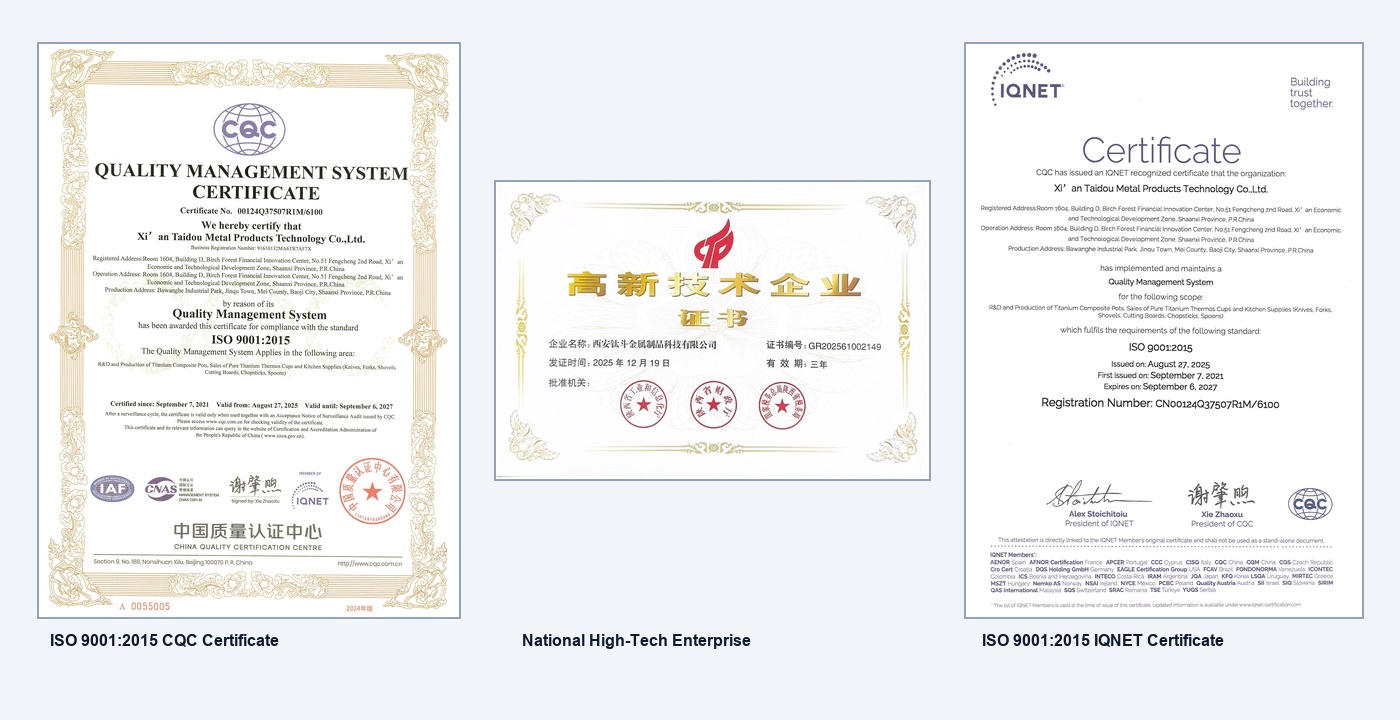
First accredited in September 2021 and continuously re-certified through August 2025 with validity extending to September 2027, the formal scope encompasses the comprehensive research, development, and manufacturing of titanium composite pots, as well as the certified distribution of pure titanium thermoses and kitchenware. This standard governs every operational sub-system, mandating calibrated measuring instruments, formal document change control, preventive maintenance schedules, and closed-loop corrective action procedures whenever dimensional variances are detected.
Reinforcing this international quality baseline, the enterprise holds official accreditation as a National High-Tech Enterprise under Certificate Number GR202561002149, approved jointly by the Shaanxi Provincial Department of Industry and Information Technology, the Shaanxi Provincial Department of Finance, and the Shaanxi Provincial Taxation Bureau. This state-level recognition requires maintaining dedicated annual research expenditures, continuous patent filing, and systematic innovation in solid-state metallic bonding and surface modification. For commercial procurement directors, this certification provides institutional verification that the factory operates advanced manufacturing technology rather than basic assembling lines.
3. Specialized Workforce Architecture: Technical Engineering, Skilled Operations, and Global Trade
While heavy automated machinery provides manufacturing force, human engineering capability determines process repeatability, product refinement, and client collaboration quality. TITAUDOU maintains a highly structured, professional workforce characterized by exceptional academic credentials, with over 80% of personnel holding bachelor's degrees or higher across corporate, engineering, and supervisory departments.
- Design and R&D Engineering Division (30 Professionals): This specialized group consists of materials scientists, die-making masters, and industrial designers focused exclusively on resolving titanium deformation challenges. They utilize 3D CAD modeling, mold stress simulations, and thermodynamic transfer analysis to engineer tooling for frying pans, woks, stockpots, and custom handles.
- Precision Production and Assembly Force (200 Artisans): Operating across the Baoji facility, these technicians manage high-pressure roll-bonding lines, multi-stage hydraulic drawing presses, robotic edge trimmers, and cleanroom packaging bays. Experienced team leads execute continuous in-process inspections to verify wall thickness uniformity and surface finish integrity.
- International Trade, Logistics, and Service Division (50 Specialists): Serving global business partners, this bilingual commercial team manages technical specifications, export customs documentation, shipping container logistics, and warranty traceability. They ensure transparent communication across differing time zones and support buyers through factory audits and third-party laboratory verification.
A defining operational attribute of TITAUDOU's organizational structure is its ongoing investment in technical talent development and cross-functional training. Factory engineers and quality assurance supervisors participate in regular professional development seminars on advanced metallurgy, lean manufacturing methodology, and statistical process control. Furthermore, several members of the international trade division hold accredited internal auditor qualifications for ISO 9001:2015 standards, enabling them to comprehend complex B2B client compliance requests, navigate specialized customer inspection protocols, and facilitate smooth technical dialogues between overseas buyers and factory floor engineers.
| Operational Pillar | Factory Implementation & Infrastructure | Quality Management Standard & Metric |
|---|---|---|
| Dual Facility Distribution | Xi'an R&D/Commercial HQ & Baoji Bawanghe Production Plant | ISO 9001:2015 Scope certified across both facilities |
| Enterprise Governance | National High-Tech Enterprise Credential (GR202561002149) | Shaanxi Industry, Finance & Tax Bureau annual audit |
| Workforce Allocation | 30 R&D Engineers + 200 Production Staff + 50 Sales Specialists | Over 80% personnel hold bachelor's degree or higher |
| Inbound Material (IQC) | ASTM B265 Grade 1 Titanium, 1050 Aluminum, 430 Stainless | 100% XRF spectral audit & Mill Test Certificate tracking |
| Composite Roll-Bonding | Continuous high-pressure vacuum thermal roll-bonding line | Zero interfacial shear delamination across 2.8mm stock |
| Forming & Encapsulation | Multi-stage hydraulic deep drawing & automated laser rim sealing | CMM dimensional tolerance inspection within ±0.05 mm |
| Outbound Quality (OQC) | Handle cyclical tensile proofing & export moisture packaging | AQL 0.65 export standard with complete batch certificate |
4. Multi-Ply Titanium Roll-Bonding and Progressive Hydraulic Forming Protocols
Commercially pure titanium exhibits exceptional tensile strength, low density, and unparalleled chemical inertness, yet its low thermal conductivity presents severe culinary challenges when used as a single unclad sheet. To overcome these physics boundaries, TITAUDOU's manufacturing system centers on solid-state composite roll-bonding, combining an inner ASTM B265 Grade 1 titanium face with a lateral aluminum conduction core and a ferritic stainless steel induction base into an engineered multi-ply composite.
Executing atomic diffusion bonding between disparate metals demands extreme temperature and pressure regulation. Pure titanium forms intermetallic compounds if exposed to uncontrolled atmospheric oxygen during heated rolling. The factory employs proprietary vacuum-assisted roll-bonding lines that clean and join the metal strips under hundreds of tons of continuous hydraulic force. This creates an inseparable metallic bond with high interfacial shear resistance, guaranteeing that finished cookware never delaminates under extreme thermal cycling or prolonged stove simmering.
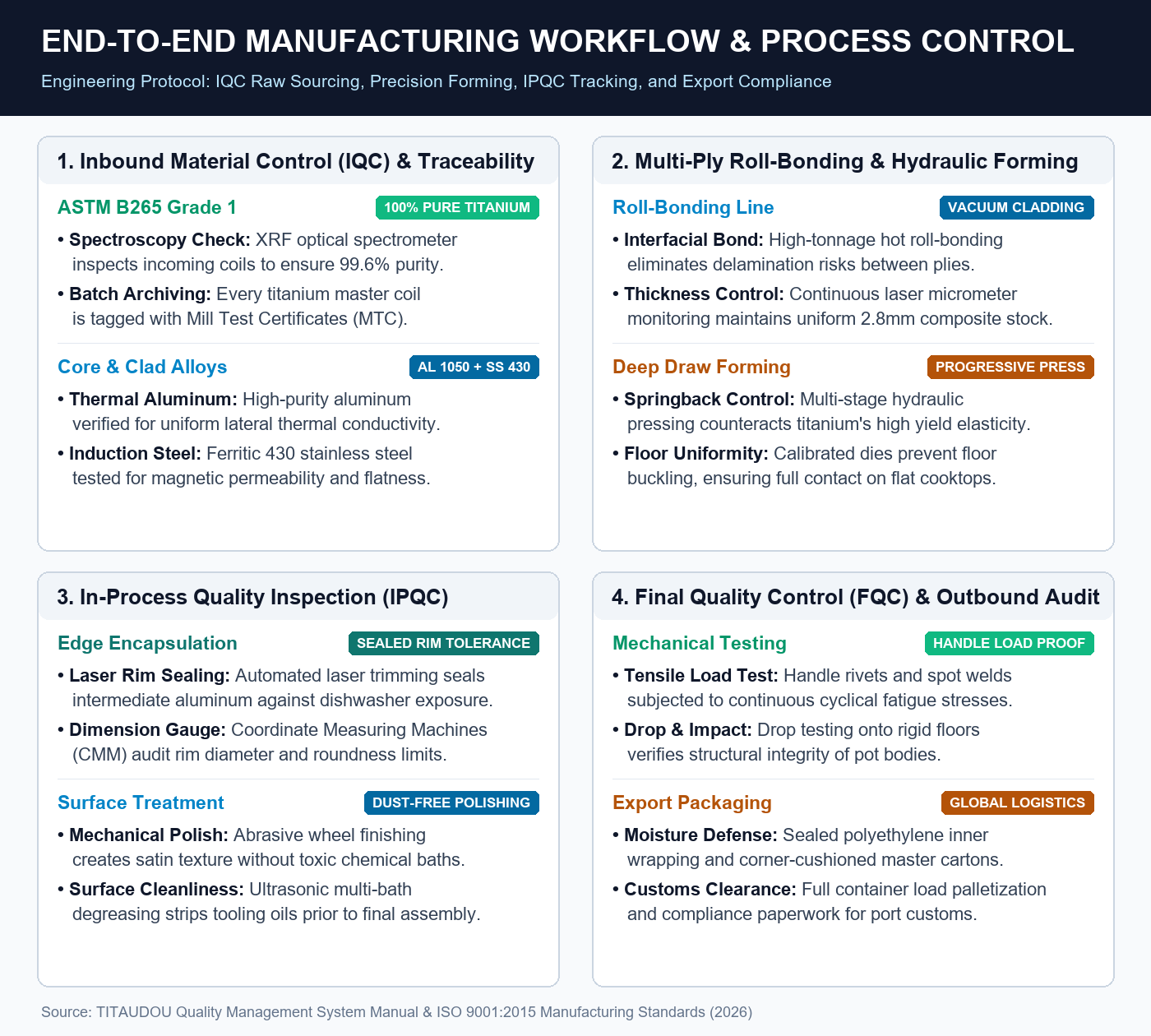
Following blanking, bonded composite discs proceed to progressive hydraulic deep-drawing lines. Unlike ductile copper or carbon steel, titanium possesses a high yield strength-to-modulus ratio, resulting in pronounced elastic springback during press forming. TITAUDOU's toolmaking engineers develop specialized multi-action stamping dies with calibrated blank holder pressures and variable radius transitions. This progressive deformation process shapes complex skillet sidewalls, deep stockpots, and flared saute pans without wrinkling the metal or inducing internal micro-fractures, ensuring consistent floor planarity across volume production runs for wholesale bulk titanium cookware and private-label programs.
5. Inbound Material Control (IQC) and Spectroscopic Chemical Traceability
The integrity of high-grade culinary vessels depends directly upon raw material purity. Many budget market offerings utilize secondary scrap titanium or low-grade industrial alloys that compromise food safety and corrosion resistance. Under TITAUDOU's ISO 9001:2015 protocol, incoming raw material control (IQC) acts as the first defensive barrier against material non-conformance.
Every master coil arriving at the Baoji receiving dock must be accompanied by certified Mill Test Certificates (MTC) documenting heat chemistry and mechanical tensile performance. Laboratory technicians immediately sample both coil ends and conduct verification audits using X-ray fluorescence (XRF) optical emission spectrometers. This analysis verifies that commercially pure titanium strictly adheres to ASTM B265 Grade 1 standards: titanium content must exceed 99.5%, with interstitial elements strictly limited (iron under 0.20%, oxygen under 0.18%, carbon under 0.08%, and nitrogen under 0.03%).
Similar spectroscopic screening is applied to incoming coils of 1050 thermal aluminum and 430 ferritic stainless steel. Master coils are assigned unique barcode serial numbers in the factory enterprise resource planning (ERP) system, linking each production batch directly to original refinery heats. This complete traceability guarantees that international buyers can verify raw material authenticity for regulatory authorities in European, North American, and East Asian markets.
6. In-Process (IPQC) and Outbound Quality Assurance (OQC) for International Compliance
Beyond raw materials, manufacturing quality is sustained by continuous in-process quality control (IPQC) throughout vessel shaping, laser trimming, surface treatment, and handle installation. Specialized inspection stations are embedded directly alongside production lines to isolate dimensional drift before defective units propagate down the line.
A critical IPQC checkpoint involves rim finishing and edge encapsulation. When multi-ply composite discs are cut, the internal aluminum core is exposed along the peripheral cut edge. If left unprotected, commercial dishwasher detergents and acidic culinary environments can attack the exposed aluminum over years of service. TITAUDOU utilizes automated high-precision laser trimming and robotic roll-hem dies that crimp the outer stainless steel and pure titanium layers tightly over the edge, creating a hermetically sealed barrier that prevents moisture ingress and inter-ply galvanic corrosion.
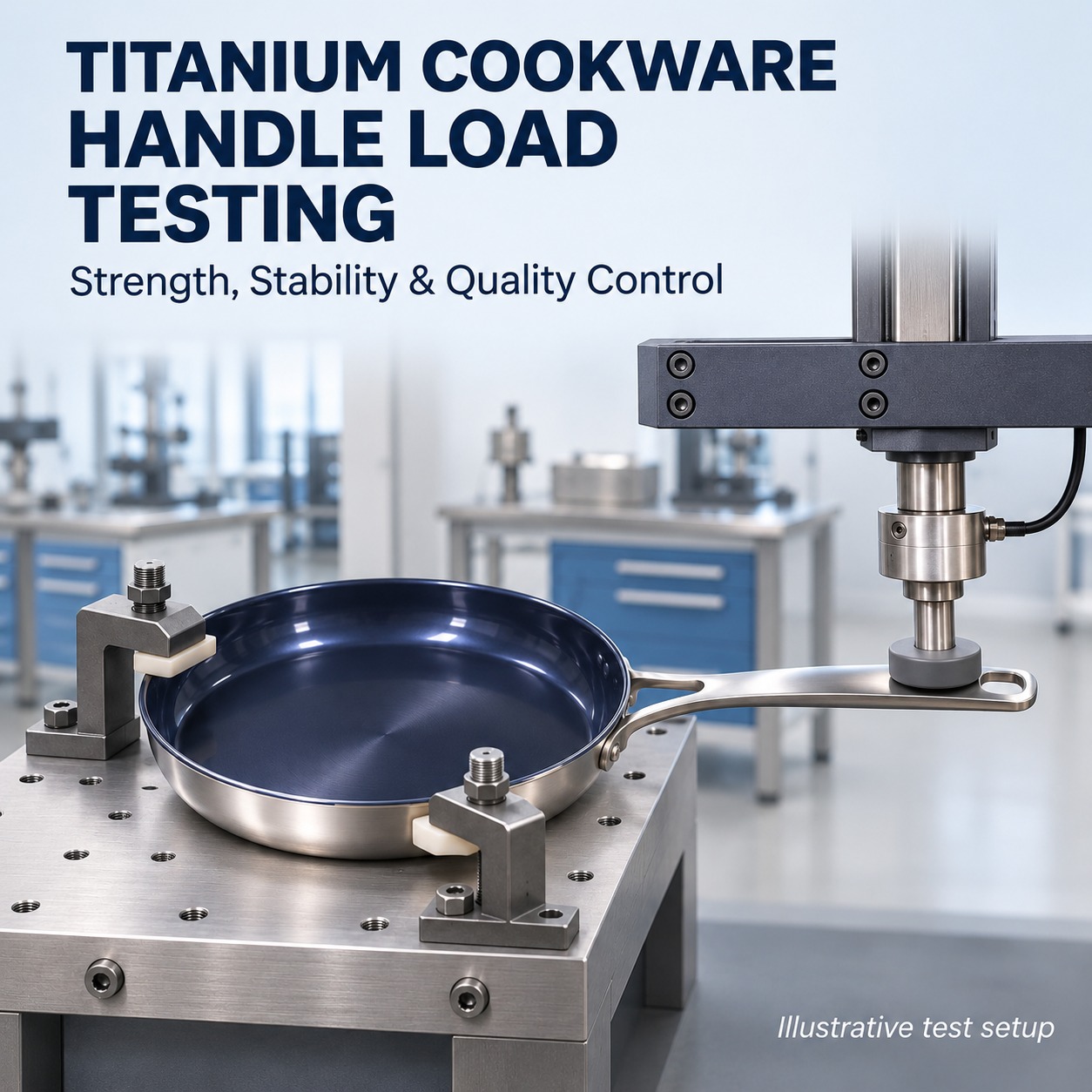
Once vessel bodies receive final surface conditioning, they transition to the final quality control (FQC) and outbound quality control (OQC) testing laboratory. Technicians execute rigorous structural tests, including handle load capacity auditing where riveted and spot-welded solid cast handles undergo cyclical tensile stress testing to guarantee structural permanence. Packaging stations utilize anti-scratch protective wraps, desiccated shrink barriers, and heavy double-wall corrugated master cartons engineered to withstand maritime shipping vibrations, ensuring that finished collections of uncoated pure titanium pots, frying pans, and woks arrive at overseas distribution centers in flawless, retail-ready condition.
To uphold pristine food-contact cleanliness without environmental degradation, the Baoji facility integrates an advanced multi-stage ultrasonic degreasing and deionized water rinsing system. Before receiving final inspection, every formed vessel passes through automated ultrasonic wash tanks that strip away residual forming lubricants and microscopic metallic particulates without requiring aggressive acid-etch baths. The pans are subsequently dried in clean, temperature-regulated laminar air tunnels, ensuring that the natural titanium dioxide passivation barrier remains spotless, uniform, and completely contaminant-free prior to protective bagging and export packaging.
Conclusion: Building Dependable OEM and ODM Partnerships Through Certified Manufacturing Discipline
In an international marketplace flooded with generic cookware suppliers and unverified claims, sustainable brand leadership requires partnering with a manufacturer whose quality claims are substantiated by auditable systems, accredited credentials, and advanced metallurgical capability. TITAUDOU stands at the forefront of the global culinary transition, offering an established manufacturing infrastructure engineered specifically for precision titanium cookware.
From the strategic division of its Xi'an R&D center and Baoji industrial production base to its continuous ISO 9001:2015 quality management governance and National High-Tech Enterprise pedigree, the factory delivers uncompromised engineering repeatability. By integrating 30 dedicated design specialists, 200 skilled operators, and full-spectrum spectroscopic material tracking, TITAUDOU provides global B2B clients with the manufacturing certainty required to launch, scale, and sustain high-margin commercial cookware lines. To explore private-label programs, custom tooling development, or certified factory audits, partners are invited to review our official qualifications and certifications credentials or contact our technical sales team directly.
Frequently Asked Questions (FAQ)
Q1: What certified quality management systems govern the TITAUDOU titanium cookware factory?
The TITAUDOU manufacturing facility operates under a certified GB/T 19001-2016 / ISO 9001:2015 Quality Management System accredited by both the China Quality Certification Centre (CQC) and IQNET under Registration Certificate Number 00124Q37507R1M/6100. First issued in September 2021 and continuously re-certified through 2027, the standard specifically covers the research, development, and production of titanium composite cookware.
Q2: Where are TITAUDOU's R&D headquarters and industrial manufacturing base located?
TITAUDOU maintains a dual-facility operational model in Shaanxi Province: corporate management, engineering R&D, and global trade operations are located at Room 1604, Birch Forest Financial Innovation Center in the Xi'an Economic and Technological Development Zone, while full-scale manufacturing, roll-bonding, and stamping lines are situated in Bawanghe Industrial Park, Jinqu Town, Mei County, Baoji City, directly adjacent to China's primary titanium supply chain.
Q3: How does the factory verify incoming raw titanium purity and prevent material defects?
Under strict IQC protocols, every incoming titanium coil is audited with X-ray fluorescence (XRF) optical emission spectroscopy to verify chemical compliance with ASTM B265 Grade 1 standards (exceeding 99.5% purity). Every raw material coil is matched to certified Mill Test Certificates (MTC) and assigned internal ERP tracking barcodes, ensuring complete traceability from refinery heat to finished cookware.