Global Freshwater shortage is accelerating the deployment of seawater reverse osmosis and thermal desalination, but materials remain a critical constraint. Seawater is highly corrosive, and desalination equipment must be designed and manufactured using materials that can withstand seawater corrosion. Titanium and titanium alloys offer exceptional resistance to chloride-induced pitting, crevice corrosion, and stress corrosion cracking, maintaining integrity under high flow, aeration, and temperature cycling. Their stable passive TiO2 film, biocompatibility with process chemistries, and high specific strength make them ideal for harsh intake and brine environments.
Within heat exchangers, condensers, brine heaters, and outfall systems, titanium tubing delivers long service life, consistent heat transfer, and reduced biofouling, often outperforming copper-nickel and duplex stainless steels on lifecycle cost. Thinner walls enabled by strength-to-weight advantages reduce module mass without sacrificing pressure tolerance, while proven weldability and rigorous non-destructive testing ensure reliability at scale. As plants push for higher recovery and operate in more contaminated coastal waters, integrating titanium tubing across SWRO trains and thermal stages provides durable, low-maintenance performance and safeguards reliable freshwater output.
1. Properties of Titanium and Titanium Alloys
1.1 High specific strength and lightweight construction
Titanium and titanium alloys combine low density with high strength. With a density roughly 40% that of carbon steel, equipment made from titanium can achieve the same pressure ratings at significantly lower weight. In desalination plants where large modules must be lifted, transported, and supported offshore or on compact plinths, this weight reduction translates to easier installation, smaller supporting structures, and improved seismic and wind-load performance.
1.2 Excellent corrosion resistance in seawater
In natural and treated seawater, titanium forms an adherent, dense TiO2 passive film that develops spontaneously in the presence of oxygen. This film exhibits strong self-healing: when locally damaged, it rapidly reforms, even in chloride-rich brines. As a result, titanium resists pitting, crevice corrosion, and stress corrosion cracking that commonly afflict stainless steels and copper-based alloys. Designers can reduce corrosion allowance, simplify coatings (often eliminating them), and lower lifecycle cost. The reliability advantage is particularly evident in splash zones, aerated intakes, and warm, high-velocity services where many alloys struggle.
1.3 High impact resistance
Titanium’s toughness and impact resistance help pressure-bearing piping and headers withstand water hammer and cyclic hydraulic shocks. In start-stop operations or rapid valve transients typical of desalination trains, titanium tubing and manifolds maintain integrity, reducing unplanned outages and inspection frequency.
1.4 Good formability, machinability, and weldability
Titanium and its alloys possess useful ductility and toughness, enabling conventional manufacturing routes for sheet, titanium tubing, forgings, and castings. Processes such as cold forming, rotary draw bending, and precision machining are well established. Titanium tube welding—using GTAW (TIG), PAW, or orbital welding with high-purity inert shielding—achieves high-quality joints suitable for pressure service, provided oxygen and moisture are strictly controlled during welding and cooling.
1.5 Recyclability and reuse
Decommissioned titanium equipment can be evaluated for material condition and, if suitable, downgraded for less severe service per design codes. After long-term use, titanium and titanium alloys retain scrap value and can be recycled efficiently, supporting sustainability goals and reducing total lifecycle cost.
2. Use of Titanium and Titanium Alloys in Seawater Desalination Technologies
Modern seawater desalination spans two main categories:
· Membrane processes (RO, ED):
o Reverse osmosis (RO) and electrodialysis (ED) rely on selective membranes to separate salts from water under pressure or electric potential. Titanium components are applied in high-pressure piping, energy recovery device housings, brine recirculation lines, booster pump internals, and heat exchange equipment serving pretreatment or post-treatment loops.
· Thermal processes:
o Low-Temperature Multi-Effect Distillation (LT-MED) and Multi-Stage Flash (MSF) evaporate and condense seawater in staged heat exchangers. Here, titanium tubing is extensively used for evaporator and condenser bundles, brine heaters, and inter-stage heat recovery exchangers. Its immunity to under-deposit attack and chloride-induced corrosion allows thin-wall designs, stable heat transfer, and long service intervals.
Across both process families, titanium’s resistance to chlorides, sulfides, and variable oxygen levels ensures reliability in intake conditions ranging from cold, clean waters to warm, bioactive, and sediment-laden seas.
3. Heat Transfer Characteristics of Titanium Tubes
3.1 Tube wall thickness
Heat exchanger tubes in desalination are typically small diameter with thin walls to maximize heat flux. Copper alloys often adopt wall thicknesses ≥0.75 mm to preserve life in corrosive service. Owing to titanium’s high specific strength and superior corrosion resistance, thin-wall titanium tubing in the 0.4–0.7 mm range is commonly and safely used, reducing thermal resistance and material mass without sacrificing pressure integrity.
3.2 Thermal conductivity and overall heat-transfer coefficient
Titanium’s intrinsic thermal conductivity is lower than that of copper alloys (on the order of a fraction of aluminum brass and copper-nickel). However, because titanium maintains corrosion resistance without heavy allowances, designers can specify thinner walls, which reduces conduction resistance. In real plants, the overall heat-transfer coefficient is often governed by fouling and film coefficients more than base-metal conductivity. Titanium’s smooth, stable passive surface discourages biofouling and scaling adherence, helping preserve clean surfaces longer and maintaining effective heat transfer over time.
3.3 Economics in practical application
On a mass basis, titanium tubes cost several times more than copper alloy tubes. Yet practical economics narrow the gap:
· Thinner walls reduce titanium tonnage per heat exchanger.
· Titanium’s density is roughly half that of copper, cutting weight further.
· Longer service life, fewer shutdowns for tube replacement, lower corrosion allowance, and reduced chemical dosing result in competitive total cost of ownership.
In many desalination installations, thin-wall titanium bundles match or outperform copper alloys on lifecycle cost, particularly in warm, aerated, or variable-quality seawater.
4. Reverse Osmosis (RO) Fundamentals and Suitability of Titanium Tubes
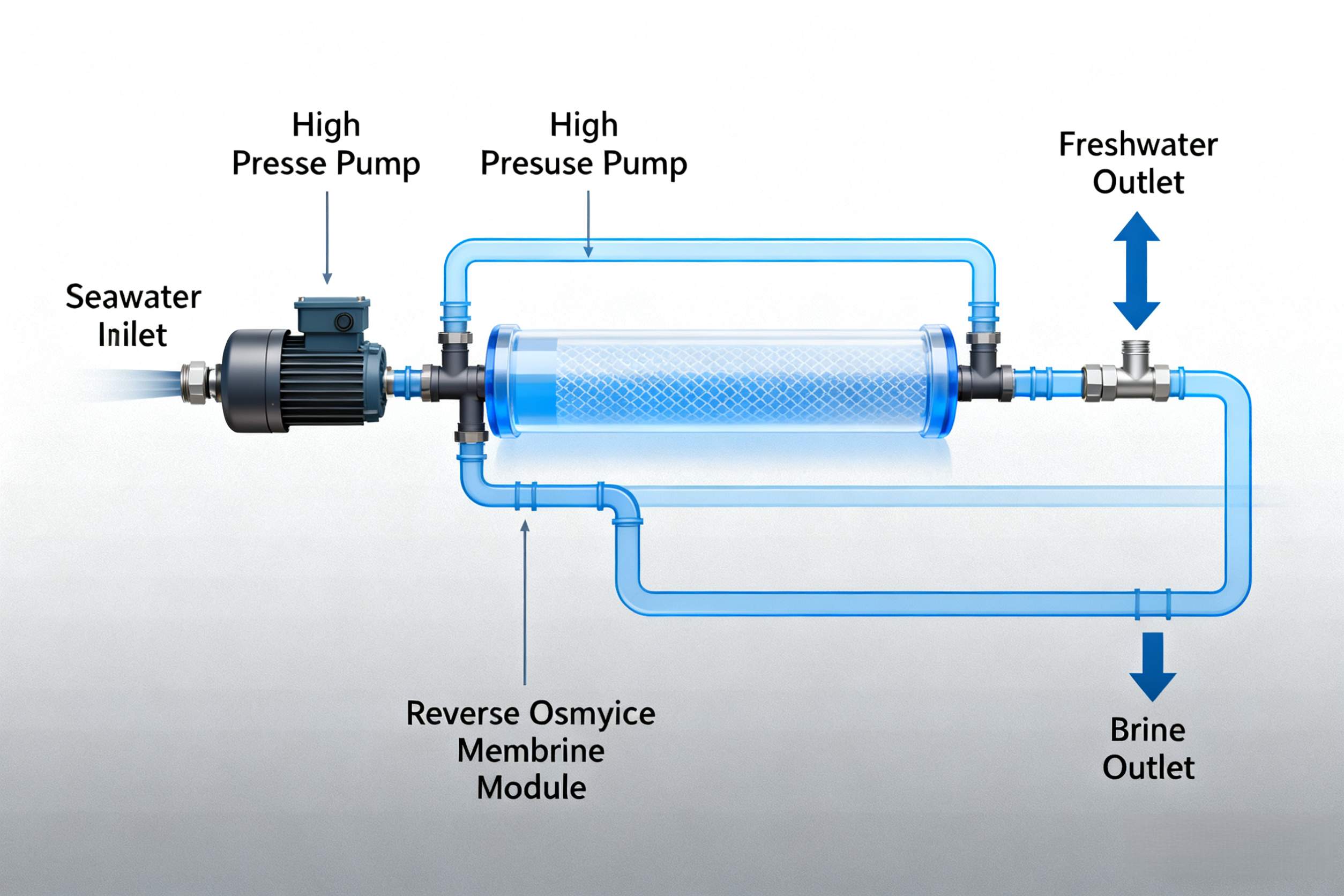
RO uses the selective permeability of semi-permeable membranes. Under applied pressure, water molecules pass from the high-salinity feed side to the low-pressure permeate side, while salts are rejected and concentrated into brine for discharge. This pressure-driven separation demands robust materials in the high-pressure loop and in auxiliary heat exchange equipment supporting pretreatment and energy recovery.
4.1 Where titanium tubing excels in RO systems
· Severe corrosion environments: Intakes with high chloride, fluctuating oxygen levels, biological activity, or residual oxidants favor titanium due to its passive film and self-healing behavior.
· Limited-maintenance or inaccessible locations: Offshore platforms, subsurface intakes, and compact skids benefit from titanium’s long intervals between interventions.
· Mass-sensitive designs: Lightweight thin-wall titanium reduces skid and platform loads, easing transport and installation, especially for modular plants.
· Long service-life requirements: Plants targeting multi-decade operation find titanium’s predictable corrosion performance and stable mechanical properties advantageous.
5. Manufacturing and Integration: titanium tubing and Titanium tube welding
· Tube production: Seamless and welded titanium tubes (CP-Ti grades such as Grade 2 for maximum corrosion resistance, and Ti-6Al-4V where higher strength is needed) are produced via established routes with tight control of chemistry (O, N, H) and microstructure to ensure ductility and toughness.
· Welding best practices: Titanium tube welding requires:
o High-purity argon (or helium) shielding, including primary, back purging, and trailing shields to prevent alpha-case formation.
o Cleanliness and precise joint fit-up; dedicated tools to avoid contamination.
o Controlled heat input and interpass temperature; orbital GTAW is widely used for consistent, high-quality autogenous welds in tube-to-tubesheet and tube spools.
· Joining in heat exchangers: Tube-to-tubesheet joints are expanded and/or welded. With titanium, seal welding followed by controlled expansion can deliver leak-tight, corrosion-resistant joints. Careful tubesheet material selection (often titanium-clad) prevents galvanic coupling.
6. Design Considerations for Desalination Systems Using Titanium Tubes
· Flow dynamics: Adequate velocity minimizes fouling but should avoid erosive regimes. Titanium tolerates higher velocities than many alloys; still, designers balance shear stress with energy cost.
· Scaling and fouling prevention: Pretreatment (filtration, antiscalants) and optimized temperature profiles reduce scale formation. Titanium’s low adhesion surface makes deposits easier to remove, and chemical cleaning protocols are typically milder than those needed for copper alloys.
· Galvanic management: Where titanium interfaces with dissimilar metals, insulating gaskets, sleeves, or titanium-clad transitions prevent galvanic attack. In seawater, titanium’s noble behavior demands careful coupling strategies.
· Inspection and monitoring: Non-destructive techniques—eddy current, ultrasonic thickness, and pressure testing—verify tube integrity. Titanium’s resistance to pitting and crevice corrosion reduces inspection frequency, but periodic checks confirm cleanliness and heat-transfer performance.
· Thermal cycling and start-stop operation: Titanium’s toughness and fatigue resistance accommodate frequent transients. Proper supports and expansion joints manage differential thermal expansion in multi-metal assemblies.
7. Sustainability and Lifecycle Performance
· Reduced chemical footprint: Titanium’s inherent corrosion resistance cuts reliance on biocides and corrosion inhibitors, lowering operating expense and environmental load.
· Energy implications: Stable heat-transfer surfaces and thin walls help maintain design efficiency over long intervals, improving plant energy performance.
· End-of-life value: High recyclability and retained material value support circular-economy objectives, particularly in regions scaling desalination capacity.
Conclusion and Outlook
China and other desalination leaders have achieved maturity in both thermal and membrane desalination, with multiple demonstration and commercial-scale plants in operation. Continued collaboration among plant developers, operators, and titanium material and equipment manufacturers will accelerate the collection of real-world performance data for titanium tubing in RO and thermal systems. Upgrading legacy titanium alloys and fabrication equipment, improving Titanium tube welding automation, and expanding deep-processing capabilities will elevate product quality, optimize cost structures, and strengthen international competitiveness. By pursuing high-end tube manufacturing, rigorous welding QA, and application-driven design, the industry can unlock the full value of titanium in safeguarding reliable freshwater production for decades.
Frequently Asked Questions and Answers
Q1: What specific corrosion mechanisms does titanium tubing resist in seawater desalination systems, and how does this compare to other commonly used materials like stainless steel or copper-nickel alloys?
A1: Titanium resists chloride-induced pitting, crevice corrosion, stress corrosion cracking, and under-deposit corrosion thanks to its rapid self-healing TiO2 passive film. In contrast, stainless steels can suffer pitting/crevice attack at modest chloride levels, and copper-nickel alloys can experience impingement attack and biofouling-related issues. Titanium also remains stable across aerated and deaerated conditions and tolerates higher flow velocities without erosion-corrosion.
Q2: How do the mechanical properties (e.g., tensile strength, fatigue resistance) of titanium tubes hold up under long-term exposure to high-temperature, high-salinity conditions in reverse osmosis (RO) or thermal desalination plants?
A2: Commercially pure titanium retains ductility and tensile strength well within typical desalination temperatures, while alloys like Ti-6Al-4V offer higher strength where needed. Titanium’s toughness and fatigue resistance support frequent start-stop cycles and water hammer events. With proper grade selection, thin-wall design, and stress-relief where applicable, long-term performance is excellent and generally superior to copper alloys in aggressive brines.
Q3: What are the key design considerations for integrating titanium tubes into seawater desalination heat exchangers, particularly regarding flow dynamics, scaling prevention, and maintenance accessibility?
A3: Maintain velocities sufficient to deter fouling but below erosive thresholds; ensure uniform flow distribution to minimize dead zones; manage galvanic interfaces with insulating elements; specify thin-wall tubes for improved heat transfer; and plan for access to tube bundles for periodic inspection and cleaning. Pretreatment and antiscalant dosing should be tuned to limit scaling, and materials for tubesheets and headers should be compatible (often titanium or titanium-clad) to preserve integrity and simplify maintenance.