The Titanium iPhone 17 Air leverages aerospace-grade titanium to achieve a stunning blend of lightness and strength. The body thickness is only an astonishing 5.6mm, even thinner than the Samsung Galaxy S25 Edge, yet the titanium frame’s high specific strength and stiffness-to-weight ratio minimize flex and denting. Its low density reduces overall mass without sacrificing rigidity, while superior fatigue and corrosion resistance help the ultra-thin chassis endure daily wear, temperature swings, and pocket torsion.
Independent stress checks pushed the device far beyond normal use. Testers tried to break this phone in half to probe structural limits, but the titanium perimeter distributed bending loads and resisted permanent deformation. It can withstand 130 pounds (about 58.97 kg) of pressure without being damaged, underscoring how titanium’s mechanical advantage supports a slimmer glass stack and tighter internal packaging. The result is a device that feels featherlight yet remains remarkably durable, setting a new benchmark for minimalist smartphone engineering.

1. iPhone Air’s ultra-slim structural design
The iPhone Air pushes minimalism to the edge with a body thickness of just 5.6 mm and a mass of only 165 g. Rather than distributing mass uniformly, Apple concentrates most hardware components toward the top of the device, intentionally leaving more internal volume and structural clearance in the lower section. This asymmetric layout increases bending stiffness where it matters most and shifts neutral axes to better resist pocket flex and torsional loads. The result is a chassis that exhibits greater stability when subject to off-axis pressure and everyday handling, while preserving that signature featherlight feel.
At the heart of this design is Apple’s exclusive Grade 5 titanium materials perimeter—an engineered titanium plate-like frame formed with tight tolerances and precision joining. As the only model in the lineup to use a titanium frame, iPhone Air not only meets Apple’s stringent internal quality metrics but reportedly exceeds its “bend test” thresholds. Grade 5 titanium’s high specific strength and favorable stiffness-to-weight ratio directly translate into better drop performance, improved resistance to denting at impact nodes, and reduced permanent set after bending events. In daily usage, that means fewer frame warps from seated flex, less micro-misalignment between display and housing, and a stronger safeguard for the battery pack, logic board, and camera array consolidated near the top.
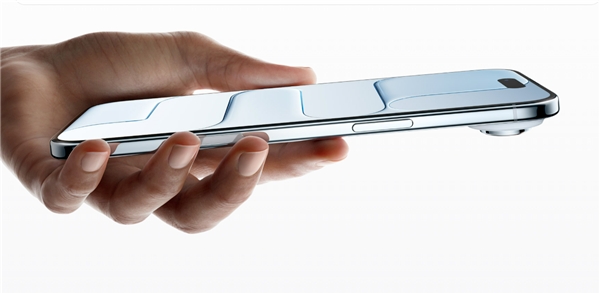
2. What “Grade 5” means in titanium materials classification
On the iPhone Air product page, Apple’s description is succinct: a Grade 5 titanium frame made with 80% recycled titanium materials, blending sturdiness and refinement. To unpack this, titanium grading generally follows ASTM specifications. Grade 5—commonly known as Ti-6Al-4V—is an alpha-beta alloy that couples high tensile strength with good formability and weldability. Compared with commercially pure titanium, Grade 5 offers significantly higher yield and ultimate strengths, which is why it is widely used in aerospace fasteners, structural brackets, and medical devices where strength-to-weight balance is crucial.
For a phone this thin, frame strength is a first-order constraint. Historically, aluminum alloy frames in ultra-slim devices could suffer from bend susceptibility when subjected to concentrated loads or repeated pocket stress. By contrast, a Grade 5 titanium plate-type perimeter—processed through precision forging, CNC finishing, and controlled heat treatment—delivers far greater resistance to plastic deformation while allowing wall sections to remain extremely thin. That means Apple can keep the silhouette impossibly slim without compromising stiffness, torsion resistance, or drop survivability.
3. Advantages titanium brings to a smartphone frame
Smartphone frames must clear a high bar for mechanical strength, fracture toughness, dimensional stability, and surface uniformity. They also need tight consistency batch-to-batch so that every unit assembles within micron-level tolerances. To hit these targets, Apple specifies a blend strategy that incorporates a high proportion of recycled feedstock—reflecting an aggressive titanium recycling thrust—tempered with a controlled amount of primary titanium. The infusion of virgin material stabilizes chemistry and microstructure, keeping mechanical and surface properties within a narrowly defined process window.
Beyond raw strength, titanium’s fatigue resistance and elastic recovery help the iPhone Air endure cyclical pocket bends and torsional moments induced by one-handed use. Its corrosion resistance (due to a stable TiO2 passive film) preserves fastener integrity and finish uniformity over years, even in humid or coastal environments. Titanium’s non-magnetic character reduces potential interference with magnetometers and compass calibration routines. Finally, the iPhone Air’s titanium frame undergoes mirror polishing: a complex finishing route that yields a thin, glass-like sheen. Visually, the polished titanium appears lighter and more refined than brushed metal, framing the display with crisp reflections while keeping fingerprints manageable through topcoat treatments.
4. Why mirror-polishing titanium is hard—and how it’s done
Achieving a mirror finish on titanium is considerably more challenging than on stainless steel or aluminum. There are four principal hurdles:
· High strength and low thermal conductivity. During polishing, localized heat can build rapidly, creating hot spots that risk “burning” the surface, altering oxide coloration, or initiating micro-cracks. Managing heat through careful process parameters, active cooling, and low-aggression abrasive selection is essential.
· Adhesion (galling) tendency. Under pressure and temperature, titanium can smear and transfer onto tools and abrasives—a bit like sticky toffee—clogging media and producing tears or drag marks. Specialized abrasives, anti-galling lubricants, and controlled feeds mitigate this risk, while frequent media refresh keeps cuts clean.
· Abrasive inefficiency. Conventional media often loads up on titanium and stops cutting effectively, which leads to inconsistent gloss and swirl patterns. Purpose-built abrasive blends with tailored grit size distributions maintain a uniform scratch pattern that can be progressively refined.
· Multi-stage finishing is mandatory. Reaching the iPhone Air’s mirror requires a laddered workflow: coarse grind to establish planarity and edge geometry; fine grind to remove primary scratches; pre-polish to close the surface; then true polish using dedicated compounds (polishing wax) and slow-speed wheels to avoid heat spikes. The final pass controls haze and color tone, delivering the uniform, high-luster look that reflects silhouettes without orange peel or rippling.
· By combining rigorously controlled metallurgy, hybrid recycled-plus-primary feedstock, and a sophisticated finishing stack, Apple aligns the tactile and visual experience of titanium with the brand’s industrial design ethos—precise, minimal, and durable.
Summary: Where titanium elevates iPhone Air
· Structural efficiency: Grade 5 titanium plate-style frame enables ultra-thin walls with high stiffness and low mass.
· Reliability: Superior resistance to permanent set and improved fatigue tolerance reduce the risk of long-term warping.
· Finish quality: Mirror-polished titanium, while difficult to produce, offers a premium, lighter-looking surface with excellent wear behavior.
· Sustainability: Titanium recycling cuts embodied energy while maintaining stringent mechanical and aesthetic standards.
In short, the iPhone Air demonstrates how a thoughtfully engineered titanium frame can make a device thinner, lighter, and tougher—all at once—while advancing material circularity.
Frequently Asked Questions and Answers
Q1: Titanium iPhone Air 2025: How does the titanium frame improve the device’s drop resistance and long-term durability compared to the aluminum chassis used in previous iPhone Air models?
A1: Grade 5 titanium has a higher yield strength and better stiffness-to-weight ratio than typical smartphone aluminum alloys, allowing thinner sections with greater resistance to denting and plastic deformation. In drops, the titanium perimeter distributes impact energy more effectively around corners and along rails, reducing localized buckling and keeping display alignment stable. Over time, titanium’s fatigue resistance helps the frame retain geometry under repeated pocket flex and torsional loads.
Q2: Titanium iPhone Air 2025: Are there expected changes in battery life or thermal management due to the titanium build, and how might the material’s thermal conductivity impact performance?
A2: Titanium’s thermal conductivity is lower than aluminum’s, which modestly reduces lateral heat spreading in the frame. Apple mitigates this with internal heat spreaders (graphite, vapor chambers) and strategic component placement concentrated near the top. The net effect on battery life is minimal; if anything, improved structural efficiency allows more space for thermal solutions without adding weight. Performance stability remains governed primarily by the internal dissipation path rather than the frame alone.
Q3: Titanium iPhone Air 2025: What rumored price point and target audience is Apple aiming for with the titanium model, and how does it differentiate from the standard iPhone 16 or Pro lineup?
A3: The titanium iPhone Air is positioned as a premium-light flagship: thinner and lighter than mainstream models, with a distinctive mirror-polished titanium frame and sustainability messaging (80% recycled titanium). Pricing is expected to slot between the standard iPhone and the Pro series, appealing to users who value minimal weight and refined design over the absolute top-end camera or Pro-class features. Differentiation centers on the titanium materials frame, ultra-slim profile, and elevated finish rather than maximal spec lists, carving out a niche for design-forward buyers who still demand durable construction.