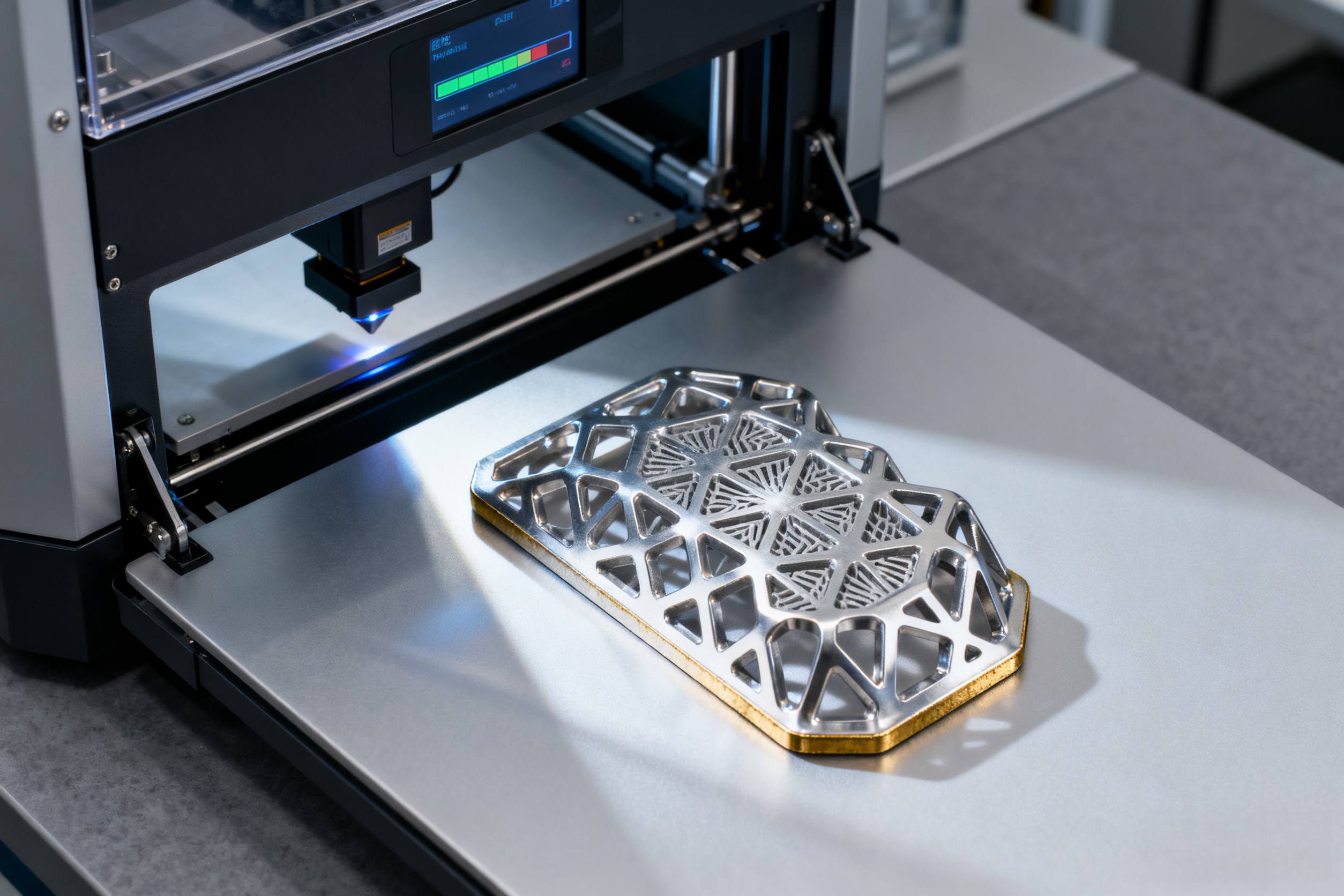
Titanium parts can be produced via two powerful, complementary routes: DMLS (direct metal laser sintering) and Computer CNC Processing. In DMLS, metal material is stacked layer by layer and melted using laser or electron beam to achieve Rapid forming of complex, lightweight geometries with internal channels, lattices, and topology-optimized features. This layerwise approach excels at design freedom, low tooling investment, and fast iteration for prototypes or low-to-medium volumes.
By contrast, CNC leverages subtractive precision—Cutting, milling or engraving from wrought billet or forged stock—to deliver tight tolerances, excellent surface finish, and consistent material properties, often with higher throughput for prismatic parts or larger production runs. CNC’s mature workflows, broad toolsets, and diverse fixturing enable repeatability and competitive costs when part designs favor accessible features.
This article outlines the key trade-offs in cost, speed, and design flexibility between Titanium DMLS and CNC: when Rapid forming shortens lead time despite higher per-part build costs; when CNC’s cycle time and material removal efficiency win; and how hybrid strategies—printing near-net shapes then finishing by machining—can optimize performance, tolerance, and total cost across prototype, bridge, and production scales.
1. DMLS Process Overview (Metal Additive Manufacturing)
Direct Metal Laser Sintering is an additive method that builds parts directly from digital data. A 3D CAD model is sliced into ultra-thin layers, creating a 2D pattern for each layer. Inside the sealed build chamber, a high-power optical laser scans across a uniformly spread metal powder layer. The system includes a material dispensing platform, a recoater roller or blade to sweep fresh powder, and a build platform that lowers incrementally. By using a focused laser (or, in other systems, an electron beam) to locally melt metal powder, the process fuses particles into dense solid sections. Layer by layer, the part is stacked and consolidated until the full geometry is produced. Inert gas (typically argon) limits oxidation; parameters such as laser power, scan speed, hatch spacing, and layer thickness control density, microstructure, accuracy, and surface roughness. Support structures are added where overhangs require heat management and stability, and they are removed during post-processing.
2. CNC Machining Process Overview (titanium cnc machining services)
CNC machining is a computer-controlled subtractive technique that processes a wide range of metals and non-metals. It covers cutting operations such as milling, turning, drilling, and boring, as well as abrasive processes like grinding. Advantages include high precision, high efficiency, excellent surface quality, and suitability for complex shapes—especially with 5-axis strategies and robust fixturing. For cnc titanium, challenges stem from high strength, low thermal conductivity, and chemical affinity with cutting tools, which can cause heat buildup, poor chip evacuation, and rapid tool wear. These are mitigated with:
· Rigid machine structures, stable workholding, and minimal overhang.
· Sharp, wear-resistant tools and coatings (carbide with AlTiN/AlCrN, PCD/CBN for finishing where applicable).
· Conservative surface speeds, higher feeds per tooth, high-pressure through-spindle coolant, and trochoidal or adaptive toolpaths.
· In-process probing and thermal compensation to maintain tight tolerances.
Despite tooling demands, CNC remains the mainstream for titanium due to mature workflows, repeatable accuracy, and improving yields that keep costs trending downward.
3. Why Choose DMLS Instead of CNC for Certain Titanium Parts
· Direct complexity from raw powder: Produce intricate, topology-optimized shapes without extrusion, forging, casting, or extensive secondary operations.
· Near-100% material utilization for the formed volume: Unfused powder is recoverable and reusable within specification, minimizing waste relative to chip-heavy subtractive methods.
· Freedom to integrate functions: Internal channels, conformal cooling, graded lattices, and consolidated assemblies reduce part count, fasteners, and downstream assembly time.
· Design iterations at constant cost: Complexity adds less cost than in subtraction; redesign cycles are rapid with minimal setup changes.
4. When DMLS Is the Better Choice
4.1 Highly complex designs
DMLS excels when parts demand internal passages, undercuts, conformal features, or lattice infills that are impractical or impossible even on advanced 5-axis mills. Complexity carries relatively modest penalties in time and cost.
4.2 Urgent metal prototypes and ultra-low quantities
For runs of roughly 1–5 parts, metal AM often delivers the fastest path from CAD to hardware. Each added iteration has similar cost, enabling quick design updates until requirements are met.
4.3 Minimizing material waste
Only laser-consolidated regions consume material; remaining powder is reclaimed. This reduces raw titanium usage and chip logistics versus machining billets or forgings.
5. When DMLS Is Not Ideal (CNC Advantages)
5.1 Smooth as-built surface or specific textures required
As-built DMLS surfaces are relatively rough compared to CNC. Achieving low Ra or precise textures requires post-processing (support removal, machining, grinding, blasting, electropolishing), which adds cost and time. CNC produces superior finishes directly.
5.2 Highest static strength and long-life fatigue
While process-optimized AM plus HIP can approach wrought properties, parts machined from forged stock typically lead in ultimate strength, fracture toughness, and high-cycle fatigue for safety-critical uses.
5.3 Large components and high-throughput production
DMLS is limited by powder-bed volume (often ~250 × 250 × 325 mm), while CNC can handle much larger envelopes (e.g., 2000 × 800 × 1000 mm or more) and scale efficiently for production.
6. Practical Trade-offs: Cost, Speed, and Design Flexibility
· Cost:
o DMLS: Higher per-part cost due to powder, build time, machine amortization, and post-processing; savings from minimal tooling, reduced assembly, and waste.
o CNC: Competitive for accessible geometries and medium-to-large runs; tool wear and cycle time can be higher in titanium but are offset by efficient finishing and established supply chains.
· Speed:
o DMLS: Rapid first articles and parallelized builds; post-processing can extend lead time but often remains shorter for prototypes.
o CNC: Fast for repeat work once programs/fixtures are proven; initial setup may be longer for complex parts.
· Design flexibility:
o DMLS: Highest geometric freedom, internal complexity “for free,” with attention to supports and thermal strategy.
o CNC: Excellent accuracy and finish; constrained by tool access, cutter reach, and fixturing, though 5-axis broadens possibilities.
7. Hybrid Flow: Print Near-Net, Finish by CNC
A combined approach leverages both strengths:
①DMLS prints a near-net blank with internal features and lightweighting.
②Stress relief and, when necessary, HIP close porosity and stabilize the microstructure.
③CNC establishes datums, precision bores, sealing faces, and fine finishes, achieving final tolerance and surface integrity.
8. Quality, Microstructure, and Inspection
· DMLS quality drivers: Powder specification (PSD, flow, oxygen), controlled recycling, parameter optimization, build orientation, and support design. In-situ monitoring and CT/UT/NDT help detect lack-of-fusion or keyhole porosity.
· CNC quality drivers: Toolpath heat management, chip control, tool wear tracking, and metrology (probing, CMM). Surface integrity (avoiding white layer or tensile residual stress) is critical for fatigue-sensitive parts.
· Post-processing: Heat treatment and HIP for AM; machining, grinding, shot peening, and polishing for function-critical surfaces.
Frequently Asked Questions and Answers
Q1: How do the design constraints and material waste differ between titanium DMLS and CNC machining, particularly for small-batch, high-complexity parts?
A1: DMLS imposes minimal geometric constraints and uses material only where needed; unfused powder is reclaimed, so waste is low. CNC requires tool access and generates chips from billet removal, increasing waste but delivering superior finish and tolerance for accessible features.
Q2: What post-processing challenges arise when integrating titanium DMLS-printed blanks with CNC finishing, and how are they addressed?
A2: Residual stress and surface roughness are common. Apply stress relief and HIP to reduce distortion risk and close porosity, then fixture thoughtfully for finishing. Use selective machining, grinding, abrasive flow, or electropolishing to meet Ra/tolerance targets, validated by CMM and NDT.
Q3: Can you CNC titanium?
Yes, Shaanxi Shenglian Yijing Technology Co., Ltd. has integrated titanium production equipment process, vacuum smelting, 1000 tons, 2500 tons, 4500 tons, 8000 tons hydraulic forging equipment, ring rolling mills, CNC lathes and other machines plus supporting processing equipment.