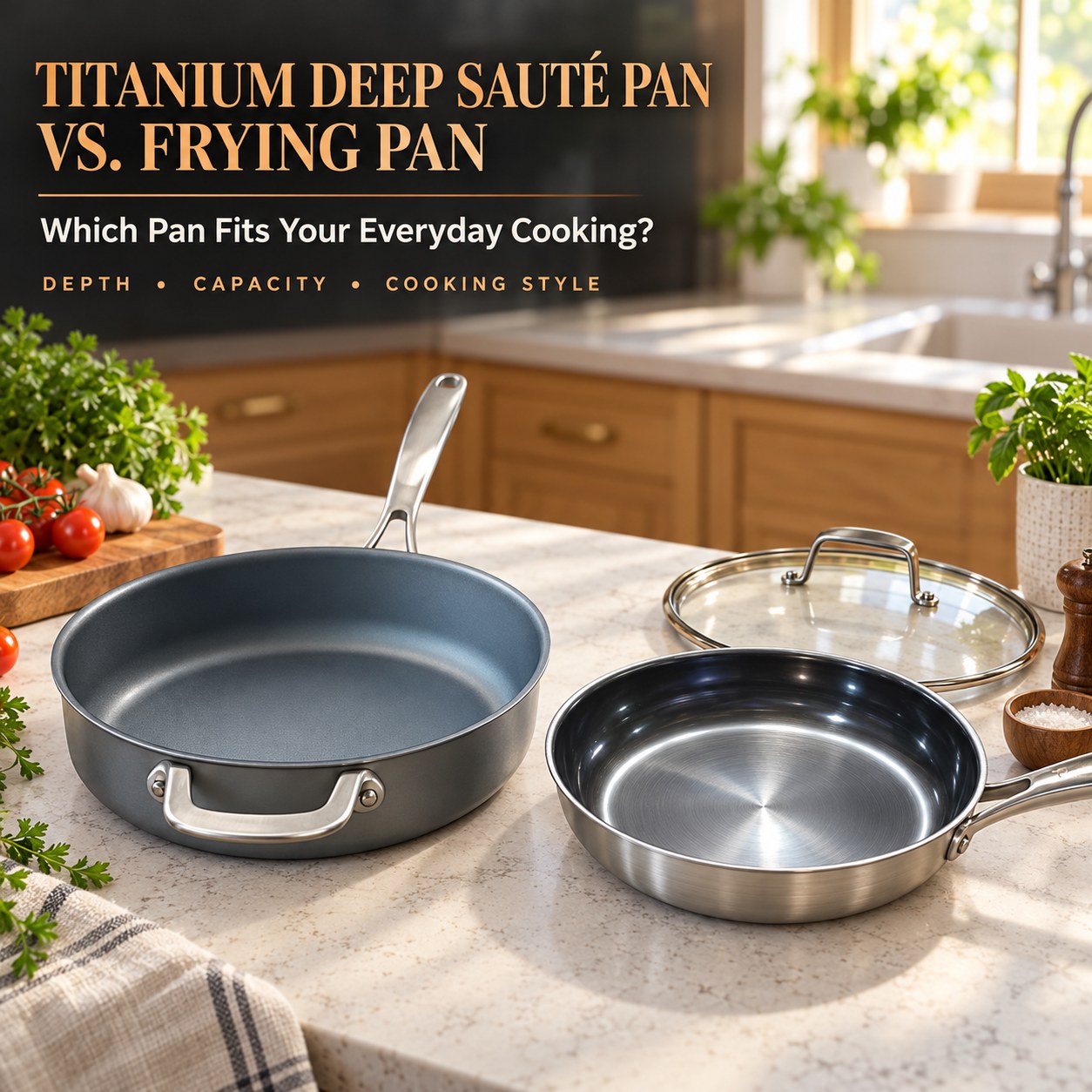
A pure titanium deep sauté pan vs standard frying pan comparison is most useful when the two pans share the same rim diameter. TITAUDOU now offers two 26cm formats: a standard pan with a 260mm rim diameter, 60mm height, 2.8mm body thickness, 2.0L stated capacity, and an approximate 1.8kg weight including the lid; and a deeper pan with the same 260mm rim diameter and 2.8mm thickness, but an 80mm height, 3.0L stated capacity, and an approximate 1.8kg weight including the lid. The meaningful difference is not a vague claim that one is "better." It is the extra 20mm of wall height and the extra 1.0L of stated capacity.
That distinction changes what the pan can contain, how easily food can be turned, and whether one vessel can carry a meal from browning to sauce or simmering. It does not automatically prove a larger flat cooking base, a different wall angle, or a different handle balance. Those details depend on the final product drawing and should be confirmed on the product page. For a buyer deciding between the two confirmed formats, however, the 60mm / 2.0L and 80mm / 3.0L specifications already provide a practical decision framework.
1. Start With the Two Confirmed 26cm Formats
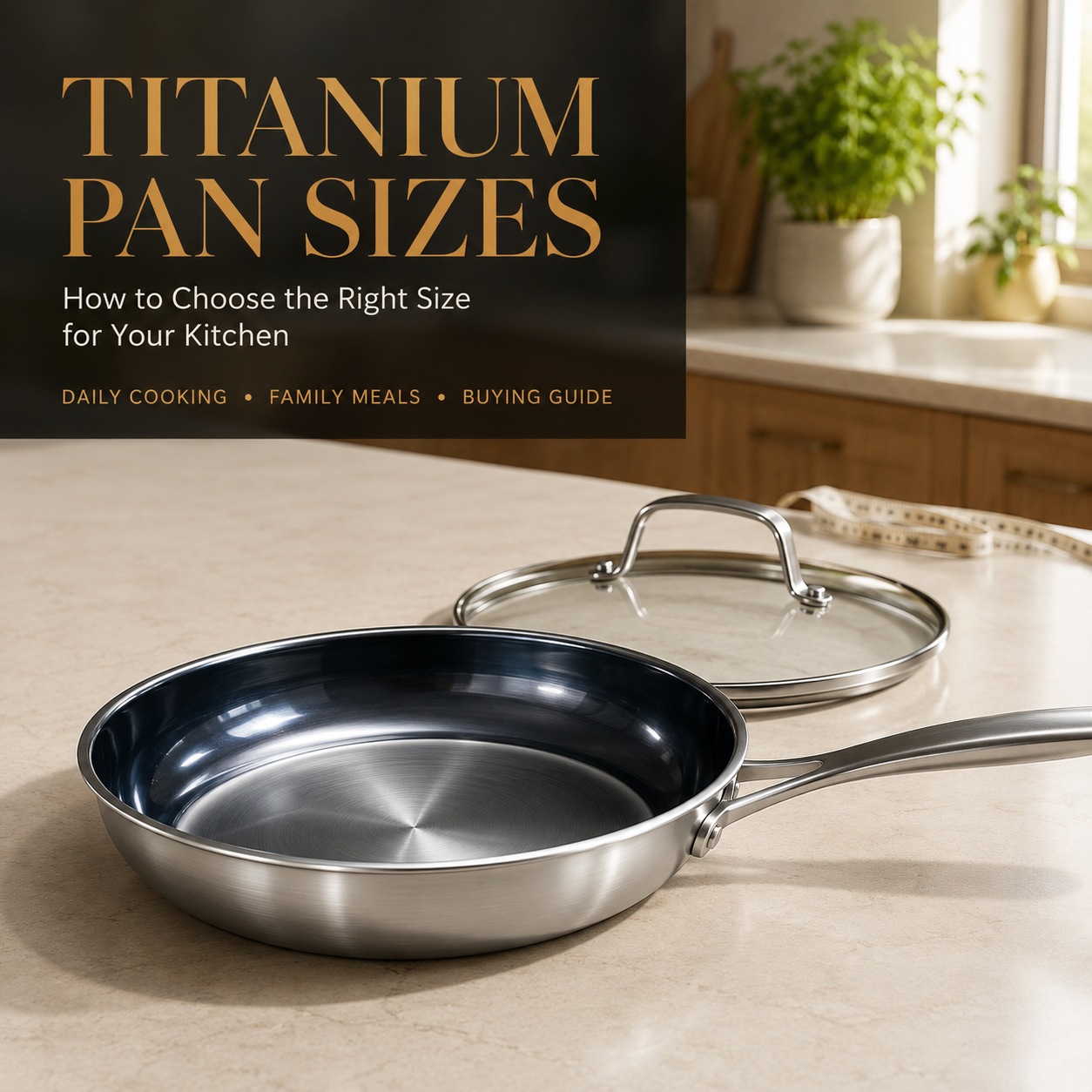
Both pans have the same 260mm rim diameter and 2.8mm thickness. That common starting point is important because it keeps this comparison focused. You are not deciding between a small skillet and a large skillet. You are choosing how much vertical room and liquid capacity you need in a 26cm pan. The standard 60mm format is specified at 2.0L, while the 80mm format is specified at 3.0L. Each weighs about 1.8kg when the lid is included.
The word "sauté" is also used inconsistently in cookware marketing. Some products called sauté pans have straight walls and a wide, flat base; some are simply high-wall frying pans. For this comparison, the deeper 80mm model is treated as a deep sauté-pan format because it has more vertical containment and a 3.0L capacity. It should not be represented as having a specific wall profile until that construction is documented. See the current TITAUDOU titanium frying pan range for the product-level specification context.
| Confirmed specification | 26cm standard frying pan | 26cm deep sauté-pan format | Buyer implication |
|---|---|---|---|
| Rim diameter | 260mm | 260mm | The two pans occupy a similar rim footprint on the stove. |
| Body height | 60mm | 80mm | The deeper format adds 20mm of vertical containment. |
| Body thickness | 2.8mm | 2.8mm | Thickness is the same stated specification in this comparison. |
| Stated capacity | 2.0L | 3.0L | The deeper format provides 1.0L more stated capacity. |
| Approximate weight including lid | About 1.8kg | About 1.8kg | Choose by cooking task rather than assuming the taller pan is heavier. |
2. What the Extra 20mm of Height Actually Changes
In a pure titanium deep sauté pan vs standard frying pan decision, 20mm sounds modest on a specification sheet. In active cooking, it can be a useful containment margin. Ingredients that are stirred with sauce, reduced liquid, or released juices need room below the rim. The 80mm pan does not create more food-contact area merely by becoming taller, but it gives the cook more vertical space before liquid or loose ingredients approach the edge.
This is most relevant when a recipe changes stages. A cook may brown protein, add aromatics, pour in stock or a sauce, and then cover or simmer. The 3.0L deep format gives more room for that transition than the 2.0L standard format. It is also more comfortable for vegetables that initially pile high and reduce as moisture cooks off. The point is not that every recipe needs a deep pan; it is that recipes with changing volume benefit from a greater containment reserve.
The lower 60mm wall has a different advantage. It keeps the working edge visually and physically open. When a cook needs to slide a turner under fish, flip an egg, or move a small quantity of food from the pan to a plate, a lower sidewall can feel more direct. That is a practical usability preference, not a claim that one geometry creates better browning. Browning depends on the actual flat base, burner fit, food crowding, and heat control, none of which can be calculated from the rim diameter alone. For rim and flat-base measurements, see the titanium pan size guide.
3. Capacity and Weight: 2.0L or 3.0L With the Same Approximate Total Weight
The pure titanium deep sauté pan vs standard frying pan choice becomes clearest when capacity is compared directly. The standard pan is specified at 2.0L, while the deep format is specified at 3.0L. That 1.0L difference is large enough to change the kind of dishes that feel comfortable. A 2.0L pan is well suited to a focused fry, a small sauce, breakfast, a side dish, or a portion where the cook wants quick access to the food. A 3.0L pan makes more sense when the recipe contains broth, tomatoes, curry, pasta sauce, or a larger quantity of vegetables that will be stirred before they reduce.
Because both pans are about 1.8kg including the lid, capacity does not come with a stated weight penalty in this pair. That is a useful product fact, but it should be read precisely. The figure includes the lid, so it is not a bare-pan comparison. It is also approximate, not a tolerance-certified number for every individual unit. Product listings should retain the word "about" unless the factory provides a controlled net-weight specification and permitted variance.
For daily handling, the load changes once food and liquid are added. A deep pan filled closer to 3.0L can be materially heavier in use than a 2.0L pan holding a small meal, even if both empty products are listed at approximately 1.8kg with lids. A buyer with limited wrist strength should therefore consider the amount of liquid they expect to lift, not only the empty cookware weight. A pan can be easy to store and still become demanding when it carries a full one-pan meal.
| Cooking need | Choose the 2.0L / 60mm standard pan when... | Choose the 3.0L / 80mm deep pan when... | Why the distinction matters |
|---|---|---|---|
| Quick frying | You want open access for turning or transferring a smaller portion. | You expect food or oil to move toward the rim during active stirring. | Wall height changes containment more than it changes the rim footprint. |
| Sauce and liquid | The recipe uses a small amount of sauce or no liquid finish. | You will add stock, sauce, tomatoes, or other liquid after browning. | The extra 1.0L capacity leaves more headroom during simmering. |
| Vegetables and one-pan meals | You cook small batches that can be moved easily with a turner. | You start with a higher volume of vegetables or combine several components. | Loose ingredients need vertical room before they cook down. |
| Handling | You prefer a lower sidewall and less reach over the rim. | You value containment, but will avoid lifting a pan when it is filled with liquid. | Both pans have about the same stated lidded weight; filled weight is recipe-dependent. |
4. When the 60mm Standard Frying Pan Is the Better Tool
Choose the 60mm standard format when frying is the main task and the food volume is controlled. A lower sidewall is practical for eggs, a fish fillet, a small portion of vegetables, a cutlet, or leftovers that need a quick reheat. The pan gives a cook direct access to the food, particularly when a broad turner needs to approach near the edge. It is also a straightforward format for anyone who prefers to slide food from the pan onto a plate without working around a tall wall.
The 2.0L capacity is not a weakness in this role. It is the correct size when the recipe does not need a large liquid reserve. A small amount of sauce can still be made in the standard pan, but the cook should avoid treating it as a 3.0L vessel. Choosing capacity honestly reduces spills and improves heat control because the user is less tempted to crowd food or pour liquid close to the rim.
The cooking surface material and the heat-spreading structure should still be evaluated separately from shape. A titanium food-contact surface does not by itself explain how evenly a pan heats. If the product uses a multi-layer body, its core and exterior serve different functions. The guide to titanium cookware heat behavior explains why material construction matters alongside pan size and burner choice.
5. When the 80mm Deep Format Earns Its Place
Choose the 80mm deep format when a recipe moves beyond a simple fry. Its stated 3.0L capacity gives more room for sautéing onions before adding tomatoes, browning chicken before a sauce, combining vegetables with noodles, or reducing a liquid after a sear. The additional wall height helps contain food during stirring, especially when the pan begins full and the ingredients have not yet softened or reduced.
A pure titanium deep sauté pan vs standard frying pan comparison is therefore not only about family size. A single cook may also benefit from the deeper format when they prefer one-pan meals, sauces, curries, or batch cooking. Conversely, a larger household can still prefer the 60mm pan for simple fried dishes if they cook in batches. Capacity should follow the recipe sequence, not just the number of people at the table.
The 80mm format also makes a lid more useful because the pan has enough headroom to cover food that is not yet fully reduced. Since both listed products include the lid in their approximate 1.8kg weight, the buyer receives a covered-cooking option without a stated difference in total lidded weight. The lid can help manage splatter and hold heat during a short finish, but it does not eliminate the need to leave enough room for liquid and food below the rim.
6. Make the Final Choice by Recipe Sequence and Product Evidence
The final pure titanium deep sauté pan vs standard frying pan choice is simple when the cooking routine is clear. Select the 260mm x 60mm x 2.8mm, 2.0L standard pan when the usual task is frying, turning, transferring, or cooking a smaller portion with an open working edge. Select the 260mm x 80mm x 2.8mm, 3.0L deep format when the meal regularly develops in the pan: brown first, then add liquid, vegetables, sauce, or a lid. In both cases, the listed lidded weight is about 1.8kg.
Before buying or listing either product, verify the product-page details that the supplied specification does not cover: actual flat base diameter, wall profile, handle construction, compatible cooktops, interior surface condition, and whether the capacity is brimful or recommended working volume. Those are not minor details. They determine pan performance, comfort, and the accuracy of any sales claim. They should be added to a final commercial specification rather than guessed from a 26cm rim diameter.
The broader material decision matters too. A product called pure titanium cookware may refer to a pure-titanium food-contact layer within a multi-layer body, or to another construction entirely. Buyers should verify the actual food-contact material and heat-spreading structure for the SKU they are considering. The titanium cookware selection guide is a useful next step for comparing material claims, cooking behavior, and intended use.
For product planning, the two formats should not be presented as duplicates. The 60mm pan is a direct daily frying tool with 2.0L capacity. The 80mm model is a 3.0L, higher-containment alternative for recipes that expand or include liquid. Keeping that distinction visible makes the choice easier for end users and prevents a product page from promising a cooking surface or handling behavior that the drawing does not support.
Conclusion: The Deeper Pan Adds Containment, Not a Different Diameter
The practical answer to pure titanium deep sauté pan vs standard frying pan is that both TITAUDOU formats begin with the same 26cm rim diameter and 2.8mm thickness, but they solve different cooking problems. The 60mm standard pan provides a 2.0L format with a lower working edge. The 80mm pan provides a 3.0L format with 20mm more wall height for sauces, liquid finishes, and higher-volume ingredients. Both are listed at about 1.8kg including the lid.
Choose the standard format for direct frying and easy utensil access. Choose the deeper format for containment and meal-building flexibility. Do not claim that the deep pan has a larger frying base, more even heating, or a specific wall angle unless the final technical drawing confirms it. The supplied facts are already enough to make a clear recommendation: 2.0L for focused frying, or 3.0L for recipes that need more vertical and liquid capacity.
Frequently Asked Questions
Q1: Is the 80mm deep pan heavier than the 60mm standard frying pan?
Not according to the supplied specification. Both 26cm pans weigh approximately 1.8kg including the lid. The deeper 80mm model can become heavier in use when it contains more food or liquid because it has a 3.0L stated capacity, while the standard 60mm model is stated at 2.0L.
Q2: Does the 80mm deep format have a larger frying surface?
That cannot be concluded from the supplied dimensions. Both pans have a 260mm rim diameter, but the actual flat base diameter and wall angle have not been provided. The confirmed advantage of the 80mm model is 20mm more height and a 3.0L stated capacity, not a documented larger flat cooking surface.
Q3: Can the 3.0L deep pan replace the 2.0L standard frying pan?
It can cover many of the same tasks, especially when a recipe needs sauce, a lid, or more containment. It does not automatically replace the lower pan for cooks who value the open access of a 60mm wall for flipping and transferring food. The better choice depends on whether your usual cooking sequence is simple frying or a one-pan meal that develops with liquid and volume.