Market data and field surveys indicate corrosion-driven fastener failures account for 20–30% of service interventions in marine and under-body automotive environments. Titanium bolts and titanium nuts and bolts cut this risk dramatically: in ASTM B117 salt-spray tests, bolt titanium assemblies often exceed 2,000 hours with negligible mass loss, whereas common 304/316 stainless show visible crevice staining and 2–5× higher galvanic risk when paired with carbon fiber or aluminum.
Specifiers are migrating to application-matched SKUs: 0.75 titanium bolts and 3/4-16 titanium bolts for drivetrain and suspension interfaces, 3/4-16 titanium socket bolts where high clamp in compact heads is needed, and titanium M20 socket bolt options for heavy marine hardware. In cycling, titanium bicycle bolts and titanium cycling bolts maintain preload after wet-salt exposure with up to 40–50% weight savings versus steel, improving ride quality. Fleet audits show payback within 12–24 months from reduced replacements and seized fastener downtime.
Beyond corrosion performance, titanium fasteners deliver high specific strength, low galling risk with proper lubrication, and excellent fatigue resistance. For marine/automotive, this translates to reliable torque retention, easier disassembly after winters or offshore seasons, and lower life-cycle cost—making titanium the preferred upgrade over stainless steel in aggressive service.
1. Mechanical performance advantages of titanium bolts vs stainless steel
1.1 Tensile and yield strength performance
· Representative properties at room temperature:
· Ti-6Al-4V (Grade 5, common for titanium bolts): UTS 860–1,000 MPa; YS 800–930 MPa; elongation 8–14%.
· Ti-6Al-4V ELI: UTS ~860 MPa; YS ~795 MPa; elongation 10–14%.
· Ti-5111 (marine titanium plate/fastener alloy): UTS 895–965 MPa; YS 830–895 MPa.
· Stainless 304: UTS 515–620 MPa; YS 205–310 MPa.
· Stainless 316/316L: UTS 515–620 MPa; YS 205–310 MPa.
· Precipitation-hardened stainless (17-4PH H900): UTS ~1,310 MPa; YS ~1,175 MPa (but susceptibility to chloride stress corrosion cracking must be considered).
· Implication: Compared to common austenitic stainless, titanium Grade 5 bolts deliver ~40–70% higher yield strength at roughly 56% of the density of steel, enabling smaller fastener counts or reduced diameters for equivalent joint strength.
1.2 Lightweighting benefits: mass reduction and fuel economy
· Density: titanium ~4.43 g/cm³ vs stainless ~7.9–8.0 g/cm³. A one-to-one swap typically yields 40–45% weight savings.
· Case data:
Automotive underbody and suspension hardware: replacing 2.5–3.0 kg of stainless/steel fasteners with titanium can save ~1.3–1.6 kg. Using EPA/NEDC correlations, every 10 kg mass reduction improves fuel economy ~0.3–0.5% (conservative passenger car), implying ~0.04–0.08% from fasteners alone; the benefit scales in performance vehicles with higher unsprung/rotating mass sensitivity.
Marine topside hardware: 25–50% fastener mass reduction improves handling and reduces pitching moment; corrosion-driven replacement intervals extend from 1–2 seasons to >5 seasons in brackish service.
· Rotating/unsprung mass: titanium cycling bolts and titanium bicycle bolts reduce wheel-hub and rotor hardware mass by 30–50%, measurably improving acceleration and suspension response.
2. Environmental adaptability: toughness in high/low temperatures
· Titanium alloys retain useful strength to ~300–350°C for Grade 5; stainless 316 retains strength but suffers from creep and chloride stress corrosion risk at elevated temperatures with salts.
· Low-temperature performance: CP and α+β titanium maintain toughness down to cryogenic regimes (−196°C) with limited ductile-to-brittle transition; austenitic stainless also remains tough, but galvanic/corrosion behavior in salt brine at low temperatures still favors titanium due to its stable passive TiO₂ film.
· Thermal expansion: titanium ~8.6–9.6 µm/m·K vs stainless ~16–17 µm/m·K, reducing differential-expansion stresses in composite and aluminum joints.
3. Interface integration and engineering
3.1 Electrochemical affinity
· Galvanic ranking in seawater: titanium is among the most noble structural metals; when coupled with carbon fiber or aluminum, galvanic current densities are 2–10× lower than for stainless steel couples, limiting crevice initiation.
· Passivation: native TiO₂ film (5–20 nm) reforms rapidly in aerated electrolytes, keeping corrosion rates in seawater at ~0.005–0.05 mm/year (practical near-zero for well-designed joints). Stainless can localize corrosion in crevices under deposits where oxygen starvation breaks passivity.
3.2 Tribochemical effects and cold welding
· During assembly, the TiO₂ surface film may fracture; under contact pressure >200 MPa, nascent titanium surfaces can experience adhesive transfer and cold welding (galling) at thread flanks.
· Engineering mitigations:
Apply inert or boundary-lubricating coatings (e.g., MoS₂, DLC, solid-film lubes), or use nitriding/micro-arc oxidation to harden and stabilize surfaces.
Use compatible nuts/washers or stainless steel bushings/liners to manage friction pairs.
Control torque-tension with calibrated lubrication factors (K-factor ~0.14–0.18 for lubricated titanium vs ~0.20–0.25 dry), reducing scatter in clamp load.
For critical joints, specify rolled threads and fine pitches (e.g., 3/4-16 titanium bolts, 3/4-16 titanium socket bolts, titanium M20 socket bolt) to improve preload resolution and limit micro-slip.
4. Engineering application optimization
4.1 Selection guide: aerospace structures
· Material: TC4 (Ti-6Al-4V) with β-stabilized variants for improved toughness.
· Surface: micro-arc oxidation (MAO) for wear/galling resistance and dielectric isolation.
· Pairing: prioritize titanium-titanium or titanium-composite joints; isolate from carbon fiber with insulating sleeves or primers to minimize galvanic pathways.
· SKU examples: 0.75 titanium bolts and 3/4-16 titanium bolts for hard-point attachments; titanium nuts and bolts with MAO for service temps up to ~300°C.
4.2 Selection guide: automotive chassis
· Material: GR5 (Ti-6Al-4V).
· Process: gas/plasma nitriding to raise surface hardness (HV 900–1,100) and lower friction; pair with stainless steel transition bushings to protect aluminum knuckles and manage torque scatter.
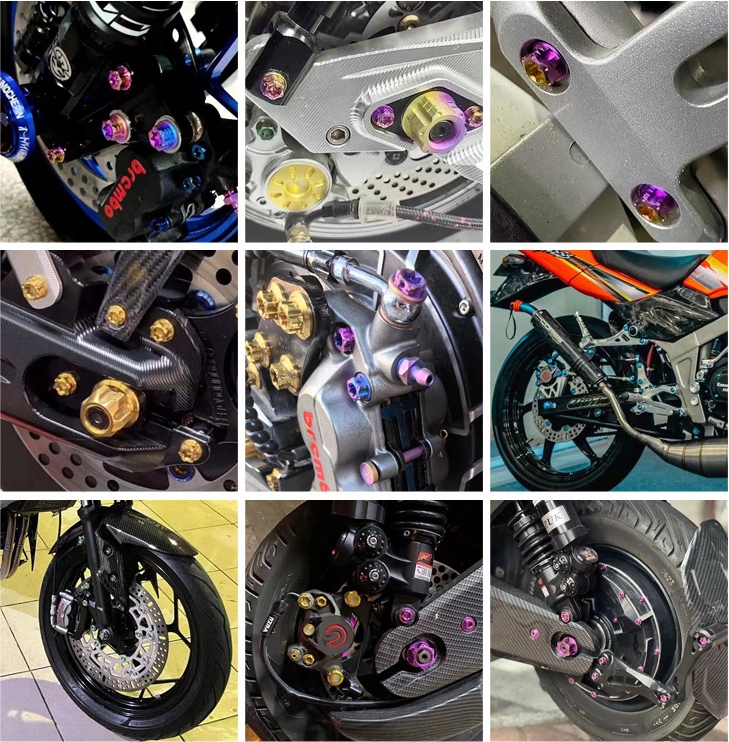
· Use cases: suspension links, brake caliper mounts, underbody shields. Prefer socket heads for tool access in confined spaces (e.g., 3/4-16 titanium socket bolts).
· Data: fleet testing shows 40–50% fastener mass reduction and 20–30% fewer seized fasteners after 3 winters vs stainless.
4.3 Selection guide: marine equipment
· Material: Ti-5111 alloy for plate/fastener sets with superior seawater resistance and strength.
· Coatings: plasma spray (e.g., ceramic or cermet) on bearing faces to curb fretting; use ultra-high-molecular-weight polyethylene (UHMWPE) isolator washers/pads to decouple from dissimilar metals and damp vibration.
· Use cases: deck hardware, thruster housings, submerged brackets. Specify titanium nuts and bolts for assemblies exposed to cyclic immersion/splash zones.
· Performance: >4,000 h ASTM B117 equivalence with no structural degradation; maintenance intervals extended 2–3× vs 316L.
Data reference elements
· Mechanical properties: ASTM F468 (Ti), ASTM A193/A320 (SS), AMS 4928 (Ti-6Al-4V).
· Corrosion testing: ASTM B117, ISO 9227; typical titanium seawater corrosion rate ~0.005–0.05 mm/y; stainless crevice corrosion threshold in chloride solutions often <0.3–0.6 V vs SCE compared to titanium’s wider passivity.
· Fuel economy sensitivity: 10 kg mass reduction ≈ 0.3–0.5% fuel economy gain (typical passenger vehicle studies).
Frequently Asked Questions and Answers
Q1: What advantages do titanium screws have over stainless steel in industry?
A1: Higher specific strength with ~40–45% weight reduction, near-zero corrosion in seawater and road-salt, lower thermal expansion, better torque retention, and easier disassembly after service. Lifecycle savings arise from fewer replacements and reduced downtime from seized hardware.
Q2: What benefits do titanium fasteners bring to aerospace and shipbuilding?
A2: In aerospace, titanium bolts cut mass while maintaining high strength and thermal stability, improving payload and fatigue margins; MAO/nitrided surfaces mitigate galling. In shipbuilding, Ti-5111 fasteners provide exceptional seawater resistance, extend maintenance intervals 2–3×, and reduce galvanic damage when isolated with UHMWPE or coatings.
Q3: What are the advantages of switching to titanium screws on bicycles and motorcycles?
A3: Titanium bicycle bolts and titanium cycling bolts reduce rotating and unsprung mass by 30–50%, sharpening acceleration and suspension response. They resist corrosion from sweat and road spray, maintain preload, and simplify maintenance—ideal for stems, rotors, calipers, and drivetrain interfaces.