Titanium materials possess excellent properties such as low specific gravity, high strength, corrosion resistance, and heat resistance, making them highly valued in demanding engineering applications. Titanium bolts, in particular, represent a typical application of titanium alloy materials in aircraft, where both performance and reliability are critical. However, the processing of titanium alloy bolts has traditionally faced significant challenges. Due to limitations in equipment capabilities and technological levels, earlier manufacturing methods required two separate heat treatment processes, internal thread tapping on a hexagonal lathe, and external contour machining using conventional equipment. These outdated processes led to long production cycles, low production efficiency, unstable quality, and poor quality consistency, which hindered the widespread adoption of titanium bolts in high-performance fields. As aerospace and other advanced industries continue to demand higher standards for fasteners, there is a growing need for improved processing technologies that can enhance both the quality and efficiency of titanium bolt production. Recent advancements in machinery, process integration, and automation have paved the way for more streamlined, reliable, and cost-effective manufacturing solutions. This article reviews the evolution of titanium bolt processing technology and explores innovative approaches aimed at overcoming past limitations, ensuring that titanium bolts can fully realize their potential in critical applications.
1. Current Titanium Bolts Processing Route and Its Problems
1.1 Existing Processing Route for Titanium Bolts
Figure 1 illustrates a typical titanium alloy bolt made of grade 5 titanium (Ti-6Al-4V). This bolt features both internal and external threads with a hexagonal head. The internal thread specification is MJ5×0.8-6H, with a depth of 16 mm, while the external thread is MJ10×1.5-6e. The shank diameter is Ф10+0.026 mm.
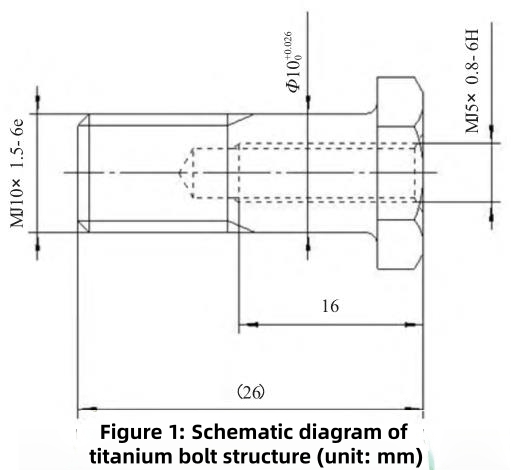
The current process route for manufacturing such a titanium bolt involves the following steps:
1. Material cutting
2. Quenching heat treatment
3. Sandblasting
4. Rough turning of the external contour
5. End face turning to ensure overall length
6. Hex milling
7. Deburring (manual)
8. Thread rolling
9. Hex lathe drilling of internal thread bottom hole
10. Aging heat treatment
11.Hex lathe tapping of internal thread
12. Hex lathe correction of internal thread (removal of residuals)
13. Finish turning of shank
14. Hex lathe correction of internal thread
15. Cleaning
16. Inspection
17. Storage
This multi-step process involves numerous procedures, repeated setup, and frequent workpiece transfers between equipment.
1.2 Problems and Root Causes in Titanium Bolts Processing
Despite the careful sequence, the traditional process for titanium bolts is fraught with issues, primarily related to internal thread processing and overall efficiency:
Major Problems
· Difficulty in Internal Thread Processing: Taps frequently break during the machining of internal threads.
· Residual Chips: After tapping, metal chips often remain in the bottom of the hole and in the thread grooves, making removal difficult.
· Inconsistent Thread Depth: There is significant variation in the depth and effective length of internal threads, leading to high rejection rates.
· Inefficient Equipment Usage: Most of the processing relies on conventional machines, resulting in many simple and dispersed operations.
· Long Production Cycle: The need for two separate heat treatment cycles and excessive machine transfers make the production timeline unpredictable and prolonged.
Root Causes
· Material Characteristics: Titanium alloys have a small deformation coefficient, and the torque required for tapping is about twice that of standard materials, increasing the risk of tap breakage.
· Chip Removal Challenges: Chips are difficult to evacuate during tapping, and resistance increases during withdrawal, further contributing to tool breakage.
· Thread Specifications: The internal thread (MJ5×0.8-6H) with a depth of 16 mm results in a length-to-diameter ratio over 3, classifying it as a slender blind hole. This complicates chip removal and tool access.
· Cooling and Lubrication Difficulties: Coolant cannot effectively reach the cutting area, causing chips to accumulate at the bottom of the hole and within threads.
· Process Control: The use of old hexagonal lathes without feed scales means that thread depth relies entirely on operator experience, resulting in poor consistency and variable thread lengths.
2. Specific Improvement Measures
The above issues primarily center on two aspects: how to machine small, deep internal threads both efficiently and with high quality; and how to speed up and streamline the overall titanium bolt production process. The following improvements address both areas.
2.1 High-Quality, Efficient Machining of Small, Deep Internal Threads
2.1.1 Tapping Internal Threads: Process and Tool Improvements
Thread Bottom Hole Optimization:
The correct bottom hole diameter is crucial. A slightly larger bottom hole diameter can significantly reduce cutting heat and force during tapping. Trials with titanium alloys show that using a drill diameter as close as possible to the thread minor diameter provides the best balance between sufficient material for thread formation and ease of chip removal.
Tap Structure Optimization:
Tap breakage in titanium alloys is mainly caused by high cutting torque and poor chip evacuation. Modifying the tap’s geometry can alleviate these issues. Most internal threads in titanium bolts are produced using straight-flute taps. By narrowing the width of the tap’s guiding lands (the calibration part), the contact area between the tap and the metal is reduced, which lowers cutting torque. Simultaneously, a narrower land increases chip space, easing chip evacuation and reducing resistance and torque during tapping.
Thread Depth and Chip Control:
To precisely control thread depth on a hex lathe, a visual or physical marker can be added to the tap (such as a colored line, a piece of copper wire, or a notch). When the marker reaches the workpiece surface, the operator stops and reverses the tap, ensuring consistent thread depth and minimizing chip compaction at the hole bottom.
2.1.2 Thread Milling: Advanced Internal Thread Machining
While optimizing tap design improves performance, chip removal after tapping can still be cumbersome. Therefore, thread milling is introduced as an advanced process. Thread milling uses CNC equipment and a specialized milling cutter, which moves along a helical path to form threads. This method produces less heat, delivers better chip control, and virtually eliminates the problem of chip compaction in blind holes. Thread milling also facilitates the production of threads with excellent surface finish and dimensional accuracy, especially for small, deep, blind holes typical of titanium bolts.
2.2 Faster and More Convenient Titanium Bolt Processing
Modern part manufacturing now widely utilizes CNC machines, which offer multifunctional operations. By integrating and combining multiple machining steps, CNC technology can dramatically improve efficiency and product quality. Key improvements include:
· Process Integration:
The number of machining steps is reduced from 17 to 10–11 steps. Previously dispersed operations—such as end face machining, hex milling, bottom hole drilling, threading, and two correction steps—are consolidated into just one or two CNC operations.
· Reduced Heat Treatment:
The process eliminates one heat treatment operation, saving both time and energy.
· Streamlined Finishing:
The finish turning of the shank is also reduced by one step, further shortening the process chain.
With the widespread adoption of CNC machinery and indexable tools, even heat-treated titanium alloys can now be machined with high efficiency and precision. The process improvements not only streamline the workflow but also ensure more consistent, higher-quality outcomes.
3. Effects of Process Improvements: Comparative Table
The table below highlights the main differences between the traditional and improved processing technologies for titanium bolts.
Aspect | Traditional Process | Improved Process |
Number of Operations | 17 | 10–11 |
Heat Treatment Steps | 2 | 1 |
Internal Thread Machining | Tapping on hex lathe, high tap breakage, poor chip removal | Thread milling or optimized tapping, improved chip evacuation, reduced tap breakage |
Chip Removal | Manual, difficult, often incomplete | Automated, efficient, nearly complete |
Thread Depth Consistency | Operator-dependent, poor control, inconsistent thread depth | Mechanized/CNC control, highly consistent |
Equipment | Conventional, separate machines, manual transfer | CNC, integrated operations, minimal transfer |
Production Efficiency | Low, with long, unpredictable cycles | High, with stable and predictable cycles |
Quality Consistency | Poor, high rejection rate | Stable, low rejection rate |
Process Complexity | High, multiple setups, manual interventions | Low, consolidated steps, automated control |
Economic Benefit | Low, due to inefficiency and high scrap rate | High, due to reduced cycle time and improved yield |
4. Summary and Outlook
The processing technology for titanium bolts has advanced significantly through the optimization of thread bottom hole size, tap structure, and internal thread machining methods. The adoption of thread milling, process consolidation, and the shift to CNC-based workflows have drastically improved quality, efficiency, and economic value. These improvements have effectively solved long-standing problems such as tap breakage, chip evacuation difficulties, inconsistent thread depth, scattered operations, and long production cycles.
As a result, the quality stability of titanium bolts has been increased, production efficiency has soared, and machining cycles have been shortened—delivering tangible benefits for manufacturers and end-users alike. Titanium bolts, and bolt titanium applications more broadly, are now better positioned to meet the rigorous demands of industries such as aerospace, medical, and advanced manufacturing.
Looking to the future, further integration of digital manufacturing technologies, real-time process monitoring, and automated quality control will continue to elevate the capabilities of titanium bolt processing, ensuring these vital components remain at the forefront of engineering solutions worldwide.
Frequently Asked Questions and Answers
1. What are the key advantages of improved titanium bolts processing technology over traditional titanium bolt manufacturing methods?
The improved technology reduces the number of operations, consolidates processes, adopts advanced thread milling, and utilizes CNC machines. This results in shorter production cycles, higher efficiency, better quality consistency, fewer tool breakages, improved chip removal, and overall lower manufacturing costs.
2. How does improved titanium bolts processing technology enhance the fatigue resistance and corrosion durability of titanium bolts?
By ensuring precise thread geometry, consistent depth, and clean thread surfaces, the improved process minimizes stress concentrations and surface defects. This enhances the fatigue resistance of the bolts. Additionally, better chip removal and controlled heat treatment preserve the integrity of the titanium alloy’s passive oxide layer, further improving corrosion durability.
3. Which industries benefit most from the latest improved titanium bolts processing technology, and what specific improvements drive this value?
Industries such as aerospace, medical, and high-performance automotive manufacturing benefit the most. The improvements most valued include precise thread quality, stable mechanical performance, reduced risk of fastener failure, shortened lead times, and the ability to meet strict international standards for safety and reliability.