Titanium products are renowned for their stability in harsh environments, but what happens to Titanium color and finish in salt spray or humid air? Thanks to a self-healing TiO2 oxide only a few nanometers thick, titanium resists tarnish and corrosion far better than most metals—even after 1,000+ hours in standardized salt fog tests, discoloration is typically minimal.
Surface appearance, however, depends on finishing. Polishing yields a mirror-like Bright surface, while controlled High temperature firing or anodizing intentionally thickens the oxide, shifting Titanium color through vivid blues, purples, and golds without dyes. These interference colors are durable, but aggressive abrasion or contamination can dull them. Routine care is simple: rinse after seawater exposure, wash with mild soap, and avoid harsh chlorides at elevated temperatures.
For architectural, jewelry, and dive-grade Titanium products, the combination of low reactivity, strong passive film, and excellent chloride resistance means “no tarnish” in typical humidity and seawater conditions. When surface brilliance fades due to wear, light Polishing or re-anodizing restores the original Bright surface and Titanium color with minimal material removal.
1. The native color of titanium and the role of finishing
· Base appearance: Titanium’s original color is a dull, silver-gray with little sheen. The ultra-thin TiO2 film (a few nanometers) is clear but light-scattering, so the metal appears non-glossy.
· Finish versatility: Through controlled finishing, titanium products can be made bright, mirror-like, satin, textured, or vividly colored. Finishes can range from purely aesthetic to highly functional (wear resistance, low friction, electrical insulation).
· Tarnish behavior: In saltwater and humid air, titanium resists tarnish because the TiO2 film is dense, adherent, and self-healing. After abrasions or scratches, fresh oxide reforms in the presence of oxygen or moisture, limiting discoloration.
2. Anodizing: color by oxide thickness and engineered textures
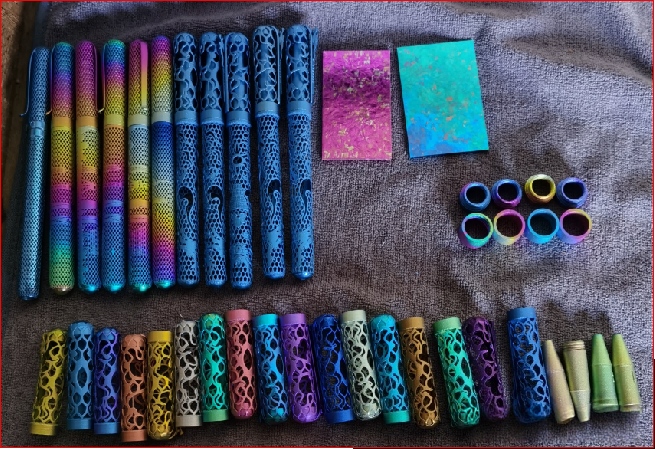
Anodizing thickens and structures the TiO2 layer using an electrolytic process. Color arises from optical interference—no pigments—so hue is set by oxide thickness, which is controlled by voltage.
· Aesthetics: Anodizing produces a broad palette (straw, gold, purple, blue, teal, green) and can be combined with blasting, brushing, or masking to create textures and patterns.
· Function: The thicker oxide improves corrosion stability in many environments and adds electrical insulation. Insulation performance can be excellent; in optimized coatings, insulation resistance can reach 100MΩ or more.
· Surface hardness: Conventional decorative anodic films on titanium are ceramic-like and harder than base metal, improving scratch resistance modestly. Microhardness of engineered anodic films varies widely with process but is typically well above the substrate’s hardness.
· Notes: Interference colors can dull with abrasion; gentle cleaning and non-abrasive handling preserve brilliance.
3. Micro-Arc Oxidation (MAO): ceramic armor for silver and black tones
Micro-Arc Oxidation (also called plasma electrolytic oxidation) drives micro-discharges that convert the surface into a thicker, crystalline ceramic (anatase/rutile) with porous or sealed morphology.
· Aesthetics: MAO readily achieves stable silver-gray to deep black finishes, prized for technical, stealth, or luxury looks without dyes.
· Surface hardness: MAO forms a true ceramic coating. Microhardness is between 1000 and 2000 HV depending on parameters (electrolyte, duty cycle, current density, sealing). This is far harder than wrought titanium, providing strong abrasion resistance.
· Insulation: Due to the ceramic nature, MAO coatings exhibit high dielectric strength and excellent Insulation performance; properly processed parts can achieve insulation resistance that can reach 100MΩ or higher.
· Corrosion: MAO significantly boosts barrier properties, reducing chloride ingress in saltwater and resisting under-film corrosion. Sealing steps can further improve impermeability.
· Friction and wear: The hard, micro-textured ceramic surface lowers wear; pairing with suitable counterfaces and lubricants prevents third-body abrasion.
4. PVD coating: brilliant lusters and functional layers
Physical Vapor Deposition (PVD) deposits thin, dense films—such as TiN, TiCN, TiAlN, DLC—onto titanium.
· Aesthetics: PVD enables glossy golds, gunmetal blacks, rainbows, and mirror-like sheen without bulk pigments. It’s a favorite for watch cases, jewelry, and architectural hardware needing a Bright surface.
· Surface hardness: Many PVD films are extremely hard (e.g., TiN and TiAlN in the 1800–2500 HV range, DLC even higher), dramatically improving scratch and wear resistance.
· Corrosion: Dense PVD layers add a barrier; combined with titanium’s passive substrate, this creates a robust duplex system against salt spray and humidity. Edge coverage and defect control are essential to prevent pinhole-initiated attack.
· Thermal limits: Colors and phases depend on deposition chemistry and can shift with High temperature firing; select films rated for service temperatures to retain hue and gloss.
5. Polishing and mirror polishing: from satin to optical brightness
Mechanical and electro-mechanical polishing refine the surface roughness.
· Aesthetics: Polishing yields a smooth, reflective finish; mirror polishing approaches specular reflection. The underlying TiO2 remains ultrathin and transparent, so the Bright surface comes from reduced micro-roughness.
· Function: Lower roughness eases cleaning, reduces biofilm adherence, and improves corrosion behavior by minimizing crevice sites. It does not significantly increase Surface hardness unless combined with coatings.
· Maintenance: Saltwater use typically requires only rinsing; fingerprints or films can be removed with mild soap and soft cloths. Avoid aggressive abrasives that can haze the finish.
6. “Ice-flower” (binghua) textures: controlled crystalline patterns
“Ice-flower” refers to decorative crystallization or patterning methods that produce frosted, fractal-like motifs reminiscent of ice.
· Aesthetics: The finish scatters light for a unique, premium matte-sparkle effect. It can be combined with anodic coloring or dark PVD to heighten contrast.
· Function: While primarily decorative, the micro-texture can help diffuse scratches. Pairing with MAO or PVD adds real wear resistance.
Summary: How surface treatments affect corrosion and tarnish in saltwater and humidity
· Titanium’s baseline: Even untreated titanium resists tarnish and corrosion in salt spray and humid air thanks to its self-healing TiO2 film.
· Anodizing: Thickened oxide enhances corrosion resistance and electrical insulation; colors are durable but can dull with abrasion.
· MAO: Provides the largest boost in Surface hardness and barrier properties. Microhardness is between 1000 and 2000 HV, and Insulation performance is excellent; insulation resistance can reach 100MΩ with suitable processing and sealing. Outstanding for marine and industrial exposure.
· PVD: Adds hard, dense, often colored or glossy layers; protects well when defects are minimized, ideal for high-end aesthetics plus function.
· Polishing: Improves cleanability and perceived brightness; best used as a base or top treatment. Does not by itself increase hardness.
· Ice-flower: Aesthetic texturing that can be layered with MAO or PVD for both beauty and durability.
In all cases, the underlying corrosion resistance of titanium remains excellent; surface engineering primarily tunes appearance, wear resistance, and auxiliary properties like insulation. In saltwater and humidity, well-executed coatings and finishes can retain color and gloss for years with minimal maintenance.
Frequently Asked Questions and Answers
Q1: Does titanium tarnish when used in high-temperature cooking, such as titanium pans or grills, and what causes discoloration under heat?
A1: Titanium does not “tarnish” like silver, but heat can thicken the oxide film, causing interference colors—straw, purple, blue—especially after High temperature firing or dry heating. This color shift is harmless and often removable with gentle Polishing; in cookware, it does not impair performance.
Q2: Does titanium tarnish inside the human body, like in orthopedic implants or dental abutments, and does this affect biocompatibility?
A2: No typical tarnish occurs in vivo. The stable TiO2 layer persists in physiological fluids, supporting excellent biocompatibility and osseointegration. Clinical-grade surfaces may be blasted, etched, or anodized; these treatments do not compromise the passive film and therefore do not degrade biocompatibility.
Q3: Does titanium tarnish more quickly if its surface oxide layer is scratched, and can the oxide layer self-repair to prevent further discoloration?
A3: Scratches locally remove oxide, but titanium’s surface passivates almost immediately in the presence of oxygen or moisture. The oxide self-repairs, limiting discoloration and under-film corrosion. For aesthetic finishes (anodic colors, PVD gloss), light wear may dull appearance; re-polishing or re-finishing restores the Bright surface and color.