“In fact, the essence of non-stick pans is very simple. With the current technology, it basically depends on coating.” Most so‑called titanium ceramic cookware is aluminum or steel with a ceramic-reinforced coating, sometimes marketed as “titanium-infused.” Some lines also use PTFE (Teflon) or hybrid stacks: primer + titanium/ceramic particles + topcoat. True solid titanium pans are rare and not inherently non-stick.
Heat stability varies by chemistry. PTFE (Teflon) is generally safe in typical cooking, but prolonged overheating above ~260–300°C (500–572°F) can degrade the polymer, causing smoke and loss of release. Sol‑gel “ceramic” coatings tolerate higher temperatures—often advertised up to ~400–450°C—but their non-stick can decline with oil carbonization and microcracking. Repeated Alternating hot and cold cycles (thermal shock) accelerates wear, especially on thin films, leading to gloss loss and sticking.
Safety concerns about carcinogens center on legacy PFOA processing aids, now largely phased out; modern PTFE and ceramic systems are typically PFOA‑free. Still, misuse matters: empty‑pan preheating on high, abrasive scouring, or metal utensils can shorten life by 30–70%. For longest service, cook below smoke points, avoid sudden quenches, hand‑wash gently, and replace when the surface turns matte, streaked, or chipped.
1. The nature of coated pans: why they don’t stick and the risks
· Principle of non-stick: Coatings reduce surface energy and smooth micro-roughness so food cannot anchor during protein denaturation or sugar polymerization. Two big families dominate:
o PTFE (Teflon) systems: very low surface energy, excellent release at modest temperatures; sensitive above ~260°C, where thermal decomposition can create fumes and permanent performance loss.
o Sol–gel “ceramic” systems: silica-based networks (Si–O–Si) that cure into a hard, glassy film; higher heat tolerance (often marketed up to ~400–450°C) but release declines faster with use.
· Hazards and misuse:
o Overheating empty pans, abrasive scouring, metal tools, or Alternating hot and cold shocks accelerate microcracks and reduce life.
o Modern PTFE and ceramic lines are generally PFOA-free; carcinogens concerns mainly relate to legacy process aids and abuse at very high temperatures.
o Chipped coatings should be replaced; while cured sol–gel and PTFE flakes are considered inert, exposed substrates can corrode or rust (on steel/aluminum without proper primers).
2. The “new looks” of non-stick
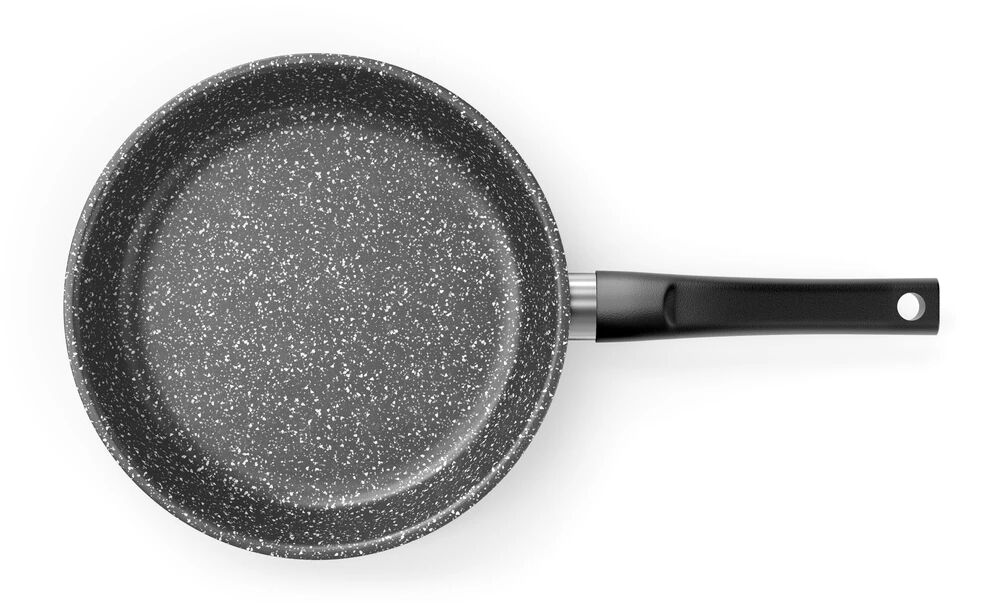
2.1 “Granite/maifan stone” non-stick: Teflon in a new skin
These pans typically embed mineral or speckled pigments in PTFE or sol–gel matrices to mimic stone. Core performance still depends on the polymer/ceramic film, not real rock. The “stone” is aesthetic and can add mild abrasion resistance, but it remains a coated system.
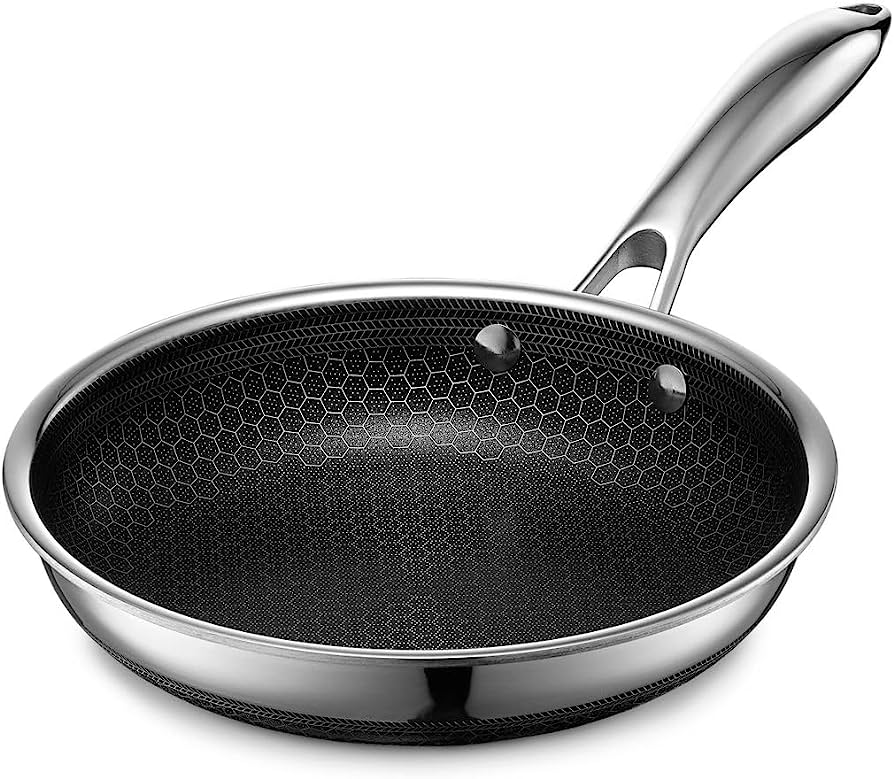
2.2 Honeycomb non-stick: Teflon wearing iron armor
“Honeycomb” or hex-mesh cookware uses a raised stainless steel texture over a non-stick layer. The metal pattern shields the coating from utensils, marketed as “physical non-stick.” In practice, the non-stick still relies on the underlying coating; the mesh reduces direct abrasion and can extend life, but overheating or harsh cleaners will still degrade the film.
3. Titanium ceramic non-stick: what it really is
Most “titanium ceramic” pans are metal (often aluminum or steel) with a silica-based sol–gel ceramic coating, sometimes “titanium-infused” with TiO2 or titanium flakes for marketing or mild hardness/whiteness tweaks. They are not solid ceramic pots.
· How it’s made: A silicon-containing sol is sprayed on a prepared metal base and cured/densified by drying or heat treatment, forming a hard, smooth layer that looks and behaves like ceramic.
3.1 Thermal stability:
o Compared with PTFE, titanium ceramic coatings generally tolerate higher temperatures. Typical practical limits:
o PTFE (Teflon): up to about 260°C (500°F) in routine use; sustained overheating degrades release and can generate fumes.
o Titanium ceramic (sol–gel): often marketed to 400–450°C; does not decompose like PTFE, so it avoids PTFE-type fumes under overheat.
3.2 Durability caveat:
· Many users report faster loss of non-stick compared with PTFE. The glassy ceramic network is hard but brittle; oil polymerization, utensil abrasion, and thermal cycling can raise surface energy and roughness within months of heavy use, sometimes 2–3 months in daily kitchens.
3.3 Care:
· Avoid steel spatulas and steel wool; use soft pads and non-abrasive cleansers. Thermal shock (Alternating hot and cold) accelerates microcracking and dulls release.
3.4 Compliance risks:
· Substandard products may contain excessive heavy metals (e.g., lead, cadmium) in pigments or fillers. Buy from brands with third-party migration tests (FDA, LFGB).
3.5 Truth-in-labeling:
· Some “titanium ceramic” lines contain little or no measurable titanium by spectroscopy; the term may refer to color, marketing, or trace additives rather than substantive Ti content.
4. What is truly uncoated non-stick? Pure titanium cookware with Physical non-stick and No chemical coating
A different path is a bare-metal, Physical non-stick approach. Representative example: Titaudou Pure titanium cookware, which is Expensive but engineered without polymer or sol–gel films.
· Construction: Pot or pan body made from 99.8% Pure titanium. The food-contact surface is created via high-temperature firing to form a nano-scale ceramic-like crystalline layer (“nano ceramic-crystal,” not an applied coating), producing a dense, inert surface integral to the metal.
4.1 Chemical stability:
· Titanium remains stable under long-term high-temperature cooking; it does not react with food acids/bases under normal culinary conditions and does not leach metal ions. The passive TiO2 layer self-heals if mechanically disturbed.
4.2 Surface robustness:
· Through appropriate high-temperature treatment and work hardening, titaudou's proprietary process produces a hardness of approximately 900 HV in the cookware's titanium layer. This makes cleaning easy—even with a steel brush—and eliminates the risk of delamination associated with coatings.
· Performance Note: Physical nonstick properties depend on process (proper preheating, oil film management, and humidity control). Unlike the low surface energy of polytetrafluoroethylene (PTFE), titanium's release properties stem from its microstructure, stable surface, and cooking technique. Titanium coatings do not chemically age, blister, or generate gas.
Maintenance quick guide
· PTFE: Preheat on low–medium; never empty on high. Nylon/wood tools. Hand wash with soft sponges. Replace when scratched or chalky.
· Titanium ceramic: Avoid thermal shock and hard scouring. Use a film of oil, clean promptly, and avoid carbonized residues.
· Pure titanium (uncoated): Season lightly for proteins, preheat properly, and you may use abrasive pads or steel brushes if needed. Periodic deep clean with boiling water and a mild alkaline detergent restores brightness.
Frequently Asked Questions and Answers
Q1: Does titanium ceramic cookware have a coating, and what materials are typically used in this coating (e.g., ceramic, titanium-infused layers, or PTFE-free compounds)?
A1: Yes. Most “titanium ceramic” cookware uses a PTFE-free, silica-based sol–gel ceramic coating applied to aluminum or steel. Some formulas are “titanium-infused” with TiO2 or metal flakes, mainly for hardness or aesthetics. A minority still use PTFE layers beneath decorative topcoats—check specifications.
Q2: If titanium ceramic cookware has a coating, is this coating primarily designed to enhance non-stick performance, or does it also contribute to heat resistance or scratch durability?
A2: Both. The ceramic matrix provides initial non-stick and higher heat tolerance than PTFE, and its glassy network improves scratch resistance. However, real-world non-stick longevity is often shorter than PTFE, especially with abrasive cleaning or thermal shock.
Q3: Does pure titanium cookware need a coating to achieve a non-stick effect? How to maintain pure titanium cookware?
A3: No coating is required. Physical non-stick is achieved by proper preheating, a thin oil film, and moisture control; the inert TiO2 surface resists sticking once the Leidenfrost-like behavior and oil polymer layer form. To maintain: avoid sudden quenching, clean with hot water and mild alkaline detergents, use abrasive pads or even a steel brush if needed (no film to strip), and occasionally reseason with a thin oil wipe after drying.