Choosing titanium cookware is not only a question of whether titanium is safe, light, or premium. The better question is whether the structure fits the way you cook. A pure titanium camping pot, a three-layer titanium saucepan, and a titanium-coated nonstick pan can all use the word titanium, but they do not behave the same when you simmer soup, reduce sauce, cook rice, or make caramel.
If you are asking about safely removing burnt on caramel sugar from a pure titanium saucepan, the cookware-selection question becomes practical very quickly. Burnt sugar is not ordinary food residue. It can harden into a glassy shell, turn into black carbon, and grip the bottom of the pan. The right pan structure helps reduce hot spots before the burn happens, and the right cleaning sequence protects the cookware after it happens.
The short answer is this: pure titanium is excellent for clean food contact, liquid-heavy cooking, and lightweight use. Three-layer titanium cookware is usually better for everyday home saucepans because the aluminum core spreads heat under the GR1 pure titanium food-contact surface. For sticky, low-moisture, sugar-heavy cooking, structure and heat control matter as much as material safety.
1. Start with the Food-Contact Surface
The first buying question should be direct: what touches food? In real pure titanium cookware, the cooking surface is titanium. In TITAUDOU cookware, that surface is GR1 pure titanium, selected for corrosion resistance, low reactivity, and clean food-contact positioning. This is different from titanium-coated nonstick cookware, where food may touch a coating system rather than metal titanium.
This difference becomes important when sugar, fruit syrup, honey glaze, or thick sauce burns. A real titanium food-contact surface can be cleaned as metal. A coated pan must be cleaned according to coating limits. A titanium label does not automatically mean you can simmer, scrape, or scrub aggressively. If the supplier cannot identify the food-contact layer, the buyer should not approve the product only because the listing says titanium.
For safety background, read TITAUDOU's article on whether titanium is safe to cook with. For material-category differences, compare titanium vs nonstick cookware. These pages explain why a coating-free titanium surface and a titanium-reinforced coating should not be judged by the same care rules.
2. Pure Titanium Cookware: Best for Lightweight, Liquid-Heavy Cooking
Pure titanium cookware is valued for light weight, corrosion resistance, and simple metal construction. It is useful for camping pots, boiling vessels, tea, broth, light soup, and other water-rich tasks. When the food is surrounded by liquid, the liquid moves heat through the pot and reduces the effect of one hot burner zone.
The tradeoff is heat spreading. Titanium is not a strong lateral heat conductor like aluminum or copper. A thin pure titanium pot can heat quickly where the flame touches it, but the heat may not spread evenly across the base. This can create problems with thick sauce, porridge, milk-based mixtures, rice with too little water, and caramel sugar. Those foods sit against the bottom and can scorch before the rest of the pot feels overheated.
Pure titanium is not the wrong material for a saucepan, but the cooking task matters. If the recipe is liquid-heavy, pure titanium can work well. If the recipe becomes dense or sticky, the cook must use lower heat, enough liquid, frequent stirring, and fast response when the color changes. For anyone concerned about safely removing burnt on caramel sugar from a pure titanium saucepan, the first prevention step is choosing whether a thin pure titanium vessel is really the best tool for sugar work.
3. Three-Layer Titanium Cookware: Better for Saucepans and Heat Control
Three-layer titanium cookware is designed to solve pure titanium's main cooking limitation. The inner layer is GR1 pure titanium for food contact. The middle layer, often a 1050 aluminum core in TITAUDOU designs, spreads heat. The exterior layer, such as 430 stainless steel, adds structure, durability, and stove compatibility.
For a saucepan, this structure matters. Sugar syrup, caramel, reduced fruit glaze, tomato paste, thick soup, and porridge all punish hot spots. If one small center area overheats, sugar can darken quickly, stick hard, and continue burning even after the user lowers the burner. A heat-spreading core does not make burning impossible, but it gives the cook a wider margin before one point becomes too hot.
This is why three-layer titanium cookware is usually the stronger home-kitchen choice for saucepans and family cooking. It keeps titanium where food contact matters while giving the pan a more forgiving thermal structure. For product examples, see TITAUDOU titanium pots and pans.
| Cooking Need | Pure Titanium Cookware | Three-Layer Titanium Cookware | Best Choice |
| Boiling water, tea, light soup | Works well because liquid distributes heat. | Also works, with better base stability. | Either, depending on weight and budget. |
| Slow simmering soup or broth | Suitable if there is enough liquid and low heat. | More forgiving because the aluminum core spreads heat. | Three-layer for home use. |
| Thick sauce, syrup, or porridge | Higher risk of center scorching. | Better heat control, but still needs stirring. | Three-layer. |
| Caramel sugar or fruit glaze | Needs very careful heat control and immediate attention. | More stable base temperature and easier recovery. | Three-layer saucepan. |
| Outdoor lightweight cooking | Strong advantage because of low weight. | Usually heavier. | Pure titanium. |
4. Slow Cooking, Caramel Sugar, and the Burnt-On Residue Problem
The practical answer to slow cooking with titanium cookware is conditional. Broth, soup, beans with enough water, congee, tomato soup, and liquid-rich stews are reasonable uses. The harder cases are thick and sticky foods: caramel sugar, syrup, fruit reduction, condensed milk, porridge, reduced tomato paste, and low-water braises. These foods do not move heat around as freely as soup.
Caramel is especially unforgiving because sugar changes quickly once the water content drops. At first, warm water can dissolve it easily. Later, it becomes a sticky amber film. If the heat continues, it hardens into a glassy layer. If it burns further, it becomes black carbonized sugar. That is why safely removing burnt on caramel sugar from a pure titanium saucepan should begin with softening and dissolving, not with dry scraping.
For cooking, start lower than you would with a heavy cast-iron pot. Use a burner that matches the saucepan base. Stir from the center outward because the center is where scorching usually begins. If the sugar or sauce darkens too quickly in one spot, remove the pan from heat instead of only lowering the knob. Residual heat in the base can keep burning sugar after the flame is reduced.
For more prevention detail, TITAUDOU's guide on why food burns quickly on titanium pans explains hot spots, oil timing, and residue. Burnt caramel sugar is one of the clearest examples of why heat distribution matters.
5. Safe Cleanup Sequence for Burnt Caramel Sugar
When caramel burns, do not panic and do not attack the pan with a knife. First, remove the saucepan from heat and let it cool until it is safe to handle. Do not pour cold water into a smoking-hot pan. Thermal shock can stress thin pans, layered cookware, handles, rivets, or exterior components. Titanium is corrosion-resistant, but the finished saucepan is still a cookware structure.
Second, cover the burnt sugar with warm water. If the residue is still amber or brown, water often softens it because sugar can dissolve back into hot water. Let it sit first. Then use low heat to bring the water to a gentle simmer. Do not boil the pan dry. Use a wooden or silicone tool to lift softened residue. This is the safest first answer to safely removing burnt on caramel sugar from a pure titanium saucepan.
Third, if black residue remains, use a wet baking soda paste or a shallow baking-soda simmer only on a confirmed uncoated titanium surface. Baking soda can help loosen stubborn carbonized residue without turning the process into dry grinding. Rinse thoroughly, wash with mild dish soap, and dry the pan. If black marks still transfer to a white towel, repeat the softening process before cooking again. TITAUDOU's separate guide on how to clean titanium cookware covers broader burnt-food cleaning.
| Residue Type | What It Means | Safe First Response | Avoid |
| Sticky amber caramel film | Sugar has thickened but is not fully carbonized. | Warm water soak, then gentle simmer and silicone scraping. | Dry scraping while the sugar is still hard. |
| Glassy burnt sugar shell | Sugar has hardened and bonded to the surface. | Longer warm soak, gentle simmer, repeated cycles. | Knife tips, chisels, or impact tools. |
| Black carbonized sugar | Sugar has burned into carbon residue. | Baking soda paste or simmer after water softening. | Bleach, oven cleaner, or unknown chemical mixtures. |
| Black flakes on a coated pan | Could be coating damage, not only burnt sugar. | Stop cooking and inspect the surface. | Aggressive scrubbing that hides coating failure. |
TITAUDOU hardened GR1 titanium gives users a stronger cleaning margin than coated cookware because the food-contact surface is hardened metal, not a fragile nonstick film. Still, the correct sequence is loosen first and scrub second. Strong cleaning is useful only after heat, water, and patience have done the main work. For black transfer diagnosis, see TITAUDOU's guide to black residue on titanium cookware.
6. Pot Shape, Capacity, Lid Fit, and Stove Matching
A buyer choosing titanium cookware for simmering should look beyond the material label. Shape matters. A taller pot with enough depth is better for broth, soup, beans, and rice because the food is surrounded by liquid. A wider saucepan is better for reducing sauce, but it also loses moisture faster and needs more attention. For caramel sugar, a stable base and controlled heat are more important than a dramatic material claim.
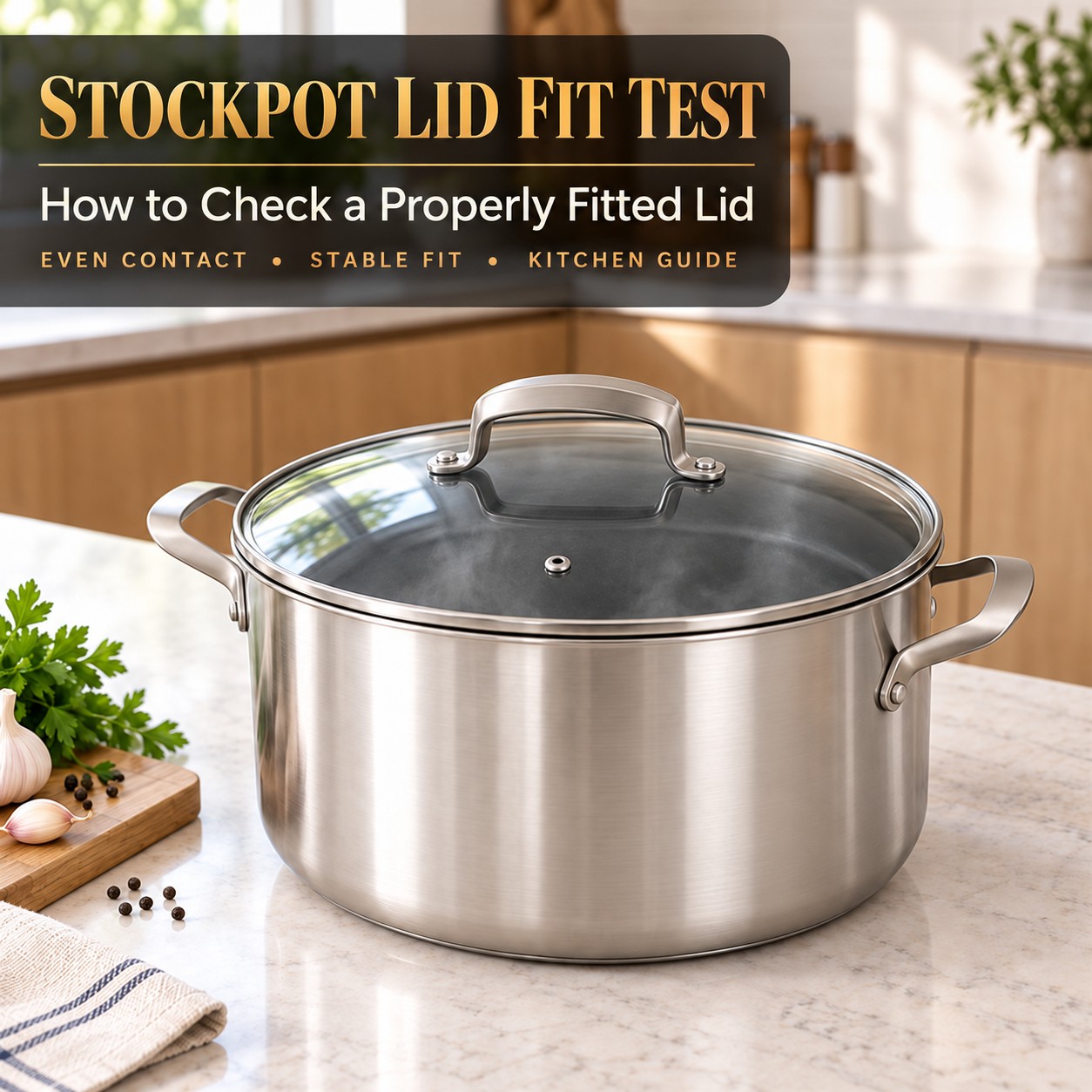
Capacity matters too. If the pot is filled too low, the food may sit in a shallow layer over the hottest part of the base. If the pot is overfilled, simmering becomes harder to control. Lid fit is also underrated. Slow simmering needs moisture control. A loose lid lets too much steam escape, while a very tight lid can make the contents boil too aggressively if the heat is not adjusted.
The stove affects the result as much as the cookware. Gas flames can create a small hot zone if the flame is too narrow or too high. Electric coils need good base contact. Glass cooktops reward flat bases. Induction depends on the exterior magnetic layer and base design. Three-layer titanium with a 430 stainless steel exterior can support induction compatibility depending on product design, but buyers should verify the exact SKU instead of assuming all titanium cookware works on every stove.
7. B2B Buyer Checks Before Ordering
For importers, wholesalers, and private-label cookware brands, titanium cookware selection should be verified by samples and documents. A good supplier should be able to explain the structure and prove the claim. The basic checks are food-contact layer, core material, base flatness, lid fit, stove compatibility, handle design, finished-product testing, and care instructions.
For saucepan programs, do not test only boiling water. Boiling water hides many problems because the liquid moves heat naturally. Add one real simmer test with tomato soup, one thick starch-based dish, one low-flame holding test, and one sugar-heavy test such as syrup or caramel under controlled conditions. These tests reveal whether the cookware is truly useful for slow cooking or only looks good in a material comparison.
Care instructions should also match the product. If the surface is TITAUDOU hardened GR1 titanium, the manual can explain stronger cleaning options with clear limits. If the product is titanium-coated nonstick, the manual must not borrow pure titanium cleaning language. For dishwasher-related care claims, read TITAUDOU's guide to whether pure titanium cookware is dishwasher safe. Sugar residue should still be loosened before dishwasher cleaning instead of being left as a thick burnt shell.
The best buying decision is not based on the word titanium alone. It is based on matching material structure to product use. A camping brand may prefer pure titanium. A home cookware brand may prefer three-layer titanium. A health-focused line may prioritize GR1 titanium food contact and coating-free positioning. A saucepan line that handles sauces, syrups, and daily simmering should prioritize heat distribution, cleanability, and clear user instructions.
Conclusion
Titanium cookware can be a strong choice, but buyers should not treat every titanium product as identical. Pure titanium is excellent for lightweight and liquid-heavy use. Three-layer titanium is more versatile for home kitchens because it improves heat distribution while keeping titanium as the food-contact surface.
For slow cooking, the honest answer is balanced. Liquid-rich soups and stews are suitable. Thick, sticky, low-moisture dishes need more care. Caramel sugar is a useful stress test because it exposes hot spots and poor timing quickly. If your concern is safely removing burnt on caramel sugar from a pure titanium saucepan, the right answer combines prevention and recovery: choose a structure with better heat control, cook with attention, cool the pan safely, soften the sugar with water, and clean back to a smooth surface before the next use.
For TITAUDOU, the preferred everyday solution is three-layer titanium: GR1 pure titanium inside, 1050 aluminum core for heat spreading, and 430 stainless steel exterior for structure and induction compatibility. That structure makes titanium cookware more practical for daily saucepans, not just more impressive on a material list.
Frequently Asked Questions (FAQ)
Q1: What is the safest first step for safely removing burnt on caramel sugar from a pure titanium saucepan?
Let the saucepan cool until it is safe to handle, then cover the burnt sugar with warm water. Let it soak, gently simmer if needed, and use a wooden or silicone tool to lift softened residue. Do not pour cold water into a smoking-hot pan or attack the sugar with a knife.
Q2: Is three-layer titanium better than pure titanium for caramel and thick sauces?
For most home kitchens, yes. Three-layer titanium keeps GR1 titanium as the food-contact layer while using an aluminum core to spread heat more evenly. That makes it more forgiving for saucepans, thick sauces, slow simmering, and sugar-heavy cooking than thin single-wall pure titanium.
Q3: Can I use steel wool after burning sugar in titanium cookware?
It depends on the surface. TITAUDOU hardened GR1 titanium can tolerate stronger cleaning than coated cookware, but you should still loosen burnt sugar with water first. Do not use steel wool on titanium-coated nonstick cookware, and use caution on ordinary soft titanium if visible cosmetic scratches matter.
For a repeatable way to separate normal lid clearance from rim or flange defects, see this guide on how to check stockpot lid fit.