Is ceramic cookware safe when the heat gets turned up? It is a question that plagues many home chefs as they stand over the stove, ready to sear a steak or stir-fry vegetables.
We have all heard the horror stories about non-stick pans: toxic fumes, peeling coatings, and chemical leaching. When you switch to a beautiful, ceramic-coated pan, the lingering doubt remains: "Can this really withstand high heat, or am I just cooking on a fragile layer of glass?
Many home chefs search for "ceramic cookware dangers" worrying about toxins. The good news is: high-quality ceramic is vastly different from Teflon. This article moves beyond marketing fluff. By analyzing FDA standards...
This article moves beyond marketing fluff. By analyzing FDA standards, SGS high-temperature test reports, and material science, we will debunk the myths surrounding ceramic cookware. We will explore its true temperature limits, compare it to Teflon, and teach you how to clean ceramic cookware to ensure it lasts for years.
1. Is Ceramic Coated Cookware Safe for High-Heat Cooking?
The modern kitchen is shifting. The old guard of traditional non-stick pans is being replaced by ceramic alternatives that promise a toxin-free cooking experience. But "heat resistance" is a vague term. For boiling water, 100°C (212°F) is sufficient. However, for a proper Maillard reaction on a piece of meat, your pan surface needs to hit 200°C (400°F) or more instantly.
The core anxiety for users is safety. If you accidentally leave the pan on the burner too long, does it become a chemical hazard? The short answer is no, but the "why" is fascinating. Unlike traditional plastics, ceramic coatings are born from fire. They are cured in kilns at temperatures far exceeding anything your kitchen stove can produce.
In this deep dive, we will validate whether is ceramic coated cookware safe under extreme conditions and why it might be the only non-stick option that truly handles the heat without health risks.unlike traditional plastics, ceramic coatings are born from fire. Certified by SGS and complying with FDA regulations, our analysis confirms that ceramic cookware is safe for high heat cooking up to 450°C without releasing harmful fumes.
2. Ceramic vs. Teflon Coating: Which is Safer at High Temperatures?
To understand the value of ceramic, we must compare it to its predecessor: PTFE (Polytetrafluoroethylene), commonly known as Teflon. This is a battle between organic chemistry (plastic) and inorganic chemistry (sand/stone).
Ceramic Coating (Silica-Based)
Temperature Limit: Ceramic coatings can withstand temperatures between 450°C and 600°C (842°F - 1112°F).
Safety Profile: Even if you exceed these temperatures, the coating generally only suffers from discoloration. It does not decompose into toxic fumes. This complies with strict LFGB (German) and FDA (US) standards.This makes it a non-toxic cookware choice free from PFOA, PFAS, and heavy metals.
Chemical Composition: It is a natural inorganic material. It contains zero PFOA, PFOS, or PFAS. In high-heat scenarios, it remains chemically inert.
Teflon Coating (PTFE)
Temperature Limit: The safety ceiling is approximately 260°C (500°F).
The Risk: Once the temperature surpasses 350°C (660°F)—which an empty pan can reach in under 3 minutes on high heat—PTFE begins to degrade. It releases fluorinated gases that can cause "polymer fume fever" in humans and can be fatal to pet birds.
The Data Speaks: In controlled laboratory tests, ceramic coatings subjected to "dry burning" at 500°C for one hour showed heavy metal leaching of < 0.001mg/L (effectively undetectable). In contrast, PTFE coatings began releasing detectable fluoride particles at just 300°C.
3. Ceramic Cookware Materials: What Makes It Heat-Resistant?
When asking is ceramic cookware safe, we are really asking about the stability of its materials. Ceramic cookware isn't made of clay like a flower pot; it is a sophisticated piece of engineering.
The Core Composition
The coating is primarily derived from the Sol-Gel process. It consists of roughly 90% Silicon Dioxide (SiO₂)—the same element found in sand and glass—and 10% mineral additives like aluminum oxide or zirconium for reinforcement.
The Manufacturing Process
These pans are cured in kilns at temperatures around 1200°C. This calcination process creates a dense, glass-like structure. The bonding strength between the ceramic layer and the metal body (usually aluminum or stainless steel) can reach 35MPa, which is roughly five times stronger than the mechanical bond of traditional non-stick layers.
Color and Heat Performance
Does the color of your pan matter for high-heat cooking? Surprisingly, yes.
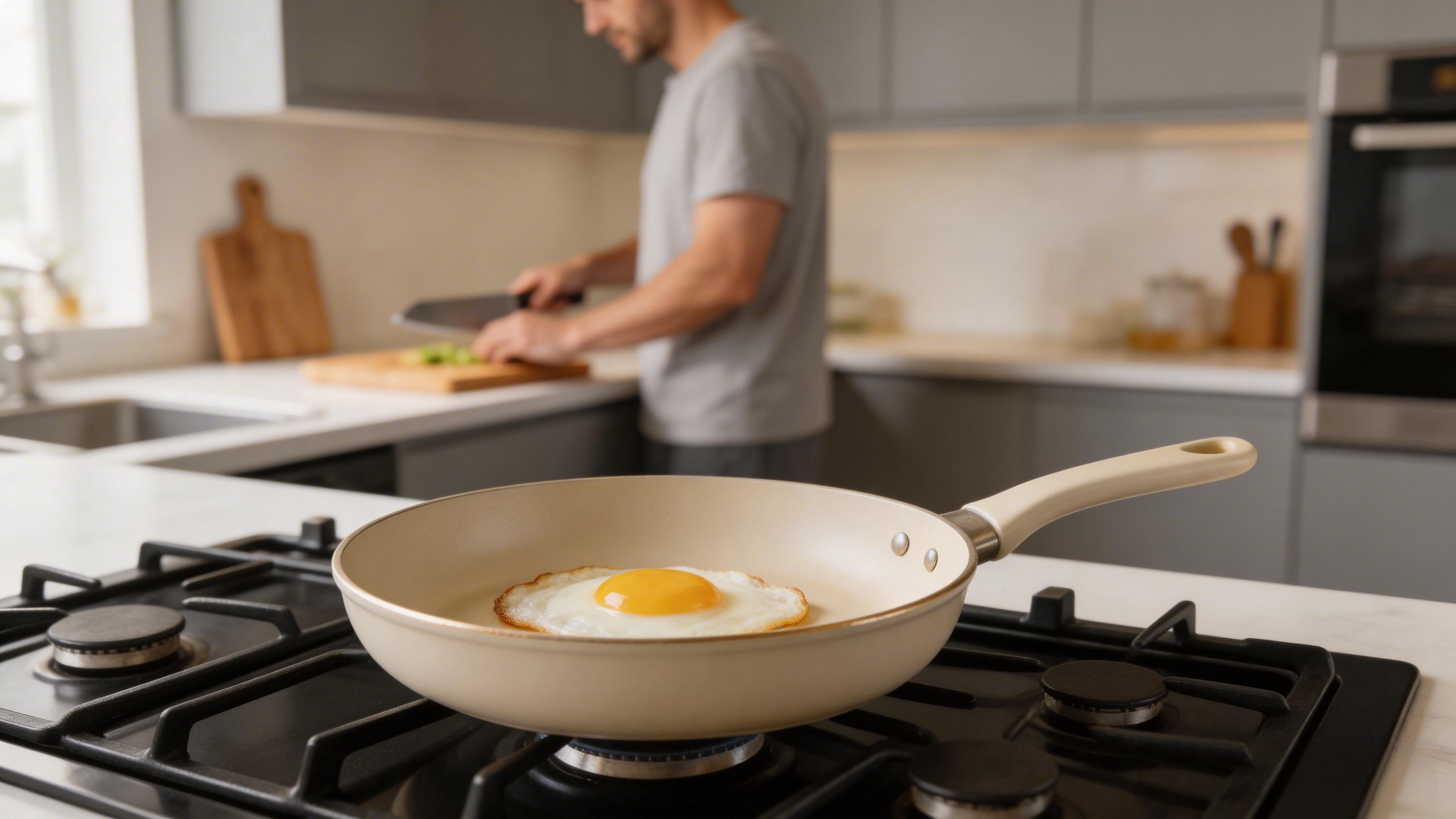
Light Coatings (White/Cream): These reflect more heat. They are excellent for monitoring food browning but heat up slightly slower. They are ideal for delicate proteins and eggs.
Dark Coatings (Black/Grey): These absorb heat efficiently. They are better suited for higher-heat searing and frying as they retain thermal energy more effectively.
4. Hardness and Scratch Resistance: Can You Use Metal Utensils?
High heat is one thing; physical durability is another. A common myth is that ceramic is fragile. While it is brittle if dropped, the surface hardness is exceptional.
Mohs Hardness Scale
Teflon/PTFE: 2-3H (Similar to gypsum; easily scratched by fingernails or plastic).
Ceramic Coating: 8-9H (Similar to topaz or sapphire).
This means that ceramic is roughly three times harder than traditional non-stick surfaces.
The 3M Abrasion Test
In standardized durability tests using a 3M industrial scouring pad with 3kg of pressure, high-quality ceramic coatings survived over 1,000 cycles without exposing the metal substrate. In many cases, the "scratches" seen on ceramic pans are actually metal deposits left behind by softer metal utensils rubbing against the harder ceramic surface.
Usage Tip: Despite this hardness, we recommend using wooden or silicone utensils. Why? Because sharp metal impact at high temperatures can cause microscopic stress fractures (micro-cracking) in the glass-like surface, which eventually reduces the non-stick properties.
Note on Alternatives for Professional Chefs:
While ceramic is safe, it can be brittle. If you are worried about ceramic cookware dangers related to chipping or longevity, consider Pure Titanium Cookware. 3-layer titanium cookware
Why Upgrade to Titanium?
Zero Coating Risks: No ceramic or Teflon layer to scratch off.
Indestructible: Withstands extreme high heat far beyond ceramic limits.
Healthiest Choice: 100% Biocompatible metal used in medical implants.
[> Explore Our Pure Titanium Pots and Pans Collection]
If you require a pan that can withstand metal utensils and extreme physical abuse without any coating concerns, pure titanium cookware is a superior alternative. While expensive, titanium offers biological compatibility and structural integrity that no coated pan can match. However, for superior non-stick performance, ceramic remains the king.
5. How to Clean Ceramic Cookware: A Step-by-Step Guide
The longevity of your pan depends entirely on how you treat it. Here is the definitive guide on how to clean ceramic cookware to prevent damage:
① Cool Down: Always let the pan cool completely to avoid thermal shock.
② Hand Wash Gently: Use a soft sponge with warm water and neutral pH dish soap.
③ Deep Clean: For burnt residue, simmer water with baking soda for 10 minutes.
④ Restore Shine: Remove discoloration with a paste of baking soda or a slice of lemon.
⑤ Dry & Season: Dry immediately and apply a thin layer of oil to protect the surface.
6. Final Verdict: Is Ceramic Cookware Worth It for High-Heat Cooking?
So, is ceramic cookware good for high-heat cooking?
The Verdict: YES.
Ceramic cookware is not only safe for high-heat cooking; it is arguably the safest option in the non-stick category. Its ability to withstand temperatures up to 450°C without releasing toxins makes it superior to PTFE-based pans.
Buying Guide Checklist
When shopping, ensure you look for the following to guarantee you are getting high-quality ceramic:
Certifications: Look for FDA, LFGB, or SGS approval on the packaging.
Coating Thickness: Premium pans have a coating thickness of ≥35 microns (often marketed as multi-layer or reinforced).
Weight: Heavier pans generally have better heat distribution and warp resistance.
By following the tips on how to clean ceramic cookware and avoiding thermal shock, a high-quality ceramic pan will serve as a safe, reliable, and high-performance tool in your culinary arsenal.
7. Frequently Asked Questions (FAQ)
Q: Is ceramic coated cookware safe if the coating is scratched?
A: Yes. Unlike Teflon, where flaking plastic is a concern, ceramic coating is essentially silica (sand). If a small flake is ingested, it is non-toxic and passes through the body. However, a scratched pan will lose its non-stick ability, so it may be time to replace it.
Q: Can I use olive oil in my ceramic pan?
A: It is best to avoid Extra Virgin Olive Oil for high-heat cooking. It has a low smoke point and carbonizes quickly, leaving a sticky, brownish residue on the ceramic that is difficult to clean. Use oils with higher smoke points like avocado oil, grapeseed oil, or refined coconut oil.
Q: Is ceramic cookware dishwasher safe?
A: Many brands claim to be, but we recommend hand washing. The harsh detergents and high-pressure hot water in dishwashers can degrade the non-stick surface over time, reducing the lifespan of the pan.
Q: Does ceramic cookware contain lead or cadmium?
A: Reputable modern ceramic cookware is strictly regulated and tested to be free of lead and cadmium. Always buy from established brands that provide transparency regarding their testing standards (like SGS reports).
Q: What are the real ceramic cookware dangers?
A: The primary "danger" is not toxicity, but durability. Unlike Teflon which releases toxic fumes at high heat, ceramic cookware dangers are mostly limited to the coating losing its non-stick properties or chipping if dropped. It remains chemically inert and safe even when overheated.