Titanium flanges enable secure, Interconnected piping where weight, Corrosion resistance, and High temperature performance are critical. This guide distills best practices for aligning welded pipe ends, positioning Eyelets for supports and instrumentation, and achieving a reliable Gasket seal under varying thermal cycles. With proper torque on Bolts and nuts—typically verified in two to three cross-pattern passes—you can reach uniform gasket compression, minimize microleaks, and protect against creep at 200–400°C service ranges. In chloride-rich or sour environments, titanium’s passive oxide film offers superior Corrosion resistance versus common stainless grades, extending maintenance intervals by 2–3×.
We cover fastener selection (material pairing to avoid galvanic mismatch), washer types for flange faces, and lubrication to stabilize friction factors during tightening. Clearances, bolt length engagement (≥1–1.5× diameter), and re-torque procedures after pressure/temperature ramp-up are specified to preserve joint integrity over the first 24–48 hours. Attention to Eyelets and hanger placement prevents bending loads that can distort gasket seating. Whether you’re assembling process lines, heat exchangers, or offshore tie-ins, disciplined control of Bolts and nuts, surface flatness, and Gasket seal quality ensures a durable, leak-tight connection from commissioning through long-term operation.
1. Advantages of Titanium Flanges
1.1 Strength-to-weight excellence
Titanium alloys deliver high specific strength, allowing robust flanges at reduced section thickness compared with many steels. In practical terms, machinists can maintain required pressure ratings while easing handling and minimizing overhung mass on small-bore valves, sensitive glass-lined equipment, or thin-wall welded pipe spools. The lower mass also reduces bending loads at supports and Eyelets (lifting/positioning points), preserving alignment during installation.
1.2 Corrosion resistance across harsh chemistries
A stable titanium oxide film provides exceptional Corrosion resistance against chlorides, seawater, wet halogens, and many oxidizing media, often outperforming common stainless steels in crevice and pitting resistance. In marine or brine service, titanium flanges extend inspection intervals and cut unplanned downtime. This passive protection remains effective without heavy coatings, simplifying surface preparation around sealing faces and bolt circles.
1.3 Non-magnetic and biocompatible
Titanium’s non-magnetic character is valuable near MRI suites, sensitive instrumentation, and magnetic flow meters, while its biocompatibility benefits pharmaceutical and food-contact utilities that demand inert wetted surfaces and low extractables.
1.4 Stability at elevated temperature
Within applicable alloy limits, titanium retains mechanical properties at temperatures that would accelerate corrosion or embrittlement in alternative materials. This High temperature performance supports hot brine, steam tracing interfaces, and certain reactor jackets, provided design codes and material data sheets are observed.
1.5 Functional flange geometry
A titanium flange is a disk-like component with:
·A central through-hole matched to the pipe’s internal diameter for smooth flow transition.
·A machined sealing face (raised-face, ring-type joint, tongue-and-groove, or flat).
·An array of Eyelets—here meaning the bolt holes on the bolt circle—laid out with specific number, size, and pitch per standard (e.g., ASME B16.5). These Eyelets accept Bolts and nuts or stud bolts to clamp mating flanges and compress the Gasket seal evenly.
2. Manufacturing Methods and Connection Forms
2.1 Manufacturing methods
· Precision casting: Used when internal galleries, weight-optimized ribs, or complex geometries are needed. Investment casting followed by HIP (hot isostatic pressing) and finish machining can satisfy demanding leakage and dimensional requirements for aerospace and specialty chemical service.
· Forging and machining: Common for high-integrity pressure components. Forged rings are machined to final dimensions, ensuring fine grain structure and consistent properties in the sealing face and bolt Eyelets.
· Plate fabrication: For large diameters and moderate pressures, titanium plate cut and machined to standard profiles can be economical, with careful control of flatness and heat input during any welding of collars or hubs.
All methods demand clean-room discipline when handling sealing surfaces: protect finish, avoid contamination that could compromise the oxide film, and document heat treatments where applicable.
2.2 Connection forms
· Bolted connection (focus of this guide): Two mating flanges compressed with Bolts and nuts or studs and heavy hex nuts, using a gasket between sealing faces. Correct preload is verified via torque wrench, ultrasonic elongation, or Bolt tensioners.
· Threaded connection: For smaller sizes or instrument take-offs, a threaded titanium flange may screw onto a male pipe thread, eliminating field welding. Best suited for low to moderate pressure and where disassembly is anticipated.
· Welded connection: Socket-weld or butt-weld flanges provide permanent, high-integrity joints with minimal crevice volume—ideal for high-vacuum, high-pressure, or cleanliness-critical lines. Welding requires inert gas shielding, back-purging, and qualified procedures to prevent contamination.
This article emphasizes bolted joints because they dominate field assembly and maintenance scenarios.
3. Tightening Technology Requirements for Equipment and Piping Flange Installation
Achieving a reliable Gasket seal depends on surface integrity, correct gasket choice, controlled bolt preload, and uniform load distribution. Follow these steps before introducing pressure or temperature.
3.1 Inspection of fasteners and mating parts
· Gasket:
o Always use a new, clean, dry gasket. Do not reuse old gaskets.
o Verify gasket type, size, pressure class, and material rating match the flange markings and service conditions (pressure, temperature, chemistry).
o Inspect for defects: nicks, delamination, embedded debris, moisture, or warpage. Reject compromised items. For spiral-wound styles, confirm proper centering ring outside the raised-face diameter.
· Flange surfaces:
o Clean sealing faces thoroughly; remove oil, grit, and oxide smut with non-abrasive wipes compatible with titanium.
o Inspect for scratches, dents, corrosion, burrs, and “waterline” radial marks crossing the sealing surface. If a radial gouge depth exceeds 0.2 mm and spans more than half the width of the gasket seating area, repair (re-machine) or replace the flange.
o Ensure the back face (nut-bearing surface) is flat, smooth, and parallel to the sealing face to avoid bending moments in studs.
o Verify flange concentricity and alignment per applicable installation standards (e.g., SH3501-2011 §6.2 for piping); excessive axial or angular misalignment will over-stress the gasket and bolts.
· Bolts and nuts (studs and heavy hex nuts):
o Confirm the specified grade, diameter, length, and coating/plating meet the design. Avoid galvanic mismatch: when titanium flanges are paired with dissimilar fasteners, use isolation washers/sleeves or select compatible alloys.
o Threads and bearing surfaces must be free of dirt, rust, scale, scoring, burrs, chips, and any contaminants that alter friction.
o Check that engaged length provides at least 1–1.5× bolt diameter of thread engagement and that 2–3 threads remain visible beyond the nut after tightening.
· Lubrication and friction control:
o Apply a consistent bolt lubricant (e.g., moly-based paste) on threads and nut-bearing faces if permitted by procedure. Record the friction factor (K) used to convert torque to preload.
o For oxygen service or where contamination is critical, use approved non-hydrocarbon lubricants or dry-film coatings.
3.2 Bolting sequence and preload development
The goal is uniform gasket compression without over-stressing any segment or crushing the gasket.
· Initial positioning:
①Use four equally spaced studs at positions 1, 2, 3, and 4 to lightly pin the flanges and center the gasket. Ensure the spiral-wound gasket’s windings remain within the raised-face edge.
②Hand-tighten the locating studs; insert remaining studs and hand-snug them to achieve a balanced starting condition. Confirm each nut leaves at least two threads exposed beyond the nut face.
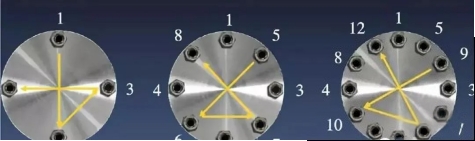
· Tightening method (hand tools and impact-assisted methods):
o Acceptable for general equipment and piping flanges when torque values are moderate. Use a ring spanner, box wrench, or calibrated impact tool with care.
o Define the number of passes and incremental load targets before starting. Perform at least three full tightening passes around the bolt circle.
· Pass 1: 50% of target torque
· Pass 2: 80% of target torque
· Pass 3: 100% of target torque
o Use a cross-pattern (star sequence) to distribute load, then perform a final circular pass at 100% to equalize variations.
o Avoid rapid, large torque jumps that could buckle or extrude the gasket.
· Using a torque wrench:
o For critical services, use a calibrated torque wrench with current certification. Record torque settings, ambient temperature, lubricant type, and sequence used. Re-torque after initial thermal/pressure ramp if procedure requires.
· Using Bolt tensioners:
o For high-pressure classes, large diameters, or where gasket seating stress is high, hydraulic Bolt tensioners or ultrasonic elongation methods provide more accurate preload by directly measuring bolt stretch. Tensioners reduce scatter caused by friction variability and are recommended for ring-type joint (RTJ) flanges, heat exchangers, and critical reactors.
· Re-torque and operational checks:
o After system heat-up and pressure stabilization (often within 24–48 hours), re-check preload if specified. Thermal cycles can relax gasket stress and reduce clamp load. Follow the same cross-pattern at the final torque.
3.3 Alignment, supports, and Eyelets
· Ensure pipe supports, hangers, and Eyelets (lifting/support holes or lugs) prevent external bending loads during assembly. Misapplied jack bolts or prying can warp the sealing face.
· For large assemblies, use temporary guide rods and soft slings to maintain alignment while inserting studs.
· Confirm that auxiliary items (instrument tees, drains) do not impose torque on the joint during tightening.
4. Gasket Selection for Titanium Flanges
· Compatibility: Select gasket materials compatible with process media and titanium to avoid galvanic or chemical incompatibility. Spiral-wound, kammprofile, PTFE envelope, or RTJ gaskets are common choices depending on pressure/temperature.
· Seating stress: Match gasket type to available bolt preload and seating stress requirement. Titanium flanges often work well with spiral-wound gaskets in raised-face profiles; RTJ suits high-pressure systems with Bolt tensioners.
· Surface finish: Observe recommended Ra for the selected gasket; too smooth may promote creep with some soft gaskets, while too rough risks leakage paths.
5. Fastener Materials and Galvanic Considerations
· Studs and nuts: Common choices include titanium alloy fasteners for full galvanic compatibility or high-nickel alloys (with isolation washers) where elevated temperatures and loads demand. Avoid carbon steel fasteners on titanium flanges in wet electrolytes without insulation.
· Isolation kits: Non-conductive sleeves and washers reduce galvanic couples across the bolt line, especially in seawater or chlorinated media.
· Washers: Hardened flat washers under nuts help
distribute load and protect the nut-bearing surface; avoid serrated washers that can gouge titanium.
6. Welding and Threaded Practices (Context to Bolted Focus)
· Welding: When flanges are welded to pipe, use qualified GTAW procedures with back-purging to prevent root oxidation. Monitor interpass temperatures; shield the heat-affected zone until metal cools to avoid discoloration and embrittlement.
· Threaded: Apply approved thread sealants compatible with oxygen or chemical service; avoid zinc-bearing compounds if prohibited. Thread engagement and proper wrench flats prevent overstressing thin-wall nipples.
7. Quality Control, Testing, and Documentation
· Dimensional checks: Verify bolt circle, Eyelets diameter, gasket seating width, and flange thickness per drawing and standard.
· NDE: For critical cast or forged flanges, employ dye penetrant (PT) on sealing faces and Eyelets zones; consider UT or radiography where specified.
· Pressure testing: Hydrostatic or pneumatic tests follow code with calibrated gauges; leak testing with helium mass spectrometry may be required for ultra-clean or vacuum systems.
· Records: Maintain torque charts, tensioner pressure logs, lubricant specs, and calibration certificates as part of turnover packages.
8. Safety and Environmental Notes
· PPE: Use eye protection, cut-resistant gloves, and hearing protection when using impact tools. Manage pinch points around Bolt tensioners and slings.
· Cleanliness: Keep sealing faces covered until the moment of assembly. Avoid graphite contamination if process media is oxygen-rich or otherwise incompatible.
· Waste handling: Dispose of used gaskets and lubricants per local regulations; prevent metallic debris from entering process lines.
Frequently Asked Questions and Answers
Q1: What factors should be considered when selecting the material grade (e.g., commercially pure titanium vs. Ti-6Al-4V alloy) for pipe titanium flanges in corrosive industrial environments like chemical processing or marine pipelines?
A1: Start with the process medium, temperature, and pressure envelope. Commercially pure (CP) titanium grades (e.g., Grade 2) offer excellent Corrosion resistance in seawater and many chlorides at moderate temperatures, with good formability. Ti-6Al-4V (Grade 5) and other alpha-beta alloys provide higher strength and better High temperature performance but may have slightly different corrosion behavior in certain reducing acids. Consider crevice/pitting susceptibility, availability of matching fasteners, weldability, and code compliance. For marine lines, CP Grade 2 flanges are common; for higher loads or temperature, Grade 5 or Grade 7 (palladium-stabilized for enhanced corrosion resistance) may be preferred. Always validate against corrosion data for the exact chemistry and use isolation kits to mitigate galvanic couples.
Q2: What are the key installation requirements (e.g., torque specifications, gasket selection, surface treatment) for ensuring leak-proof performance of pipe titanium flanges in high-pressure liquid or gas transport systems?
A2: Define target bolt preload based on gasket seating stress and pressure class, then achieve it with a calibrated torque wrench or Bolt tensioners using a cross-pattern in multiple passes (50%/80%/100%). Select a gasket compatible with media and temperature—spiral-wound or RTJ for high pressure—and ensure the flange surface finish meets the gasket’s Ra specification. Keep sealing faces clean, dry, and defect-free; replace any flange with radial damage >0.2 mm across more than half the seating width unless re-machined. Use consistent lubrication to stabilize friction, confirm proper thread engagement, and re-check preload after initial heat/pressure cycling if specified.
Q3: How do the design standards (e.g., ASME B16.5, DIN 2501) for pipe titanium flanges differ from those for stainless steel or carbon steel flanges, particularly in terms of pressure ratings and dimensional tolerances?
A3: ASME B16.5 and DIN/EN standards define dimensions, pressure classes, facing types, and tolerances largely independent of material; however, allowable pressure-temperature ratings derive from material properties in the relevant code (e.g., ASME II-D). Titanium’s allowable stresses at given temperatures can differ from stainless or carbon steel, which may shift the maximum service envelope even when the dimensional series is identical. Tolerances for bolt circles, Eyelets diameters, and facing heights are the same per the standard, but material-specific notes may apply for marking, heat treatment, and testing. Always pair the dimensional standard (B16.5/DIN) with the appropriate material specification and code calculations to confirm pressure ratings for the selected titanium grade.