High-purity titanium is an important functional film material in the field of electronic information, valued for its unique physical and chemical properties. With the rapid development of integrated circuits, displays, solar energy, and other high-tech industries, the demand for advanced thin film materials is rising rapidly. Magneto-controlled sputtering technology (PVD) has emerged as one of the key technologies for preparing these thin films, offering precise control over film composition and thickness.
In this context, high-purity titanium sputtering targets have become indispensable consumables in the magnetronized sputtering process. The performance, purity, and consistency of these titanium targets directly determine the quality and functionality of the deposited films, impacting everything from semiconductor devices and flat panel displays to photovoltaic cells. As industries continue to move toward miniaturization, high integration, and higher efficiency, the market application prospects for high-purity titanium sputtering targets are becoming increasingly broad. Their essential role in enabling next-generation devices highlights the ongoing importance of innovation and quality in titanium target manufacturing for modern electronic applications.
1. Applications and Performance Requirements of Titanium Sputtering Targets
Titanium sputtering targets serve a wide range of industries, each with its own set of performance requirements. These requirements generally focus on purity, microstructure, weldability, and dimensional accuracy, all of which are crucial for the successful deposition of functional thin films. As summarized below, the needs of integrated circuits, flat panel displays, and other industries vary significantly, driving continuous innovation in titanium metallurgy and processing.
Performance requirements of titanium targets in different industries | |
Performance Category | Performance requirements |
purity | Used for non-integrated circuits: 99.9%, |
Microstructure | For non-integrated circuits: average grains are less than 100 μm |
Welding performance | For non-integrated circuits: soldering, single body For integrated circuits: single body, soldering, diffusion welding |
Dimensional accuracy | For non-integrated circuits: 0.1 mm |
1.1 Titanium Sputtering Targets for Integrated Circuits
In integrated circuit (IC) manufacturing, the demand for ultra-high-purity titanium targets is paramount. Typically, the purity required is above 99.995%, and for leading-edge applications, even higher purities such as 6N (99.9999%) and 7N (99.99999%) are sought. These high-purity titanium sputtering targets are essential for forming contact layers, diffusion barriers, and interconnects in advanced semiconductor devices.
Historically, the IC titanium sputtering target market was dominated by major manufacturers from the United States and Japan. However, since the early 2000s, Chinese manufacturers have gradually entered the market, initially processing imported high-purity titanium raw materials into lower-end targets. In recent years, domestic companies such as Youyan Yijin and Jiangfeng Electronics have made significant strides, focusing for years on the manufacture of sputtering targets. Notably, Jiangfeng Electronics has broken technological barriers, successfully producing 6N- and even 7N-grade titanium sputtering targets. These advances have enabled Chinese target manufacturers to collaborate closely with domestic magnetron sputtering equipment providers, helping drive the growth of China’s integrated circuit PVD industry.
The manufacturing of IC-grade titanium sputtering targets involves highly complex processes, reflecting the highest standards in titanium purification and metallurgy. The raw titanium must be refined to extreme purities, and the finished target must meet strict requirements for microstructure, grain size, crystallographic orientation, and defect control to ensure consistent and reliable thin-film deposition.
1.2 Titanium Sputtering Targets for Flat Panel Displays
Flat panel displays, including liquid crystal displays (LCDs), organic light-emitting diodes (OLEDs), electroluminescent (E-L) displays, and field emission displays (FEDs), represent another major application field for titanium sputtering targets. The display market is currently dominated by LCDs, accounting for over 90% of all flat panel display sales. In these applications, thin films are predominantly formed by sputtering.
Key metallic sputtering targets used in display manufacturing include aluminum (Al), copper (Cu), titanium (Ti), and molybdenum (Mo). Among these, titanium targets for flat panel displays typically require a purity greater than 99.9%, slightly lower than that for integrated circuits but still demanding in terms of consistency and performance. The main performance requirements in this segment are high uniformity and low defect rates, as display films must exhibit consistent optical and electrical properties over large areas.
2. Magnetron Sputtering Titanium Target Fabrication Technology
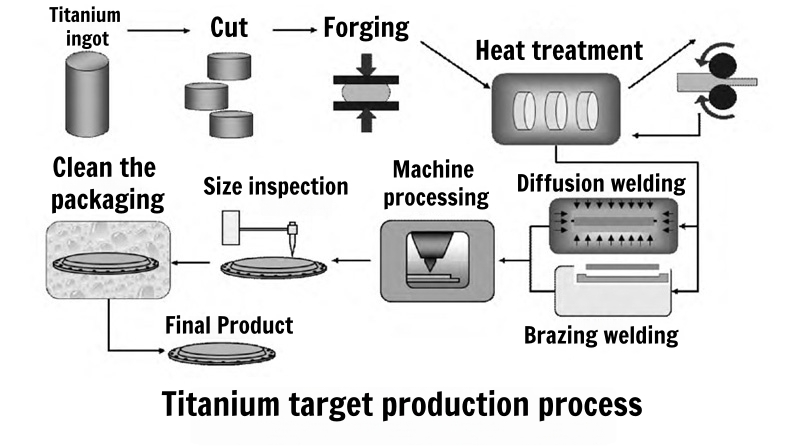
The preparation technology for magnetron sputtering titanium targets is highly specialized and demanding. The pathway from raw material to finished target involves multiple stages of titanium purification and advanced titanium metallurgy, each critical for achieving the desired product quality.
2.1 Titanium Metallurgy and Purification
Raw titanium is rarely pure enough for direct use in sputtering targets. Commonly, titanium is extracted from ores such as rutile or ilmenite, then purified using the Kroll process or other advanced refining methods. Additional purification steps, such as vacuum distillation, electron beam melting, or zone refining, may be required to achieve the ultra-high purities needed for IC and high-end display targets.
2.2 Ingot Preparation: EB and VAR Methods
The production of titanium sputtering targets generally relies on two main ingot preparation technologies:
Electron Beam Melting (EB) Ingot:In this method, titanium is melted using a high-energy electron beam under vacuum conditions. The process allows for precise control of impurities and results in a homogenous, high-purity titanium ingot. EB melting is widely used for producing ultra-high-purity titanium for integrated circuits and critical applications.
Vacuum Arc Remelting (VAR) Ingot:VAR is another mainstream technology for producing high-quality titanium ingots. Titanium is melted by an electric arc under a vacuum, allowing for further purification and homogenization. VAR ingots are suitable for both IC and display targets, depending on the level of purity and microstructural control required.
2.3 Pre-Sputtering and Burn-in Reduction
For titanium sputtering targets intended for 300 mm sputtering machines, particularly in IC manufacturing, the requirements for consistency and cleanliness are especially stringent. To reduce the burn-in time (the period required to stabilize the target surface during installation), the sputtering surface of the target is often pre-sputtered and cleaned before packaging. This step minimizes contamination and ensures that the first deposited films meet the highest quality standards.
3. Technical Requirements for Titanium Sputtering Targets
To ensure the quality of deposited thin films, the properties of the titanium sputtering target must be strictly controlled. Decades of practical experience and research have identified several critical factors that impact target performance.
3.1 Purity
The purity of the titanium target is the most direct factor affecting the performance of the sputtered film. Higher purity means fewer impurity elements in the deposited film, directly translating to better corrosion resistance, electrical conductivity, and optical performance. For integrated circuit sputtering targets, the purity must usually be above 99.995%, while ultra-high-end applications may require 6N or 7N purity.
Purification steps during production must eliminate not only metallic impurities but also gaseous contaminants like oxygen and nitrogen, which can adversely affect film performance. The control of radioactive elements and alkali metals is particularly important for semiconductor and electronic information applications.
3.2 Average Grain Size
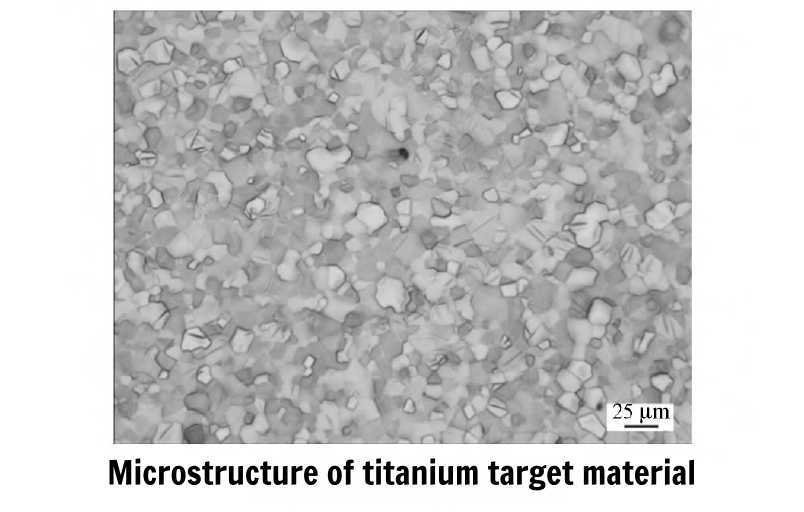
Titanium sputtering targets are typically polycrystalline, with grain sizes ranging from micrometers to millimeters. Grain size has a substantial impact on both sputtering rates and film uniformity:
· Fine-Grained Targets:
Finer grains lead to faster sputtering rates and more uniform film deposition. For IC applications, the average grain size is generally required to be below 330 μm; for ultra-fine grain targets, it can be less than 10 μm.
· Uniform Grain Distribution:
When grain sizes across the sputtering surface are consistent, the deposited film’s thickness is more uniform, resulting in better device performance and yield.
3.3 Crystallographic Orientation
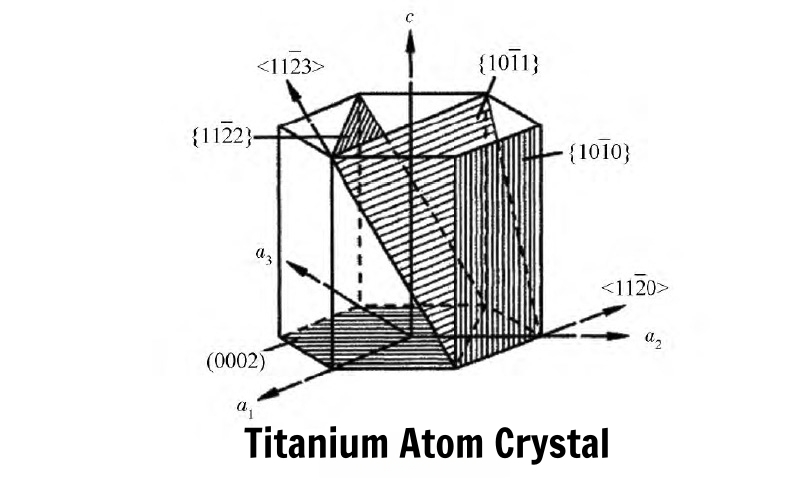
Titanium metal has a hexagonal close-packed (hcp) crystal structure. During sputtering, titanium atoms are more likely to be ejected along the densest atomic planes. By engineering the crystallographic orientation of the target, it is possible to maximize sputtering rates and achieve better film thickness uniformity. A well-controlled crystallographic structure minimizes directional bias and improves the reliability of the deposited film, especially for large-area applications.
3.4 Structural Uniformity and Dimensional Precision
Uniformity in both structure and dimensions ensures consistent film deposition and compatibility with sputtering equipment. Precision machining and finishing are required to meet tight tolerances, especially for large, complex, or custom-shaped targets. Any deviation can result in equipment wear, non-uniform sputtering, or film defects.
3.5 Weldability and Mechanical Performance
For certain applications, titanium sputtering targets are welded onto backing plates or assembled into complex target systems. Good weldability and mechanical strength are necessary to prevent delamination, cracking, or warping during high-power sputtering operations.
4. Ongoing Innovation and Future Trends
As the demand for high-purity, high-performance titanium sputtering targets continues to rise, the titanium metallurgy and purification industries are under constant pressure to innovate. Continued advances in electron beam and vacuum arc melting, along with new refining techniques, are pushing the boundaries of achievable purity and microstructural control.
In China, the rapid growth of domestic manufacturers is beginning to reshape the global titanium target market landscape. Collaboration between target producers and sputtering equipment manufacturers is creating tailored solutions for integrated circuits, displays, and solar energy, strengthening the entire thin-film technology ecosystem.
Looking forward, as device integration scales and precision requirements increase, the need for even higher purity, finer grain size, and more controlled crystallographic orientation will only intensify. This evolution will require not only advanced titanium metallurgy but also tighter integration across the value chain—from raw materials to finished sputtering targets and downstream device manufacturing.
Conclusion
Titanium sputtering targets are at the heart of modern thin-film technology, underpinning the performance and reliability of integrated circuits, flat panel displays, and other advanced devices. The stringent requirements for purity, grain size, crystallographic orientation, and dimensional accuracy reflect the central role of titanium purification and metallurgy in meeting the challenges of next-generation electronic and optoelectronic manufacturing.
With the rapid development of the electronic information industry, titanium sputtering targets will remain a key strategic material. Ongoing innovation in material science and manufacturing processes will ensure that they continue to meet the ever-increasing demands for efficiency, miniaturization, and performance in global technology markets.