Titanium forging begins with disciplined billet heating and tight thermal control. The forging temperature is set within a narrow window—typically 850–980°C for α‑β alloys—to enable plastic flow without coarsening grains. A deliberate deformation strategy defines per‑pass reduction (about 20–35%) and cumulative strain (>60%) to refine microstructure, suppress adiabatic shear, and reduce surface cracks. To prevent oxidation and alpha‑case, surface protection is applied via glass or boron‑based coatings, inert‑gas shrouds, and clean tooling. Hot die forging with preheated dies (≈250–400°C) improves die fill, lowers flow stress by 10–15%, and limits local overheating at fillets and flash lands. Interpass temperature control (≈700–780°C) maintains uniformity between reductions.
After forming, the workflow transitions to finishing and property stabilization. Scale removal and light machining expose sound metal for inspection. Heat treatment—stress relief or solution and aging tuned to alloy and section size—locks in strength and toughness, with Ti‑6Al‑4V typically achieving 900–1,050 MPa yield. Final quality gates include NDT (UT/PT), hardness checks, and dimensional verification to standards. By integrating precise forging temperature control, a robust deformation strategy, vigilant surface protection, and optimized hot die forging practices, manufacturers minimize defects, reduce surface cracks, eliminate local overheating risks, and deliver consistent, high‑quality titanium components.
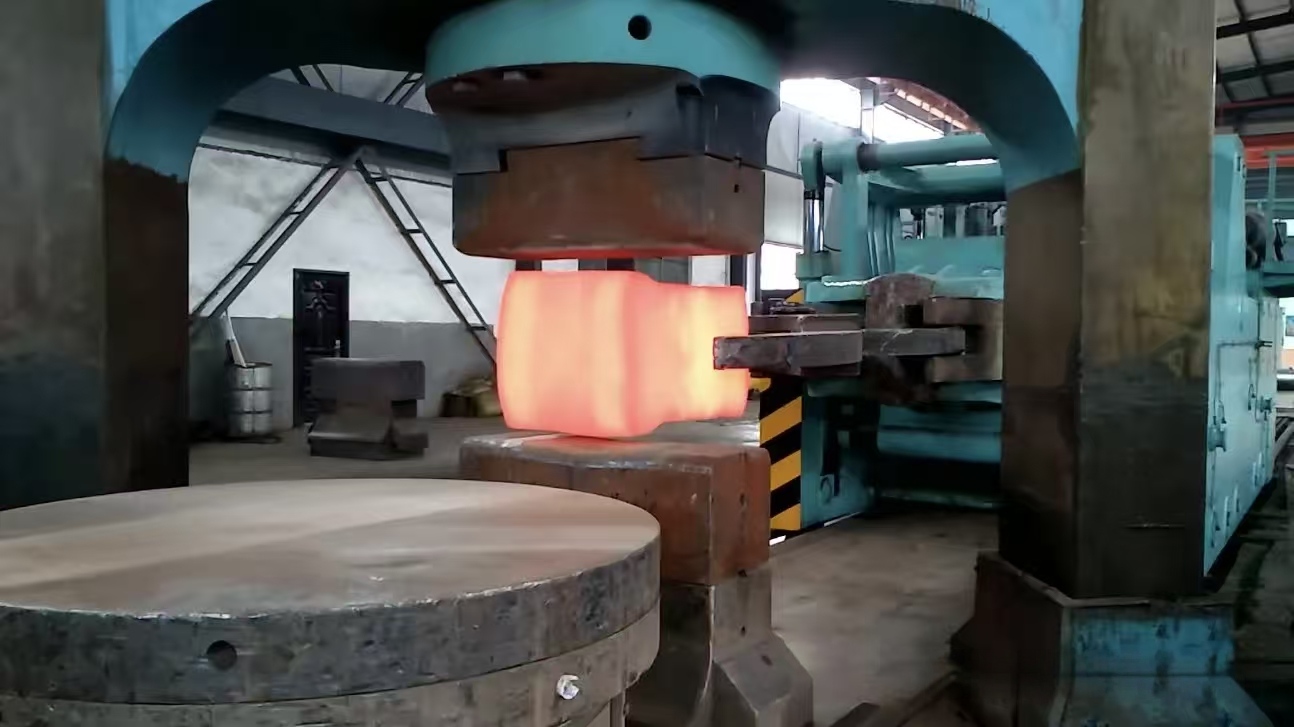
1. Forging Process Parameters and Deformation Mechanisms
1.1 Temperature Control, Phase Transformation, and Forging temperature Windows
Forging temperature is the single most sensitive lever governing the microstructure and properties of titanium alloys. Relative to the β-transus (Tβ), open-die operations are typically classified into:
· β forging (above Tβ),
· (α+β) forging (below Tβ),
· near-β forging (close to, but not exceeding, Tβ).
These regimes produce markedly different microstructures and consequently different mechanical responses. β forging favors full β recrystallization and subsequent basketweave or Widmanstätten α formation on cooling; it is effective for breaking down large β grains in cast ingots, but requires careful control to avoid Local overheating and excessive α-plate growth on cooling. The (α+β) regime encourages duplex or bimodal structures wherein primary α (αp) is retained while transformed β yields secondary α (αs); this balance usually provides an optimal combination of strength, ductility, and fatigue resistance for structural components. Near-β forging exploits higher diffusivity and dynamic restoration in the β matrix while preserving enough αp to anchor texture and improve crack-growth resistance.
Practical selection revolves around alloy-specific Tβ (e.g., ~995–1010°C for Ti-6Al-4V; alloy-dependent for Ti-6Al-2Sn-4Zr-2Mo, Ti-5553, Ti-6Al-2Zr-1Mo-1V). In production, the billet core must be controlled within a narrow band to avoid temperature gradients that would promote nonuniform flow and Local overheating at fillets, corners, and flash lands. Typical soak strategies deliberately limit surface-to-core ΔT to ≤30–50°C before the first reduction. Throughout reductions, interpass temperature controls (e.g., holding within 700–780°C for α+β alloys) stabilize flow stress and help Reduce surface cracks associated with chilled skins and α-case.
1.2 Strain-Rate Sensitivity and Deformation strategy
Titanium alloys are strain-rate sensitive: their flow stress and restoration mechanisms vary strongly with strain rate (ė) and temperature. In the α+β field, Ti-6Al-2Sn-4Zr-2Mo (Ti-6242, a U.S. α+β alloy analogous in behavior to mid-strength wrought alloys) exhibits clear rate sensitivity: at lower deformation temperatures and higher ė, the material shows flow softening due to adiabatic heating, shear localization, and microstructural instability; at higher temperatures and lower ė, a steady-state flow is observed, supported by dynamic recovery/recrystallization.
Representative behaviors observed in α+β processing windows:
· Around 780–870°C with ė ≥ 10 s⁻¹, adiabatic shear bands or localized flow instabilities can occur, threatening dimensional accuracy and surface integrity.
· Around 870–900°C with ė ≈ 0.001 s⁻¹, superplastic deformation can be achieved in fine-grained material, enabling large uniform strains when lubrication and protection are adequate.
· Near ~990°C with ė ≈ 0.001 s⁻¹, large-grain superplasticity may be observed in suitable β-stabilized microstructures.
From these behaviors, a practical Deformation strategy for conventional (α+β) forging of U.S. α+β alloys (e.g., Ti-6Al-4V, Ti-6242) is to select relatively low strain rates to stabilize flow, limit adiabatic heating, and Reduce surface cracks. On presses with variable speed, typical per-pass reductions of 20–35% with controlled dwell can be used, while ensuring tooling and billet temperatures keep friction and thermal gradients low. Where high productivity is needed, temperature compensation, staged reductions, and targeted lubrication are introduced to suppress shear localization at edges and corners.
1.3 Degree of Deformation and Microstructural Evolution
The magnitude of plastic work fundamentally shapes the evolving morphology of α and β phases. For Ti-6Al-4V (the U.S. counterpart to common α+β production alloys), tests at 950°C show a non-monotonic response of the primary α grain size with increasing deformation: initial deformation elongates and coarsens αp due to directional growth and partial spheroidization; with higher total strain, αp fragments and becomes equiaxed as dynamic/static recrystallization and boundary migration proceed, refining the microstructure and increasing hardness. At the same forging temperature (950°C), when the deformation degree rises from 10.7% to 69.6%, the hardness increases by about 4.8%. This improvement reflects grain refinement, elevated dislocation density, and more favorable α/β boundary configurations.
The deformation degree also governs the morphology and distribution of secondary α (αs). At smaller strains, αs nucleates preferentially at phase and grain boundaries and grows into the β matrix as straight, fine lamellae. At larger strains, the β matrix accumulates defects—dislocations, vacancy clusters—that provide intragranular nucleation sites; αs thus forms simultaneously at boundaries and within β grains, leading to a more heterogeneous and often tougher microstructure. Strategically, engineers tune total reductions not only to meet dimensional needs but to drive the αp fraction, αs thickness, and colony size toward the targeted balance for fatigue, creep, and fracture performance.
2. Equipment System Architecture and Technical Requirements
2.1Heating Equipment and Temperature Control: Atmosphere and Surface protection
Open-die titanium forging demands heating systems capable of producing a uniform thermal field, precise temperature control, and flexible atmosphere management. Because titanium readily reacts with oxygen and nitrogen at high temperatures, surface absorption produces an oxygen-enriched layer (α-case) that embrittles the skin, elevates flow stress, and promotes cracking. Thus, atmosphere control and Surface protection are central to both microstructural goals and defect prevention.
An industrially proven approach uses a ring (annular) furnace with flame heating and zoned control—preheat, heat, and soak—arranged in a continuous loop. A representative cycle for titanium and titanium alloy ingots includes:
· Preheat zone: 800 ± 50°C for 60–70 min,
· Heating zone: 900–1150°C for 70–90 min,
· Soaking zone: similar temperature to the heating zone for 60–90 min.
Charging and discharging occur between preheat and soak; the rotating hearth completes one revolution so that each billet passes sequentially through the three zones, equalizing temperature and minimizing gradients. The furnace atmosphere is managed to a mildly oxidizing condition to limit deep nitriding while controlling oxygen potential; in many lines, supplemental measures—glass-based coatings, boron- or rare-earth-modified lubricants, or inert shrouds—provide additional Surface protection to Reduce surface cracks and α-case growth.
Process planning must also respect the time–temperature–diameter relationship. With surface heating of a Ø350 mm billet to 1100–1150°C, holding within the most reactive temperature band for 3–4 hours can drive an oxygen-enriched layer thickness to ≥1 mm if unprotected. This reality underscores why coatings, shorter time at peak, and faster equalization are essential. Infrared thermography and embedded thermocouples are commonly used to verify core temperatures and limit surface-to-core ΔT that could otherwise cause Local overheating in thinner sections during the first forging blow.
2.2 Forging Machines and Deformation Control: Implementing the Deformation strategy
Titanium’s high flow stress and rate sensitivity make hydraulic presses the primary choice for open-die breakdown and subsequent shaping. Compared with mechanical presses and steam hammers, hydraulic presses offer:
· Long, controllable stroke and adjustable speed for tailored ė,
· Stable force application to minimize shock and Local overheating at contact interfaces,
· Compatibility with isothermal or hot die forging setups where dies are preheated (often 250–400°C) to lower interfacial heat loss and stabilize flow.
In Hot die forging, die preheat reduces thermal gradients, lowers peak flow stress by roughly 10–15%, improves die fill for near-net geometries, and helps Reduce surface cracks by softening the surface layer and suppressing chilled skins. Force–stroke control combined with feedback from load cells, ram position sensors, and pyrometry enables closed-loop execution of the Deformation strategy: per-pass reductions of 20–35%, dwell for heat re-equilibration, and carefully scheduled 180°/90° rotations to distribute strain and texture. For sensitive alloys (e.g., near-β systems like Ti-5553), isothermal forging may be adopted to nearly eliminate transient temperature drops that trigger flow localization.
2.3 Auxiliary Systems and Quality Control: Simulation, Sensing, and Optimization
Modern titanium forging lines integrate inspection, control, and heat treatment subsystems to ensure consistency. Process modeling has become central for designing robust windows that avoid Local overheating, undersurface laps, and die wear. Representative studies include:
· For a Ti-5553 (Ti-5Al-5V-5Mo-3Cr) torsion arm, finite element simulation verified the feasibility of hot forging process routes and die designs. An orthogonal experimental plan, analyzed by range and variance, produced optimized parameters: forging temperature 820°C, forging speed 25 mm/s, die temperature 350°C. The resulting average grain-size standard deviation was 0.110 μm, and the maximum forming load reached 1690 t. These metrics indicate tight microstructural uniformity and predictable press capacity utilization.
· For Ti-6Al-2Zr-1Mo-1V (Ti-6211) aerofoil parts, finite element models embedding a dynamic recrystallization (DRX) sub-model mapped stress, strain, temperature, and strain-rate fields during forging. This allowed correlation between local DRX fraction and resultant grain sizes in thin web regions versus thicker bosses, informing localized adjustments to pass reductions and tool thermal management.
In-line quality control uses:
· Non-contact temperature measurement (pyrometers, IR cameras) and embedded thermocouples for accurate Forging temperature feedback,
· Load and displacement monitoring for consistency of per-pass reductions,
· Acoustic emission or online ultrasonic spot checks to detect subsurface defects,
· Post-forge NDT (UT/PT), hardness and microhardness profiles, and metallographic audits to validate phase balance and α morphology.
Data infrastructure ties these elements together, enabling adaptive control to Reduce surface cracks, manage lubricant delivery, and protect die surfaces. Lubrication itself is a quality lever: glass-based lubricants tailored to titanium provide both Surface protection and friction control, suppressing α-case growth and stabilizing strain partitioning at the surface.
3. Heat Treatment Processes and Microstructure–Property Control
Heat treatment closes the loop between forging-induced microstructures and final properties by relieving residual stresses, tuning α/β phase distributions, and stabilizing textures. The optimal schedule is coordinated with the selected forging path and cooling rate.
For Ti-6Al-4V, a common post-forge anneal of (720 ± 10)°C × 1 h followed by air cooling (AC) efficiently removes residual stresses, raises ductility, and stabilizes the microstructure. This treatment:
· Maintains and stabilizes primary α (αp) to support fatigue crack initiation resistance,
· Coarsens secondary α (αs) within transformed β modestly, lowering interfacial energy, which can improve fracture toughness and long-term thermal stability,
· Reduces residual microstrains accumulated during large-deformation steps.
For other systems:
· Ti-6Al-2Sn-4Zr-2Mo in the (α+β) forged condition can benefit from sub-transus solution followed by aging to optimize the balance of αp fraction and αs thickness for strength–toughness synergy.
· Near-β and metastable β alloys (e.g., Ti-5553) often receive solution treatment in the β or near-β field and subsequent aging to precipitate refined α within the β matrix, delivering high strength with controlled ductility. Process windows are frequently refined using differential scanning calorimetry (DSC) and dilatometry to align aging temperatures with peak precipitation kinetics.
Heat treatment planning also guards against Local overheating during quench or slow-cool transitions that could grow α plates excessively. Furnace uniformity surveys, controlled ramp rates, and load thermocouples ensure thermal homogeneity. Surface conditioning before heat treatment—removal of scale and any α-case by machining or chemical milling—prevents defect persistence and ensures clean surfaces for NDT. Final property verification typically includes tensile tests, low-cycle/high-cycle fatigue, and fracture toughness, tied back to microstructural metrics such as αp volume fraction, αs lamella thickness, and prior-β grain size.
Integrating Parameters: A Practical Deformation strategy to Reduce surface cracks and Avoid Local overheating
· A robust titanium forging plan integrates:
· Forging temperature bands aligned with the alloy’s Tβ and targeted microstructure (β breakdown vs. α+β duplexing),
· Strain-rate control to avoid adiabatic shear; low ė in α+β for alloys like Ti-6242 or Ti-6Al-4V to enable steady-state flow and superplasticity where applicable,
· Total reduction sufficient to fragment αp and refine grains in Ti-6Al-4V, recognizing the 4.8% hardness uplift from 10.7% to 69.6% strain at 950°C as a directional cue,
· Surface protection through coatings and controlled atmospheres in ring furnaces, minimizing α-case (e.g., mitigating the ≥1 mm oxygen-enriched layer risk for Ø350 mm billets held 3–4 h at 1100–1150°C without protection),
· Hot die forging or isothermal variants with 250–400°C die temperatures to smooth flow and Reduce surface cracks, especially at radii and parting lines,
· Digital simulation with DRX models, supported by orthogonal experiment design, to set and verify windows such as 820°C billet, 25 mm/s ram speed, and 350°C die for Ti-5553, ensuring predictable grain uniformity and forming loads.
· The outcome is a controlled, repeatable process that delivers defect-lean surfaces, uniform microstructure, and stable mechanical properties, while preserving die life and press utilization.
Conclusion
From controlled billet heating to targeted heat treatments, titanium forging succeeds by harmonizing Forging temperature control, a disciplined Deformation strategy, and rigorous Surface protection. Choosing appropriate regimes relative to Tβ, staging strain to guide microstructural evolution, and leveraging Hot die forging to temper gradients collectively Reduce surface cracks and prevent Local overheating. With integrated simulation, precise temperature and rate control, and validated post-forge heat treatments, producers achieve consistent grain refinement, phase balance, and mechanical reliability across U.S. alloys such as Ti-6Al-4V, Ti-6Al-2Sn-4Zr-2Mo, Ti-6Al-2Zr-1Mo-1V, and Ti-5553. The resulting components meet stringent requirements for aerospace, energy, and high-performance industrial applications.
Frequently Asked Questions and Answers
Q1: What is the difference between cold forging and hot end forging of titanium forgings?
A1: Cold forging of titanium is limited due to high flow stress, low room-temperature ductility, and strong work hardening; it is usually confined to small reductions or heading of commercially pure grades with generous radii. Hot end forging refers to forming the end regions of a bar or billet at elevated temperature (typically in the α+β or β field). Hot end forging reduces flow stress, enables large shape changes, activates dynamic restoration, and minimizes cracking risk—especially when combined with hot die forging and effective Surface protection.
Q2: What is the forging temperature of titanium alloy?
A2: It depends on composition and target microstructure. For α+β alloys like Ti-6Al-4V, working windows commonly span ~850–980°C; near-β processing may approach Tβ (~995–1010°C for Ti-6Al-4V). Alloys such as Ti-6242 exhibit superplastic behavior near 870–900°C at very low strain rates (≈0.001 s⁻¹). Always reference the alloy’s β-transus and establish interpass controls to avoid Local overheating.
Q3: How to make titanium forge?
A3: Implement a controlled workflow: use a ring or equivalent furnace to heat uniformly with atmosphere control and Surface protection; set the Forging temperature relative to Tβ for the desired microstructure; apply a Deformation strategy with low to moderate strain rates and 20–35% per-pass reductions; use Hot die forging (250–400°C dies) to stabilize flow and Reduce surface cracks; monitor temperature, load, and strain with sensors; finish with an appropriate heat treatment (e.g., 720 ± 10°C × 1 h + AC for Ti-6Al-4V) and full NDT. This integrated approach prevents Local overheating, refines grains, and delivers high-quality titanium components.