Ti-1023 titanium alloy is a near-beta titanium alloy valued for its high strength, excellent thermal properties, and outstanding mechanical performance. Because of these attributes, Ti-1023 has attracted widespread attention in the engineering community and is increasingly used for manufacturing load-bearing structural parts, particularly in aerospace and other high-performance fields. However, a critical factor affecting the reliability and fatigue life of these parts is their surface integrity.
In most cases, the origin of fatigue cracks in metal components can be traced to their surface. This means that the fatigue life of a part is highly dependent on its surface quality—roughness, hardness, residual stress, and especially the absence of surface defects or micro-cracks. Compared with structural steel, stainless steel, and high-temperature alloys, titanium alloys like Ti-1023 are particularly sensitive to surface damage and defects. Even minor imperfections can more easily induce fatigue cracks and lead to early fatigue failure in titanium alloys than in other metals. This sensitivity makes the control of surface integrity especially important for titanium fasteners and structural parts.
Polishing is a key finishing process used to enhance the surface integrity of metal parts. By removing surface asperities, micro-burrs, and other irregularities, polishing reduces crack initiation sites and helps extend the fatigue life of components. However, Ti-1023 titanium alloy presents unique challenges in polishing due to its low thermal conductivity and high chemical activity. When conventional polishing methods are used, heat can quickly accumulate at the contact area, risking surface burns, formation of oxide droplets, and other defects that degrade surface quality and mechanical performance. Additionally, the chemical reactivity of titanium can cause unwanted interactions between the alloy and the polishing medium, potentially leading to surface contamination or embedding of abrasive particles.
Given these issues, optimizing the polishing process for Ti-1023 titanium alloy is essential. One promising approach involves CNC (Computer Numerical Control) polishing using wool felt wheels combined with fluid abrasives. Studying the CNC polishing process and its impact on the surface integrity of Ti-1023 titanium alloy is of great significance for improving the fatigue life of these parts. In this process, fluid abrasives are introduced during polishing. As the abrasives flow, they not only provide the mechanical action needed for surface smoothing but also help carry away excess heat. This reduces the polishing temperature and effectively prevents the formation of burn droplets or other thermally induced defects.
This study focuses on the CNC polishing process for Ti-1023 titanium fasteners using a wool felt wheel and fluid abrasives. The aim is to analyze how this method affects surface integrity and, by extension, the fatigue performance of Ti-1023 titanium alloy parts. By evaluating surface roughness, microstructure, and the presence of defects after polishing, the research provides important insights for manufacturers looking to optimize the durability and reliability of titanium alloy components. Improving surface integrity through advanced polishing directly contributes to extending the service life and enhancing the safety of critical load-bearing parts made from Ti-1023 titanium alloy.
1. Titanium Alloy Surface Integrity Experiment
1.1 Ti-1023 Titanium Alloy Test Material
To closely simulate actual part manufacturing conditions, this experiment utilized TB6 (Ti-1023) titanium alloy specimens that underwent preliminary milling treatment. The milling process employed a disk milling cutter with a diameter of 50 mm and four cutting edges, using triangular RPMT1606MOE-JS VP15TF inserts. The precise milling parameters were set as follows: spindle speed n = 200 rpm, feed rate vf = 100 mm/min, and milling depth ap = 0.5 mm. As a result, the milled specimen surface exhibited an initial roughness of Ra = 1.2 μm, closely mirroring real-world part surface conditions before final finishing.
Ti-1023Titanium alloy chemical composition | |||
Al | V | Fe | Ti |
2.6-3.4 | 9.0-11.0 | 1.6-2.2 | margin |
1.2 Experimental Equipment and Method
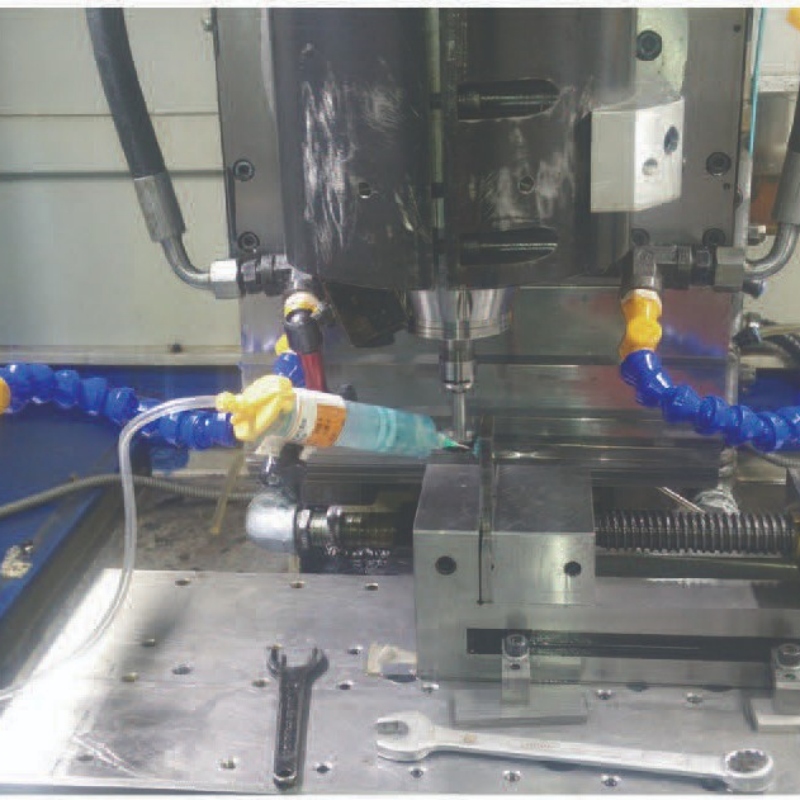
Polishing trials were carried out on a three-axis high-speed CNC machine tool. The polishing tool was a wool felt wheel, with a shank diameter of 6 mm, a polishing face diameter of 25 mm, and a thickness of 5 mm. The wheel was pressed from natural wool fibers, a material widely recognized for its effectiveness in polishing metals while minimizing the risk of introducing surface damage due to its fine, soft fibers.
For the abrasive, an oil-based diamond paste with a grit grade of W10 was selected. This abrasive enables efficient material removal and a high-quality surface finish. The combination of a CNC machine, wool felt wheel, and diamond paste provided precise control over the polishing process, enabling detailed study of how different parameters affected surface integrity.
2. Experimental Process and Result Analysis
2.1 Effect of Preload on Wool Felt Wheel Wear and Surface Quality
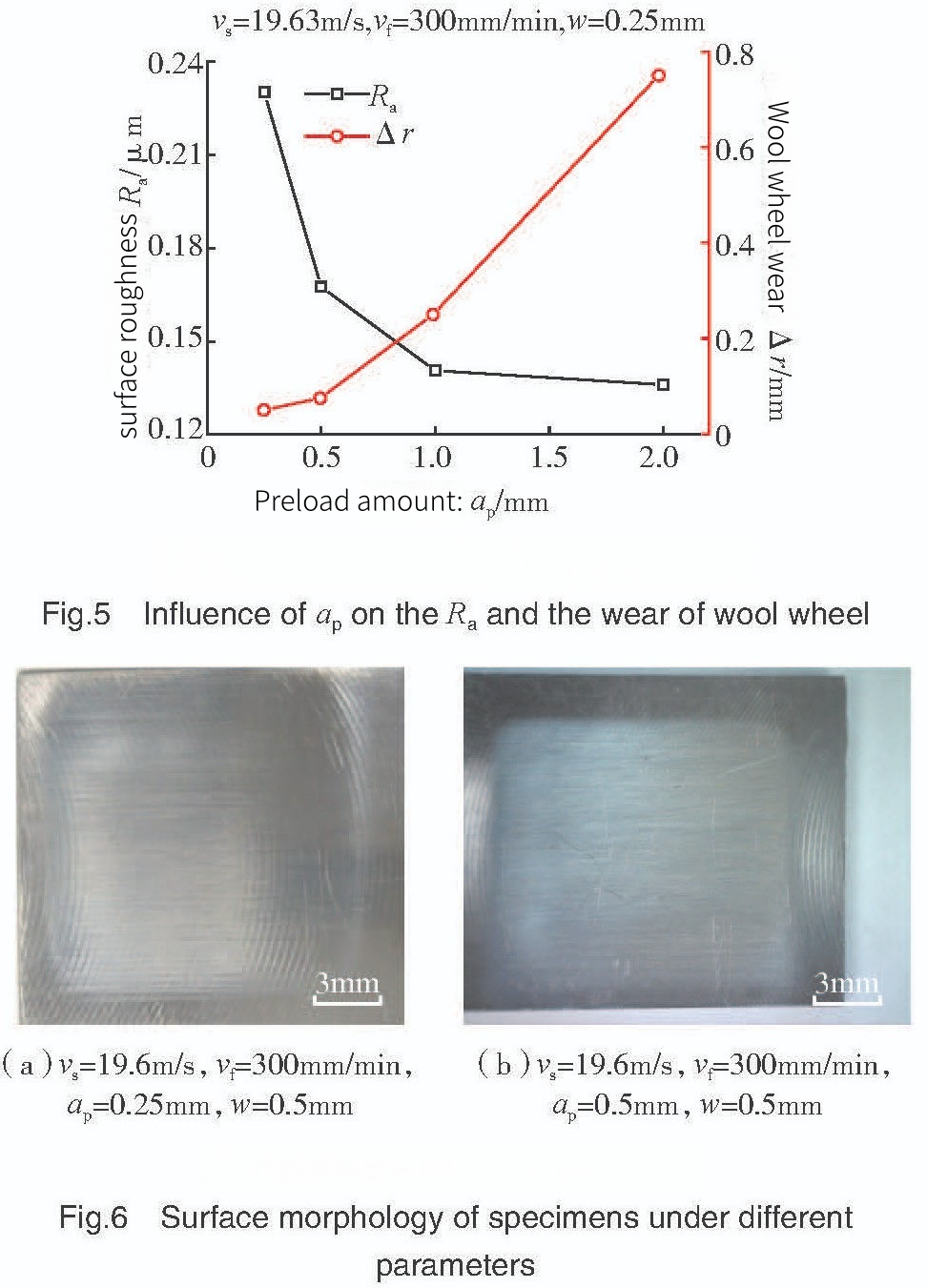
The wool felt wheel, composed of natural compressed wool, can experience significant wear if subjected to excessive preload during polishing, which in turn negatively impacts both polishing efficiency and final surface quality. To systematically study this, a series of wear tests were conducted with varying preload values: ap = 2 mm, 1 mm, 0.5 mm, and 0.25 mm. Other polishing parameters were held constant during these trials.
The results (see Figures 5 and 6) demonstrated that with larger preloads, the wool felt wheel wore down rapidly, shortening its effective life and causing greater variability in the actual polishing pressure. This variation led to uneven polishing and inconsistent surface quality. On the other hand, when the preload was too small, the polishing action was insufficient to remove the original milling marks, resulting in inadequate surface finishing. After analysis, a preload of ap = 0.5 mm was identified as optimal—it provided enough force to effectively remove milling marks and reduce surface roughness while ensuring reasonable wheel life and consistent polishing quality.
2.2 Influence of Polishing Parameters on Surface Roughness
A Taylor Hobson profilometer was employed to measure surface roughness after polishing. Five evenly distributed points were sampled in the feed direction on each specimen. For each point, roughness was measured both perpendicular and parallel to the feed direction, and the higher value was taken as the representative roughness.
Key findings on the impact of wool felt wheel polishing parameters on surface roughness were as follows:
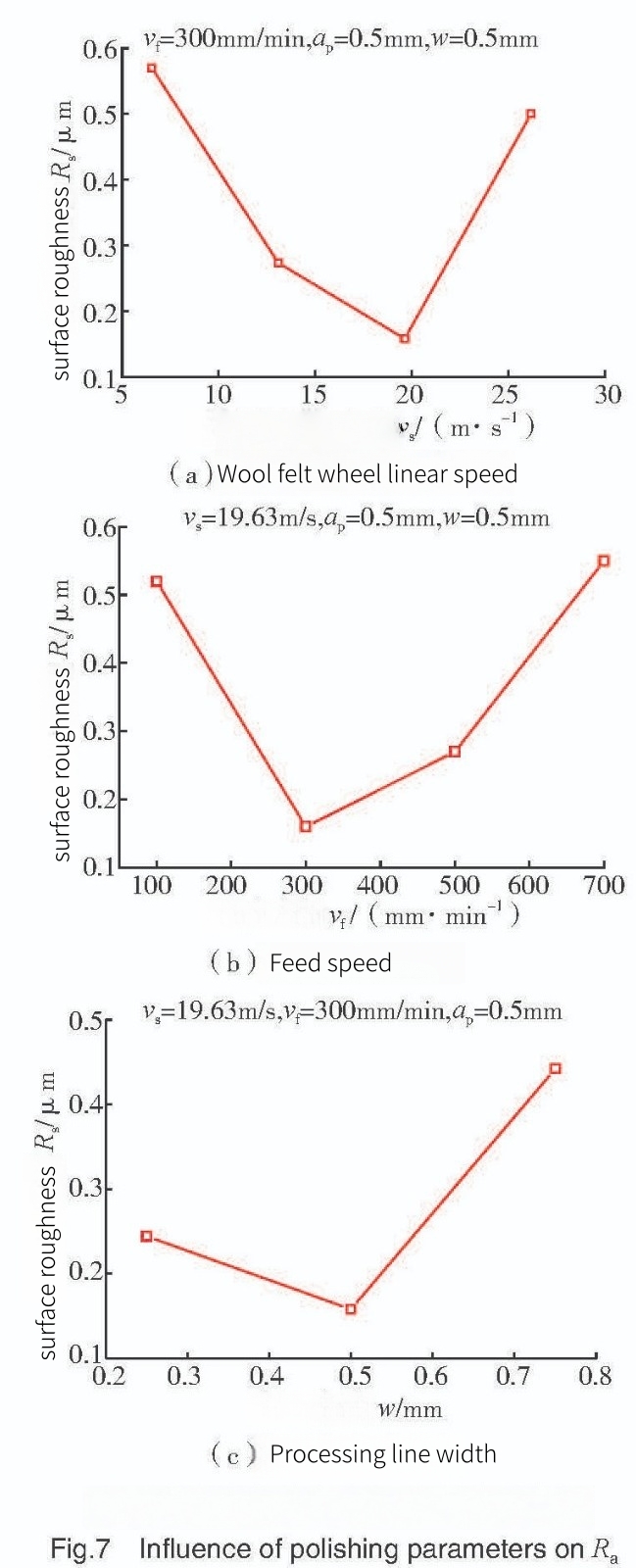
① Surface Roughness Reduction: After polishing, all specimen surfaces exhibited roughness values below Ra 0.6 μm, with the lowest reaching Ra 0.16 μm. This represents a substantial improvement over the pre-polished state (Ra ≈ 1.2 μm).
② Polishing Parameter Trends: Surface roughness changed in a consistent pattern relative to polishing parameters: it first decreased, then increased. At high line speeds (vs > 26.16 m/s), low feed rates (vf < 100 mm/min), and small widths of pass (w < 0.25 mm), the abrasive removal action was overly aggressive, creating new polishing marks and increasing roughness (Figures 8(a)–(c), 9(a)–(c)). Conversely, at low line speeds (vs < 13.08 m/s), high feed rates (vf > 500 mm/min), and large widths of pass (w > 0.75 mm), the original milling marks were not fully removed, also resulting in higher roughness (Figures 8(d)–(f), 9(d)–(f)). The optimum surface finish was achieved at intermediate parameter settings.
2.3 Influence of Polishing Parameters on Surface Hardness
The Vickers microhardness of polished surfaces was measured using a HV-1000 microhardness tester. Five points on each specimen were randomly tested and averaged, with results compared to the pre-polished (milled) surface hardness.
It was found that surface hardness decreased slightly after polishing, with the maximum difference not exceeding 1.5 HRC. This suggests that the polishing process partially removed the work-hardened layer formed during milling but did not significantly affect the underlying material. The result is a more consistent and stable surface hardness after polishing, which is beneficial for ensuring uniform mechanical properties and reliable fatigue performance across the component.
2.4 Influence of Polishing Parameters on Surface Residual Stress
Surface residual stress was measured using a Proto iXRD X-ray residual stress analyzer. Test points were distributed across the geometric center of the polished surfaces, with measurements taken in both the feed (X) and pass width (Y) directions.
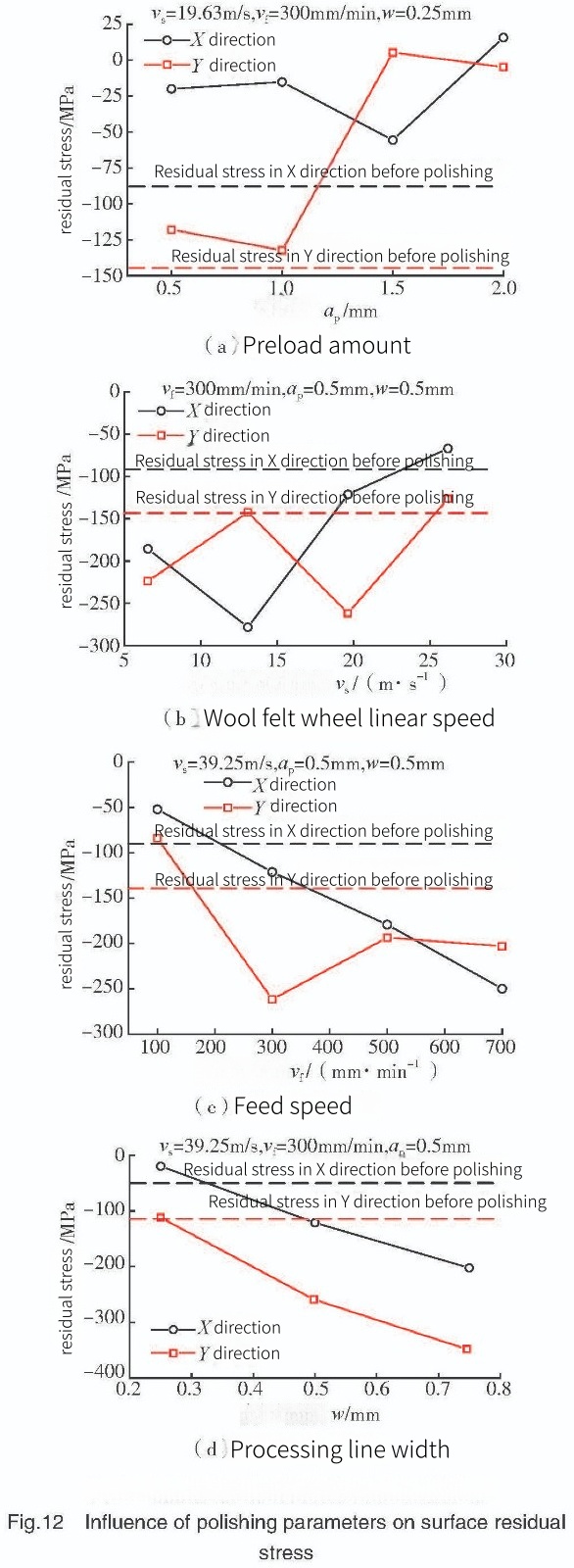
The influence of preload, line speed, feed rate, and width of pass on residual stress is shown in Figures 12(a)–(d). After milling, the X-direction residual stress was -87.8 MPa, and the Y-direction was -146.5 MPa—both compressive. After polishing, especially with optimized parameters, residual compressive stress increased in absolute value. For example, with the optimal parameters, the X-direction residual stress reached -121.3 MPa and the Y-direction -261 MPa. Enhanced compressive residual stress is advantageous, as it counteracts crack initiation and thus improves fatigue strength.
3. Conclusions
① Feasibility of Wool Felt Wheel Polishing: CNC polishing of Ti-1023 titanium alloy using a wool felt wheel is a practical and effective method. Wear tests confirm that with carefully selected polishing parameters, wool felt wheel wear is minimal, enabling long-duration polishing suitable for engineering applications.
② Improvement of Surface Integrity: Wool felt wheel polishing can significantly reduce surface roughness from about Ra 1.2 μm to below Ra 0.2 μm. The process also partly removes the surface work-hardened layer from previous machining, while maintaining stable and consistent surface hardness—an important factor for fatigue resistance and uniform quality. Additionally, compressive residual stress is enhanced after polishing, further contributing to improved fatigue performance.
③ Optimal Polishing Parameters: The best results were achieved with a line speed of vs = 19.63 m/s, feed rate vf = 300 mm/min, preload ap = 0.5 mm, and width of pass w = 0.5 mm. Under these conditions, milling marks were completely removed, surface roughness reached 0.15 μm, and residual compressive stresses were substantially increased in both principal directions, all of which favor higher fatigue strength for titanium alloy components.
4. Engineering Implications
The research demonstrates that by optimizing polishing parameters, especially with the use of a wool felt wheel and fine diamond paste, it is possible to greatly enhance the surface integrity of Ti-1023 (TB6) titanium alloy fasteners. Improved surface roughness, stable hardness, and increased compressive residual stress collectively extend the fatigue life and reliability of titanium alloy parts, which is critical for high-stress, high-precision engineering applications in aerospace, marine, and advanced manufacturing sectors.
Frequently Asked Questions and Answers
1. What impact does Ti-1023 titanium surface polishing have on its corrosion resistance and wear performance? A comparative analysis of polished vs. unpolished surfaces in marine industrial environments.
Polishing the surface of Ti-1023 titanium alloy can significantly reduce surface roughness and remove micro-defects, which are common initiation sites for both corrosion and wear. In marine environments, smoother, defect-free surfaces are less susceptible to localized corrosion and pitting, as there are fewer sites for corrosive agents to penetrate. Moreover, a polished surface offers lower friction and reduced abrasion in service, improving wear resistance. Comparative studies show that polished Ti-1023 components maintain their structural integrity and resist corrosion much better than unpolished parts under equivalent marine conditions, leading to longer service life and reduced maintenance needs.
2. Key process parameters in Ti-1023 titanium surface polishing: How to optimize abrasive particle size and polishing pressure to enhance surface finish quality for high-precision engineering parts?
The quality of the surface finish in Ti-1023 titanium alloy polishing is highly sensitive to both abrasive particle size and polishing pressure. Finer abrasives (such as W10 diamond paste) are recommended for final polishing steps to achieve sub-micron roughness and prevent the introduction of new surface scratches. Polishing pressure or preload should be optimized—too high will accelerate tool wear and potentially damage the surface; too low may fail to remove prior machining marks. Experimental evidence suggests that a moderate preload (ap = 0.5 mm) combined with a fine abrasive produces the best balance of efficient material removal, tool life, and superior surface finish. For high-precision applications, it is crucial to fine-tune these parameters in conjunction with feed rate and polishing speed to achieve consistent, repeatable results.