What should you consider when buying a pure titanium cookware set? Start by confirming what touches the food, what sits beneath that surface, and whether the base works on your stove. Then compare thickness, handle construction, the vessels you will actually use, care requirements, and the cost per useful piece. A set is valuable only when its construction and configuration suit your cooking; the word “titanium” on a listing does not establish either point.
This titanium cookware set guide keeps the original buying question in view: safety, material type, set size, and value are connected decisions. A lightweight single-metal pot may be an excellent choice for boiling water, while a layered pan may be easier to use for everyday stovetop cooking. Neither is automatically the better purchase. Ask for a construction diagram and a specification for each vessel before comparing prices or piece counts.
1. Identify the Material and the Food-Contact Surface
“Pure titanium,” “titanium-clad,” and “titanium-reinforced nonstick” describe different constructions. A single-metal titanium vessel has titanium through its wall. A clad vessel may have a titanium food-contact layer bonded to a more conductive core. A nonstick pan may merely contain titanium particles in its coating; its exposed cooking surface is still a coating. If you are specifically shopping for a pure titanium cookware set, a titanium-themed coating is not an equivalent substitute.
Check the full wall and base, not just the interior. A magnetic stainless-steel base can be useful for induction, but it means the whole vessel is not single-metal titanium. That distinction is not a defect if the seller states it clearly. The practical questions are which material contacts food, which layers move heat, which layer provides magnetic coupling, and whether the advertised claim refers to the pan body or only the coating. Our titanium cookware material guide explains the main categories in more detail.
For a single-metal claim, request the titanium grade, material certificate or traceable supplier specification, and a clear cross-section or manufacturing description. Do not treat an unexplained “food grade” label as evidence of a particular alloy, and do not assume a test report for one model covers every item in a set. Importers should match the document to the exact SKU, contact surface, and destination-market requirements. Home buyers can ask the seller for a plain-language material breakdown instead of relying on ambiguous listing images.
Safety is a construction and use question, not a label. Bare titanium's corrosion resistance does not validate an unidentified coating, adhesive, or handle. Ask for food-contact documentation applicable to the finished product and follow its temperature and care limits.
| Construction | What it means for cooking | What to verify |
|---|---|---|
| Single-metal titanium | Lightweight and corrosion resistant, but heat may concentrate above the burner. | Grade, wall and base dimensions, and stove compatibility. |
| Titanium food-contact layer with a core | Core can spread heat more evenly; weight and performance depend on the stack. | Layer order, core material, bonding, and total thickness. |
| Titanium-reinforced coating | Cooking and care follow the coating system, not bare titanium. | Coating chemistry, substrate, use limits, and replacement policy. |
2. Compare Thickness, Base Shape, and Heat Behavior
Thickness matters, but a single number does not describe how a pan cooks. Ask whether a quoted measurement applies to the side wall, the bottom, the combined clad stack, or only one layer. A thicker base can resist deformation and moderate hot spots, while extra metal also adds weight and may slow response. A thin-walled pot can make sense for travel or boiling; a frying pan used for eggs or delicate proteins puts more pressure on even heat distribution. The right specification depends on use rather than a universal minimum millimeter figure.
Titanium itself does not spread heat as readily as aluminum. This is why a pure titanium vessel can have a very different cooking feel from a titanium-contact pan with an aluminum core. If you expect low-maintenance simmering or broad, even browning, ask for the base structure and test a sample on the heat source you actually own. For more on how dimensions affect practical use, see our titanium cookware thickness guide.
Set the pan on a flat surface and check for wobble, especially if you have a smooth-top electric or induction stove. A slightly shaped cold base may be intentional in some designs, so assess how it sits and heats under normal use rather than demanding that every unloaded pan look identical. Compare cooking diameter with the burner diameter; an oversized pan on a small heating zone will not heat evenly just because its material is premium. If shopping remotely, ask for bottom diameter, total thickness by location, and a flatness tolerance or sample demonstration.
3. Examine Handles, Lids, and Everyday Handling
A set that feels balanced empty can become awkward when a pot holds water or a pan holds food. Lift each vessel in the way you would move it from the stove to a sink. Check grip length, clearance from the hot body, edges that press into your hand, and whether the center of weight feels manageable. A helper handle is especially useful on a larger pot. “Stay-cool” is not an absolute promise: metal handles can become hot on the stove, in the oven, or near another burner.
Rivets and welds are attachment methods, not automatic quality grades. Rivets can provide an inspectable mechanical joint but may leave interior cleaning points. A weld can leave a smoother interior but its quality depends on the design and execution. Ask how the handle is joined, whether the joint can be inspected, and whether there are reported loosening or leak issues. Our riveted-versus-welded handle guide covers the tradeoffs.
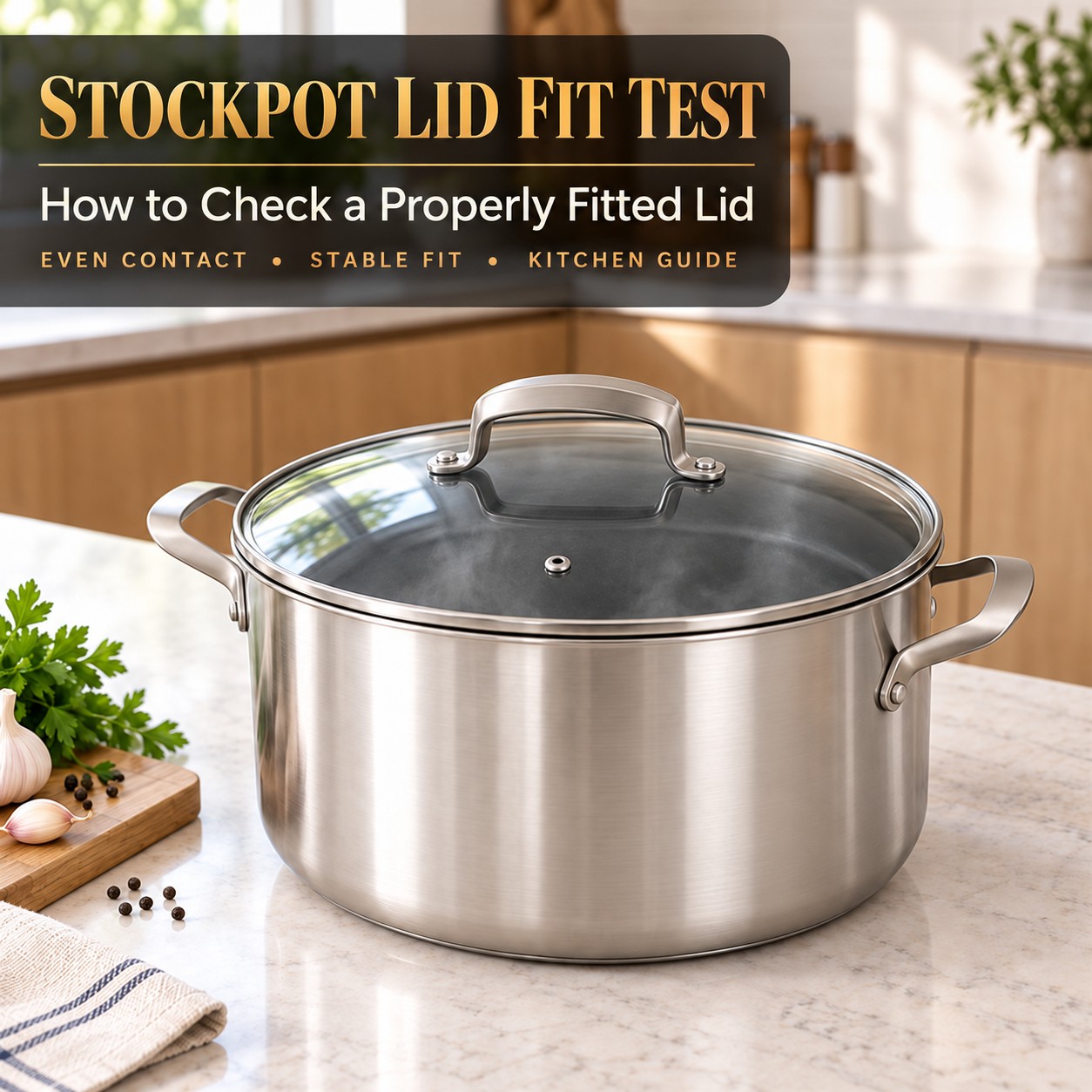
Also examine lid fit, knob material, steam venting, and the rim. A loose lid can be inconvenient for covered simmering; a lid that fits several vessels can reduce storage needs. Tempered glass, silicone seals, plastic knobs, and insulated handle parts may impose different oven or dishwasher limits from the metal pan. The lowest-rated component sets the practical limit. If the set includes a steamer, check that it sits securely and allows a usable water level below the food. These details matter more over years of use than a decorative finish.
4. Match Every Vessel to Your Stove and Oven
Compatibility belongs to the complete vessel, not to the word “titanium.” Gas generally gives broad flexibility, though a flame larger than the base can heat handles and waste energy. Electric coil and smooth ceramic or glass tops reward stable, flat bottoms and an appropriate match between the heating zone and the pan. For induction, the base must have a suitable magnetic layer and make adequate contact with the hob. A single-metal pure titanium pan should not be assumed induction-ready. A magnet adhering firmly to the base is a useful first check, but the model-specific stove instructions and a real heating test are stronger evidence.
If a listing claims that an entire pure titanium set works on induction, ask whether each piece has a bonded magnetic base and whether the claim applies to the smallest saucepan as well as the largest pot. Base diameter can matter because some hobs do not detect a small vessel. The product’s construction should explain induction compatibility without pretending a steel-backed vessel is single-metal titanium. Read our induction compatibility guide for a focused check.
Oven use requires its own check. Ask for a temperature rating for the pan, handle, lid, and knob, and confirm whether the lid must be removed. Do not transfer an advertised rating from one pan in the range to a whole mixed-material set. For a household that changes stoves often, construction flexibility can justify a higher price, but only if the current and likely future cooktops are named in the specification. An induction claim without a base description is a question to investigate, not a benefit to count.
5. Count Useful Vessels, Not Marketing Pieces
A five-piece or ten-piece label may count lids, steamer inserts, utensils, or accessories. Write down the actual cooking vessels first, then note which lids and extras are included. A practical core may be a frying pan, a small saucepan, and a larger covered pot, but the right mix depends on your meals. A person who mostly boils and steams needs a different set from someone who sautés vegetables and cooks sauces every day. There is no reliable rule that maps household size directly to a fixed number of advertised pieces.
Look at capacity, usable cooking surface, and burner fit for each vessel. Nominal capacity does not mean you can fill a pan to its rim and cook comfortably. Check whether a saucepan can hold your usual batch without boiling over, whether a frying pan has enough flat cooking area, and whether the largest pot fits your sink and storage space. If two included pans do essentially the same job, a smaller set plus one carefully chosen separate piece may be better value. A shared lid can be efficient, but only if it fits securely on both vessels.
B2B buyers should request a bill of materials and a piece-by-piece list for the exact set configuration. Confirm which parts are interchangeable, which replacement lids and handles can be ordered, and whether the packaging makes the contents obvious to customers. Consumers can use the same discipline: ignore the headline piece count until the listing shows dimensions, capacities, materials, and included components for every item. This avoids paying for an impressive box that duplicates cookware already in the kitchen.
6. Check Cleaning Requirements Before You Buy
Bare titanium, a titanium-contact clad surface, and a coated nonstick surface need different care. Bare titanium is corrosion resistant, but that does not make it naturally as release-friendly as a sound nonstick coating. Food can adhere if a pan is overheated, under-oiled for the recipe, or loaded before the cooking surface is ready. A coated pan may release food more readily at first, but its care instructions and usable life depend on the coating. Ask which surface is exposed and follow the instructions for that exact model.
For routine washing, let the vessel cool enough to handle safely, then use warm water, mild detergent, and a nonabrasive cloth or sponge. Soak stuck-on food instead of attacking it with a tool that could damage a coating or polished finish. Avoid thermal shock from placing a very hot vessel into cold water, particularly when it has bonded layers or a glass lid. Dishwasher claims should cover the entire assembly, including handles and lids; “dishwasher safe” for the metal body alone is not the same promise.
Check whether the manufacturer recommends seasoning, forbids aerosol sprays, limits utensils, or calls for particular cleaners. These are product-specific instructions, not universal titanium rules. If cookware will be used by several people, choose a surface whose care requirements they will actually follow. Our cleaning guide for titanium cookware offers a more detailed routine. A low purchase price loses appeal if daily cleaning is frustrating or a delicate coating is likely to be misused.
7. Judge Purchase Value With Verifiable Specifications
Price alone is a poor way to compare sets with different construction and piece definitions. First remove accessories you would not otherwise buy. Compare the remaining price with the number of useful cooking vessels, their sizes, and their expected role in your kitchen. Then consider replacement parts, warranty terms, return conditions, and the effort of maintaining the surface. A higher initial price may be justified by a better-fitting configuration or a more suitable base, but it is not proof of longer life or safer materials.
Ask sellers to document the material stack, titanium grade or surface system, thickness by location, weight, capacities, stove compatibility, oven limits, and care instructions. A listing that is precise about these points is easier to compare than one relying on “premium,” “healthy,” or “professional.” Beware of unsupported lifetime guarantees, blanket nonstick claims for bare titanium, and certification language that does not name a specific test, product, and applicable market. If the claim cannot be tied to the set you are buying, treat it as unverified.
For brands and importers, inspect a production-representative sample on the target stove and with typical recipes before committing to a configuration. Confirm the written specification and test documentation match the final components, including lids and handles. Ask what happens if a batch fails dimensional or surface inspection, and keep packaging claims aligned with what the product actually contains. A manufacturer relationship can help with documentation and replacement parts; our titanium cookware manufacturing page explains that route. For a household buyer, the equivalent is to read the model-specific manual and use a return window to test the pan in your own kitchen.
| Buying question | Evidence to request | Why it matters |
|---|---|---|
| Is the food-contact surface titanium? | Material stack or cross-section for each vessel. | Separates bare metal, clad metal, and coating claims. |
| Will it work on my stove? | Base material, diameter, flatness, and model-specific stove rating. | Prevents a costly induction or smooth-top mismatch. |
| Are the pieces useful? | Vessel list, capacities, cooking diameters, lids, and accessories. | Shows value beyond the advertised piece count. |
| Can I live with its care? | Cleaning, utensil, oven, dishwasher, and warranty instructions. | Reveals ownership effort and limitations. |
Conclusion
The best set is not necessarily the lightest, thickest, largest, or most expensive. Identify the actual food-contact material, match the base and dimensions to your stove, handle the vessels, and count only pieces you will use. A true single-metal titanium set may suit lightweight, straightforward cooking; a disclosed layered construction may suit a buyer who prioritizes more even stovetop heat or induction use. Either choice can be sensible when the specifications, care burden, and price are clear.
FAQ
Is a pure titanium cookware set automatically compatible with induction?
No. Induction depends on a suitable magnetic base and adequate contact with the hob. If the seller claims induction compatibility, ask for the base construction and the rating of each vessel. A magnetic base may be useful, but it changes the claim that the whole pan is single-metal titanium.
How can I tell whether a cookware set is truly pure titanium?
Request a layer-by-layer material specification for every vessel and clarify whether “pure” refers to the food-contact surface or the entire body. A coating containing titanium is not a solid titanium wall. Match any supplied material document to the exact model rather than relying on a generic certificate.
Is a larger titanium cookware set better value?
Only if its extra vessels solve real cooking needs. Count cooking vessels separately from lids and accessories, then compare capacities, burner fit, storage space, and the price of the pieces you would actually use. A smaller, well-matched set can be a better purchase than a larger collection of duplicates.