In Mechanical equipment subjected to vibration, thermal cycling, and shock, Loose fasteners are a leading source of unplanned downtime and safety risk. For titanium bolts—chosen for high specific strength and corrosion resistance—the core challenge is sustaining clamp load despite lower elastic modulus and friction scatter. This is one of the Frequently asked and common questions among reliability engineers and maintenance teams, especially for rotating machinery and high‑temperature assemblies.
Effective Anti-loosening technology combines design features, surface control, and disciplined installation. Proven measures include prevailing‑torque nuts, thread‑locking patches or adhesives, lockwire and castellated nuts, and serrated/conical washers to raise joint stiffness. Torque‑angle or yield tightening can cut clamp scatter by 30–50% versus torque‑only, while solid‑film lubricants (MoS2, silver) or PVD coatings stabilize friction. In soft or composite stacks, sleeves or interference fits reduce micro‑slip; in high‑vibration zones, jam‑nuts and periodic torque audits (e.g., every 250–500 operating hours) maintain reliability. Data‑driven monitoring—pilot strain‑gauging and post‑service clamp checks—helps refine preload targets and re‑torque intervals over the asset life..
1. Hazards and causes of loosening in titanium fasteners
1.1 Hazards of loosening
Fasteners do more than join parts—they locate, clamp, seal, and protect equipment. When Titanium bolts or Titanium screws loosen, the immediate consequences include increased vibration, amplified relative motion between parts, and growing joint gaps. Over time, these effects escalate:
· Fretting wear at faying surfaces and hole enlargement
· Loss of preload leading to micro-slip, fatigue crack initiation, and ultimately fastener fracture
· Damage to the workpiece (elongated holes, delamination in composites, gasket failure)
· Secondary failures in adjacent components due to misalignment and resonance
· Safety incidents, including equipment downtime, leakage, and in severe cases personal injury or catastrophic failure
In rotating machinery, pressure vessels, or structural frames, even a small loss of clamp load can shift the load path and concentrate stress at threads or under-head fillets, drastically shortening service life.
1.2 Root causes of loosening
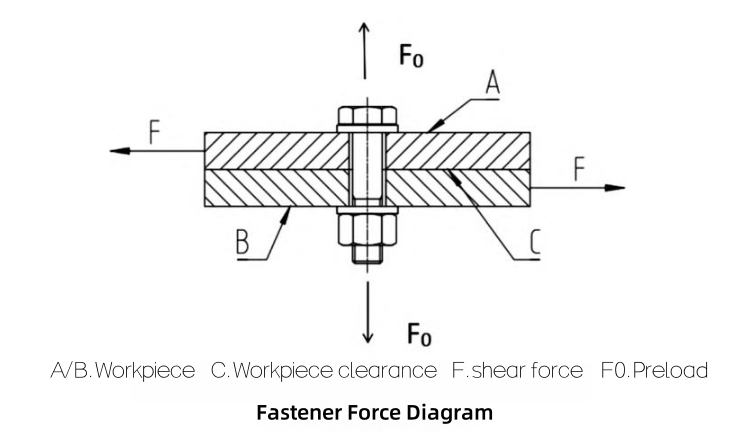
Threaded joints rely on a designed preload F0 created by tightening torque. Preload keeps interfaces closed, generates frictional resistance, and stabilizes the structure under service loads. Loosening typically follows one of these pathways:
· Dynamic excitation (vibration, impact): Cyclic shear at the interface drives micro-rotation of the nut/bolt if frictional resistance is insufficient. As the loosening amount grows, preload decays and the protective effect disappears.
· Thermal cycling: Differential thermal expansion between joint members and the fastener changes clamp load. Repeated cycles can reduce preload through embedment and stress relaxation.
· Embedment and relaxation: Surface roughness peaks plastically deform under load; coatings and gaskets creep; soft materials (polymers, composites, thin aluminum) settle, reducing preload.
· Insufficient or scattered preload: Variability in friction (k-factor), poor lubrication, or torque-only methods lead to under- or over-tightening; joints with low initial preload are more prone to early loosening.
· Galling and surface damage: Titanium’s tendency to gall increases friction variability during tightening and can damage threads, undermining consistent preload.
· Geometry and stiffness issues: Short grip lengths, low joint stiffness, or oversized holes increase joint slip and the likelihood of self-loosening.
To maintain reliability, anti-loosening measures must address both micro-rotation and preload stability, while accounting for titanium’s material characteristics.
2. Anti-loosening methods for titanium threaded fasteners
Different Mechanical equipment and environments produce different loosening risks. Selecting the right method depends on service loads, accessibility, reusability requirements, temperature exposure, and compatibility with titanium (low modulus, galling behavior, friction sensitivity). Below are established methods, their mechanisms, and the situations where they excel.
2.1 Spot-welded thread locking (weld lock)
This approach permanently prevents rotation by welding the bolt head or nut to the mating part, intentionally compromising the thread path so it cannot back off.
· Method
o Tighten the fastener to the specified torque to achieve the target preload F0.
o Apply localized electric welding (spot or tack) at the nut-to-part or bolt head-to-part interface, or at the nut-to-bolt junction, disrupting the helical thread path.
· Advantages
o Highest resistance to loosening; effectively permanent with long service life.
o Not affected by vibration, thermal cycling, or lubricants.
· Limitations
o Not reusable; removal requires cutting or grinding.
o Heat input risks affecting titanium’s surface and may alter local properties; qualified procedures and heat control are necessary to avoid embrittlement or microstructural damage.
o Typically used where disassembly is not required (e.g., guards, fixtures, safety covers).
2.2 Thread-locking adhesive (chemical locking)
Thread-locking adhesives cure anaerobically: they remain liquid in air and polymerize when oxygen is excluded between metal surfaces, creating a bonded layer that resists rotation and seals the thread.
· Method
o Clean and dry threads thoroughly; apply adhesive to male/female threads; assemble to target torque within the adhesive’s work time; allow specified cure time before service load.
· Advantages
o Easy to apply; provides sealing against fluids; available in removable, medium, and high-strength grades.
o Low shrinkage and wide chemical compatibility.
· Limitations
o Performance declines in high shock, high-amplitude vibration, or elevated temperatures beyond the product’s rating.
o Adhesives rely on adhesion and shear of the polymer layer; under severe cyclic loads, long-term resistance can diminish as micro-movements accumulate.
o Requires strict surface preparation; residual oils or oxide contamination on titanium can impair bonding.
Best used where vibration is moderate and periodic disassembly may be needed. For high vibration, combine with mechanical methods.
2.3 Slotted (castellated) nut with cotter pin
A mechanical positive lock that prevents nut rotation by inserting a cotter pin through a hole drilled in the bolt shank aligned with slots in a castellated nut.
· Method
o Tighten the nut to the specified torque; align a nut slot with the pre-drilled hole in the bolt; insert and bend the cotter pin to lock.
· Advantages
o Highly reliable; once pinned, the nut cannot rotate open.
o No dependence on friction; ideal for joints where preload must be retained under severe vibration.
· Limitations
o Requires a special bolt with a precisely located cross-hole; alignment after torque can be challenging since the hole location depends on stack height.
o Adds manufacturing and assembly steps; limited applicability when alignment is impractical.
Best for critical safety joints and where maintenance visual inspection is required.
2.4 Locking (tab) washer
A form of positive mechanical retention that uses a special washer with bendable tabs. After tightening, one tab is folded against a flat on the nut or bolt head to prevent rotation.
· Method
o Place the locking washer under the nut/bolt; tighten to specification; bend the appropriate tab against a head/flats face.
· Advantages
o Simple, visible, effective; widely used across machinery categories.
o Independent of friction and less sensitive to lubrication variability.
· Limitations
o Washers often need to be custom-sized for hole patterns and tab geometry; the need for associated anchor features can increase cost.
o Tabs are typically single-use; replacement required on reassembly.
Useful for general machinery where robust, visible retention is desired without permanent welding.
2.5 NORD-LOCK wedge-locking washers
A specialized two-piece washer system with cam faces on the inner sides and serrations on the outer faces. It converts loosening rotation into increased tension, using wedge action to resist back-off.
· Mechanism
o The cams have a greater wedge angle than the thread pitch angle. Any attempt by the nut/bolt to rotate loose forces the washers to climb the cams, increasing the clamping distance and thus tension—counteracting loosening.
· Advantages
o Uses tension rather than friction; proven resistance to vibration-induced loosening.
o Reusable, consistent performance even with lubrication changes; effective on slotted holes or when bolt bending occurs.
· Limitations
o Requires sufficient bearing area and compatible surface hardness to allow serrations to grip without damaging soft materials.
o Adds stack height; may not be suitable under very thin heads or in flush countersunk applications unless paired with specific geometries.
Ideal for high-vibration assemblies, including rotating equipment, pumps, and structural frames.
3. Comparison of anti-loosening methods
3.1 Welding is a permanent
Non-reusable method for preventing fasteners from loosening. It has a specific application scenario, primarily in situations where permanent fixation is required and disassembly is not necessary. While welding provides very high thread strength, it destroys the thread structure and cannot be disassembled later.
3.2 Thread locking adhesive is a method for preventing loosening.
The principle is to add a solidifying agent to the thread gap to secure the threads. This method is simple to use, effective, and allows bolts to be reused. However, because the service life of the solidifying agent gradually decreases with fatigue caused by the vibration frequency of the bolt, this method is generally used in general applications where vibration is not severe and the anti-loosening effect is not strictly required.
3.3 Specialized bolt and washer locking methods.
As the most widely used locking method, they are widely used to prevent fasteners from loosening across various mechanical applications, particularly in critical applications or where locking is critical. This method offers numerous advantages, including simple installation, effective locking, and reusability. NORD-LOCK locking washers, in particular, are standardized in both imperial and metric systems, making them very convenient to use.
| Comparison of characteristics of commonly used anti-loosening methods | |||
| Anti-loosening method | Welding anti-loosening method | Thread tightening glue anti-loosening method | Special bolt and gasket anti-loosening method |
| Anti-loosening strength | Very strong | Weaker | powerful |
| Ease of installation | difficult | Simple | Simple |
| Installation efficiency | Low | high | high |
| Installation costs | Low | Low | high |
| Is it reusable? | no | yes | yes |
Practical guidance for titanium joints
· Preload control
o Use torque–angle or yield-based tightening to cut clamp scatter versus torque-only methods. This is especially important with titanium due to friction variability and lower modulus.
o Validate k-factor with the actual lubricant and surface finish used. MoS2 or silver-based solid-film lubricants help stabilize friction and reduce galling.
· Surface integrity and galling mitigation
o Avoid dry titanium-on-titanium or titanium-on-stainless contacts when tightening. Apply approved lubricants to threads and under-head bearing surfaces.
o For repeated assemblies, inspect threads for galling marks; replace damaged hardware.
· Joint stiffness and geometry
o Increase grip length where feasible to store more elastic energy in the bolt, improving preload retention.
o Ensure hole quality (size, roundness, surface finish). Oversize or rough holes increase micro-slip and fretting.
· Embedment and relaxation
o After initial tightening, consider a short dwell and re-torque for joints with soft interfaces, gaskets, or coated surfaces to compensate for early embedment.
o In composites or soft metals, use sleeves/bushings and larger bearing surfaces to reduce local compressive creep.
· Environmental and service considerations
o For thermal cycling, select anti-loosening methods not sensitive to temperature (mechanical locks, wedge locks).
o Where fluids or contamination are present, adhesives that also seal can be beneficial, but confirm chemical and temperature ratings.
· Maintenance strategy
o Implement torque audits at defined intervals (e.g., 250–500 operating hours for high-vibration machinery) and after major thermal cycles.
o Use witness marks (paint) for visual loosening detection where appropriate.
Case selection scenarios
· High vibration, frequent maintenance access: NORD-LOCK washers or castellated nuts with cotter pins; torque–angle tightening; MoS2 lubrication to limit galling.
· Permanent, safety-critical without future disassembly: Spot-welded locking; document weld procedures and heat input for titanium.
· Moderate vibration with need for sealing and periodic disassembly: Medium-strength anaerobic thread-locking adhesive combined with a prevailing-torque nut or a tab washer.
· Composite or soft stack-ups: Use bushings/sleeves and large-diameter washers; avoid aggressive serrations directly against soft materials; wedge-lock plus hardened intermediate washer.
Common mistakes to avoid
· Relying solely on torque values from steel joints without adjusting for titanium’s different friction behavior.
· Applying adhesives to oily or unabraded titanium surfaces—leading to poor cure and early loosening.
· Using aggressive serrated washers directly on soft aluminum or composite laminates without an interface washer.
· Ignoring preload verification; failing to audit torque tools and tightening angle calibration.
· Drilling cotter-pin holes without proper deburring and surface finishing, introducing notch effects.
Frequently Asked Questions and Answers
Q1: What are the key differences in effectiveness between mechanical anti-loosening solutions (e.g., lock nuts, washers) and chemical solutions (e.g., thread-locking adhesives) for titanium bolts under cyclic loading?
A1: Mechanical solutions provide positive or geometry-based resistance to rotation and typically retain effectiveness regardless of lubrication or temperature within operating limits—examples include castellated nuts with cotter pins, tab washers, and wedge-lock washers. They excel under high-amplitude vibration and shock because they don’t depend solely on friction. Chemical solutions bond the thread flanks and fill gaps, offering sealing and ease of use, but their resistance can diminish under severe cyclic shear, elevated temperatures, or poor surface preparation. For titanium bolts in high-vibration service, mechanical locking or hybrid approaches (mechanical plus adhesive) usually outperform adhesive-only strategies.
Q2: How do the unique material properties of titanium (e.g., low friction coefficient, susceptibility to galling) influence the selection and performance of anti-loosening solutions compared to steel bolts?
A2: Titanium’s tendency to gall makes dry assemblies risky; lubricants or solid-film coatings are recommended to stabilize friction and achieve target preload without thread damage. Its lower elastic modulus means greater bolt elongation for a given load, making preload control (torque–angle) and joint stiffness design more critical. These factors favor anti-loosening methods that are less sensitive to friction scatter—such as wedge-lock washers, tab washers, and castellated nuts—over methods that rely purely on friction. Additionally, when drilling for cotter pins or using serrated elements, attention to notch sensitivity and bearing stresses is essential to avoid fatigue penalties.
Q3: What pre-installation surface treatments or preparation steps are critical to ensuring the reliability of anti-loosening solutions for titanium bolts, and why are they necessary?
A3: Cleanliness and surface conditioning are pivotal. For adhesives, degrease with solvent (e.g., acetone or isopropyl alcohol), lightly abrade to remove oxide and increase surface energy, then clean again before application; this ensures proper anaerobic cure and bond strength. For mechanical methods, ensure smooth bearing surfaces and apply approved lubricants to prevent galling and stabilize torque–tension. When using wedge-lock washers on soft materials, introduce a hardened intermediate washer to protect the surface. For castellated systems, precisely locate and deburr the cotter-pin hole to prevent stress concentrations. These steps reduce friction variability, protect against damage during tightening, and preserve long-term preload stability.