Titanium Additive Manufacturing has evolved into a production-grade pathway for high-value parts that demand strength, corrosion resistance, and complex geometry. Its high strength and excellent corrosion resistance make titanium alloy an indispensable material in aerospace, medical equipment and other fields. Through 3D printing technology, the geometric shape of titanium alloy can be precisely controlled to achieve the design and production of complex structures—lattices, internal channels, and integrated assemblies—while attaining near‑wrought density, tight tolerances, and repeatable mechanical properties. When properly parameterized and qualified, 3d printed titanium routinely achieves ≥99.9% density, ±50 μm dimensional accuracy, and as‑built Ra 20–30 μm surface roughness, positioning it as a leading solution for precision parts and one‑piece primary load‑bearing components.
1.Titanium Additive Manufacturing: Process Overview
Main industrial routes include:
· Powder Bed Fusion (PBF): Laser Powder Bed Fusion (LPBF/SLM) and Electron Beam Melting (EBM). Suited to fine features, thin walls, and precision.
· Directed Energy Deposition (DED): Laser/e-beam with powder or wire feed. Ideal for large near-net builds and repairs.
· Binder Jetting (BJT): High-throughput green-part printing with debinding, sintering, and optional HIP.
All methods construct parts layer-by-layer, achieving full metallurgical bonds. PBF dominates for implants and flight hardware due to accuracy and qualification maturity; EBM’s high preheat reduces residual stress; DED scales to large geometries; BJT targets cost-effective series production.
2.Step-by-Step Titanium 3D Printing Workflow
2.1 Data Processing
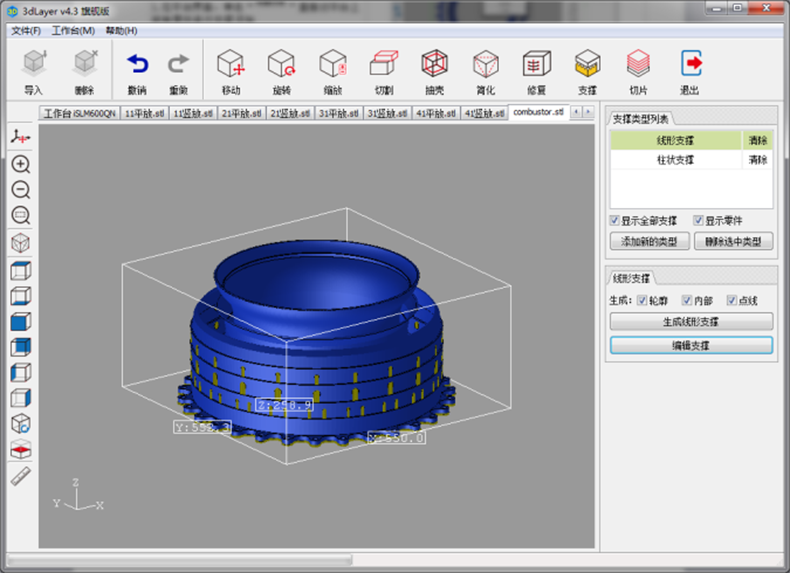
· Add supports: Export the CAD as STL, import into 3dLayer (support/slicing software), repair meshes, select build orientation, and design supports for overhangs, heat extraction, and distortion control.
· Slice the model: Use 3dLayer to slice supported geometry along Z, generating SLC layer files. Define contours, hatch patterns, layer thickness, and scan vector rotation to balance accuracy, density, and residual stress.
2.2 Printer and Powder Preparation
· Start water chiller: Confirm coolant lines are clear and fluid level is normal to stabilize optics and scan head temperature.
· Install recoater: Mount blade/soft recoater and verify uniform gap to the build platform; this sets consistent layer thickness.
· Mount baseplate: Hoist and secure the baseplate on the Z-stage; raise to recoater height. Baseplate flatness and cleanliness are critical for first-layer adhesion
· Level initial powder: Evenly distribute and level powder using the recoater to establish a uniform starting layer.
· Clean build chamber: Remove residual powder and debris from seals, windows, and mechanisms.
· Inert gas purge: Flood with argon (or nitrogen as permitted) to reduce O2 below the specified threshold; monitor O2 continuously.
· Preheat: After O2 stabilizes, enable chamber/baseplate heating to mitigate thermal gradients and improve wetting.
· Enable laser: Power on and arm the laser; verify interlocks, beam quality, and galvo calibration.
2.3 Start Printing
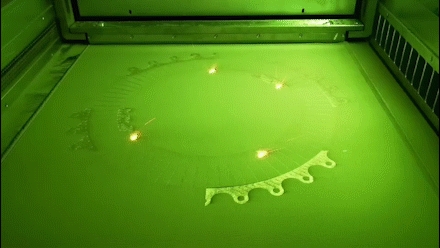
· Load job data: Import SLC files into the Presto SLM control system and arrange parts/coupons to optimize gas flow and thermal balance.
· Set parameters: Select laser power, scan speed, hatch spacing, layer thickness, contour passes, and scan strategy (stripes/islands with layer rotation) matched to the titanium grade.
· Automated powder handling: The closed-loop system meters powder from the feed cylinder, spreads it, and continuously sieves/recycles overflow powder to maintain consistency.
· Monitor build: Real-time sensors manage powder feed, sieving, delivery, and overflow recovery. Optional melt pool monitoring and layer imaging detect anomalies early, supporting traceability and quality assurance.
2.4 Build Completion and Part Removal
· Shutdown: Turn off laser, heaters, and gas supply; cool under inert atmosphere to prevent oxidation.
· Depowdering: Following powder-safety protocols, recover surrounding powder to the circulation unit.
· Move baseplate to depowdering unit: Evacuate internal powder using vibration, inert gas jets, and ultrasonic assist. Log recovered powder for reuse tracking (O/N pickup).
· Remove from baseplate and supports: Bandsaw or wire-EDM the part from the baseplate; remove supports by machining with fixturing that prevents distortion.
2.5 Heat Treatment
· Stress relief: Reduce internal stresses, limit distortion, and avoid cracking (e.g., Ti-6Al-4V stress relief at ~650–750°C in vacuum/inert).
· HIP (as required): Collapse internal porosity (e.g., 900–930°C, 100–120 MPa argon), then controlled cool.
· Solution + aging (for beta/near-beta alloys): Tailor strength and toughness.
Perform heat treatment with the part on the baseplate when geometry retention is critical. Follow with precision machining to final tolerance and surface finishing as needed.
3.Core Titanium AM Methods in Detail
3.1 Powder Bed Fusion (LPBF/SLM, EBM)
· Capabilities: Fine features, tight tolerances, high density, repeatability. As-built microstructure (e.g., α′ martensite in Ti-6Al-4V) can be tuned to α+β via heat treatment.
· Strengths: Qualification pathways for aerospace/medical; excellent for trabecular textures on Artificial bones and dental implants.
· Challenges: Residual stress and supports; careful gas flow management and preheat are essential.
3.2 Directed Energy Deposition (DED)
· Capabilities: Repair, feature addition, large parts; coarser resolution than PBF but higher deposition rates.
· Strengths: Multi-axis builds, hybrid print-and-machine workflows.
· Challenges: Wider heat-affected zones; more post-machining to meet tolerances and finish.
3.3Binder Jetting (BJT)
· Capabilities: High throughput for small/medium parts; debinding, sintering, and optional HIP to reach target density.
· Strengths: Low distortion during printing, scalable production.
· Challenges: Shrinkage control and microstructure tuning during sintering; properties depend on strict furnace control.
4.Materials and Powder Specifications
Common materials:
· Ti-6Al-4V (Grade 5): Aerospace workhorse.
· Ti-6Al-4V ELI (Grade 23): Lower interstitials, preferred for implants and medical devices.
· Commercially Pure Ti (Grades 1–4): Superior corrosion resistance and ductility at lower strength.
· Beta/near-beta alloys (e.g., Ti-15-3-3-3, beta-21S): Higher strength, creep resistance, or improved formability.
Key powder attributes:
· Particle size distribution (PSD): LPBF typically 15–45 μm; tight PSD improves packing and density.
· Morphology and flowability: Near-spherical particles from gas atomization promote smooth recoating and uniform layers.
· Purity/interstitials: Oxygen, nitrogen, hydrogen must be tightly controlled; elevated interstitials embrittle titanium and degrade fatigue life.
· Reuse management: Track reuse cycles, sieve mesh, oxygen pickup, and humidity; blend virgin/recycled powder to maintain consistency.
5.Process Parameters and Their Effects
· Energy input: Laser power and scan speed set linear energy density. Too low = lack-of-fusion porosity; too high = keyhole porosity and spatter.
· Hatch spacing and overlap: Ensure intertrack remelt and uniform fusion; poor overlap produces stitching defects.
· Layer thickness: Thinner layers improve resolution and density but reduce throughput; thicker layers increase speed at the risk of porosity if energy isn’t adjusted.
· Scan strategy: Islands/stripes with layer rotation reduce residual stresses and texture, improving isotropy.
· Preheat and gas flow: Preheat lowers thermal gradients; optimized argon flow clears spatter and fumes, stabilizing the melt pool.
6.Precision, Surface Finish, and Densification
· Accuracy: ±50 μm achievable with calibrated optics, stable recoating, and distortion compensation in slicing.
· Surface roughness: As-built Ra 20–30 μm typical; finishing options include machining, blasting, chemical milling, electropolishing, and anodizing. For implants, controlled roughness can enhance osseointegration.
· Densification: HIP is the standard for eliminating internal pores, improving fatigue strength and damage tolerance—critical for flight hardware and load-bearing Artificial bones and dental implants.
7.Post-Processing and Qualification
· Heat treatments: Tailor α/β phase balance for the desired strength–ductility–toughness tradeoff.
· Machining: Use sharp tools, ample coolant, and conservative speeds to counter titanium’s low thermal conductivity and work hardening.
· Coatings and surfaces: For threaded parts, silver or MoS2 coatings mitigate galling; anodizing aids identification and surface conditioning.
· Inspection: CT scanning for internal defects; dye penetrant for surface cracks; tensile/fatigue testing on witness coupons; microstructure checks (α lamellae, prior β grains); hardness and density verification. Maintain full traceability of powder lots, parameters, and sensor logs for certification.
8.Design Considerations for 3d Printed Titanium
· Support strategy: Orient to minimize supports in critical areas; use sacrificial pads and breakaway features to ease removal.
· Overhangs and thin walls: Respect process limits (e.g., >45° overhang without supports; minimum wall ~0.4–0.6 mm depending on setup).
· Drainage and cleanability: Provide powder escape holes and fillets in internal channels and lattices.
· Fatigue-critical features: Align principal stress paths with scan vectors; specify HIP and surface finishing to meet endurance limits.
· Part consolidation: Integrate brackets, bosses, and channels to reduce assembly count and mass while improving reliability.
Medical Focus: Artificial Bones and Dental Implants
Titanium’s biocompatibility and corrosion resistance underpin its use in patient-specific orthopedics and dental restorations. Artificial bones benefit from lattice shells (300–800 μm pores) that tune stiffness to bone, minimizing stress shielding. Dental implants and abutments leverage precise fit, customized emergence profiles, and micro-rough surfaces that support osseointegration. Grade 23 (ELI) is preferred for its low interstitials and improved toughness. Rigorous cleanliness, validated sterilization, and fatigue testing in simulated physiological conditions are essential before clinical use.
Frequently Asked Questions and Answers
Q1: What are the key sequential steps in the titanium 3D printing process description, from powder preparation to post-processing, and what critical role does each step play in ensuring part integrity and mechanical properties?
A1: The sequence is powder control → data preparation (orientation, supports, slicing) → machine preparation (chiller, recoater, baseplate, purge, preheat) → parameterized build (laser power, scan speed, hatch, layer) with automated powder handling and in-situ monitoring → cool-down and depowdering → support/baseplate removal → heat treatment (stress relief, HIP, STA) → machining/finishing → inspection (CT, mechanical tests). Each step mitigates a specific risk: powder quality prevents inclusions and porosity; orientation/supports control distortion; purge/preheat prevent oxidation and reduce stress; tuned parameters stabilize the melt pool and density; HIP removes residual pores; finishing restores tolerances; inspection validates internal and external integrity.
Q2: How do material characteristics of titanium powder (e.g., particle size, flowability, purity) influence the parameters described in the titanium 3D printing process, such as laser power, scanning speed, and layer thickness?
A2: Finer, spherical powders improve packing and allow thinner layers and lower energy per track but may reduce flowability and increase oxidation risk, calling for careful gas flow and humidity control. Coarser powders need higher energy density (more power or slower speed) and thicker layers to achieve full fusion. Elevated oxygen/nitrogen content requires stricter inerting and may reduce ductility, influencing parameter margins and reuse limits. Flowability affects recoater speed and layer uniformity, directly impacting porosity and surface quality.
Q3: What common defects (e.g., porosity, cracking, delamination) are addressed in a detailed titanium 3D printing process description, and what process adjustments or monitoring techniques are specified to mitigate these issues?
A3: Lack-of-fusion porosity is mitigated with adequate energy density, correct hatch overlap, and appropriate layer thickness. Keyhole porosity is reduced by moderating power/speed and maintaining stable gas flow. Cracking and delamination are addressed via chamber preheat, stress-reducing scan strategies, robust supports, and post-build stress relief. Surface balling and roughness improve with contour passes, optimized hatch, thinner layers, and recoater tuning. In-situ monitoring (melt pool sensors, layer imaging) flags anomalies; HIP collapses residual pores; CT and metallography verify internal quality before release.