Ti45Nb titanium metal in β-type titanium alloy is gaining prominence for aerospace fastening where weight, fatigue life, and joint integrity are critical. It has the characteristics of high plasticity (elongation can reach more than 20%, cross-section shrinkage as high as 60%~80%), corrosion resistance, excellent cold working performance, and other characteristics that enable complex head-to-shank forming, precise rolled threads, and tight dimensional tolerances. Compared with commercially pure titanium, the shear strength and tensile strength are higher than pure titanium and deformation resistance is lower than pure titanium, allowing efficient cold heading with reduced risk of cracking and manageable tool loads. The beta-stabilized matrix delivers a favorable strength-to-weight ratio and lower elastic modulus, improving load sharing in composite-metal stacks and reducing stress concentrations at fastener holes.
Functionally, Ti45Nb fasteners provide stable preload, enhanced shear capacity, and superior high-cycle fatigue performance in aggressive aerospace environments. The alloy’s passive oxide film resists chloride-induced attack and mitigates galvanic corrosion when paired with carbon fiber or aluminum alloys. Excellent cold workability supports consistent surface integrity at thread roots, which is vital for crack initiation control, while reliable machinability ensures uniform torque-tension behavior across production lots. Together, these attributes position Ti45Nb aerospace titanium fasteners as a next-generation choice for airframes, nacelles, and landing gear assemblies demanding durable clamp force, corrosion resilience, and long service life.
1. Ti45Nb material overview: why a stable beta alloy matters
Ti-45Nb is a stable β-type titanium alloy engineered to bridge a long-standing gap in aerospace fastening: achieving cold-formable plasticity close to commercially pure titanium while providing substantially higher strength. Early aerospace rivets and small titanium bolts relied heavily on grade 2 titanium (commercially pure). Although grade 2 titanium offered excellent corrosion resistance and superb ductility for cold riveting, its mechanical strength was too low for highly loaded joints. On the other end of the spectrum, metastable β-type alloys and even titanium grade 5 (Ti-6Al-4V) provide high strength, but their deformation resistance and room-temperature plasticity are inadequate for efficient cold heading or cold riveting in many fastener geometries.
Ti-45Nb emerged precisely to solve this trade-off. Ti45Nb titanium metal in B-type titanium alloy has the characteristics of high plasticity (elongation can reach more than 20%, cross-section shrinkage as high as 60%–80%), corrosion resistance, excellent cold working performance, and other characteristics that are uniquely suited to fastener production and installation. Compared with pure titanium, the shear strength and tensile strength are higher than pure titanium and deformation resistance is lower than pure titanium, enabling reliable cold heading and cold riveting without excessive tool wear or cracking. In standardized evaluations, Ti-45Nb reaches approximate tensile strength of 450 MPa and shear strength of 350 MPa, while preserving a forgiving work-hardening response.
2. Application scope: from specification to fleet-wide adoption
Extensive international research on Ti-45Nb over decades has matured its processing methods and design allowables. The alloy’s fastener products were codified early; Ti-45Nb entered AMS 4982 in 1974, signaling confidence in its chemistry and processing controls for aerospace use. Since then, the alloy has supplanted grade 2 titanium as the default material for many aerospace rivets and small-diameter fasteners, especially where cold installation and improved joint strength are required.
One hallmark application is the bimetal rivet strategy that pairs a Ti-45Nb shank with a titanium grade 5 (Ti-6Al-4V) upset or complementary segment, combining cold-rivet capability with elevated shear performance. This configuration not only boosts rivet shear but also enables cold riveting operations that reduce heat input to surrounding composite or thin-gauge metallic skins. Airbus and Boeing programs have widely deployed these rivets in fuselage panels, wing structures, and control surface assemblies where galvanic compatibility, weight reduction, and long-term fatigue reliability are critical.
Beyond rivets, Ti-45Nb supports:
· Cold-headed titanium bolts and titanium screws in light-to-medium duty structural joints, offering better formability than titanium grade 5 while delivering higher strength than grade 2 titanium.
· Fasteners in mixed-material stacks (carbon fiber reinforced polymer to aluminum or titanium) where a lower modulus aids load sharing and reduces stress concentration at the hole.
· Corrosion-critical zones (marine/coastal operations, de-icing fluid exposure) where the alloy’s passive film and niobium-stabilized β matrix maintain integrity.
Becuse Ti-45Nb can be cold formed and thread rolled effectively, manufacturers can scale production with lower scrap, consistent thread geometry, and improved fatigue performance, all while meeting aerospace dimensional and mechanical standards (e.g., NAS, MS, EN, HB specifications as applicable).
3. Ti-45Nb chemical composition
Ti-45Nb is characterized primarily by its high niobium content, stabilizing the β phase at room temperature. A representative chemistry window is:
Ti45Nb titanium alloy chemical composition % | |||||||||||
Main ingredients | Impurities, no greater than | ||||||||||
Nb | Ti | C | N | H | O | Si | Fe | Cr | Mg | Mn | Other elements |
42.00~47.00 | Remaining | 0.04 | 0.03 | 0.0035 | 0.16 | 0.03 | 0.03 | 0.02 | 0.01 | 0.01 | 0.5 |
4. Phase constitution and microstructure evolution
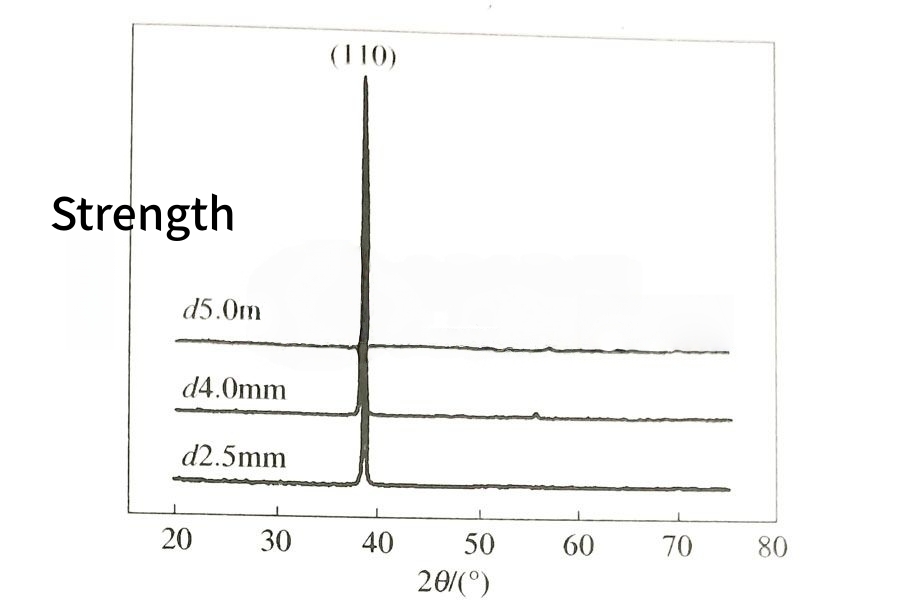
The dominant phase of Ti-45Nb is bcc β. This β-phase framework underpins its cold workability, relatively low modulus, and capacity for strain accommodation during forming.
4.1 As-worked microstructure (processing condition)
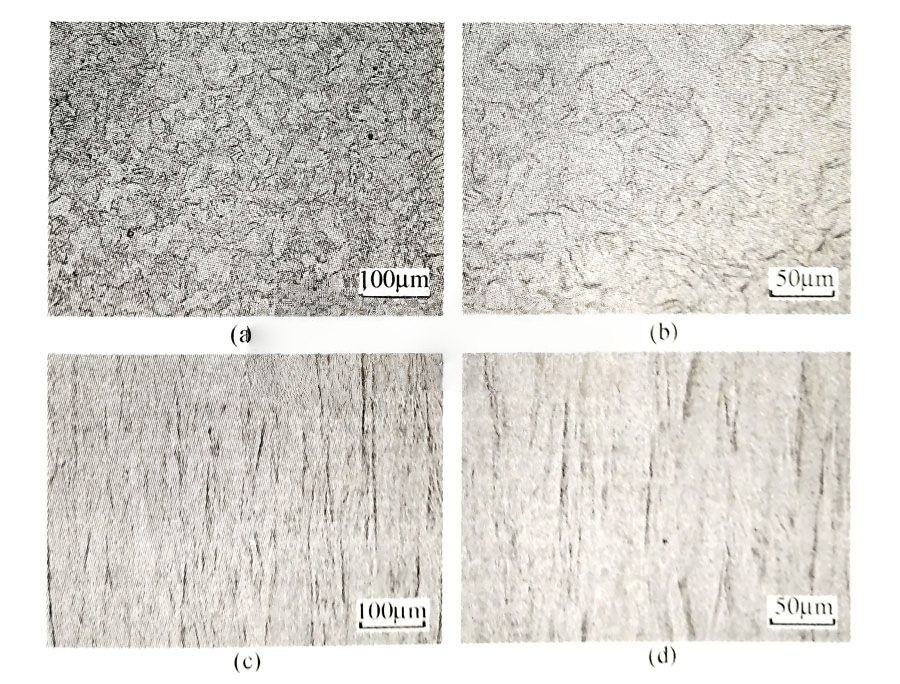
In wire or rod products processed by cold drawing, Ti-45Nb exhibits a characteristic fiber texture. Cold drawing imposes substantial plastic strain, producing dense slip bands near grain boundaries and elongating grains along the drawing direction. This fibrous morphology enhances strength through work hardening while still preserving substantial elongation, enabling downstream cold heading and thread rolling with controlled springback. The fibrous flow orientation is particularly beneficial in fastener heads and under-head fillets, where continuous metal flow improves resistance to fretting and crack initiation under cyclic loads.
4.2 Annealed microstructure (post-processing condition)
After annealing, the alloy undergoes recovery and recrystallization. The resulting grains are more equiaxed, with cleaned grain boundaries and reduced dislocation density. Annealing restores ductility, stabilizes dimensions, and homogenizes properties prior to final forming or machining. For fastener production, a balanced path may use partial cold work for strength followed by a tailored anneal to achieve the target combination of elongation, hardness, and thread formability. This sequence ensures high-quality rolled threads and consistent torque–tension behavior across batches.
The interplay between cold work and anneal allows manufacturers to tune properties: higher cold reduction increases strength and fatigue resistance at the expense of ductility; annealing reopens forming windows while retaining adequate strength for service. Because Ti-45Nb is β-stable, it avoids brittle α-case issues common when alpha-rich alloys are overheated in air—yet surface protection and subsequent cleaning remain important to preserve thread integrity and corrosion resistance.
5. Manufacturing routes for Ti-45Nb fasteners
Although Ti-45Nb can be hot worked, its defining advantage is reliable cold workability at room temperature, enabling cost-effective, high-quality production.
Wire and bar preparation
VAR/EB refined ingots are hot worked to intermediate sizes, then cold drawn to final wire or bar with tight diameter control. Interstitials and residuals are monitored throughout to protect ductility and fatigue performance.
· Cold heading and riveting
The alloy’s low deformation resistance relative to titanium grade 5 allows efficient cold heading of rivet heads and small bolt heads without microcracking. Proper die lubrication and surface finish reduce galling risk. For rivets, Ti-45Nb shanks are routinely cold formed, enabling on-aircraft cold riveting—a key benefit for thin skins and composite structures.
· Thread rolling
External threads are typically rolled to induce compressive residual stress at the root and to align surface grains along the thread profile. Ti-45Nb accepts rolled threads cleanly, with minimal tearing when pre-roll diameters and surface prep are controlled. For nuts and internally threaded parts, tapping or internal thread rolling may be used depending on size and property state.
· Heat treatment
Annealing schedules are selected to achieve target elongation and hardness for downstream forming and final properties. Because the alloy is β-stable, conventional solution aging used for α–β alloys (e.g., titanium grade 5) is less central; instead, recovery/recrystallization anneals are tuned for microstructure control, balance of strength and ductility, and dimensional stability.
· Surface finishing and cleanliness
Alkaline cleaning and light blasting remove oxides and contaminants. Passivation stabilizes the protective oxide film, enhancing corrosion resistance and thread performance. Careful handling prevents surface nicks at critical stress concentrators like thread roots.
· Quality control
Mechanical testing (tensile, shear), microstructural examination (grain size, texture), and nondestructive checks (eddy current, dye penetrant for surface-breaking defects) are standard. Thread gaging and torque–tension correlation ensure installation consistency. Compliance with specifications such as AMS 4982, NAS, and HB standards is verified lot by lot.
6. Integration into modern airframe design
In airframe joints, engineers increasingly combine advanced composites and thin metallic laminates. Ti-45Nb’s unique balance—ductility, moderate strength, corrosion resistance, and low modulus—supports:
· Fuselage skin-to-frame and wing skin-to-spar joints where cold rivets are preferred for speed, joint stability, and minimal thermal impact.
· Control surfaces and nacelle panels that experience vibration, corrosive fluids, and temperature cycling.
· Repairs and retrofits where on-wing cold riveting reduces downtime and maintains structural margins without hot work.
Bimetal rivets that combine a Ti-45Nb shank with a titanium grade 5 upset deliver superior shear performance and controlled installation forces. This hybrid approach is now common in Airbus and Boeing fleets and is supported by long service records demonstrating stable clamp loads and low maintenance demand.
7.Practical considerations for engineers and manufacturers
· Material selection: Specify Ti-45Nb when cold forming and corrosion resistance are priorities but grade 2 titanium lacks strength. For higher-load bolts, consider titanium grade 5; for maximum cold workability in rivets with enhanced strength, Ti-45Nb is often optimal.
· Process windows: Maintain clean surfaces and controlled cold reductions to avoid surface tearing before rolling. Select anneal cycles to reset ductility without sacrificing too much strength.
· Thread design: Favor rolled threads for external features; ensure pre-roll diameters and root radii meet NAS/HB tolerances. Verify torque–tension consistency in representative joint stacks.
· Galvanic management: Use isolating washers or sealants in CFRP/Al stacks; confirm compatibility of coatings and sealants with titanium to protect the passive film.
· Inspection: Combine destructive and nondestructive testing; monitor microstructure in as-drawn and annealed states to validate fiber or equiaxed morphologies as intended.
Frequently Asked Questions and Answers
Q1: What unique mechanical properties (e.g., fatigue resistance, high-temperature stability, or corrosion resistance) does the Ti-45Nb alloy offer for aerospace titanium fasteners, and how do these properties address the extreme operational conditions of aircraft structures or engine components?
A1: Ti-45Nb provides a distinctive blend of near-CP ductility with higher tensile (≈450 MPa) and shear (≈350 MPa) strength, a stable β (bcc) matrix with lower elastic modulus for improved load sharing, and robust corrosion resistance via a protective oxide film. These traits support cold forming and rolled threads with superior root integrity, enhancing fatigue resistance under high-cycle vibration. The alloy’s corrosion behavior mitigates chloride and galvanic attack common in airframe environments. While service temperatures in airframes are typically moderate, Ti-45Nb’s β stability preserves properties across typical operational ranges, making it ideal for skins, panels, and structural joints rather than the hottest turbine zones.
Q2: How do the manufacturing processes (e.g., β-phase forging, heat treatment, or thread rolling) for Ti-45Nb aerospace titanium fasteners differ from those of conventional Ti-6Al-4V fasteners, and what adjustments are critical to ensuring compliance with aerospace standards like NAS or HB specifications?
A2: Unlike Ti-6Al-4V, which often relies on warm/hot heading and aging to reach high strength, Ti-45Nb is optimized for cold work. Manufacturers emphasize cold drawing, cold heading, and thread rolling, followed by tailored anneals for recovery/recrystallization rather than precipitation hardening. Critical adjustments include tighter control of interstitials to maintain ductility, surface preparation to prevent tearing during rolling, and precise pre-roll diameters for clean thread formation. Compliance with NAS/HB requires rigorous dimensional gaging, mechanical testing, and microstructural validation (fiber vs. equiaxed states) to ensure consistent torque–tension and fatigue performance.
Q3: In which specific aerospace applications (e.g., airframe joints, turbine engine casings, or landing gear assemblies) are Ti-45Nb titanium fasteners most effectively utilized, and what performance advantages do they provide over other titanium alloys or high-strength steel fasteners in these scenarios?
A3: Ti-45Nb fasteners excel in airframe joints—fuselage skins, wing panels, control surfaces, and nacelle assemblies—where cold installation, low modulus, and corrosion resistance are valued. Compared with grade 2 titanium, they deliver higher shear and tensile capacity; compared with titanium grade 5, they offer superior cold formability for rivets and small-diameter fasteners. Against high-strength steel, Ti-45Nb provides major weight savings and superior corrosion resistance, with adequate strength for many structural joints. The net benefit is lighter structures, reliable clamp loads, and improved fatigue margins in thin-gauge or composite-rich assemblies.