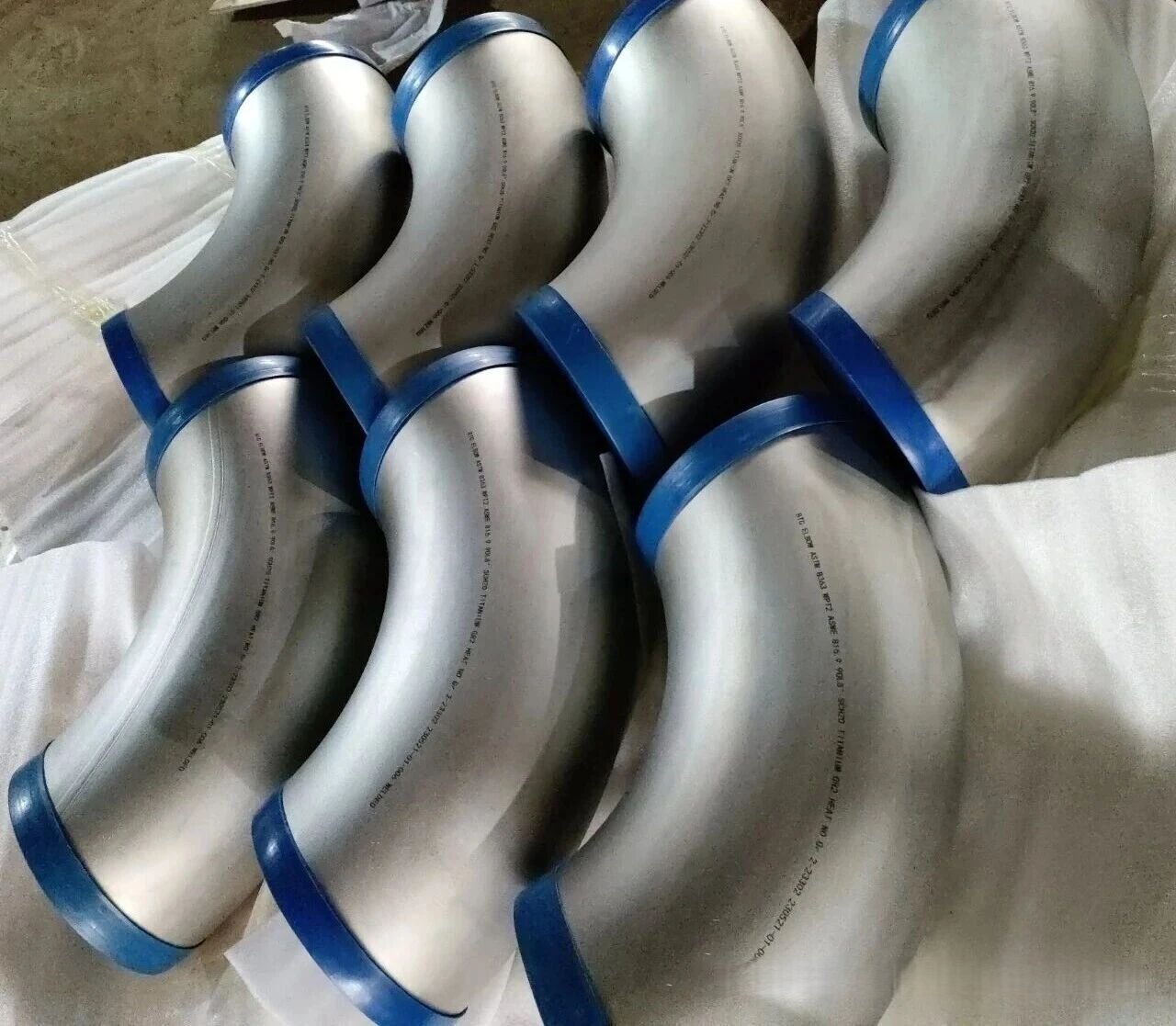
Titanium elbow is one of the important pipe fittings in each pipeline system. In addition to changing the flow direction of the medium, it also increases the flexibility of the pipeline, ensuring smooth operation and adaptability even in complex layouts. This is especially crucial in high-pressure oil and gas applications, where reliable fittings are essential to prevent leaks and maintain system integrity.
When the medium passes through the elbow, the pressurized medium rushes directly to the back of the elbow, and the medium flows along the back to the outlet. It can be seen that the back of the elbow is subjected to both greater pressure and severe erosion corrosion, indicating that its back load is greater than any other part. These challenges highlight the need for pipe fittings with superior durability and resistance to harsh environments. Seamless titanium elbows, with their exceptional strength, corrosion resistance, and fatigue performance, are increasingly preferred for extending the lifespan and reliability of high-pressure oil and gas pipelines. This article explores the manufacturing process and key benefits of seamless titanium elbows in modern pipeline engineering.
1. Titanium Elbow Material Properties
1.1 High-Pressure Resistance
Pressure Range:
Industrial pure titanium elbows typically operate at working pressures of ≤10MPa. However, titanium alloy elbows, through wall thickness optimization and alloy strengthening, can achieve working pressures up to 30MPa—significantly higher than conventional pipeline requirements.
Mechanical Support:
Pure titanium boasts a tensile strength of ≥345MPa, while high-performance titanium alloys (such as Ti-6Al-4V) can exceed 895MPa. The high yield strength of these Titanium materials ensures that the structure will not deform or fail under sustained high-pressure conditions. Titanium elbows thus offer superior mechanical reliability for high-stress environments.
1.2 Fatigue Resistance
Cyclic Life:
Pure titanium elbows maintain a fatigue limit of approximately 600MPa under alternating stress, with a lifespan exceeding 10^7 cycles. This exceptional endurance makes them ideal for pipeline systems subject to frequent vibration or pressure fluctuations.
Crack Growth Resistance:
Titanium alloy elbows, especially after high-pressure heat treatment, can experience fatigue strength increases of up to 80%, with crack growth rates reduced to the order of 10⁻⁶ mm/cycle. This means cracks propagate extremely slowly, greatly extending service life even in aggressive, cyclic service.
Lightweight Vibration Damping:
Titanium’s low density—only 4.5g/cm³—reduces the inertia load on pipelines. This lightweight characteristic not only simplifies pipe support structure but also delays the initiation of fatigue cracks, further boosting operational reliability.
2. Common Types of Titanium Elbows
Angle Classification:
Titanium elbows are available in standard angles of 45°, 90°, and 180°. These specifications address most pipeline routing needs. For unique engineering requirements, non-standard angles such as 60° can be custom-fabricated to match specific installation geometries.
Radius Options:
Elbows are also categorized by radius, with long-radius (LR) and short-radius (SR) variants available. Long-radius elbows (typically 1.5D of pipe diameter) are favored in high-pressure and corrosive applications due to smoother flow and reduced turbulence.
3. Connection Methods for Titanium Pipe Fittings
Direct Welded Connection:
Welded joints are the default for high-pressure or high-temperature pipelines. This connection type offers excellent sealing performance and mechanical integrity, ideal for critical applications in oil & gas, chemical plants, and power stations.
Flanged Connection:
Flanged elbows facilitate easy installation, removal, and maintenance. They are widely used in large-diameter pipeline systems, particularly where regular inspection or replacement is required.
Threaded Connection:
Threaded titanium elbows are best suited for small-diameter pipelines. They enable quick assembly and disassembly, making them practical for instrumentation lines or low-pressure service.
Socket Connection:
Though less common for titanium, socket connections are used for flexible joints, especially in plastic or cast iron systems. They provide a simple yet effective means for joining sections where some movement or vibration absorption is needed.
4. Manufacturing Processes for Titanium Alloy Elbows
4.1 Hot Press Forming
Process Overview:
Hot press forming is the mainstream process for high-strength, seamless titanium elbows. Titanium tube or pipe sections are heated to the critical austenitizing temperature (usually 850-950°C), ensuring the titanium alloy enters a malleable state. Specialized forming molds then bend the material to precise angles—such as a 90° elbow—under controlled pressure.
Key Considerations:
· Temperature and Radius Control: Maintaining precise heating temperature and forming radius is vital to prevent cracking or spring-back.
· Heat Transfer Optimization: Given titanium’s poor thermal conductivity, both heating rate and mold design must be optimized to ensure uniform heating.
· Post-Forming Treatment: After forming, the elbow undergoes acid pickling or polishing to remove oxide layers and enhance corrosion resistance.
4.2 Welded Elbow Manufacturing
For large-diameter elbows, forming from a single seamless tube may not be economically feasible. Instead, segments of Titanium tube are cut and welded together.
· Welding Quality: High-quality GTAW (TIG) or plasma arc welding is used.
· Inspection: All weld seams are subject to rigorous non-destructive testing (NDT) to detect internal or surface defects.
4.3 Stamped Elbow Manufacturing
Stamping Process:
Thin-wall elbows (typically small or medium diameters) can be efficiently produced via stamping. Titanium sheets are pressed into shape with precision molds.
· Advantages: High production efficiency, excellent consistency in wall thickness and angle.
· Limitations: Suitable primarily for thinner-walled Titanium materials due to limitations in forming thicker sections via stamping.
5. Application Fields and Case Studies for Titanium Elbows
5.1 Oil & Chemical Industry
Application Scenario:
Titanium alloy elbows are vital for transporting highly corrosive media, such as sulfuric acid, hydrochloric acid, or chlorinated hydrocarbons. Their superb corrosion resistance and mechanical durability safeguard system integrity.
Case Study:
A major refinery replaced stainless steel elbows with titanium alloy elbows in their acid transfer lines. The service life of the pipe fittings was extended to over 10 years, with a dramatic reduction in maintenance frequency and downtime.
5.2 Nuclear Power and Marine Engineering
Application Scenario:
In nuclear power plants, titanium elbows are used in seawater cooling systems and radioactive fluid pipelines. Their resistance to seawater corrosion, radiation, and marine biofouling makes them indispensable in these harsh environments.
Advantages:
· Radiation Resistance: Titanium alloys remain stable under neutron and gamma irradiation.
· Biofouling Resistance: The surface of titanium resists marine organism attachment, reducing cleaning and maintenance costs for offshore and subsea installations.
6. Quality Control for Titanium Alloy Elbows
6.1 Non-Destructive Testing (NDT)
Ultrasonic Testing (UT):
Used to detect internal flaws such as cracks, inclusions, or voids within Titanium materials. UT is highly effective for ensuring the integrity of seamless and welded elbows.
Radiographic Testing (RT):
Employed primarily for weld seam inspection, RT reveals volumetric defects like porosity or incomplete fusion. Both UT and RT are aligned with standards such as ASTM B363 and ASME BPVC Section VIII.
6.2 Hydrostatic Pressure Testing
Each titanium elbow is pressure-tested according to ASME B16.9 or customer-specific standards. The test involves filling the component with water and pressurizing it to ensure there are no leaks or deformations—critical for high-pressure oil & gas systems.
6.3 Surface Treatment
Acid Pickling:
Removes oxidation and scale from the elbow’s surface, restoring the native oxide film and maximizing corrosion resistance.
Sandblasting or Polishing:
Improves surface finish, reduces sites for corrosion initiation, and prepares the elbow for further coating if required.
Conclusion
Titanium alloy elbows have become a cornerstone of modern, high-performance pipeline systems. Their high strength, low density, outstanding fatigue resistance, and remarkable corrosion resistance make them the material of choice for the world’s most demanding industries. Whether in aggressive chemical environments, nuclear power cooling loops, or subsea oil & gas applications, seamless titanium elbows and other precision Titanium pipe fittings offer unmatched durability and safety. As technology advances, manufacturing processes continue to evolve—enabling even larger, more complex, and higher-performance titanium components to meet tomorrow’s engineering challenges.
Frequently Asked Questions and Answers
1. What key factors influence the selection of hot-press forming versus cold-press forming in titanium elbow manufacturing, and how do these processes impact the grain structure and mechanical properties (e.g., tensile strength, fatigue resistance) of Ti-6Al-4V elbows?
The main considerations are material thickness, desired elbow radius, and cost efficiency. Hot-press forming is preferred for thick-walled or large-diameter elbows and offers finer grain structure with improved tensile strength and fatigue properties, especially in Ti-6Al-4V. Cold-press forming is suitable for thin-walled elbows but may result in residual stress and less optimal grain alignment, potentially affecting mechanical performance.
2. How does the control of heating temperature and holding time during the forming stage of titanium elbow manufacturing affect the prevention of oxidation defects and the maintenance of dimensional accuracy, particularly for large-diameter (≥DN200) elbows?
Precise temperature and holding time are crucial. Excessive heating or prolonged exposure increases oxidation, forming brittle alpha-case layers on Titanium materials. Controlled temperatures and inert atmospheres (e.g., argon shielding) minimize oxidation and ensure the elbow retains accurate shape and dimensions, especially for large-diameter elbows where heat distribution is challenging.
3. What non-destructive testing methods (e.g., ultrasonic testing, penetrant testing) are critical in titanium elbow manufacturing to detect internal defects like cracks or inclusions, and how do these align with international standards such as ASTM B363 or ASME BPVC Section VIII?
Critical NDT methods include ultrasonic testing (UT) for detecting internal cracks and inclusions, and penetrant testing (PT) for surface flaw detection. These methods ensure product reliability and compliance with ASTM B363 and ASME BPVC Section VIII, which set strict standards for Titanium pipe fittings used in pressure applications.