Key Takeaways
Core Points: Professional cookware selection directly impacts food quality, kitchen efficiency, and long-term costs. Understanding the differences between stainless steel, cast iron, titanium, and aluminum cookware enables chefs and kitchen operators to make informed purchasing decisions that serve their specific operational needs. A well-planned cookware configuration matched to your kitchen type—fast casual, fine dining, hotel banquet, or specialty cuisine—can significantly improve both product quality and operational efficiency while reducing the total cost of ownership over time.
Introduction
In any professional kitchen, the cookware is the foundation of daily operations. Every sauce, every sauté, every wok preparation, every braise and roast depends on the quality and appropriateness of the equipment in the hands of your cooks. Yet many kitchen operators treat cookware selection as an afterthought, defaulting to whatever is cheapest, most readily available, or most familiar.
This approach inevitably costs money in the long run. Poor-quality cookware compromises food quality, frustrates experienced chefs who must compensate for equipment limitations, and requires frequent replacement that erodes budget over time. Meanwhile, the right equipment—thoughtfully matched to your kitchen type, menu requirements, and cooking style—becomes a competitive advantage that pays dividends through improved quality, reduced chef fatigue, and fewer replacement costs.
This guide provides professional chefs and kitchen operators with a comprehensive framework for selecting, configuring, and maintaining cookware that serves your specific operational needs. We will examine material properties in depth, explore configuration strategies for different kitchen types, discuss budgeting approaches that balance quality with cost effectiveness, and provide practical guidance for maximizing the lifespan of your equipment investment.
1. Why Professional Chef Cookware Selection Matters
The Impact of Cookware on Food Quality
Food quality in professional kitchens depends on precise control over cooking variables: temperature, heat distribution, surface contact, timing, and heat retention. Cookware is the primary interface between heat source and ingredient, making its quality and appropriateness fundamental to the results your kitchen produces. The difference between adequate and exceptional food often traces directly back to equipment choices.
Heat distribution matters profoundly: Poor-quality cookware with uneven heating creates hot spots that burn food in some areas while leaving other sections undercooked or underdone. This inconsistency makes it impossible to execute precise recipes consistently across a busy service, forcing chefs to constantly monitor and adjust rather than trusting their equipment. In a fine dining context, where every plate must be identical, this variability is unacceptable.
Material reactivity affects flavor: Reactive metals like aluminum can interact unfavorably with acidic ingredients, imparting metallic notes to delicate sauces, discoloring light-colored preparations, and fundamentally altering the intended character of your dishes. Professional kitchens require non-reactive surfaces that preserve ingredient integrity regardless of what you are cooking.
Retained heat influences plating and service: The heat retention characteristics of different materials affect how food behaves during plating and the critical window between cooking and service. Cast iron holds heat far longer than stainless steel, requiring timing adjustments that affect kitchen flow and plating sequences. Understanding these characteristics allows you to account for them in your service flow.
Surface non-stick properties matter for delicate items: Eggs, fish, and certain vegetables release from properly seasoned or naturally non-stick surfaces in ways that preserve presentation quality. Equipment that tears or breaks delicate proteins compromises the visual appeal and perceived value of your plates.
How the Right Equipment Improves Kitchen Efficiency
Beyond food quality, appropriate cookware directly impacts how efficiently a kitchen operates. Equipment friction—struggling with inadequate tools—compounds across hundreds of daily preparations into significant lost time and frustrated staff.
Reduced prep and cooking time: Quality cookware with excellent heat conductivity and distribution reduces the time required to bring ingredients to temperature and maintain consistent cooking conditions. Chefs spend less time fighting their equipment and more time focusing on the craft of cooking.
Less chef fatigue translates to better performance: Heavy cookware causes cumulative physical strain during long shifts. Lighter materials like titanium reduce fatigue, helping chefs maintain focus, precision, and positive attitude throughout demanding service periods. Fatigue-related errors—burns from careless handling, drops from exhausted grip, mistakes from diminished concentration—cost far more than quality equipment ever could.
Simplified workflows eliminate friction: Well-matched cookware eliminates the daily frustrations of working with inappropriate equipment—woks that are too small or wrong shape for your burners, stockpots without sufficient capacity forcing multiple batches, pans that do not fit available burner sizes forcing inefficient heat management.
Consistent equipment reduces training burden: When all your cookware performs identically, training new staff becomes simpler. They learn one set of behaviors and expectations rather than compensating for different equipment characteristics on different stations.
Professional vs. Consumer Cookware: Understanding the Gap
Consumer-grade cookware and professional equipment exist in completely different categories despite sometimes similar appearances. Understanding these differences prevents costly purchasing mistakes that ultimately compromise kitchen performance.
| Characteristic | Consumer Cookware | Professional Cookware |
|---|---|---|
| Material gauge/thickness | Thinner, lighter construction to reduce cost | Thicker, heavier construction for durability and heat management |
| Heat distribution | Often uneven, significant hot spots | Consistent, even heating across entire surface |
| Durability | Designed for occasional home use measured in hours per week | Engineered for daily commercial use measured in hours per day |
| Handle construction | Lightweight, often plastic, attached with screws or weak welds | Riveted metal, heat-resistant grips, permanent secure attachment |
| Lid fit | Loose, imprecise fit allowing steam escape | Tight seal, precise temperature and moisture control |
| Bottom stability | Thin bottoms that may warp over burners | Thick, flat bottoms that maintain contact with heat sources |
| Lifespan | 3-5 years typical with light home use | long service life with proper commercial care |
Professional cookware costs more upfront—often two to five times more for equivalent-sized pieces—but delivers dramatically better results and longevity. For commercial kitchens running daily service, consumer equipment simply cannot hold up to the demands, leading to early failure, compromised food quality, and ultimately higher total cost of ownership.
2. Understanding Different Cookware Materials
Stainless Steel Cookware: The Commercial Kitchen Standard
Stainless steel remains the dominant material in professional kitchens for excellent reasons that have stood the test of decades of commercial cooking evolution. Understanding stainless steel's properties allows you to deploy it effectively where it performs best.
Advantages of stainless steel in commercial settings:
• Exceptional durability: Quality stainless steel cookware lasts 15-20 years with proper care, surviving the daily abuse of commercial kitchens better than most alternatives
• Corrosion resistance: Chromium content creates a passive oxide layer that resists rust and staining from exposure to water, acids, and commercial cleaning agents
• Non-reactive surface: Will not interact with acidic foods, preserving flavor integrity across all menu items
• High temperature tolerance: Suitable for everything from gentle sautéing to high-heat searing without degradation
• Easy sanitization: Smooth, non-porous surfaces resist bacterial growth and clean to sanitary standards easily
• Visual appeal: The bright, reflective surface maintains an attractive appearance in open-kitchen contexts
Limitations to acknowledge:
• Moderate heat conductivity: Stainless steel alone conducts heat poorly, requiring aluminum or copper core layers for even distribution
• Heavier weight: Can cause chef fatigue during extended use, particularly for larger pieces
• Not naturally non-stick: Requires oil or seasoning to prevent sticking with delicate proteins
Optimal applications for stainless steel: Stockpots for daily production of stocks, soups, and large-batch preparations. Saucepans for general sauce work where precision is less critical than durability. Braising pans for their versatility across cooking methods. General-purpose commercial cooking where durability and reliability outweigh other considerations.
Cast Iron Cookware: Superior Heat Retention
Cast iron cookware offers distinct advantages for specific applications that have made it a professional kitchen staple for generations. Knowing when to deploy cast iron versus other materials is an important part of cookware strategy.
Advantages that justify cast iron's place:
• Exceptional heat retention: Cast iron holds heat significantly longer than any other cookware material, providing consistent temperature despite adding cold ingredients
• Excellent searing capability: The combination of high heat retention and dry cooking surface develops superior Maillard reaction crusts on meats and vegetables
• Natural non-stick when properly seasoned: Well-seasoned cast iron provides excellent food release without chemical coatings
• Remarkable durability: Properly maintained cast iron can last for generations, often becoming family heirlooms
• Even heating when properly preheated: Despite slow heat conductivity, once heated cast iron provides remarkably even cooking surface temperatures
Limitations that affect usability:
• Very heavy: Difficult to handle, especially for large pieces, contributing to fatigue and safety concerns
• Slow heat response: Temperature changes take significantly longer to affect surface temperature, requiring advance planning
• Requires dedicated maintenance: Must be seasoned regularly to prevent rust and maintain non-stick properties
• Reactive if poorly seasoned: Can interact unfavorably with acidic foods if seasoning is compromised
Best applications for cast iron: Griddle cooking where sustained heat is required. High-heat finishing for steaks and proteins requiring excellent crust development. Enameled Dutch ovens for slow braising where heat retention benefits the process. Specific station applications where cast iron's characteristics align with cooking requirements.
Titanium Cookware: The Premium Professional Option
Premium titanium represents the cutting edge of professional cookware technology, offering unique advantages that address many frustrations chefs have lived with for generations. The higher cost is increasingly justified by measurable benefits in the right applications.
Advantages that set titanium apart:
• Exceptional strength-to-weight ratio: Approximately 50% lighter than equivalent stainless steel, dramatically reducing chef fatigue
• Superior durability: Resists scratching, denting, corrosion, and thermal shock better than most materials
• Complete inertness: No reactivity with any food type, including highly acidic ingredients, ensuring absolute flavor purity
• Natural non-stick properties: Develops patina with use without chemical coatings, improving over time rather than degrading
• 20+ year lifespan: Outlasts most other materials in commercial settings with proper care
• Medical-grade safety: The same material used in surgical implants ensures absolute food safety
Limitations to consider honestly:
• Higher initial cost: 40-60% premium over equivalent stainless steel requires justification through long-term analysis
• Requires quality construction: Must feature multi-ply cladding with aluminum core for proper heat distribution
• Temperature sensitivity: Heats and cools more quickly than traditional materials, requiring some technique adjustment
• Best applications for titanium: High-end kitchens where precision and chef comfort matter. Wok stations where weight reduction transforms usability. Operations where chef talent retention is a priority. Health-focused establishments valuing chemical-free cooking surfaces. Any setting where premium quality justifies premium investment.
Aluminum Cookware: Value and Performance Considerations
Aluminum cookware occupies the value segment of commercial equipment, offering good performance at accessible price points. Understanding when aluminum serves well—and when it falls short—prevents both overspending and inadequate equipment choices.
Advantages of aluminum cookware:
• Excellent heat conductivity: Distributes heat evenly and responds quickly to temperature changes
• Lightweight: Easy to handle during extended use without fatigue concerns
• Affordable: Lower cost than stainless steel, titanium, or copper alternatives
Significant limitations in commercial use:
• Reactive with acidic foods: Can leach aluminum into food and affect flavor, presenting health and quality concerns
• Soft surface: Dents and scratches easily under commercial use conditions
• Shortened lifespan: Typically 3-5 years in commercial settings before requiring replacement
• Induction incompatibility: Standard aluminum does not work on induction cooktops
• Maintenance sensitivity: Requires careful handling to prevent damage
• Best applications for aluminum: High-volume operations with budget constraints where equipment is frequently replaced. Specific tasks where heat conductivity is prioritized over durability. Situations where equipment might be lost, damaged, or where capital is limited. Not recommended for food-contact surfaces in professional kitchens due to reactivity concerns.
3. Professional Kitchen Cookware Configuration
Fast Casual Restaurant Configuration Strategy
Fast casual operations prioritize speed, consistency, and efficiency while managing food costs carefully. Cookware configuration for this segment emphasizes durability and throughput over premium precision.
Recommended configuration for fast casual:
• 2-3 large stockpots (12-20 quart capacity): Essential for batch cooking soups, stocks, and high-volume preparations that support the menu
• 4-6 sauté pans (10-12 inch diameter): For à la minute cooking, finishing, and items prepared to order
• 2-4 flat-bottom woks (14-16 inch diameter): For high-volume stir-fry applications central to the menu
• 2-4 saucepans (2-4 quart capacity): For sauces, grains, vegetables, and small-batch items
• 1-2 brazier or Dutch oven: For braising and slow-cooking applications that add menu depth
Griddle or flat-top plate: If menu includes breakfast items or grilled elements
Configuration priorities for fast casual: Durability and speed over premium materials. Quality stainless steel tri-ply construction provides the best value for high-volume fast casual operations. Focus investment on pieces that see daily heavy use rather than specialty items used infrequently.
Fine Dining Restaurant Configuration Strategy
Fine dining kitchens require precision and presentation quality that justify premium equipment investments. Configuration emphasizes control, consistency, and the specific requirements of an elevated menu.
Recommended configuration for fine dining:
• Multiple copper or tri-ply saucepan sets (1-4 quart range in various sizes): Essential for the sauce work that defines fine dining quality
• High-quality sauté pans (8-12 inch): For finishing and à la minute preparations where visual presentation is paramount
• Specialty precision pieces: Small Windsor-style pans for reductions, spherical sauté pans for emulsions, special shapes for specific techniques
• Rondeau or braiser pans: For controlled moist cooking methods that develop flavor and tenderness
• Cast iron skillets: For high-heat finishing and searing where crust development is essential
• Titanium or premium stainless stockpots: For stock and large preparations where chef comfort affects quality during long prep sessions
• Small specialty pieces: Petit pots, cusinart-style pans, and other precision tools for plate finishing
Configuration priorities for fine dining: Precision heat control, superior cooking surface quality, and ergonomic design that supports extended focused work. Consider titanium investment for frequently used pieces to reduce chef fatigue during long shifts while maintaining absolute quality control.
Hotel and Banquet Kitchen Configuration Strategy
Hotel kitchens face unique demands: extreme volume variability, diverse service requirements, and the need to produce quality across multiple cuisines simultaneously. Configuration must support this versatility.
Recommended configuration for hotel banquet:
• Large-volume stockpots (20-40 quart capacity): For banquet-style production of stocks, soups, and mass-scale preparations
• Hotel pans (full, half, and third sizes in both 4 and 6 inch depths): For steam table and buffet service compatibility
• Multiple large sauté pans: For high-volume batch cooking of proteins and vegetables
• Brazier pans in various sizes: For batch braising operations that support menu depth
• Stockpot stands and accessories: For efficient use of large equipment in limited station space
• Asian cooking equipment: If menu requires, including appropriate wok equipment with proper ventilation integration
Configuration priorities for hotel kitchens: Volume capacity, versatility, and durability over premium precision. Stainless steel tri-ply or D5 construction provides best value for variable-demand environments where equipment must handle everything from intimate dining to large banquet functions.
4. Commercial Cookware Budget Planning
Scientific Approach to Budget Allocation
Effective cookware budgeting requires understanding how different pieces contribute to kitchen output and prioritizing investments accordingly. A strategic approach prevents both overspending on unnecessary premium items and underspending on critical daily-use equipment.
Core equipment priority (60-70% of cookware budget): Allocate the majority of your budget to pieces used daily and critical to quality:
• Stockpots: Essential for daily stock and soup production, typically used every service
• Saucepans: The workhorse of most stations, handling sauces, grains, and small-batch preparations throughout service
• Sauté pans: Primary cooking vessel for many stations, requiring quality construction for consistent results
Secondary equipment (20-30% of budget): Allocate to supporting pieces that enable menu variety:
• Woks: Essential for Asian cuisine or stir-fry stations
• Braisers and Dutch ovens: For braising and slow-cooking that adds menu depth
• Specialty pieces: For specific menu items that define your culinary identity
Tertiary equipment (10% of budget): Reserve for backups and occasional needs:
• Replacement handles and small parts: For emergency repairs that extend equipment life
• Backup vessels: For high-wear items that may need refinishing
• Specialty pieces: For seasonal or rotating menu items that appear periodically
Cost Control and Value Balance Strategies
Where investment delivers the best returns:
• Frequently used pieces: Higher-quality investment in daily-use items pays compounding returns through durability, performance, and reduced chef fatigue
• Heat distribution critical items: Saucepans and sauté pans where even heating directly affects quality justify premium construction
• Chef comfort items: Heavy-use pieces where weight reduction improves productivity and reduces injury-related costs
Where economizing makes sense:
• Rarely used specialty items: Consider renting or borrowing rather than purchasing for occasional menu items
• Low-precision applications: Boiling operations where material quality matters less than capacity
• High-wear disposable pieces: Items that see extreme abuse may justify lower-cost replacement strategies
5. Quality Identification for Commercial Cookware
Understanding Material Specifications
Decoding material specifications allows you to evaluate cookware quality beyond superficial appearance and marketing claims.
Stainless steel grades explained:
• 18/10 (304 grade): Premium grade containing 18% chromium and 10% nickel. Excellent corrosion resistance, brilliant mirror finish. The standard for quality commercial cookware that must withstand daily use and harsh cleaning.
• 18/8 (301 grade): Slightly lower nickel content providing 8% versus 10%. Good corrosion resistance, somewhat less brilliant finish. Acceptable for most commercial applications where budget constraints exist.
• 18/0 (430 grade): No nickel content, making it magnetic. Lower corrosion resistance but suitable for exterior layers where induction compatibility matters and cost savings are valuable.
Cladding specifications determine performance:
• Tri-ply construction: Three layers—typically 18/10 stainless interior, aluminum core for conductivity, magnetic stainless exterior. Excellent heat distribution and induction compatibility.
• D5 (five-ply) construction: Five layers with additional stainless layers surrounding the aluminum core. Superior temperature control and heat distribution for precision cooking applications.
Workmanship Inspection Points
Physical inspection reveals quality that specifications alone cannot guarantee. Evaluate these details before purchase.
Handle construction quality indicators:
• Handles should be permanently riveted with smooth, seamless installation that leaves no gaps or rough edges
• Rivets should be flush with cookware surface, without raised edges that collect food residue
• Handle should remain cool to the touch during stovetop use, indicating proper heat insulation design
• Handle attachment should feel solid and stable without movement or wobble when gripped firmly
Surface quality evaluation:
• Interior surface should be smooth and uniform throughout, without scratches, pits, or discoloration
• Welded seams should be smooth and strong, without visible gaps or rough patches
• Bottom should be flat and even when viewed on a level surface, without warping visible to the eye
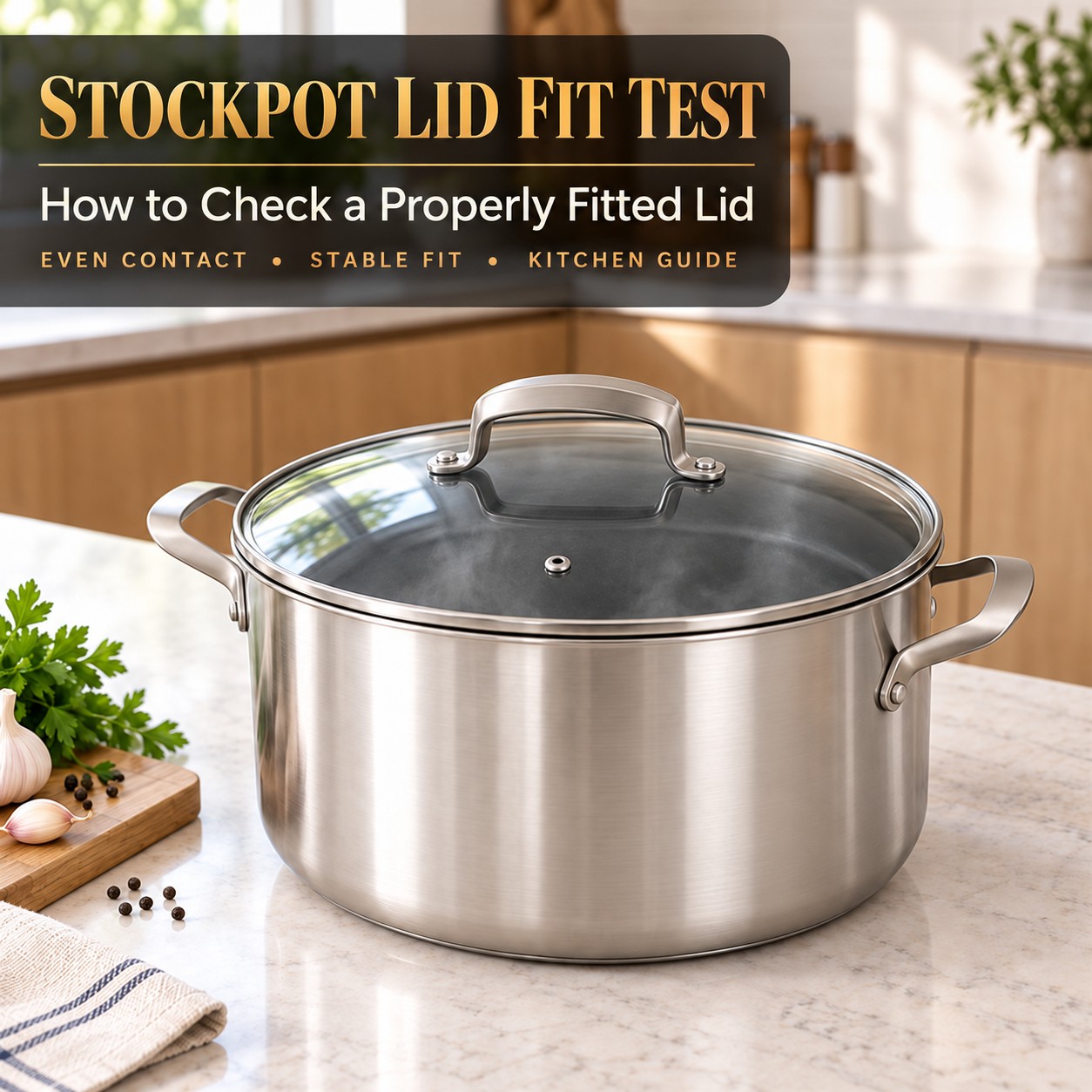
Lid fit testing:
• Lid should fit snugly without rocking or requiring force to place
• Steam should not escape readily when lid is properly placed on the pot
• Lid handle should remain cool to touch during cooking operations
Certification Reference and Value
Certifications provide third-party verification of quality and safety standards that protect your investment.
NSF International Certification: Indicates the equipment has been tested and meets public health standards for commercial food service equipment. Essential for any equipment used in commercial food preparation in the United States.
CE Marking: Required for equipment sold in European Economic Area. Indicates conformity with health, safety, and environmental requirements that may exceed US standards in some dimensions.
UL Certification: Underwriters Laboratories testing for electrical safety. Relevant for cookware with electrical heating elements or components.
ISO 9001: Manufacturing quality management system certification. Indicates consistent quality in production processes but does not certify the product itself for food service use.
6. Maintenance and Lifespan Management
Daily Maintenance Standards for Peak Performance
Proper maintenance dramatically extends cookware life and maintains cooking performance that affects food quality daily.
Proper cleaning procedures protect your investment:
• Clean cookware after each use while still warm but not hot—extreme temperature differences cause thermal stress
• Use hot water, mild detergent, and soft cloths or sponges specifically designed for cookware
• Remove stubborn residue with appropriate non-abrasive cleaners specifically formulated for the cookware material
• Dry immediately after washing to prevent water spots and mineral deposits that affect appearance
Critical practices to avoid:
• Steel wool and abrasive scrubbers cause permanent surface damage that compromises performance
• Chloride-based cleaners cause pitting corrosion in stainless steel that cannot be repaired
• Extended soaking weakens metal and damages professional-grade finishes
• Automatic dishwasher cleaning for aluminum and cast iron items accelerates degradation
Factors That Determine Cookware Lifespan
Negative factors that shorten useful life:
• Thermal shock: Rapid temperature changes that cause warping, cracking, or delamination
• Impact damage: Dropping or striking cookware against hard surfaces causing dents or handle loosening
• Chemical damage: Exposure to salt, acids, or harsh cleaners that degrade surfaces over time
• Insufficient maintenance: Failure to clean, dry, and store properly compounds into irreversible damage
Positive factors that extend useful life:
• Proper cleaning: Following manufacturer-recommended procedures consistently
• Appropriate storage: Using protective padding between stacked pieces to prevent surface damage
• Regular inspection: Catching and addressing problems early before they escalate into failures
• Correct use: Using each piece within its intended parameters rather than pushing beyond design limits
Replacement Cycles and Update Strategy
Material-based replacement timelines for planning:
• Aluminum: 3-5 years in commercial settings with heavy daily use
• Stainless steel: 10-15 years with proper care and maintenance
• Cast iron: long service life, often lasting generations with proper seasoning maintenance
• Titanium: long service life with proper care and appropriate use
Triggers that indicate replacement is needed:
• Visible warping that affects cooking performance and heat distribution
• Handle looseness that creates safety concerns during use
• Surface degradation that affects food quality, safety, or cleanability
• Corrosion that cannot be addressed through professional restoration
7. Procurement Channels and Contract Management
Selecting Reliable Suppliers
Supplier selection significantly affects the total value you receive from your cookware investment beyond the initial purchase.
Criteria for supplier evaluation:
• Commercial kitchen experience: Suppliers with specific professional kitchen experience understand real-world equipment demands and can recommend appropriate solutions
• Product quality consistency: Consistent quality across product lines and over time, avoiding the frustration of varying quality in what should be identical pieces
• Technical support capability: Ability to provide specifications, demonstrations, and application guidance that helps you select appropriate equipment
• Warranty and return policies: Clear, reasonable terms that protect buyer interests when problems arise
• Reference installations: Willingness to provide references from similar operations, demonstrating confidence in their products
Key Contract Terms for Cookware Purchasing
Well-structured purchasing contracts protect both parties and prevent misunderstandings that damage relationships and operations.
Essential contract elements:
• Detailed specifications: Specific model numbers, grades, quantities, and delivery dates rather than generic descriptions that leave room for interpretation
• Delivery timeline: Clear delivery dates with meaningful penalties for delays that disrupt your operations
• Acceptance criteria: Defined standards for acceptable quality at delivery, providing objective criteria for acceptance
• Warranty coverage: Duration, scope, and claim procedures that clearly establish responsibilities
• Payment terms: Clear milestones tied to delivery and acceptance that protect both parties
Importance of After-Sales Service
Strong after-sales support often matters more than initial purchase terms for long-term cookware value.
Value of strong after-sales support:
• Replacement parts availability: Handles, lids, and small parts extend equipment life when repairs are possible rather than replacement
• Technical guidance: Manufacturer support for application questions and troubleshooting prevents misuse that shortens equipment life
• Warranty claim handling: Efficient processes when defects occur that minimize operational disruption
• Product updates: Notification of improvements and discontinued lines helps planning for future purchases
8. Industry Trends and Future Outlook
Material Innovation Directions
Cookware materials continue to evolve, with innovations that may affect future purchasing decisions.
Emerging materials and constructions:
• Advanced titanium alloys: New formulations improving strength while reducing weight further, potentially making titanium more accessible
• Ceramic-titanium hybrids: Combining ceramic non-stick properties with titanium durability, potentially eliminating trade-offs
• Recycled content materials: Growing availability of commercial cookware with recycled stainless steel content addressing sustainability concerns
• Surface treatment innovations: New coating and treatment technologies improving durability, non-stick properties, and longevity
Environmental and Sustainability Considerations
Sustainability increasingly affects purchasing decisions as operators consider environmental impact alongside performance and cost.
Sustainability factors in cookware selection:
• Longevity: Longer-lasting equipment reduces replacement frequency and the environmental cost of manufacturing
• Repairability: Equipment designed for handle replacement and refurbishment extends useful life and reduces waste
• Material recyclability: Stainless steel and titanium are fully recyclable at end of useful life, closing the material loop
• Manufacturing processes: Growing emphasis on reduced energy consumption in production facilities
Smart Kitchen Equipment Trends
Technology integration in cookware remains nascent but points toward future possibilities.
Technology integration in cookware:
• Temperature sensing: Cookware with integrated temperature sensors enabling precision cooking monitoring
• Connected kitchen systems: Equipment that communicates with kitchen management systems for tracking and optimization
• Automated monitoring: Systems tracking equipment usage, wear patterns, and maintenance needs to optimize replacement timing
Conclusion
Professional cookware selection is a consequential decision that affects every aspect of kitchen operations—from immediate food quality and chef productivity to long-term cost management and competitive positioning. The time invested in making thoughtful equipment decisions pays dividends through years of improved performance and reduced problems.
Key takeaways for kitchen operators:
• Match materials to applications strategically: Stainless steel, cast iron, titanium, and aluminum each serve specific purposes effectively—the key is deploying each where it performs best
• Configure for your specific kitchen type: Fast casual, fine dining, hotel banquet, and specialty operations have fundamentally different requirements and priorities
• Budget strategically based on usage patterns: Invest most heavily in frequently used pieces where quality pays compounding returns
• Verify quality before purchase through inspection: Understand specifications, inspect workmanship carefully, and require appropriate certifications
• Maintain properly to extend equipment life: Following manufacturer care guidelines extends useful life significantly and protects your investment
• Plan for replacement proactively: Understanding expected lifespan helps with budgeting and prevents emergency purchases made under time pressure
Quality professional cookware represents a significant investment—but one that pays compounding returns through improved food quality, enhanced kitchen efficiency, reduced chef fatigue, and decreased long-term replacement costs. The right equipment, matched to your specific operational needs and maintained properly, becomes a competitive advantage that distinguishes your kitchen year after year.
Explore our titanium cookware collection for premium options designed specifically for the demands of professional kitchen environments.
Frequently Asked Questions
What is the most important factor when selecting professional chef cookware?
The most critical factor is matching cookware material and construction to your specific cooking applications and kitchen type. A Michelin-starred kitchen preparing delicate sauces requires different equipment than a high-volume fast casual operation producing consistent basics. Beyond material selection, prioritize quality indicators like proper cladding construction, secure permanent handle attachment, appropriate gauge thickness for commercial use, and certifications that verify safety and durability standards. The best cookware is not necessarily the most expensive—it is the equipment that most effectively serves your specific menu, cooking style, operational requirements, and budget constraints while supporting your chefs in delivering consistent quality.
How many pieces of cookware does a professional kitchen need?
Professional kitchen cookware quantity depends entirely on menu scope, volume, and station configuration. A small fine dining kitchen with two stations may need only 15-25 pieces of carefully selected equipment, while a large hotel banquet kitchen may require hundreds of hotel pans and various equipment pieces to handle diverse functions. The key principle is ensuring each distinct cooking application has appropriately sized and specified equipment available when needed without excessive redundancy or dangerous shortages. Focus on core pieces used daily first—saucepans, sauté pans, stockpots—before adding specialty items for less frequent preparations.
Is titanium cookware worth the investment for commercial kitchens?
Titanium cookware offers excellent value despite higher initial costs for operations where the benefits align with operational needs. The 50% weight reduction significantly reduces chef fatigue during long shifts, which can improve retention and reduce injury-related costs that often exceed equipment savings. Titanium's 20+ year lifespan often exceeds stainless steel equivalents, resulting in lower total cost of ownership when calculated properly over time. For fine dining operations where precision matters, high-volume wok stations where weight affects technique, or kitchens where experienced chef talent represents significant investment, titanium delivers the best return on investment. For basic high-volume applications where initial cost is the primary constraint, standard quality stainless steel remains the better value choice.