1. Blanking: The Initial Forging Process
1.2 Controlled Deformation Degree
1.3 Recrystallization and Grain Refinement
2. Multi-Directional Repeated Upsetting: The First Stage
2.2 Achieving a Homogeneous Microstructure
3. Second Multi-Directional Repeated Upsetting
3.3 Control Deformation Degree
4. Forging Techniques to Prevent Defects
4.1 Corner Cooling and Crack Prevention
4.3 Die Forging for Near-Net Shapes
5. Importance of Forging Temperature and Deformation Degree
Mastering Titanium Bar Stock Forging
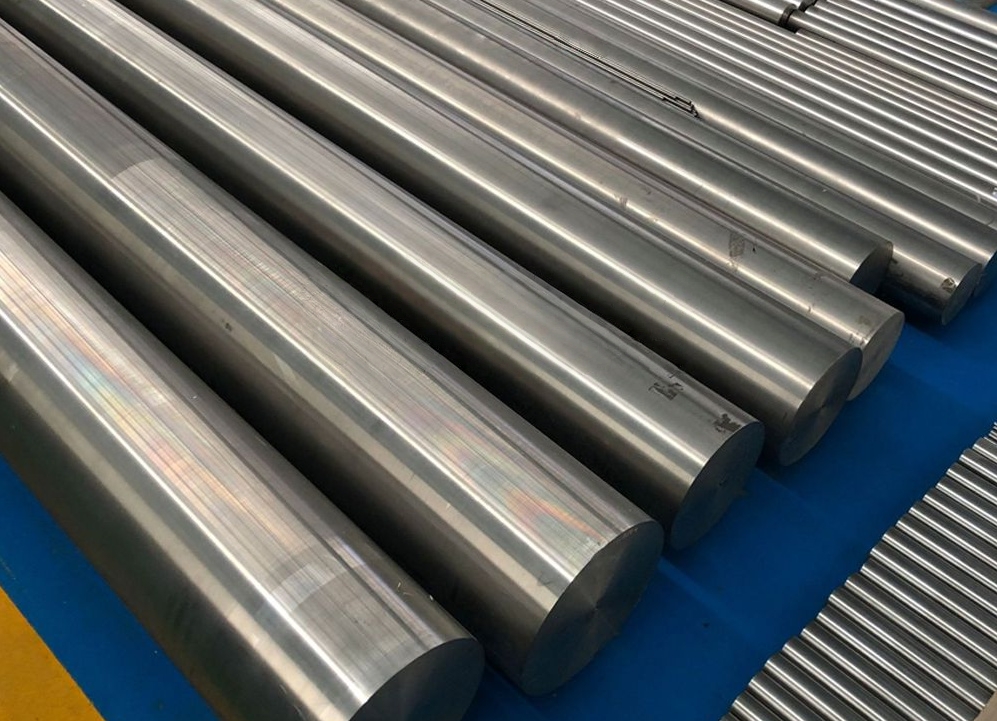
The manufacturing process of titanium bar stock involves highly specialized techniques to achieve the desired mechanical properties, uniform microstructure, and dimensional accuracy. Blanking and multi-directional repeated upsetting are key steps in the forging process, ensuring that the titanium bar stock has optimal strength, ductility, and performance. This article explores the detailed processes, challenges, and best practices for forging titanium bar stock.
1. Blanking: The Initial Forging Process
Blanking begins at temperatures 150–250°C above the β-transformation point of titanium. At this stage, titanium exhibits the highest plasticity, making it ideal for breaking down the original cast structure.
Key Steps in the Blanking Process:
Begin with light and rapid strikes to deform the ingot and crush the coarse primary grain structure.
This step ensures the breakdown of the casting structure, improving plasticity for subsequent forging.
1.2 Controlled Deformation Degree:
Maintain a deformation degree of 20–30% to ensure the ingot achieves the desired microstructural refinement.
1.3 Recrystallization and Grain Refinement:
Recrystallization intensifies with increasing temperature, longer holding times, and finer grains.
To prevent abnormal grain growth caused by excessive recrystallization, gradually reduce the forging temperature and strictly control the heating and holding time.
1.4 Final Blanking:
Forge the ingot into the required cross-sectional size and cut it into dimension-specific blanks for further processing.
Benefits of Blanking:
Crushing the casting structure improves the titanium’s ductility.
Refined microstructure ensures better performance in subsequent forming processes.
2. Multi-Directional Repeated Upsetting: The First Stage
The first stage of multi-directional repeated upsetting begins at a temperature 80–120°C above the β-transformation point. This process refines the titanium microstructure and improves uniformity throughout the blank.
Steps in the First Multi-Directional Upsetting Process:
2.1 Alternating Forging:
Perform 2–3 cycles of upsetting and elongation, alternating between the axes and edges of the blank.
This approach ensures that the entire cross-section of the blank develops a uniform, fine-grain microstructure with B-zone deformation characteristics.
2.2 Achieving a Homogeneous Microstructure:
Alternating the forging direction eliminates coarse grains and ensures uniformity.
If the blank proceeds directly to rolling, this step becomes unnecessary.
3. Second Multi-Directional Repeated Upsetting
The second stage of multi-directional upsetting is similar to the first but depends on the final application of the titanium bar stock.
Preventing Shear Bands and Cracks:
3.1 Preheat the Tools:
Ensure that forging tools are preheated to minimize surface cooling of the titanium blank.
Use faster striking speeds to reduce the contact time between the blank and tools.
3.3Control Deformation Degree:
Limit the degree of deformation during each stroke to prevent the formation of X-shaped shear bands and cracks.
4. Forging Techniques to Prevent Defects
4.1 Corner Cooling and Crack Prevention:
Corners of titanium blanks cool faster, so frequent flipping of the blank and adjusting the hammer force are necessary to avoid sharp angles and cracks.
During hammer forging, start with light strikes causing deformation of 5–8%, then gradually increase the deformation amount.
4.3 Die Forging for Near-Net Shapes:
Die forging is used to produce blanks with shapes and dimensions close to the final product.
Unlike steel alloys, in titanium, the final forging step significantly influences the microstructure and properties since heat treatment has limited effects on titanium alloys.
5. Importance of Forging Temperature and Deformation Degree
The forging temperature and deformation degree are critical factors in determining the final microstructure and properties of titanium bar stock:
Excessive Temperature: Leads to coarse grains and reduced strength.
Insufficient Deformation: Fails to break down the casting structure, resulting in poor ductility.
Proper Control: Ensures uniform grain size, enhanced performance, and reduced risk of defects.
Mastering Titanium Bar Stock Forging
The processes of blanking and multi-directional repeated upsetting are crucial for producing high-quality titanium bar stock with a uniform microstructure and superior mechanical properties. By carefully controlling forging temperatures, deformation degrees, and tool preheating, manufacturers can prevent defects like shear bands, cracks, and corner cooling issues.
For industries requiring premium titanium bar stock for aerospace, medical, or industrial applications, precise forging processes ensure optimal performance and reliability.
Need high-quality titanium bar stock tailored to your needs? Contact us today to learn more about our specialized forging techniques and premium products.