Grade 5 titanium, renowned for its high specific strength, corrosion resistance, and non-magnetic properties, is one of the most widely used titanium alloys today. As an α+β dual-phase alloy, it offers excellent weldability, low density, and outstanding high-temperature performance. With the increasing demand for larger and more complex titanium alloy components, welding has emerged as an indispensable and highly efficient connection method in titanium manufacturing, drawing growing attention from researchers and engineers alike. Grade 5 titanium is extensively utilized in aerospace, weapon systems, and advanced equipment due to its superior mechanical properties and versatility. This article explores various welding methods applied to grade 5 titanium, examining their technical characteristics and the resulting joint performance to guide best practices in advanced manufacturing applications.
1. Weldability Analysis of Grade 5 Titanium
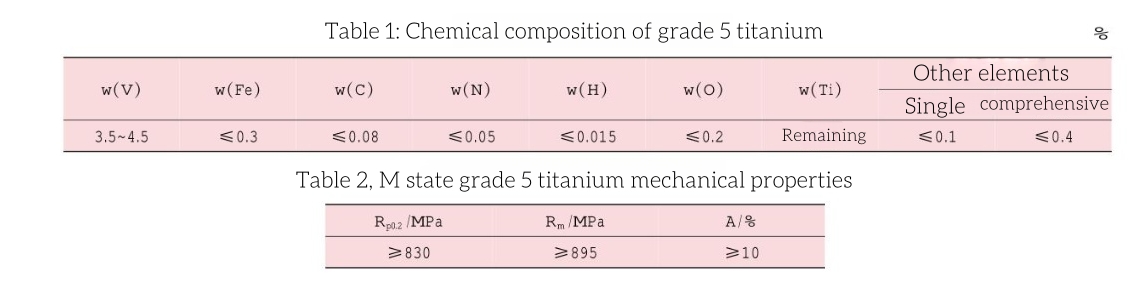
Grade 5 titanium’s chemical composition and mechanical properties (see Table 1 and Table 2) grant it a unique combination of strength and ductility. However, its high chemical reactivity at elevated temperatures introduces several challenges during welding. When exposed to the atmosphere during welding, Grade 5 titanium readily absorbs gases such as oxygen, nitrogen, and hydrogen from air, water vapor, and surface contaminants like grease. This absorption can result in gas porosity and embrittlement, causing a marked decrease in the ductility and toughness of weld joints.
Key Issues in Welding Grade 5 Titanium
· Gas Contamination: High-temperature titanium is highly reactive. Inadequate shielding allows for gas absorption, forming pores and embrittling the joint.
· Poor Thermal Conductivity: Titanium’s low thermal conductivity leads to wide heat-affected zones (HAZ) and coarse grains, particularly in the weld zone, which can lower joint ductility.
· Hydrogen Embrittlement and Cold Cracks: The presence of hydrogen and residual stresses can promote cold cracking, especially as titanium’s low elastic modulus makes it susceptible to deformation and difficult to correct post-welding.
· Post-Weld Stress: High residual stresses from cooling can cause distortion and affect dimensional stability.
Essential Welding Precautions
To achieve high-quality welded joints in Grade 5 titanium, several process controls are mandatory:
· Pre-weld Cleaning: Complete removal of oil, grease, and moisture from the workpiece surface.
· Control of Interpass Temperature: Maintaining appropriate temperatures between weld passes to avoid overheating.
· Atmospheric Shielding: Employing high-purity inert gases (typically argon) to protect the weld pool from air contamination.
· Post-Weld Cooling: Managing cooling rates to minimize residual stresses and distortion.
· Post-Weld Heat Treatment (PWHT): Applying stress-relief annealing to release welding-induced stresses, stabilize dimensions, and remove residual hydrogen.
Through careful compliance with these measures, Grade 5 titanium can be reliably welded into medium- and high-strength structures with excellent joint integrity.
2. Analysis of Joint Performance with Different Welding Methods
Grade 5 titanium supports a range of advanced welding technologies, each with unique advantages, limitations, and effects on joint quality. Below, we analyze key methods, referencing empirical data and industry standards.
2.1 TIG Welding (Gas Tungsten Arc Welding, GTAW)
Process Characteristics
TIG welding (argon arc welding) is the most widely used method for titanium alloys, including Grade 5. The process is characterized by a wide heat-affected zone and significant thermal deformation. Key control points include strict pre-weld cleaning and robust shielding to prevent gas contamination and formation of brittle phases.
2.1.1 Effect of Filler Material on Joint Performance
Following ISO15614.5-2004 standards, Grade 5 titanium can be TIG welded using either Grade 5 or Grade 9 filler wire, followed by post-weld heat treatment (e.g., 600°C for 1 hour).
· Grade 9 Filler Wire: Produces joints with lower tensile strength but greater plasticity. Suitable when ductility is prioritized.
· Grade 5 Filler Wire: Yields higher tensile strength but lower ductility, ideal for applications demanding maximum strength.
Selection Principle:
For high-pressure vessels or structural components, filler metal is generally chosen to match the composition and strength of the base metal. However, due to the reduced ductility of high-strength titanium alloy joints, selecting a slightly lower-strength filler can help achieve a better balance between strength and toughness under working conditions.
2.1.2 Effect of Different Heat Treatments on Joint Properties
Using 1.6mm Grade 9 filler wire, welds are tested both in as-welded and heat-treated states. After heat treatment, the hardness of the weld zone increases due to oxygen absorption during annealing, and the weld zone’s hardness surpasses that of the HAZ. In the as-welded state, the HAZ and parent material remain harder than the weld seam.
Implication:
Proper heat treatment can improve the overall uniformity and toughness of the joint, but may also increase hardness and reduce local ductility due to interstitial element absorption. Careful optimization is required.
2.2 Cold Welding
Cold welding for titanium uses short, high-energy discharges from a tungsten electrode, with each pulse melting the base metal for a fraction of a second. Because the pulse duration is extremely short compared to the interval between pulses, heat does not accumulate in the weld area.
Advantages for Grade 5 Titanium:
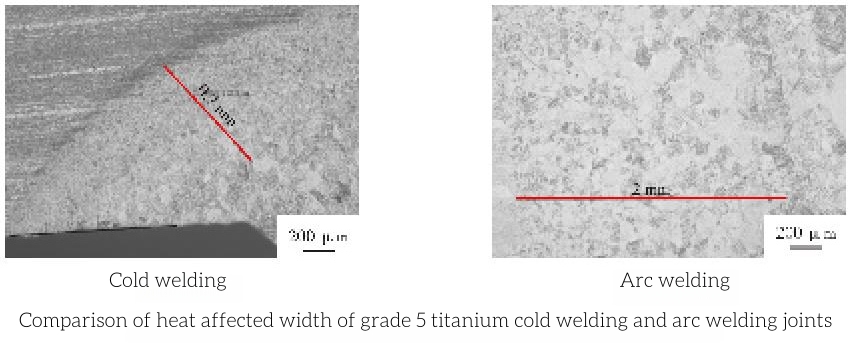
· Narrow HAZ: Minimal heat input results in a very small heat-affected zone (0.7–1.0mm for 2mm plate), roughly half that of TIG welding.
· Low Distortion: The rapid heat dissipation reduces thermal deformation and residual stresses.
· Suitable for Thin Sections: Particularly beneficial for electronics, medical devices, and thin-walled aerospace components.
Microstructural Observation:
Compared to TIG welding, cold-welded joints exhibit finer grain structure and less pronounced changes in hardness between the weld seam and HAZ. Weld strength is comparable, but the reduction in HAZ width and deformation is a significant advantage.
2.3 Laser Welding
Laser welding is highly suitable for titanium alloys, especially in thin sheets and precision components.
Key Features:
· High Energy Density: Concentrated heat input enables deep, narrow welds and high travel speeds.
· Minimal Distortion: Fast cooling rates reduce residual stresses and warping.
· High Efficiency and Quality: Laser welding of Grade 5 titanium produces joints with excellent strength and elongation (>11%), often matching or exceeding the parent material.
Application Scope:
Laser welding is increasingly used for aerospace, medical, and micro-electronics due to its precision and repeatability.
2.4 Electron Beam Welding (EBW)
Electron beam welding offers several metallurgical and mechanical advantages for Grade 5 titanium:
· Superior Metallurgical Quality: The high vacuum environment prevents atmospheric contamination, leading to clean, inclusion-free joints.
· Narrow, Deep Welds: High aspect ratio welds with fine grain structure and minimal angular distortion.
· Enhanced Joint Strength: EBW joints often show higher tensile strength than the base metal, with slightly reduced plasticity. After heat treatment, the joint strength can increase, while the parent metal may slightly decrease in strength.
Suitability:
Particularly effective for thick sections and critical, high-performance assemblies where joint integrity is paramount.
2.5 Resistance Spot Welding
Resistance spot welding is used for joining thin sheets of Grade 5 titanium. As material thickness increases, welding current and duration must also increase, resulting in larger weld nugget diameters and improved shear strength.
Key Points:
· Scalability: Effective for a range of sheet thicknesses.
· Mechanical Performance: Shear strength increases with weld size, provided process parameters are correctly managed.
3. Existing Issues and Research Directions
Despite Grade 5 titanium’s excellent weldability, several challenges remain, particularly for high-performance and safety-critical applications.
3.1 Fatigue Behavior of Welded Joints
Titanium welds differ fundamentally from those in steels due to the non-homogeneous nature of the weld, geometric discontinuities, and residual stress fields. While titanium joints offer high strength, their limited ductility makes them more sensitive to fatigue crack initiation and propagation. The fatigue characteristics of different welding methods (TIG, laser, EBW, cold welding) require further systematic study, especially under complex loading conditions.
3.2 Incomplete Strength Evaluation Systems
Currently, the standards for evaluating titanium alloy welded joints are not as comprehensive as those for steels. More research is needed to develop evaluation methodologies that account for the unique microstructural and mechanical characteristics of titanium welds, including multi-axial stresses, dynamic loads, and environmental factors.
4. Conclusion
· Weldability: Grade 5 titanium offers excellent weldability with a range of joining methods, including TIG, laser, electron beam, and cold welding. Strength, ductility, and toughness typically meet or exceed engineering standards, provided process controls are rigorously observed.
· TIG Welding: Using Grade 9 filler wire, average joint strength reaches 982.5 MPa with 7.5% elongation, demonstrating balanced strength and ductility as well as good low-temperature toughness and uniform microstructure.
· Cold Welding: Compared to TIG, cold welding produces a narrower HAZ (0.7–1.0mm vs. 1.8–2.2mm), minimizes deformation, and maintains comparable joint strength. The weld zone hardness remains lower than the HAZ, facilitating better stress distribution.
· Laser Welding: Laser-welded Grade 5 titanium joints exhibit high tensile strength and elongation (>11%), approaching base metal properties and offering superior performance over traditional TIG welding.
· Electron Beam Welding: EBW yields joints with even higher strength than the parent material and good low-temperature toughness. Post-weld heat treatment further enhances joint strength, albeit with a minor reduction in parent material strength.
· Resistance Spot Welding: Increased current and duration for thicker materials produce larger welds and higher shear strength, making this technique effective for sheet assembly.
With continued advances in welding technology and deeper understanding of grade 5 titanium’s microstructural behavior, manufacturers can achieve high-performance, reliable joints for the most demanding applications.
Frequently Asked Questions and Answers
1. What are the most effective welding methods for Grade 5 titanium (Ti-6Al-4V), and how do they differ in influencing weld joint performance metrics like tensile strength and fatigue resistance?
The most effective methods include TIG welding, laser welding, electron beam welding, cold welding, and resistance spot welding. TIG welding offers reliable strength and ductility, but higher heat input can increase grain size. Laser and electron beam welding provide narrower HAZ, higher tensile strength, and better fatigue properties due to finer microstructure and reduced residual stress. Cold welding is ideal for precision and minimal distortion. The choice depends on part geometry, required mechanical properties, and application environment.
2. How does the choice of welding parameters (e.g., heat input, shielding gas type, post-weld heat treatment) impact the microstructural evolution and mechanical performance of Grade 5 titanium welds, and what analysis techniques are used to evaluate these effects?
Heat input affects grain growth and HAZ width—lower heat input (as in laser or cold welding) results in finer grains and better mechanical properties. High-purity argon shielding prevents gas contamination and embrittlement. Post-weld heat treatment relieves residual stresses, stabilizes dimensions, and modifies microstructure for improved toughness. Evaluation techniques include optical microscopy, SEM, hardness testing, tensile and fatigue testing, and non-destructive testing such as ultrasonic inspection.
3. What are the key challenges in achieving high-performance Grade 5 titanium welds, and how do comparative performance analyses of different welding processes (e.g., TIG vs. laser welding) guide process selection for critical applications?
Challenges include controlling gas contamination, managing residual stresses and distortion, and optimizing microstructure for both strength and ductility. Comparative analysis shows that laser and electron beam welding offer superior joint strength, finer microstructure, and less distortion compared to TIG welding, making them preferable for critical, precision parts. However, TIG remains versatile and cost-effective for many applications. Selection depends on balancing performance requirements, cost, and manufacturability.