Grade 5 titanium(Ti-6Al-4V)is widely recognized for its excellent mechanical performance and is extensively used in applications requiring strength and stability at elevated temperatures. Since Grade 5 titanium currently works mainly at 400°C, we tested its multi-stress creep data at this temperature, drew the time-stress curve under a certain residual deformation, and analyzed and discussed the creep properties of TC4 titanium alloy. Internationally, the mainstream high-temperature titanium alloys include American Ti-1000, British IMI834, Russian BT36, and Chinese Ti600. These titanium alloys are known for their high instantaneous strength and outstanding creep resistance when exposed to high temperatures, making them essential in aerospace and high-performance engineering. This article focuses on the detailed creep behavior of Grade 5 titanium at 400°C, comparing its properties to other advanced alloys, and provides critical insights into its long-term reliability and application limits in demanding high-temperature environments.
1. Experimental Principles and Methods
1.1 Test Principle
Creep testing is a fundamental method for evaluating a material’s dimensional stability under prolonged stress at elevated temperatures. The standard procedure applies a constant tensile load axially to a specimen at a controlled temperature, recording total and residual elongation over time to determine creep rupture time and deformation characteristics. This method captures both elastic and plastic strain components, providing critical data for predicting long-term performance in service conditions.
1.2 Test Method
Given that grade 5 titanium is most commonly employed at 400°C, we defined failure criteria as 0.1% residual creep deformation at 35 hours and 0.2% residual creep deformation at 100 hours. The specimens were prepared from titanium rod with an initial diameter of 20 mm. After heat treatment (holding at 780°C for 1.5 hours followed by air cooling), the rods were machined into standard creep test specimens with a 10 mm diameter.
All creep tests were conducted using an RD2-type creep testing machine. This equipment offers a force accuracy of class 0.5 and a coaxiality deviation of less than 6%, ensuring high-precision results. The specimens were subjected to multi-stress creep tests at 400°C, with continuous monitoring of elongation and precise determination of the time to reach predefined residual deformation levels.
2. Experimental Results and Discussion
2.1 Test Results
The multi-stress creep tests produced a comprehensive set of data, recording the relationship between total elongation and time for grade 5 titanium rod at 400°C. The results, visualized in Figure 1,
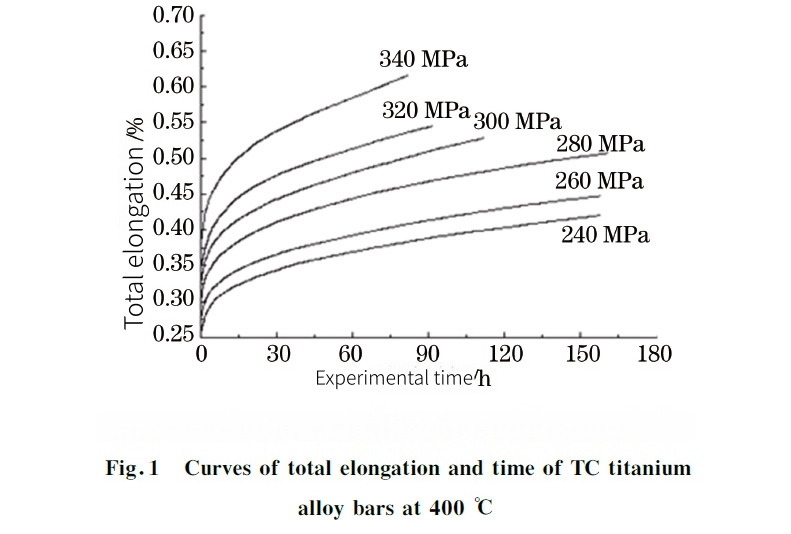
show the elongation behavior under various applied stresses. Calculations based on these data yielded the elastic deformation characteristics of grade 5 titanium at 400°C, as summarized in Table 1.
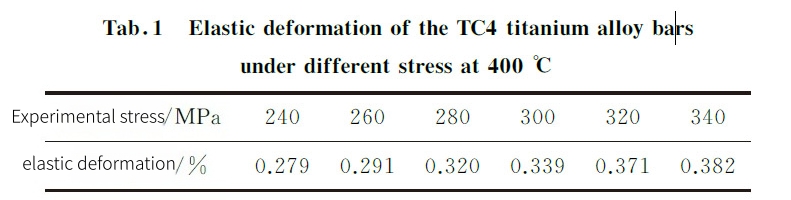
During a creep test, the total elongation of the specimen consists of both elastic and plastic (creep) deformation. Only the total elongation is directly measured during the test, while elastic deformation is assumed to remain constant at a given stress throughout the test. Using the data in Table 1, we determined the total elongation corresponding to 0.1% and 0.2% residual deformation, which served as the criteria for terminating each test run. The corresponding stress levels and times for each criterion are listed in Table 2.
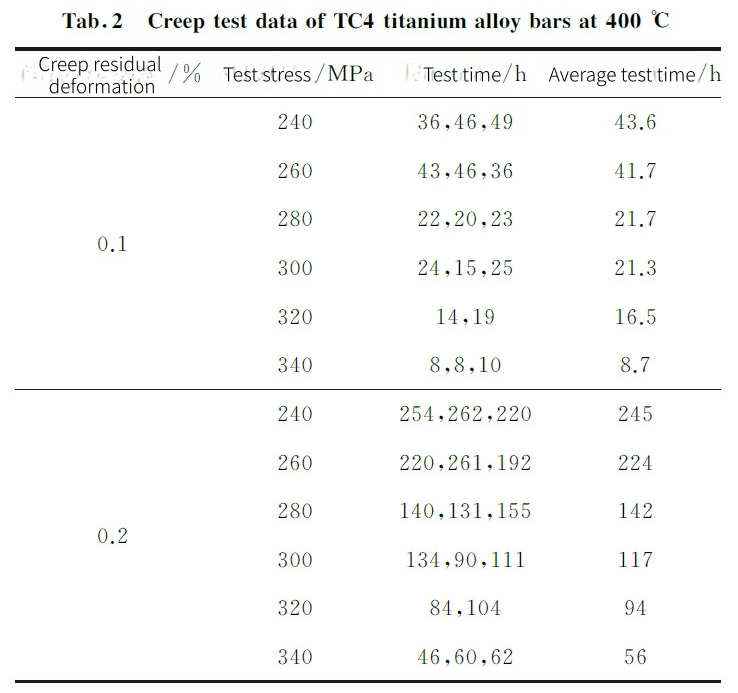
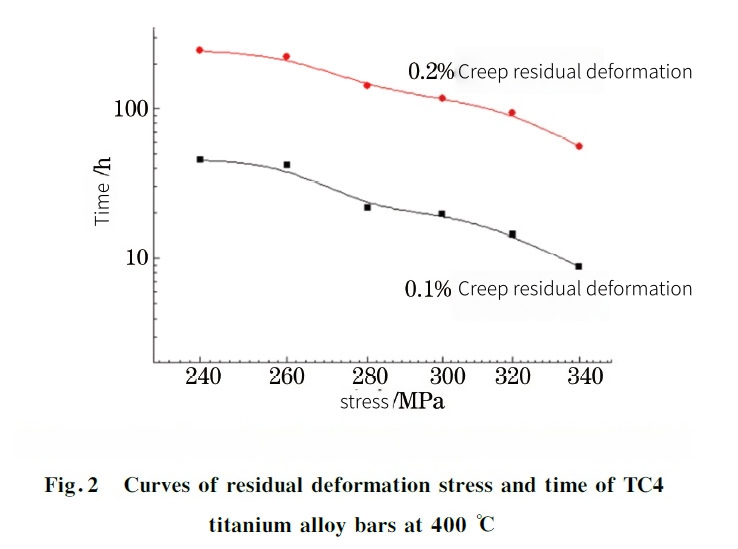
Based on this result, the stress-time curve of the specified residual deformation at the specified temperature is drawn, as shown in Figure 2.
2.2 Discussion
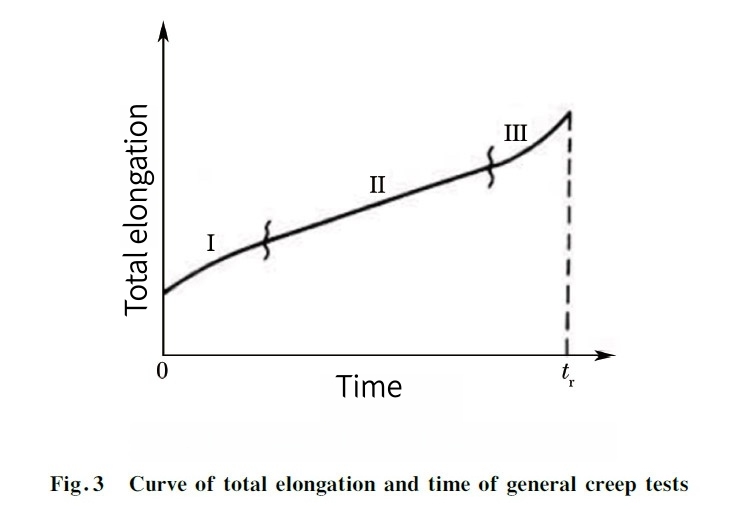
Analysis of the creep curves, particularly Figure 3, reveals the characteristic three-stage behavior common to metallic materials under high-temperature creep:
Primary (Stage I): Acceleration decreases and strain rate increases until reaching a steady state. The curve’s slope decreases and the trend becomes more gradual.
Secondary (Stage II): The strain rate becomes steady and constant, indicating a balance between work hardening and recovery mechanisms. The curve exhibits a constant slope.
Tertiary (Stage III): The strain rate increases rapidly, leading to fracture. The curve’s slope increases sharply as failure approaches.
By applying the principle that total elongation equals the sum of elastic and plastic deformation, and using the defined residual creep criteria (0.1% and 0.2%), we established precise end points for each test. Across all stress levels, six tests were completed for each condition. Despite variations in test duration, the observed plastic deformation remained relatively consistent, with values tightly clustered around 0.1% ±0.005% and 0.2% ±0.008%.
The results confirm that, under the specified test conditions, the elastic deformation of grade 5 titanium rod at a given stress remains unchanged as time progresses. This is a valuable finding for engineering design, as it affirms the predictability and stability of elastic behavior even under prolonged high-temperature loading.
3. Conclusions
3.1 Time to Creep Stabilization
The time required for grade 5 titanium rod to reach a steady-state creep regime decreases as the applied stress increases. Higher stress levels accelerate creep, leading to shorter stabilization times and higher steady-state creep rates. This relationship is crucial for predicting material lifespan in service.
3.2 Relationship Between Stress, Time, and Deformation
At 400°C, under the conditions of 0.1% and 0.2% residual deformation, the test data for grade 5 titanium rod demonstrate an approximately linear relationship between applied stress and test time when both values are plotted on logarithmic scales. Importantly, elastic deformation does not change with time under a constant applied stress, further underscoring the alloy's reliability for dimensional stability in long-term, high-temperature applications.
3.3 Applicability of the Test Method
This experimental approach enables accurate determination of the creep performance of grade 5 titanium rod under prescribed operational conditions. It is especially useful when sample material is limited, providing robust guidelines for material selection and component design in high-stress, high-temperature environments.
4. Engineering Implications
The results from these creep tests have direct applications in the aerospace, power generation, and advanced manufacturing sectors, where grade 5 titanium is frequently specified for turbine blades, engine components, and structural elements exposed to prolonged service at high temperatures. Understanding the creep behavior of titanium rod under realistic operating conditions ensures safer designs, optimizes material usage, and extends component life cycles.
Comparisons with other high-temperature titanium alloys—such as Ti-1000 (USA), IMI834 (UK), BT36 (Russia), and Ti600 (China)—highlight that while grade 5 titanium may not possess the absolute highest creep strength, its well-balanced mechanical properties, workability, and cost-effectiveness make it an attractive choice for many industrial and aerospace applications.
Frequently Asked Questions and Answers
1. What Are the Standard Creep Behavior Test Methods for Grade 5 Titanium at High Temperatures, and How Do They Ensure Reliability in Aerospace Component Design?
Standard creep testing for grade 5 titanium at high temperatures involves subjecting a precisely machined specimen to a constant tensile load at a controlled temperature, typically using a high-precision creep testing machine. The test records total elongation over time, allowing analysis of elastic and plastic (creep) deformation. By defining failure criteria based on residual creep strain (e.g., 0.1% or 0.2%), engineers can predict long-term deformation under service conditions. This approach ensures the reliability and safety of aerospace components, such as turbine blades and structural supports, by providing data that supports conservative, robust design limits.
2. How Do Key Parameters in Creep Behavior Tests of Grade 5 Titanium at High Temperatures Affect Long-Term Performance Predictions for Gas Turbine Engine Parts?
Key parameters—such as testing temperature, applied stress, residual deformation criteria, and specimen heat treatment—directly influence the measured creep rate, stabilization time, and ultimate failure time. Higher stress and temperature accelerate creep, reducing component lifespan. By accurately characterizing how grade 5 titanium rod behaves under these conditions, engineers can develop more precise life prediction models, optimize maintenance schedules, and select appropriate safety factors for gas turbine engine parts operating at or near 400°C.
3. Why Are Creep Behavior Tests Critical for Grade 5 Titanium at High Temperatures, and How Do They Guide Material Selection in High-Stress Industrial Applications?
Creep tests are essential for understanding how grade 5 titanium deforms over time under sustained load at elevated temperatures. This knowledge is crucial for selecting materials that maintain dimensional stability and mechanical integrity in high-stress environments, such as power plants, aerospace engines, and industrial reactors. Reliable creep data enable engineers to compare grade 5 titanium with other advanced alloys, ensuring the optimal balance of performance, safety, and cost-effectiveness for each application.