Due to factors such as product design and processing conditions, some parts of the titanium alloy rod and wire surfaces may remain exposed in the final product. As a result, medical titanium alloy rods and wires have very high requirements for surface quality to ensure safety and reliability in clinical applications. Among the various surface defects found in titanium rods and wires, fine cracks are considered the most harmful, as they can significantly compromise the material’s strength and long-term performance.
In this study, medical titanium alloy rods and wires of commonly used specifications were selected for investigation. Non-destructive testing methods such as visual inspection and ultrasonic testing, which are currently widely used in the industry, were employed to conduct experiments and evaluate their effectiveness in detecting fine cracks. The aim of this paper is to summarize the key non-destructive detection techniques for cracks in titanium wires and rods, providing valuable insights for manufacturers and quality control professionals who seek to maintain the highest standards of surface integrity in medical and industrial titanium products.
1. Material Selection
For this comparative study, a total of 20 titanium alloy rods and wires were selected, representing a spectrum of commonly used diameters and lengths for industrial and medical applications:
· 2.4mm wire: 3 pieces
· φ5.1mm wire: 3 pieces
· φ5.2mm wire: 3 pieces
· 6.0mm rod: 3 pieces
· φ13.5mm rod: 2 pieces
· φ14.5mm rod: 2 pieces
· φ16.5mm rod: 4 pieces
All rods and wires were selected with lengths ranging from 2000mm to 3000mm to simulate actual production and clinical implantation scenarios. The variety in diameters allows for a comprehensive evaluation of detection methods across both thin wires and thick rods, which may present different challenges in crack detection.
2. Testing Procedure
To thoroughly assess the surface quality and internal integrity of titanium alloy rods and wires, the following sequence of non-destructive testing (NDT) methods was adopted:
2.1 Visual Inspection
Initial assessment to identify obvious surface cracks or defects with the naked eye and magnifying aids.
2.2 Ultrasonic/Eddy Current Testing
Application of advanced ultrasonic and eddy current probes to detect sub-surface flaws and micro-cracks.
2.3 X-ray Testing
Radiographic examination to identify internal or volumetric defects invisible on the surface.
2.4 Dye Penetrant Testing (DPT)
Application of color-contrast dye to highlight surface-breaking cracks through capillary action.
2.5 Fluorescent Penetrant Testing (FPT)
Use of high-sensitivity fluorescent dyes and ultraviolet light to detect the smallest surface micro-cracks.
Each method is designed to complement the others, ensuring no critical defect is missed—an approach particularly vital for quality assurance in titanium alloy rods and wires destined for medical implantation or high-stress industrial use.
3. Testing Equipment
The following specialized equipment was used to maximize detection reliability and accuracy:
· Handheld Magnifier & Stereo Magnifier
For enhanced visual inspection of surface features.
· Zeiss Optical Microscope
For high-resolution examination and documentation of crack morphology.
· CTS-22 Ultrasonic Flaw Detector
Coupled with immersion focusing probes, optimized for detecting near-surface and internal cracks.
· EEC Eddy Current Flaw Detector
For rapid, non-contact scanning of surface and sub-surface flaws, especially in thin wires.
· X-ray Flaw Detector
Provides radiographic imaging of volumetric defects within rods and wires.
· DPT-5 Dye Penetrant Kit
For color-contrast crack detection using capillary action.
· Self-Emulsifying/ Post-Emulsifying Fluorescent Penetrant Inspection System
For high-sensitivity detection of micro-cracks, in accordance with HB/Z61-1998 sensitivity level 3.
4. Test Results and Analysis
4.1 Visual Inspection
Visual inspection, aided by magnification, was able to detect most wide or open surface cracks. Specifically:
· No cracks detected: All 3 pieces of φ2.4mm wire; 2 pieces of φ5.2mm wire; 1 piece of φ6.0mm rod; 1 piece of φ13.5mm rod; 1 piece of φ14.5mm rod; 2 pieces of φ16.5mm rod.
· Cracks detected: The remaining rods and wires exhibited various degrees of surface cracking, which were marked and recorded for further analysis.
Conclusion:
Visual inspection is effective for identifying large, open cracks but may miss fine or tightly closed surface micro-cracks, especially those that are narrow or shallow.
4.2 Ultrasonic Shear Wave Testing
Ultrasonic shear wave testing was performed on φ13.5mm, φ14.5mm, and φ16.5mm rods using the CTS-22 device and immersion focusing probes. Artificial notches (15x0.1x0.1mm, LxWxD) were introduced as calibration standards.
· φ13.5mm rods:
o 1# rod: Detected a non-critical single signal (-6dB).
o 2# rod: No defect signals observed.
· φ14.5mm rods:
o 1# rod: Detected a non-critical single signal (-3dB).
o 2# rod: No defect signals observed.
· φ16.5mm rods:
o 1#, 3#, 4#: No defect signals observed.
o 2#: Detected a critical defect signal (+2dB) and non-critical signals (-3~-1dB) elsewhere.
Conclusion:
Ultrasonic detection is sensitive to cracks equivalent to or larger than the minimum artificial notch (15x0.1x0.1mm), but distinction between true flaw echoes and background noise becomes more difficult as flaw size decreases.
4.3 X-ray Detection
X-ray testing was applied to 2# and 3# pieces of φ5.2mm wire and a φ5.5mm standard rod.
· Results:
o Only artificial notches on the standard rod were clearly visible on the radiographs: 15x0.2x0.2mm notches were distinct, while 5x0.1x0.1mm notches were faint.
o No cracks were observed on φ5.2mm wires.
Conclusion:
X-ray detection is effective for identifying volumetric or large defects but not suitable for fine, surface-breaking cracks—especially in wires or thin rods.
4.4 Fluorescent Penetrant Testing
Following HB/Z61-1998 (sensitivity level 3), all samples were subjected to fluorescent penetrant testing.
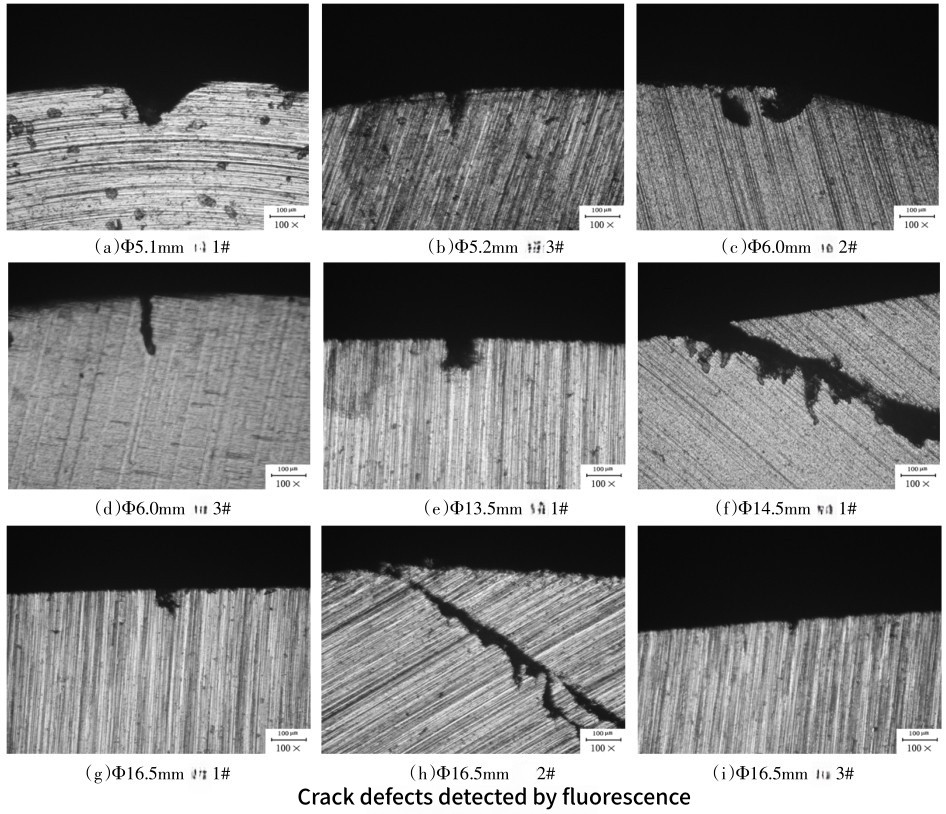
· No cracks detected: 1–3# of φ2.4mm wire, 1–2# of φ5.2mm wire, and 4# of φ16.5mm rod.
· Cracks detected: All other rods and wires exhibited clear, visually prominent crack indications under UV light.
Conclusion:
Fluorescent penetrant testing is highly sensitive to surface-breaking micro-cracks, providing clear and direct visual evidence even for very small defects.
5. Result Verification and Comparative Analysis
To compare the effectiveness of each detection method, cross-sectional metallographic microscopy was performed at all locations marked as defective or accepted by the various NDT techniques.
5.1 Visual Inspection
· Findings:
Visual inspection reliably detected major, wide-open cracks, but was prone to missing narrow or fine micro-cracks. Magnification improved detection but did not fully eliminate the possibility of oversight.
5.2 Ultrasonic Shear Wave Detection
· Findings:
Higher sensitivity improves detection but increases background noise, making it difficult to distinguish micro-defects from surface scratches or noise reflections. Effective detection is generally limited to flaws equal to or larger than the minimum artificial notch size (15x0.1x0.1mm).
5.3 X-ray Detection
· Findings:
X-ray is best suited for volumetric or internal defects. It is not effective for detecting planar or fine surface cracks, especially in thin wires.
5.4 Dye Penetrant Testing
· Findings:
Suitable for detecting cracks with significant capillary action (depth-to-width ratio >1.5). Offers improved sensitivity over visual inspection, but may still miss the finest cracks.
5.5 Fluorescent Penetrant Testing
· Findings:
Demonstrated the highest sensitivity for surface micro-cracks, providing clear and prominent indications even for the smallest defects. Detection rates for micro-cracks were significantly higher than with other methods.
6. Summary
For Titanium alloy rods and wires, especially those intended for medical implantation or high-performance applications, ensuring surface integrity is critical. This study confirms that:
· Visual inspection can detect most wide surface cracks, but is less effective for fine micro-cracks unless aided by high magnification.
· Ultrasonic shear wave is effective for detecting sub-surface and near-surface flaws larger than the minimum artificial notch, but can struggle with background noise and distinguishing very small defects.
· X-ray testing is best for identifying large, volumetric flaws, not fine cracks.
· Dye penetrant and especially fluorescent penetrant testing offer the highest sensitivity to surface-breaking micro-cracks, with fluorescent penetrant providing the most reliable and intuitive results.
Combining multiple NDT methods—beginning with visual inspection and progressing through ultrasonic, X-ray, and penetrant techniques—enables manufacturers to ensure the highest standards of quality and safety for titanium alloy rods and wires, particularly those used in critical biomedical implantation or aerospace applications.
Frequently Asked Questions and Answers
1. What are the primary nondestructive testing methods for detecting cracks in titanium wires and rods, and how do they differ in accuracy for micro-crack vs. macro-crack detection?
Primary methods include visual inspection, ultrasonic testing, X-ray inspection, dye penetrant testing, and fluorescent penetrant testing. Visual and X-ray methods are more suitable for detecting macro-cracks, while ultrasonic and especially fluorescent penetrant testing are highly sensitive to micro-cracks.
2. Which nondestructive testing method is most reliable for inspecting cracks in titanium wires and rods used in aerospace applications, and what factors affect its detection performance?
Fluorescent penetrant testing is generally the most reliable for detecting surface-breaking micro-cracks, which are most critical in aerospace. Ultrasonic testing is preferred for detecting sub-surface cracks in thicker rods. Detection performance depends on crack orientation, surface finish, equipment sensitivity, and operator expertise.
3. What are the key challenges in applying nondestructive testing methods to detect cracks in thin titanium wires vs. thick titanium rods, and how can testing protocols be optimized?
Thin wires present challenges due to small surface area and limited defect volume, making micro-crack detection difficult for X-ray and ultrasonic methods. Thick rods allow better ultrasonic penetration but require careful calibration. Protocols can be optimized by combining multiple methods (especially penetrant testing for surface cracks and ultrasonic for internal flaws) and tailoring sensitivity settings to sample geometry and expected defect types.