In aircraft manufacturing, titanium alloy fasteners play a pivotal role in uniting composite skins, aluminum frames, and high-temperature engine structures. By replacing steel with titanium bolts, airframers Reduce structural weight by roughly 40–50% at equal strength class, helping cut fuel burn and CO2. For a single-aisle aircraft, a few hundred kilograms saved can translate to 0.5–1.0% efficiency gains across typical mission profiles. Beyond mass, titanium’s native oxide film helps Prevent electrochemical corrosion at mixed-material joints—particularly carbon fiber–aluminum interfaces—where galvanic potentials otherwise accelerate attack. Improved corrosion resistance directly Improve the lifespan of the body, extending inspection intervals and lowering maintenance costs.
Titanium alloy fasteners also offer high specific strength and good fatigue performance, sustaining clamp load under vibration and thermal cycling from −55°C to 200°C (and higher in engine bays). Their compatibility with composites reduces risk of fiber cut-through and hot-wet degradation, while tailored coatings (e.g., MoS2, PVD) manage friction and galling. Although procurement cost is higher—often 3–5× steel—the lifecycle payoff includes fewer replacements, reduced sealant use, and weight-driven payload or range benefits. As fleets shift to advanced composites and hybrid structures, the strategic use of titanium bolts becomes a cornerstone in achieving lighter, longer-lasting, and more sustainable airframes.
1. Main classifications of titanium alloy fasteners
Aviation titanium fasteners are broadly divided into threaded titanium fasteners, interference fasteners, and special fasteners. Their strength-to-weight advantages and electrochemical compatibility suit aluminum, titanium, and composite structures across the airframe.
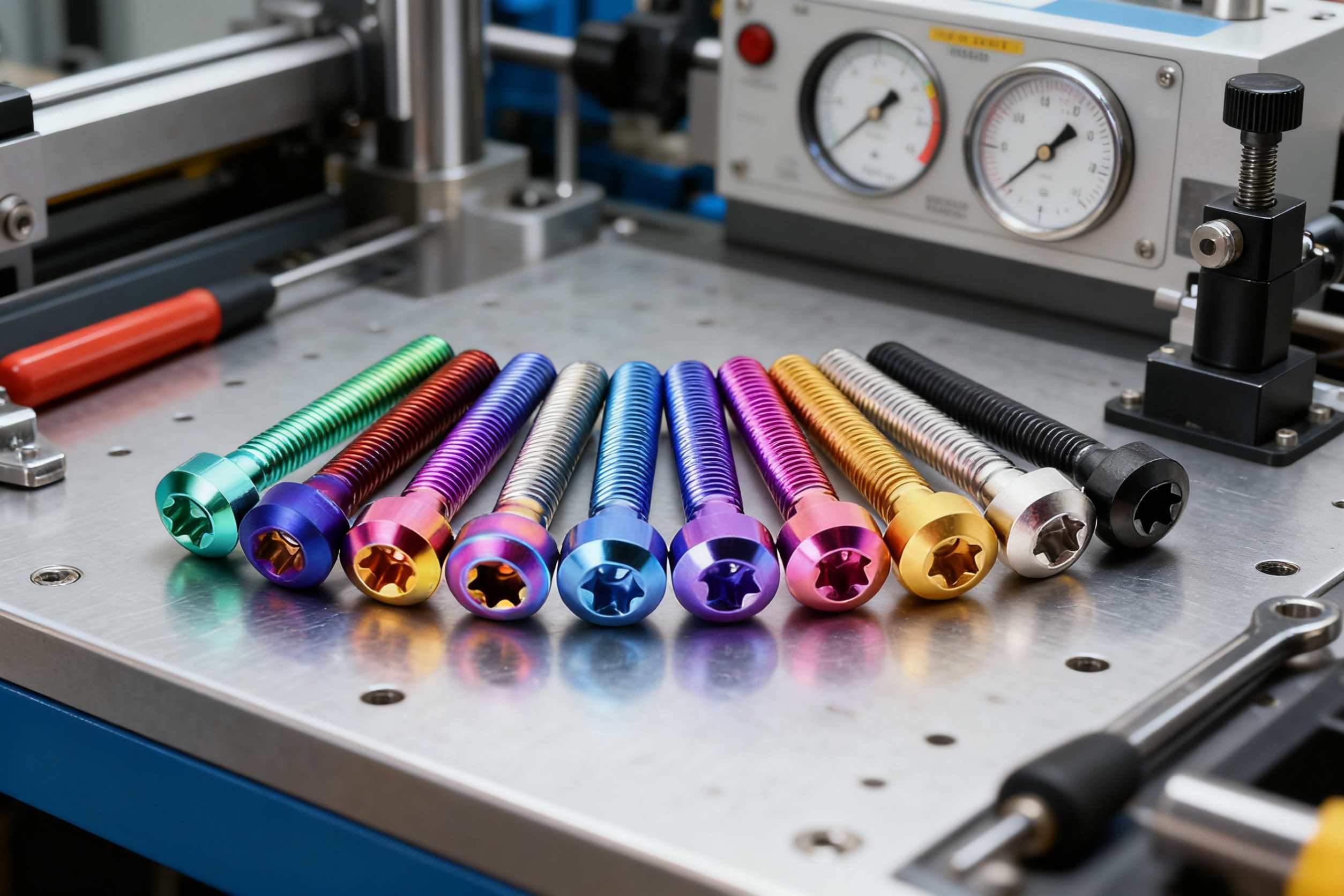
1.1 Threaded titanium fasteners
· Ordinary titanium bolts
o Heads: 100° and 130° countersunk, hex head, 12-point head, and 12-point flange head.
o Drives for 100° countersunk: Phillips cross, high-torque cross, tri-wing, high-torque slot, and proprietary high-torque slot designs.
o Fits: clearance-fit and interference-fit shanks to tune load transfer and fatigue life.
· High-lock bolts (single-sided installation)
o Widely used due to controlled break-off collars; available in tension-type and shear-type variants.o Common heads: 100° countersunk and low-profile protruding.
o Shear types often pair with aluminum collars; tension types with stainless steel collars for thread strength.
· Eddie bolt fastening system (4th-generation nut system)
o Bolt threads feature five grooves; nuts have three protrusions.
o During installation the protrusions drive the nut; at target preload they deform into the grooves, locking load and limiting damage to thin or composite stacks.
o Benefits include controlled preload and improved compatibility with composites.
1.2 Interference fasteners
Rising fatigue life requirements—about 5,000–8,000 flight hours for military aircraft and near 50,000 for commercial aircraft—have driven extensive use of interference-fit joints that pre-compress hole walls and delay crack initiation. On commercial transports, nearly all non-removable shear-transferring fasteners adopt interference fit.
· Metallic structures
o Examples: MD pins, interference Hi-Lok bolts, 70° interference bolts, interference lockbolts.
o Installation: rivet guns (impact) or pull guns (tension swaging), with calibrated interference magnitudes.
· Composite structures
o Sleeved interference lockbolts protect laminates and spread bearing loads.
o Systems such as HI-LEX provide controlled clamp in thicker or sandwich composites.
1.3 Special titanium fasteners
Designed for high load transfer and limited-access assembly.
· Titanium lockbolts (ring-groove pins)
o Applications: highly loaded joints (e.g., wing-to-spar, pylon fittings).
o Heads for metals: 100° countersunk and protruding; fits: clearance, interference, enlarged diameter.
o Composite variants include 100° and 130° countersunk and protruding heads, often with bushings; installed with pull guns for controlled preload.
· One-sided (blind) threaded fasteners and blind rivets
o Enable fastening where the backside is inaccessible.
o Examples: TIMATIC blind rivets, COMPOSI-LOK II threaded blind fasteners, COMPOSI-BOLT threaded blind fasteners.
o Recent developments include sleeved interference blind fasteners and maximum-grip blind threaded systems.
2. Titanium bolt manufacturing
High-reliability Titanium bolt manufacturing integrates controlled forging, precision machining, thread rolling, heat treatment, and surface lubrication to achieve consistent performance.
· Forging
o Warm/hot forging promotes favorable grain flow at head–shank transitions, enhancing fatigue strength.
o Parameters (temperature, strain rate) are tightly controlled to avoid defects and alpha-case.
· Heat treatment
o Solution and aging schedules for alpha–beta titanium alloys are qualified with load thermocouples and controlled quenches to prevent quench cracking and microstructural imbalance.
o End-cropping of wire/billets removes defect-prone segments and reduces inclusion/porosity risks.
· Thread formation
o Rolled threads are preferred to impart compressive residual stresses and refined root radii; surface integrity targets (Ra/Rz) minimize initiation sites.
· Lubricity and anti-galling finishes
o Solid-film lubricants (e.g., MoS2-based) and noble metal lubricants (e.g., silver) stabilize torque–tension relationships, reduce galling risk, and support elevated-temperature service.
o Compatibility with primers, sealants, and composite contact surfaces is validated during qualification.
3. Titanium bolt inspection
Titanium bolt inspection spans raw material control, in-process checks, non-destructive testing, and functional torque–tension audits.
· Material verification
o Confirm alloy composition, interstitial levels (O, N, H), and metallurgical cleanliness; for critical parts, require melt-route certification and macro-etch screening.
o Mechanical tests: tensile, shear, hardness, and when applicable fracture toughness and fatigue coupons.
· Dimensional and surface quality
o Gauge head geometry, shank diameter/interference, thread pitch/lead/run-out; control surface roughness on bearing surfaces and thread flanks.
o Visual and dye penetrant inspection capture laps, tool marks, and surface-breaking flaws.
· NDT and functional checks
o Ultrasonic inspection for internal discontinuities on larger diameters or critical lots.
o Eddy current for near-surface flaws and heat-treatment verification.
o Torque–tension (k-factor) correlation tests confirm clamp consistency under specified lubricants.
o Hydrogen content checks and delayed-fracture tests ensure surface processes have not introduced embrittlement risk.
4. Why interference fit and preload control matter
Aircraft structures see cyclic loading from gusts, landing impacts, pressurization, and engine vibrations. Interference fit imposes compressive hoop stress at holes, delaying fatigue crack initiation, while stable preload keeps joints closed to prevent fretting. Because titanium’s elastic modulus is lower than steel’s, bolts elongate more for a given load; well-chosen grip lengths, stiff joint members, and torque–angle strategies are used to achieve target clamp without over-stressing threads. Proprietary systems (e.g., high-lock and Eddie bolt) enable precise preload, especially in thin skins and sandwich structures that are sensitive to crush.
5. Application highlights across the airframe
· Fuselage skins and frames (Al and CFRP): 100°/130° countersunk bolts provide flush aerodynamics; controlled preload protects thin skins and cores.
· Wings and spars: interference lockbolts and high-lock systems move high shear with consistent clamp.
· Pressurized fuselage barrels: threaded titanium bolts with sealing features support long fatigue life under pressure cycles.
· Pylons and nacelles: temperature-resilient alpha–beta alloys with anti-galling finishes maintain joint reliability.
· Landing gear doors and fairings: vibration-prone interfaces use prevailing-torque collars and thread patches to resist loosening.
· Composite-to-metal joints: sleeves and controlled-preload systems protect laminates and stabilize long-term clamp.
6. Shaanxi Shenglian Yijing Technology Co., Ltd. supplies titanium alloy fasteners.
With the increasing content of composite materials and rising airframe performance targets, Chinese projects are increasingly specifying titanium alloy fasteners not only in composite materials but also in primary metal structures. New aircraft typically require tens of thousands of titanium alloy fasteners per fuselage, resulting in significant weight savings.
· Representative products available
o Our factory offers representative products such as 100° high-lock bolts, flat head high-lock bolts, 100° countersunk bolts, 120° cup head bolts, pan head bolts, and hexagon head bolts, including both clearance and interference rods
· Advanced alloys
o In addition to the commonly used TC4 (Ti-6Al-4V) fasteners, our factory also offers Ti-6Al-1.5Cr-2.5Mo-0.5Fe-0.3Si fasteners. Compared to TC4, this alloy has higher temperature sensitivity and offers potential advantages under strict processing controls and in specific high-temperature conditions. Manufacturing and Quality Processes include controlled forging, precision rolling, surface lubrication, and full batch traceability via a Manufacturing Execution System (MES). Routine operations include macroetch sampling, end trimming, and nondestructive testing (NDT) of critical batches to meet aerospace standards.
Installation best practices
· Anti-galling and friction control
o Use specified solid lubricants (MoS2, silver) on threads and under-head bearing surfaces; avoid dry titanium-on-titanium or titanium-on-stainless contacts.
o Validate k-factor and torque–tension curves at relevant temperatures for predictable preload.
· Torque strategy
o Prefer torque–angle or yield-based tightening for critical joints to minimize clamp scatter; fine-pitch threads and prevailing-torque collars improve vibration resistance.
· Interference control
o Ream holes to tight tolerances for roundness and surface finish; document interference magnitudes; use calibrated installation equipment (pull or rivet guns).
· Corrosion management
o Employ sealants, isolating bushings/washers, and primers in mixed stacks (CFRP/Al/Ti) to limit galvanic couples and protect faying surfaces.
Frequently Asked Questions and Answers
Q1: What specific titanium alloy grades (e.g., Ti-6Al-4V, Ti-6Al-7Nb) are most commonly used for aviation titanium bolts, and how do their mechanical properties (tensile strength, fatigue resistance) meet the stringent requirements of aircraft engine and airframe applications?
A1: Ti-6Al-4V (TC4) dominates airframe applications thanks to tensile strength around 1000–1100 MPa, solid fracture toughness, and robust fatigue behavior up to roughly 350°C. Ti-6Al-7Nb is used where niobium’s phase-stabilizing effect and corrosion performance are valued. For higher-temperature or tailored properties, alloys such as Ti-6Al-1.5Cr-2.5Mo-0.5Fe-0.3Si are available. Coupled with rolled threads, optimized fillets, and, where applicable, interference fits, these alloys meet stringent fatigue and strength requirements across airframe and nacelle structures.
Q2: What torque specifications and anti-galling techniques are critical for installing aviation titanium bolts in high-vibration components like landing gear or turbine engine casings, and how do these differ from steel bolt installation procedures?
A2: Titanium joints require controlled friction via MoS2 or silver lubricants and sometimes PVD/DLC on bearing surfaces; dry assembly is avoided. Torque–angle or yield-based tightening is favored over torque-only to reduce clamp scatter. Fine threads and prevailing-torque collars enhance vibration resistance. Compared with steel, torque values are adjusted for different k-factors, and joint stiffness (grip length, member stiffness) is emphasized due to titanium’s lower modulus. Post-installation audits verify preload retention.
Q3: How do aviation titanium bolts perform in extreme environmental conditions (e.g., high-altitude temperature fluctuations, hydraulic fluid exposure), and what non-destructive testing methods are used to ensure their reliability over airframe lifespans?
A3: Titanium bolts maintain mechanical properties across wide temperature swings and exhibit excellent compatibility with aviation fluids and de-icing agents. Their passive oxide film supports corrosion resistance in humid or saline conditions. Reliability is ensured through NDT methods such as dye penetrant for surface-breaking flaws, ultrasonic for internal discontinuities, and eddy current for near-surface defects and heat-treatment verification. Functional tests—torque–tension audits, hydrogen content checks, and delayed-fracture screens—help guarantee performance over tens of thousands of flight hours.