In aerospace, joints are designed around clamp load, not “feel.” ISO 9152 standardizes MJ thread practices so titanium bolts and nuts achieve stable preload with low risk of galling or loosening. A simple rule of thumb answers what percent yield should titanium bolts be preloaded to: target roughly 60–70% of yield to balance fatigue life and retention. With lubricant, torque spec for lubricated titanium bolts is calculated using T ≈ K·F·d; a typical nut factor K with approved solid-film lube is about 0.15–0.18, which keeps torque reasonable and repeatable.
For context, a suggested preload for 0.75in titanium bolt (3/4-16 UNJ/MJ class) commonly falls in the tens of kilonewtons, while a titanium M20 socket bolt of similar grade lands in a comparable range when properly lubricated. The exact value comes from the drawing and material lot, not guesswork.
Practical tips: use matched hardware from a titanium bolt kit, keep threads clean, apply the specified lube, and use a calibrated wrench. Whether you’re assembling s parts titanium bolts in service bays or installing flight hardware, following ISO 9152 guidance ensures consistent preload and reliable performance across titanium fasteners.
Calculating the correct preload for titanium bolts is not as simple as referencing a standard steel chart. Due to titanium's lower modulus of elasticity (Young's Modulus) and its susceptibility to thread galling (cold welding), applying standard torque values can lead to disastrous fastener failure. In this guide, we break down the specific torque coefficients needed for aerospace-grade titanium fasteners.
1. Experimental Design
1.1 Test Principle (per ISO 9152 on installation-formed fastener preload)
This study follows ISO 9152 for torque–tension testing, using synchronized torque application and axial load acquisition to quantify the relationship among tightening torque, preload, and the tightening coefficient K (commonly T = K·F·d). The test bench applies torque at constant rate while measuring axial force with high precision and simultaneously tracking angle and frictional work. Distinct tightening phases (seating, elastic, pre-yield) are identified to ensure comparability and repeatability of K across different conditions for each titanium bolt.
1.2 Specimen Selection and Variables
Because K is influenced by many factors (material, surface state, lubrication, run-in cycles, environmental temperature/humidity, tightening method), we selected titanium alloy fasteners (Ti-6Al-4V family) as the test objects and covered representative sizes and scenarios:
· Sizes: fine-pitch MJ/UNJ and metric fine threads, including titanium stem bolts and a titanium m20 socket bolt; matched titanium nuts and washers to maintain material compatibility and consistent bearing surfaces.
· Variables:
Tightening method: turning the nut vs. turning the bolt (consistent tool engagement and bearing face).
Lubrication: cetyl alcohol (long-chain alcohol) vs. T12 grease, plus a clean-dry reference for trend only.
Repeated assemblies: five tightening cycles on the same sub-sample to assess K drift due to surface evolution.
Environment: low-temp/low-humidity, low-temp/high-humidity, high-temp/low-humidity, high-temp/high-humidity, and room conditions; lateral-bias tests run in each to extract stabilized K.
Metrics: preload F, torque T, K, angle, slip onset at interfaces, and short-term residual preload decay.
With this design, we map how tightening method, lubrication, assembly count, and environment shape the torque–preload function, providing process control guidance for titanium bolt and titanium stem bolts in engineering practice.
Metric | Steel (Grade 8.8) | Titanium (Gr.5) | Preload Impact |
Yield Strength (Min) | 640 MPa | ~880 MPa | Titanium offers higher clamping force potential per size. |
Young's Modulus(Elasticity) | ~210 GPa | ~114 GPa | Ti is "springier." It maintains preload better under thermal cycling but stretches more. |
Galling Risk | Low | Critical: Lubrication is mandatory to achieve accurate preload torque. | |
High | |||
Density | 7.85 g/cm³ | 4.43 g/cm³ | 45% weight reduction for same structural preload. |
As shown in the comparison table above, calculating the preload for titanium bolts requires a different approach than steel. While Grade 5 Titanium (Ti-6Al-4V) offers a superior yield strength of ~880 MPa, its lower Young's Modulus means it is more elastic.
Key Engineering Insight: Because titanium is more susceptible to galling, the friction coefficient (K-factor) can be unpredictable without proper lubrication. When determining your torque specs, you must account for this to prevent bolt failure.
2. Analysis of Factors Affecting Tightening Torque
2.1 Effect of Tightening Method on K
With bolts, nuts, and lubrication held constant, five specimens were tested per method. In all T–F curves (horizontal axis: preload F; vertical axis: torque T):
· Turning the nut generally produced smoother curves and narrower K scatter. This method stabilizes the load path and bearing contact, reducing shaft torsion “stealing” axial load and lowering uncertainty at the head/bearing interface.
· For the same preload, torque was typically lower and repeatability better with nut-turning—beneficial for precise elastic-region control, especially on larger sizes like the titanium m20 socket bolt to minimize assembly variation and early micro-slip.
Conclusion: When material and lubrication are fixed, prefer turning the nut to reduce K variability and improve preload achievement and consistency.
2.2 Effect of Lubrication on K
In two matched groups (bolts, nuts, tightening method identical; N=5 per group), results (per Figures 5 and 6 trends) show:
· From zero load up to 35% of tensile load, total torque with cetyl alcohol was lower than with T12 grease, indicating lower K and improved linearity/predictability of the T–F curve.
· Cetyl alcohol spreads uniformly on threads and bearing surfaces, reducing initial friction; some greases exhibit a shear-in film formation phase at low load, raising early torque and scatter.
Engineering takeaway: For first-time assembly of titanium bolt and titanium stem bolts, cetyl alcohol is preferred to lower installation torque, tighten dispersion, and suppress early fretting/galling. Film continuity and repeatability matter more than nominal viscosity.
2.3 Effect of Assembly Count on K
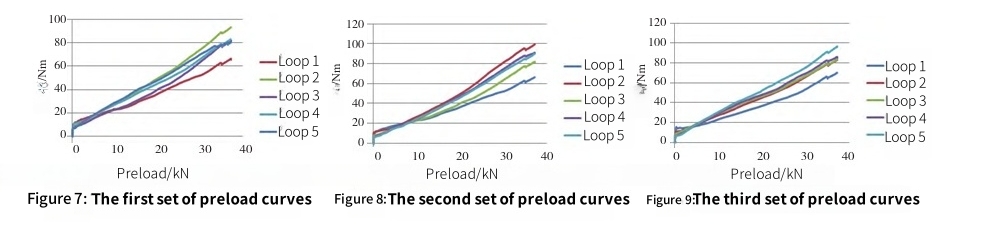
Keeping all else constant (bolts, nuts, tightening method, lubrication), three groups underwent five tightening cycles each (per Figures 7–9 trends). Observations:
The Critical Role of Lubrication on Preload
"Achieving the target preload for titanium bolts heavily depends on the friction coefficient. Unlike steel, bare titanium threads have a high tendency to seize.
Dry Assembly: Highly unpredictable preload (K ≈ 0.30+). Not recommended for critical aerospace applications.
With Anti-Seize/Lubricant: We recommend using Molybdenum Disulfide (MoS2) or specific aerospace lubricants to stabilize the K-factor (typically K ≈ 0.12 - 0.16).
Warning: Always reduce your torque input by 20-30% when using lubricants to avoid exceeding the yield strength of the titanium bolt."
· Torque rises with preload overall, but under cetyl alcohol, the relationship between torque and cycle count is not linear; scatter is notable.
· At 35% of tensile load, the first cycle consistently required less torque than cycles 2–5. Run-in modifies micro-topography of threads, increasing real contact and altering flank conformity; friction rises, driving higher torque for the same axial load.
· Repeated assembly also alters bearing-surface micro-scratches and roughness, shifting the ratio of thread to bearing friction and amplifying K scatter.
Recommendation: Replace bolt and nut after three disassemblies in service. For critical joints (e.g., titanium m20 socket bolt), track tightening cycles and set replacement thresholds to prevent loss of preload or over-tightening from degraded surfaces.
2.4 Effect of Temperature and Humidity (Lateral-Bias Tests) on K
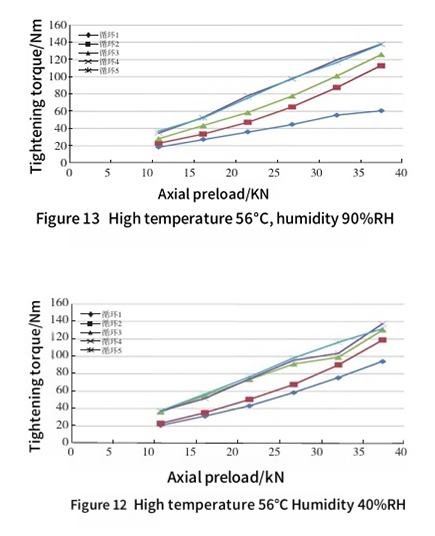
For the same sub-sample bolt, five repeated cycles were run in each environment; Figures 10–13 compare T–F curves across conditions. Stabilized K values:
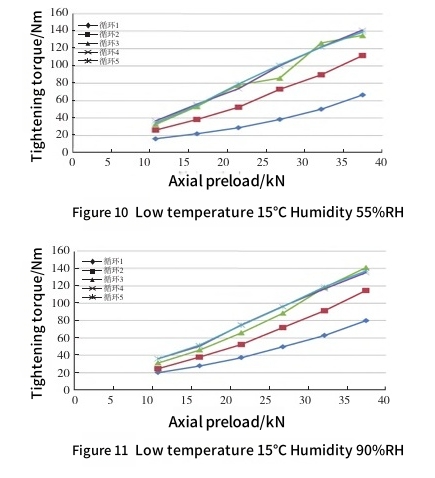
· K1 = 0.15 (15°C, 55% RH)
· K2 = 0.18 (15°C, 90% RH)
· K3 = 0.21 (56°C, 40% RH)
· K4 = 0.14 (56°C, 90% RH)
· K5 = 0.16 (room temperature and humidity)
Trend interpretation:
· As axial load increases from zero to 35% of tensile load, low-temp/high-humidity (K2) shows slightly higher K than room baseline, suggesting humidity can increase interfacial adhesion for some lubricants; yet high-temp/high-humidity (K4) shows the lowest K, implying temperature plus moisture may promote better film spreading or stable shear.
· High-temp/low-humidity (K3) is the highest at 0.21, indicating reduced lubricant effectiveness and unstable shear film in dry, hot conditions, thus increased friction and torque. This effect is pronounced for titanium-on-titanium pairs.
· Room condition (K5) sits mid-range and can serve as a baseline for conversions and process planning.
Engineering notes: For titanium bolt and titanium stem bolts in hot, dry service, adjust torque upward or switch to a more robust solid-film lubricant. In humid or fluctuating environments, perform on-site K calibration to avoid misapplying room-condition torque values.
3. Conclusions and Engineering Guidance
3.1 Material and Surface Treatment Strongly Influence K
K is sensitive to joint material pairing, roughness, coatings/films, and cleanliness. For practicality and repeatability, use the “turn the nut” method when assembling titanium fasteners; for the first assembly, prefer cetyl alcohol to reduce torque, dispersion, early micromotion, and galling—applicable to titanium stem bolts, titanium m20 socket bolt, and other titanium bolt sizes.
3.2 Assembly Count Matters
The effect of tightening cycles on K is not strictly linear. Repeated assemblies alter thread/bearing surfaces and raise the torque needed for the same preload. Replace standard parts after three disassemblies; if reuse is required, validate the specific lot via testing and implement torque bias designs and process windows accordingly.
3.3 Design Torque for the Actual Environment
Define environmental boundaries (temperature, humidity, cleanliness, media) before application. If field conditions differ from design assumptions, run small-sample K calibration and then set the tightening plan. In hot, dry, or highly variable environments, choose more stable lubricants and matched washers, and use torque-plus-angle or axial-load monitoring for closed-loop control.
3.4 General Method for Uncovered Sizes and Materials
For sizes/materials not covered here (e.g., dissimilar nuts, alternate surface treatments, special films), integrate fastener material, lubrication, assembly count, bearing condition, and tool accuracy into torque design. Measure K under representative conditions, build a torque–load conversion, and codify it in drawings or work instructions to avoid preload errors from over-generalization.
—Grounded in ISO 9152, this framework supports the titanium bolt family (including titanium stem bolts and the titanium m20 socket bolt) by centering on measured K, controlling lubrication and tightening method, and bounding with environment and cycle effects to achieve stable, controllable preload and robust fatigue life.
Frequently Asked Questions and Answers
Q1: What percent yield should titanium bolts be preloaded to?
A1: In aerospace applications, the target preload for titanium bolts is typically designed to be 65% to 75% of the material's proof load or yield strength (e.g., Ti-6Al-4V yield strength is approx. 880 MPa) The exact value should be set using lot-specific K, surface/lubrication condition, and joint stiffness ratio, validated by torque–tension tests.
Q2: Torque spec for lubricated titanium bolts?
A2: Use T = K·F·d. Lubrication lowers K and reduces scatter, but values vary widely by lubricant, film, and surface prep. Use the specified lubricant and calibrate K on representative samples, then back-calculate torque. Do not reuse torque values across different lubricants.
Q3: Suggested preload for 0.75in titanium bolt?
A3: Determine preload from the target fraction of yield (typically 60–70%), then convert with the measured K for your lot and lubricant. Verify with torque-plus-angle or direct load measurement; for critical joints, record achieved axial load and perform breakaway checks to confirm stability
Q4: Why do titanium bolts lose preload?
A4: Titanium has a lower modulus of elasticity compared to steel, making it more "springy." However, relaxation can occur due to surface embedding or thermal expansion mismatches. Using proper washers and calculating the correct clamping force is essential.