1. Production Methods of Titanium Tubes
2. Seamless Titanium Tube Production Techniques
2.1 Piercing by Drilling and Extrusion
2.3 Oblique Rolling and Piercing
3. Oblique Rolling and Piercing Techniques for Seamless Titanium Tubes
3.1 Two-Roll Oblique Rolling and Piercing
3.2 Three-Roll Oblique Rolling and Piercing
4. Challenges in Titanium Tube Piercing
4.1 Common Issues in Three-Roll Piercing
4.2 Solutions: Secondary Piercing
5. Summary of Titanium Tube Processing Methods
6. Applications of Seamless Titanium Tubes
Titanium and titanium alloys are vital structural metals, prized for their low density, high strength-to-weight ratio, resistance to high temperatures and corrosion, non-magnetic properties, and biocompatibility. While titanium was difficult to extract and only became commercially viable in the 1950s, its exceptional properties have since enabled its use in sectors such as aerospace, aviation, marine engineering, weapons manufacturing, petrochemicals, chemical processing, and medical devices.
Among titanium products, titanium tubes are widely used due to their outstanding performance and durability. This article explores the production and processing of seamless titanium tubes, focusing on oblique rolling and piercing techniques, and highlights their advantages and challenges.
1. Production Methods of Titanium Tubes
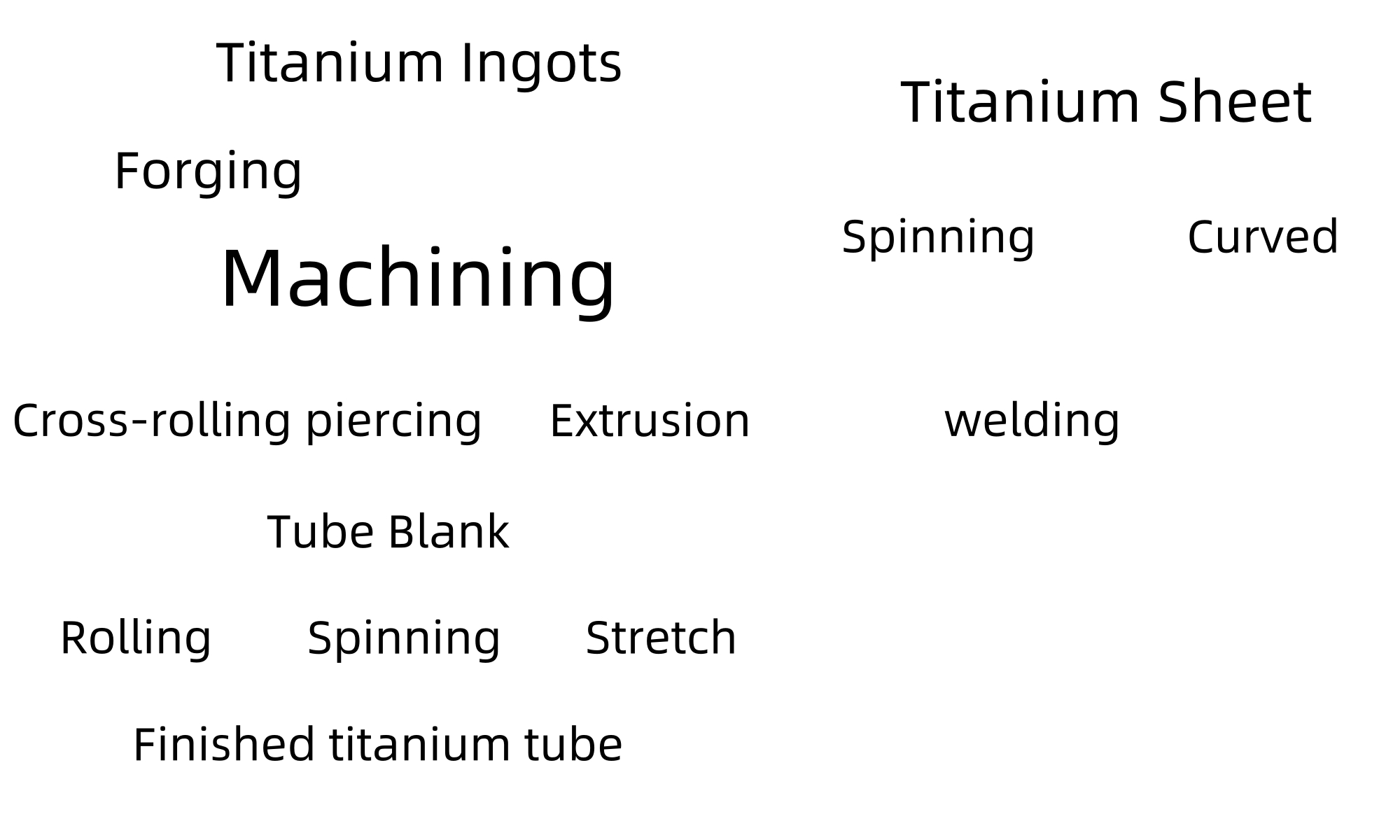
Several methods are used to produce titanium and titanium alloy tubes, including:
Extrusion
Welding of plates (or strips)
Oblique rolling and piercing
Each method has its advantages and limitations, depending on the requirements for tube dimensions, wall thickness, and mechanical performance.
2. Seamless Titanium Tube Production Techniques
2.1 Piercing by Drilling and Extrusion
This method involves drilling and extruding the titanium billet, resulting in high deformation, fine grain structure, and uniform wall thickness.
Advantages:
Produces thin-walled titanium tubes.
Ensures uniform wall thickness and excellent mechanical properties.
Extrusion often uses glass lubrication or sleeve lubrication:
Glass Lubrication: Still under development in some regions, with challenges related to selecting suitable glass lubricants.
Sleeve Lubrication: A more mature process, providing smooth tube surfaces but requiring significant acid consumption to remove sleeves, leading to higher environmental costs.
In this method, titanium plates or strips are rolled and welded to form tubes.
Advantages:
High production efficiency and low cost.
Produces tubes with uniform wall thickness and good inner surface quality.
Suitable for large-diameter tubes and simple equipment setups.
Disadvantages:
The weld seam is a weak point, making this method unsuitable for high-performance applications.
Difficulties in cleaning weld seams.
2.3 Oblique Rolling and Piercing
his process involves using an oblique rolling machine to pierce titanium billets into seamless tubes.
Advantages:
Low metal consumption and minimal environmental pollution (no sleeves or lubricants required).
Low equipment and tooling costs.
High product yield and low processing costs.
Limitations:
The process is not flexible, producing limited product varieties.
Unable to produce thin-walled tubes or long tube blanks.
Surface defects, such as peeling or head cracking, may occur.
3. Oblique Rolling and Piercing Techniques for Seamless Titanium Tubes
Oblique rolling and piercing can be performed using two main methods:
3.1 Two-Roll Oblique Rolling and Piercing
This is the more established technique for seamless titanium tube production. However, it has several drawbacks:
Poor dimensional accuracy.
Higher occurrence of surface defects, such as peeling and cracking.
3.2 Three-Roll Oblique Rolling and Piercing
This method is an improvement over the two-roll process and offers several advantages:
Improved Dimensional Precision: Produces tubes with precise diameter and wall thickness.
Better Surface Quality: Reduces peeling and cracking on the inner and outer surfaces.
Capability for Thin-Walled Tubes: Can produce tubes with a diameter-to-wall-thickness ratio greater than 10.
Higher Efficiency: Improved production speed.
Due to its advantages, the three-roll technique has become increasingly popular in seamless titanium tube manufacturing. Some companies have integrated three-roll design improvements into their existing two-roll systems.
4. Challenges in Titanium Tube Piercing
Despite its advantages, seamless titanium tube production using oblique rolling and piercing faces several challenges.
4.1 Common Issues in Three-Roll Piercing
Tube Wall Penetration: In some cases, the titanium tube wall is punctured during the rolling process.
Stuck Mandrels: The mandrel may become stuck inside the tube, interrupting production.
4.2 Solutions: Secondary Piercing
To address these challenges, researchers are exploring the use of secondary piercing in titanium tube production.
Reduction Amount:
In secondary piercing, the reduction required in the first pass is minimal, reducing deformation and making it easier to pierce the tube.
Small reduction rates also minimize internal surface defects.
Heating Requirements:
Titanium’s thermal conductivity is lower than that of stainless steel. For secondary piercing, manufacturers consider heating the titanium billet only once, though further research is needed to optimize heating cycles.
Rolling Speed:
Secondary piercing requires lower rolling speeds for the first pass, which improves surface quality and reduces defects.
While secondary piercing is still in the research phase for titanium, it is expected to significantly improve production efficiency and tube quality in the future.
5. Summary of Titanium Tube Processing Methods
Key Takeaways:
①Titanium tube production involves various methods, tailored to meet market requirements for dimensions, wall thickness, and performance characteristics.
②Oblique rolling and piercing are the most common methods for seamless titanium tube production, with two-roll and three-roll techniques offering distinct advantages and limitations.
③Secondary piercing, though not widely applied to titanium yet, has the potential to address challenges in seamless tube production.
6. Applications of Seamless Titanium Tubes
Seamless titanium tubes are widely used in industries where strength, corrosion resistance, and reliability are critical:
Petrochemical Industry: Heat exchangers and piping systems exposed to corrosive environments.
Aerospace: Hydraulic pipelines and fuel conduits in aircraft and rocket engines.
Chemical Processing: Equipment handling strong acids and alkalis.
Medical Devices: Biocompatible tubing for implants and surgical instruments.
Despite advancements in welded titanium tubes, seamless titanium tubes remain irreplaceable in high-stakes applications where safety and performance are paramount.
Processing method conclusion
The production and processing of seamless titanium tubes through oblique rolling and piercing techniques represent a critical aspect of titanium manufacturing. While challenges remain, advancements in three-roll piercing and secondary piercing methods promise to improve production efficiency and tube quality.
For industries requiring high-performance titanium products, seamless titanium tubes remain the top choice. Collaborating with experienced titanium tube manufacturers ensures access to cutting-edge solutions tailored to specific applications.
Looking for high-quality seamless titanium tubes? Contact us to explore our advanced titanium production capabilities and solutions.