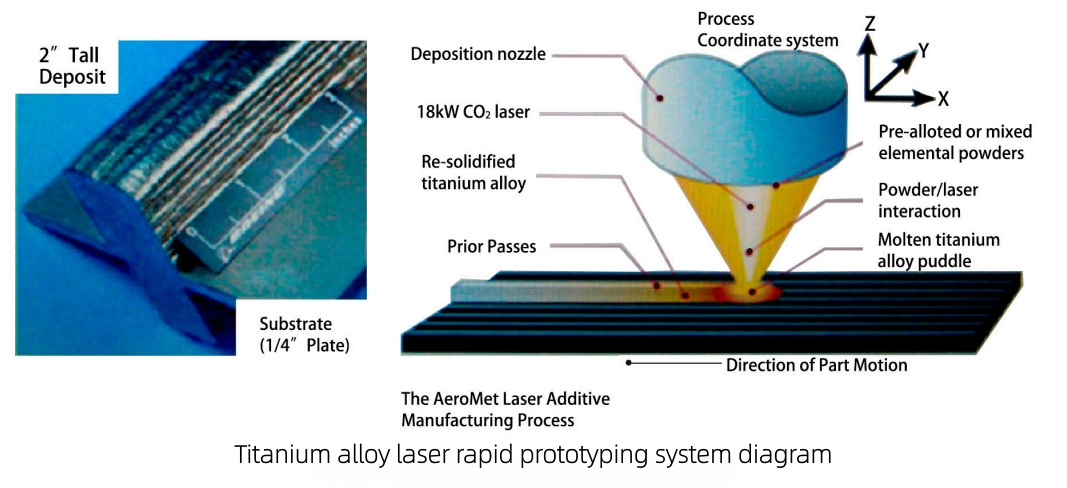
3D Printed Titanium, also known as titanium additive manufacturing, represents a transformative fusion of computer-aided design (CAD), advanced material processing, and precision molding technology. This innovative approach utilizes digital model files to guide the layer-by-layer deposition of titanium metal materials. Through various methods—such as extrusion, sintering, melting, light curing, and spraying—titanium powder is systematically built up to form complex, high-performance structures。
The preparation of titanium powder suitable for 3D printing is a critical step, as powder characteristics like particle size, shape, and purity directly impact the quality, mechanical properties, and performance of the final printed components. Recent advancements in atomization and powder processing technologies have enabled the production of titanium powder with tailored properties for additive manufacturing. As a result, 3D Printed Titanium is increasingly utilized in demanding applications such as aerospace, biomedical implants, and high-performance engineering, where lightweight, corrosion resistance, and mechanical strength are essential. This article explores the preparation methods and key characteristics of titanium powder optimized for modern 3D printing technologies.
1. Basic Requirements for 3D Printed Titanium Powder
For additive manufacturing technologies such as Laser Powder Bed Fusion (LPBF), also known as selective laser melting, the fundamental requirement for titanium alloy powder is its ability to be uniformly spread across the build platform. However, a range of powder characteristics—including appearance, chemical composition, particle size and distribution, particle shape, flowability, specific surface area, apparent density, purity, and hollow particle content—play pivotal roles in determining the quality and performance of 3D printed parts.
1.1 Appearance Quality
The appearance of titanium alloy powder should be silver-gray with a metallic luster, free from visibly oxidized particles, foreign matter, or agglomerates. High-quality powder should exhibit a uniform color and minimal surface defects, as discoloration or the presence of clumps may indicate oxidation, contamination, or moisture absorption, all of which can adversely affect powder handling and final part properties.
1.2 Chemical Composition
The chemical composition of titanium alloy powder must comply with the relevant standards for titanium and titanium alloy grades. This ensures mechanical properties and corrosion resistance in line with application requirements. Key elements to be controlled include titanium (Ti) as the base metal and alloying elements such as aluminum (Al), vanadium (V), tin (Sn), molybdenum (Mo), chromium (Cr), manganese (Mn), zirconium (Zr), nickel (Ni), copper (Cu), silicon (Si), and yttrium (Y). Impurity content, particularly oxygen, nitrogen, hydrogen, and carbon, must be strictly limited, as excessive levels can embrittle titanium and reduce mechanical performance.
1.3 Particle Size and Distribution
Particle size refers to the average diameter of powder particles, while particle size distribution describes the spread and uniformity of these sizes within a batch. For additive manufacturing, especially LPBF, the particle size distribution should approximate a normal (Gaussian) distribution, typically within the 0–53 µm range. This ensures optimal packing density, uniform powder spreading, and consistent layer formation, which are vital for high part density and surface finish.
1.4 Particle Shape
Powder morphology is another critical factor. The particles should be spherical or near-spherical, with a sphericity of at least 0.9. Spherical powders flow better, pack more efficiently, and form denser layers, all of which contribute to higher part quality and reduced defects such as porosity or lack of fusion in the printed component.
1.5 Powder Flowability
Flowability describes how easily the powder passes through a defined aperture, which is typically assessed by measuring the time taken for 50 grams of powder to flow through a standardized funnel (Hall flowmeter). The angle of repose should not exceed 45°, and the Hall flow rate should not be longer than 38 seconds per 50 grams. Good flowability is essential for uniform powder spreading, stable layer thickness, and defect-free printing.
1.6 Specific Surface Area
Specific surface area, usually expressed in cm²/g or m²/g, depends on particle size, shape, composition, and apparent density. Powders with more complex shapes or smaller particles have higher specific surface areas, which increases their surface energy and, potentially, their chemical reactivity. While a higher specific surface area can improve sintering behavior, it may also increase the risk of contamination or oxidation, so a balanced approach is necessary.
1.7 Purity
High purity is demanded for titanium powders used in additive manufacturing. The powder must be free of inorganic nonmetallic inclusions, foreign metal particles, contaminants, and any substances that could degrade the mechanical or corrosion properties of the final parts. The presence of even minute impurities can cause local defects, embrittlement, or reduced fatigue performance.
1.8 Hollow Powder Content
Hollow particles are an unavoidable byproduct of certain powder production methods. However, the content of hollow powder in a batch should not exceed 2%. Excessive hollow particles can lead to increased porosity, reduced density, and even premature failure in printed parts.
2. Preparation Methods and Characteristics of 3D Printed Titanium Powder
Producing high-quality titanium and titanium alloy powders for additive manufacturing presents greater challenges than conventional metals like stainless steel or nickel-based superalloys. Titanium’s high chemical reactivity at elevated temperatures means that it can easily react with atmospheric gases or crucible materials, making strict contamination control essential. Therefore, the preparation processes for 3D printed titanium powder are designed to achieve high purity, controlled oxygen content, and the desired particle characteristics.
The three main preparation methods for additive manufacturing-grade titanium powder are: Plasma Rotating Electrode Process (PREP), Gas Atomization, and the Hydride-Dehydride (HDH) process.
2.1 Plasma Rotating Electrode Process (PREP)
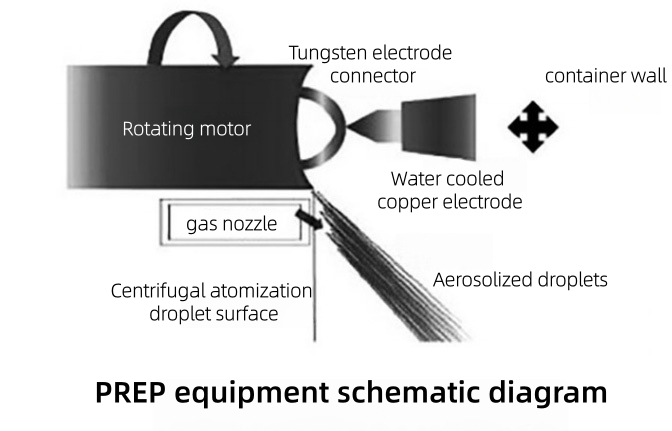
The Plasma Rotating Electrode Process is a centrifugal atomization method widely used to produce high-quality titanium alloy powders. The process begins by fabricating titanium or titanium alloy feedstock into round bars. The end of the rotating bar is melted by a plasma arc under an inert gas atmosphere (typically argon or helium). The bar rotates at extremely high speed (10,000–20,000 rpm), and the centrifugal force propels the molten metal from the bar’s end into fine droplets. These droplets solidify rapidly in the inert gas, forming spherical titanium alloy powder particles.
PREP offers several advantages: the resulting powder is highly spherical, has low contamination (since it avoids contact with crucibles), and exhibits excellent flowability and packing density. However, PREP is limited by its relatively low production efficiency and high cost, and it generally produces larger powder particles compared to gas atomization.
2.2 Gas Atomization
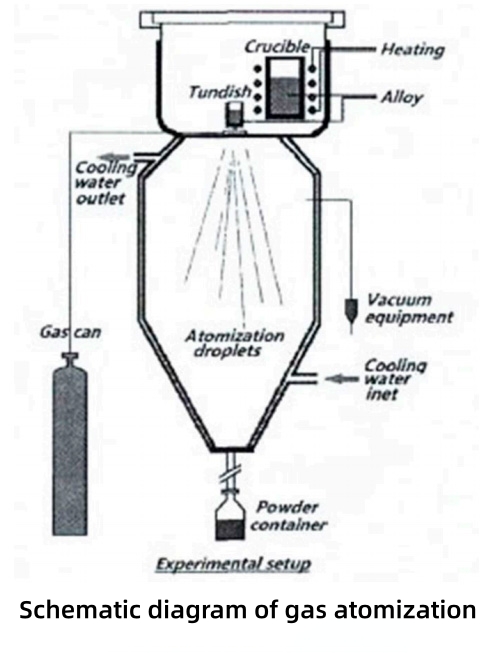
Gas atomization is the most widely used method for producing titanium and titanium alloy powders for 3D printing. In this process, titanium or titanium alloy is melted by high-frequency induction heating, with the molten metal being poured through a nozzle. High-pressure inert gas jets (usually argon) impinge on the molten stream, breaking it into fine droplets. These droplets solidify while descending through the atomization chamber, forming powder particles.
Gas atomization offers several key advantages:
· It yields powders with a high degree of sphericity and narrow particle size distribution.
· The use of induction heating reduces the risk of contamination from crucibles.
· Powders produced are highly pure and have fine, rapidly cooled microstructures.
Gas atomization can be tuned to produce a range of particle sizes, including the fine powders (15–45 μm) needed for LPBF. The process is scalable and cost-effective for industrial production.
2.3 Hydride-Dehydride (HDH) Process
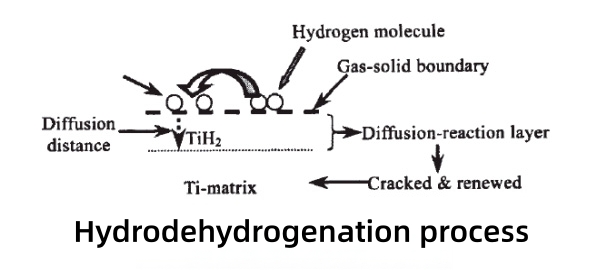
The HDH process is an economical and versatile route for producing titanium powder. Titanium or titanium alloy feedstock is first hydrogenated at elevated temperatures, forming brittle titanium hydride (TiHx). The hydride is then mechanically crushed and milled into fine powder. Finally, the powder is dehydrogenated in a vacuum or inert atmosphere at high temperature, leaving pure titanium powder behind.
The HDH process is summarized by the following reactions:
· Hydrogenation: Ti + x/2 H₂ → TiHx (x = 1.88–1.99), t > 300°C
· Dehydrogenation: TiHx → Ti + x/2 H₂, t > 300°C
HDH powders are less spherical than those produced by atomization, but the process is more cost-effective and allows for relatively good control of composition and particle size. Additional sieving and spheroidization steps may be used to improve powder quality for additive manufacturing.
3. Comparison of Chinese and International 3D Printed Titanium Powder Technology
As additive manufacturing using titanium alloys has rapidly developed worldwide, both China and other leading industrial nations have established their own powder production technologies. However, some differences remain in powder quality, consistency, and performance, which can influence the quality and competitiveness of 3D printed titanium parts.
3.1 Apparent Density
Apparent (tap) density is a measure of how tightly powder particles can pack together, affecting the final density and mechanical properties of printed parts. The apparent density of Chinese TC4 titanium alloy powders is slightly lower than that of foreign products, with domestic powders averaging 2.33 g/cm³ and a variance of 0.18, compared to 2.55 g/cm³ and a variance of 0.21 for international powders. While the absolute difference is not large, higher apparent density generally translates to better part densification and reduced porosity in the final printed product.
3.2 Flowability and Consistency
Flowability influences powder spreading and layer uniformity during printing. Domestic titanium alloy powders exhibit slightly lower flowability than international powders, with Hall flow rates of 35.1 seconds per 50 grams compared to 26.8 seconds per 50 grams for foreign products. In terms of consistency (measured by variance), Chinese powders show greater variability (variance of 5.3 vs. 0.7 for international powders), which may lead to less predictable performance in additive manufacturing.
3.3 Particle Size Distribution
Particle size distributions for domestic and international titanium powders are broadly similar, typically ranging from 25–60 μm for Chinese powders and 23–55 μm for foreign counterparts. However, the size distribution in Chinese powders shows greater fluctuation, indicating less tight process control. This can affect powder spreading, packing density, and ultimately the microstructure and mechanical properties of printed components.
3.4 Hollow Powder and Inclusions
Both domestic and international titanium alloy powders contain some hollow spherical particles, a byproduct of atomization processes. The incidence of hollow powder is comparable, with domestic powders averaging a hollow sphere rate of 0.25 (variance 0.2) and international powders at 0.26 (variance 0.2). However, the presence of inclusions and foreign material—especially in domestic powders—can be more variable, potentially impacting part quality.
3.5 Trace Element Control
Both Chinese and international powders generally meet standard requirements for trace element content (oxygen < 1500 ppm, nitrogen < 500 ppm, etc.). However, the consistency of trace element levels in domestic powders is lower, with greater fluctuations noted from batch to batch. This can influence the mechanical properties and reliability of printed parts, especially for critical aerospace or biomedical applications.
4. Summary and Outlook
3D Printed Titanium technology is widely recognized as a transformative manufacturing process. Its advantages include high material utilization, minimal machining allowance, shortened production cycles, reduced manufacturing costs, and high design flexibility. These benefits make it ideally suited for custom and small-batch production of complex, high-performance components in aerospace, gas turbines, defense, medical, and other advanced industries.
As the demand for large, complex, and high-quality titanium additive manufacturing grows, the importance of producing superior titanium alloy powder becomes even more pronounced. High-quality powder is the foundation for achieving accurate, reliable, and repeatable additive manufacturing results. Consequently, advances in both titanium powder preparation and 3D printing technologies are crucial for the continued development of this field.
The future of 3D printed titanium and titanium alloy powder lies in improving powder sphericity, flowability, purity, and consistency, as well as reducing costs. Technological innovations, tighter quality control, and supply chain collaboration will drive the next generation of titanium additive manufacturing, ensuring broader application and greater competitiveness for both domestic and international manufacturers.
Frequently Asked Questions and Answers
1. What Are the Key Steps in Developing a 3D Printed Titanium Powder Production Plan: From Powder Selection to Post-Processing Optimization?
Developing a production plan for 3D printed titanium powder involves several critical steps:
· Powder Selection: Choose titanium powder with the appropriate composition, particle size, shape, and purity for the intended additive manufacturing technology and final application.
· Process Optimization: Select the most suitable preparation method (e.g., gas atomization, PREP, or HDH) to achieve the desired powder characteristics.
· Quality Control: Implement rigorous testing for appearance, chemical composition, particle size distribution, flowability, and purity.
· Printing Parameter Tuning: Adjust machine settings (laser power, scan speed, layer thickness) to match the powder’s properties for optimal building performance.
· Post-Processing: Apply necessary post-printing processes such as heat treatment, hot isostatic pressing, or surface finishing to enhance mechanical properties and remove residual stresses.
· Final Inspection: Conduct comprehensive inspections—mechanical testing, microstructure analysis, and non-destructive evaluation—to ensure the printed parts meet application standards.
2. What Are the Main Challenges in Planning for 3D Printed Titanium Powder Applications, and How to Address Powder Quality Control and Cost Management?
The main challenges include:
· Ensuring Powder Quality: Consistent sphericity, flowability, and chemical purity are essential to avoid defects, porosity, or compromised mechanical properties in printed parts.
· Controlling Trace Elements and Contaminants: Continuous monitoring and strict supplier qualification are required to maintain low levels of oxygen, nitrogen, and other impurities.
· Managing Costs: Titanium powder production is energy-intensive and expensive. Efficient process design, recycling of unused powder, and optimizing production yields can help control costs.
· Batch-to-Batch Consistency: Implementing process controls, statistical quality analysis, and comprehensive documentation can minimize variability.
3. How to Optimize a 3D Printed Titanium Powder Plan for Enhanced Print Quality and Production Efficiency: Strategies for Parameter Tuning and Supply Chain Coordination?
Optimization strategies include:
· Parameter Tuning: Systematically vary and optimize laser power, scan speed, layer thickness, and powder recoating settings to suit the specific powder batch.
· Powder Handling: Employ advanced powder handling and recycling systems to minimize contamination and maintain powder quality over multiple cycles.
· Supply Chain Collaboration: Work closely with powder suppliers to ensure reliable delivery of consistent, high-quality powder.
· Integrated Quality Management: Use real-time monitoring, feedback loops, and data analytics to track powder and print performance, enabling rapid process adjustments.